
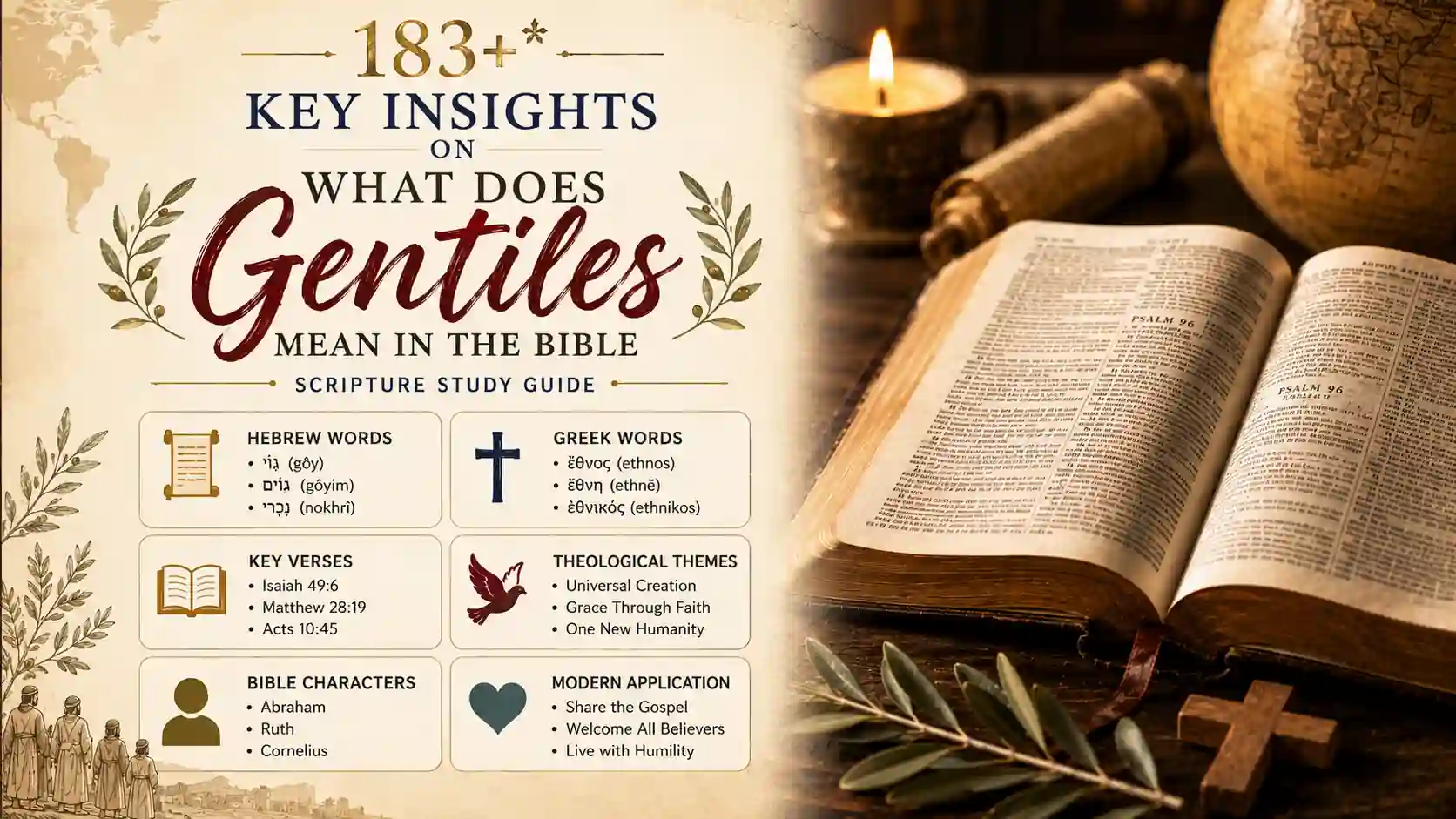
What does Gentiles mean in the Bible? The term usually identifies the nations and peoples outside Israel, especially those who were not ethnically Jewish or participants in Israel’s covenant life. Yet Scripture does not treat Gentiles as a single, spiritually unchangeable class. Gentiles may oppose God, seek Him, bless Israel, receive judgment, or enter His redeemed people through faith.
As you trace the word from Genesis to Revelation, you discover a unified story. God chose Israel for a special covenant purpose, while always intending His salvation to reach every nation through Abraham’s promised offspring, Jesus Christ.
Key Gentiles Scripture References
| Verse | Passage Snippet | Context |
|---|---|---|
| Genesis 12:3 | All families blessed | Abraham’s calling includes worldwide blessing |
| Isaiah 49:6 | Light for the Gentiles | The Servant brings salvation to the earth |
| Matthew 28:19 | Make disciples of all nations | Jesus commands a worldwide mission |
| Luke 2:32 | Light to the Gentiles | Simeon identifies Jesus as universal Savior |
| Acts 10:45 | Gift poured on Gentiles | Cornelius receives the Holy Spirit |
| Acts 13:47 | Light for the Gentiles | Paul applies Isaiah to missionary work |
| Romans 11:13 | Apostle to the Gentiles | Paul explains his particular ministry |
| Galatians 3:8 | Gentiles justified by faith | Abraham’s promise anticipates the gospel |
| Ephesians 2:13 | Brought near by Christ | Former outsiders join God’s covenant people |
| Revelation 7:9 | Every nation and people | The redeemed worship before God’s throne |
Gentiles Bible Translation Comparison
| Verse | KJV | NIV | ESV | NASB |
|---|---|---|---|---|
| Isaiah 49:6 | light to the Gentiles | light for the Gentiles | light for the nations | light of the nations |
| Matthew 6:32 | Gentiles seek | pagans run after | Gentiles seek | Gentiles eagerly seek |
| Matthew 28:19 | teach all nations | make disciples of all nations | make disciples of all nations | make disciples of all nations |
| Acts 10:45 | on the Gentiles | even on Gentiles | even on the Gentiles | on the Gentiles also |
| Acts 13:48 | Gentiles heard this | Gentiles heard this | Gentiles heard this | Gentiles heard this |
| Romans 3:29 | God of the Gentiles | God of Gentiles | God of Gentiles | God of Gentiles |
| Romans 11:13 | apostle of the Gentiles | apostle to the Gentiles | apostle to the Gentiles | apostle of Gentiles |
| Galatians 2:8 | apostleship of the Gentiles | apostle to the Gentiles | apostle to the Gentiles | apostle to the Gentiles |
| Ephesians 2:11 | Gentiles in the flesh | Gentiles by birth | Gentiles in the flesh | Gentiles in the flesh |
| 1 Peter 2:12 | among the Gentiles | among the pagans | among the Gentiles | among the Gentiles |
Gentiles People and Bible Characters
| Person | Role | Connection |
|---|---|---|
| Abraham | Covenant patriarch | Promised blessing for all nations |
| Rahab | Canaanite woman | Joined Israel through courageous faith |
| Ruth | Moabite widow | Entered Israel and David’s family line |
| Naaman | Syrian commander | Confessed Israel’s God after healing |
| Nebuchadnezzar | Babylonian king | Learned that God rules earthly kingdoms |
| Cyrus | Persian ruler | Authorized the Jewish return from exile |
| Roman centurion | Faith-filled officer | Praised by Jesus for remarkable faith |
| Cornelius | Gentile God-fearer | First major Gentile household in Acts |
| Paul | Apostle and missionary | Commissioned to carry Christ to nations |
| Titus | Greek believer | Accepted without compulsory circumcision |
Original Hebrew and Greek Words for Gentiles
| Original Word | Transliteration | Strong’s # | Literal Meaning |
|---|---|---|---|
| גּוֹי | gôy | H1471 | nation or people |
| גּוֹיִם | gôyim | H1471 | nations or Gentiles |
| עַם | ʿam | H5971 | people or community |
| נָכְרִי | nokhrî | H5237 | foreign or foreigner |
| זָר | zār | H2114 | stranger or outsider |
| ἔθνος | ethnos | G1484 | nation or ethnic people |
| ἔθνη | ethnē | G1484 | nations or Gentiles |
| ἐθνικός | ethnikos | G1482 | Gentile or pagan |
| Ἕλλην | Hellēn | G1672 | Greek, often non-Jew |
| ἀκροβυστία | akrobystia | G203 | uncircumcision |
Related Biblical Concepts of Gentiles
| Concept | Connection | Supporting Verse |
|---|---|---|
| Abrahamic blessing | All nations blessed through Abraham | Genesis 12:3 |
| Election of Israel | Israel chosen for covenant service | Deuteronomy 7:6 |
| Light to nations | God’s Servant reaches Gentiles | Isaiah 49:6 |
| Fear of God | Some Gentiles honored Israel’s God | Acts 10:2 |
| Repentance | God grants Gentiles life-giving repentance | Acts 11:18 |
| Justification by faith | Gentiles receive righteousness through faith | Galatians 3:8 |
| One new humanity | Jew and Gentile reconciled in Christ | Ephesians 2:15 |
| Grafting | Believing Gentiles share covenant blessings | Romans 11:17 |
| Great Commission | Disciples are made among all nations | Matthew 28:19 |
| Final worship | Every nation praises the Lamb | Revelation 7:9 |
Historical and Cultural Context of Gentiles
| Aspect | Detail | Biblical Source |
|---|---|---|
| Israel’s calling | Israel was set apart among nations | Exodus 19:5-6 |
| Circumcision | Mark of Abraham’s covenant household | Genesis 17:10-14 |
| Torah distinctions | Laws shaped Israel’s holy identity | Leviticus 20:24-26 |
| Temple boundaries | Gentiles had restricted access | Acts 21:28-29 |
| Diaspora synagogues | Gentiles sometimes heard Scripture there | Acts 13:42-48 |
| Proselytes | Converts joined Jewish covenant practice | Acts 2:10 |
| God-fearers | Gentiles worshiped God without full conversion | Acts 10:1-2 |
| Food fellowship | Shared meals created controversy | Galatians 2:11-14 |
| Roman occupation | Judea lived under Gentile political power | Luke 3:1 |
| Jerusalem council | Gentiles were not required to become Jews | Acts 15:19-29 |
Theological Themes Concerning Gentiles
| Theme | Explanation | Scripture |
|---|---|---|
| Universal creation | God created and rules every people | Acts 17:26 |
| Human sin | Jews and Gentiles alike are guilty | Romans 3:9 |
| Covenant promise | Nations are blessed through Abraham | Genesis 22:18 |
| Messianic mission | Christ fulfills Israel’s worldwide calling | Luke 2:32 |
| Grace through faith | Gentiles are justified apart from ethnicity | Romans 3:29-30 |
| Spirit’s inclusion | The Spirit confirms Gentile acceptance | Acts 10:44-47 |
| Reconciliation | Christ removes covenant hostility | Ephesians 2:14 |
| Humble dependence | Gentile believers must reject arrogance | Romans 11:18 |
| Shared inheritance | Gentiles become fellow heirs in Christ | Ephesians 3:6 |
| Global kingdom | Every nation worships the Lamb | Revelation 5:9 |
Modern Application of Gentiles for Believers
| Area | Practice | Scripture |
|---|---|---|
| Identity | Ground your belonging in Christ | Galatians 3:28 |
| Humility | Refuse ethnic or spiritual pride | Romans 11:20 |
| Evangelism | Share the gospel across cultures | Matthew 28:19 |
| Fellowship | Welcome believers from every background | Romans 15:7 |
| Reconciliation | Pursue peace within Christ’s body | Ephesians 2:14 |
| Hospitality | Receive strangers with sincere love | Hebrews 13:2 |
| Justice | Reject partiality and favoritism | James 2:1 |
| Worship | Celebrate the church’s global character | Revelation 7:9 |
| Scripture study | Read Israel’s story with gratitude | Romans 15:4 |
| Witness | Live honorably before unbelieving nations | 1 Peter 2:12 |
גּוֹי GôY Means a Nation Before It Means an Outsider
The principal Hebrew word translated “Gentile” is גּוֹי, gôy, Strong’s H1471. Its basic meaning is “nation” or “people.” Context determines whether it refers to a foreign nation, the nations collectively, or even Israel itself. God told Abraham that He would make him a “great nation,” using the same Hebrew word in Genesis 12:2.
This prevents you from assuming that gôy always carries a hostile or insulting meaning. The word identifies a national group before it expresses any spiritual judgment. Israel is distinguished from the גּוֹיִם, gôyim, because of God’s covenant calling, but the nations remain under His rule and within His saving purpose.
What Does Gentiles Mean in the Bible’S New Testament?
The main Greek word is ἔθνος, ethnos, Strong’s G1484, with the plural ἔθνη, ethnē. It may mean “nation,” “people,” or “Gentiles.” In Jewish settings it commonly distinguishes non-Jews from the Jewish people. English words such as “ethnic” are related to this language of peoples and cultural groups.
Some translations use “pagans” when a passage emphasizes religious behavior rather than ancestry. In Matthew 6:32, for example, Jesus describes the nations as anxiously pursuing material needs. The point is not that every non-Jew behaves identically, but that God’s children should live with a different confidence in their heavenly Father.
From Abraham’S Promise to Cornelius’S Household
God’s concern for Gentiles begins long before Paul’s missionary journeys. The Lord promised Abraham that all the families of the earth would be blessed through him. Israel was chosen not merely to receive privilege, but to display God’s holiness and carry His blessing toward the nations.
This purpose reaches a decisive moment in Acts 10. Cornelius, a Roman centurion and God-fearer, hears the gospel from Peter. The Holy Spirit comes upon his household before circumcision, proving that God welcomes Gentiles through faith in Jesus rather than requiring them first to assume Jewish ethnicity.
The Jerusalem council in Acts 15 confirms this truth for the growing church. Gentile disciples are not required to become Jewish proselytes or bear the whole covenant sign system given to Israel. They are called to turn from idolatry and immoral practices while living in fellowship with Jewish believers.
One New Humanity without Erasing Jew or Gentile
Paul teaches that Jews and Gentiles share the same fundamental problem. All have sinned, and neither Torah possession nor Gentile background provides righteousness before God. The same God justifies the circumcised and the uncircumcised through faith in Jesus Christ.
Ephesians 2 describes Gentiles as once separated from Israel’s covenant privileges, without the Messiah and without hope. Through Christ’s blood, those who were far away have been brought near. Jesus creates “one new humanity,” reconciling both groups to God without pretending their historical backgrounds never existed.
Romans 11 adds a necessary warning. Gentile believers are compared to wild olive branches grafted into a cultivated tree. You may rejoice in grace, but you must never treat the Jewish people with contempt. You stand by faith, not by cultural superiority, and the root supports you.
Questions Bible Students Ask About Gentiles
Does גּוֹי, gôy, always mean a non-Jewish nation?
No. It usually describes nations, but Genesis 12:2 and other texts can use it for Israel.
Why do some translations say “pagans” instead of “Gentiles”?
“Pagans” highlights idolatrous conduct, while “Gentiles” primarily identifies non-Jewish peoples.
Were Rahab and Ruth still considered Gentiles after joining Israel?
They were Gentile by birth, yet faith joined them to Israel’s covenant community and messianic history.
Does Acts 10 teach that Gentiles can be saved without circumcision?
Yes. The Spirit’s arrival upon Cornelius’s household showed that faith in Christ, not circumcision, marked their acceptance.
Does Ephesians 2 erase every distinction between Jews and Gentiles?
No. It abolishes hostility and unequal access to God while honoring the real histories of both peoples.