
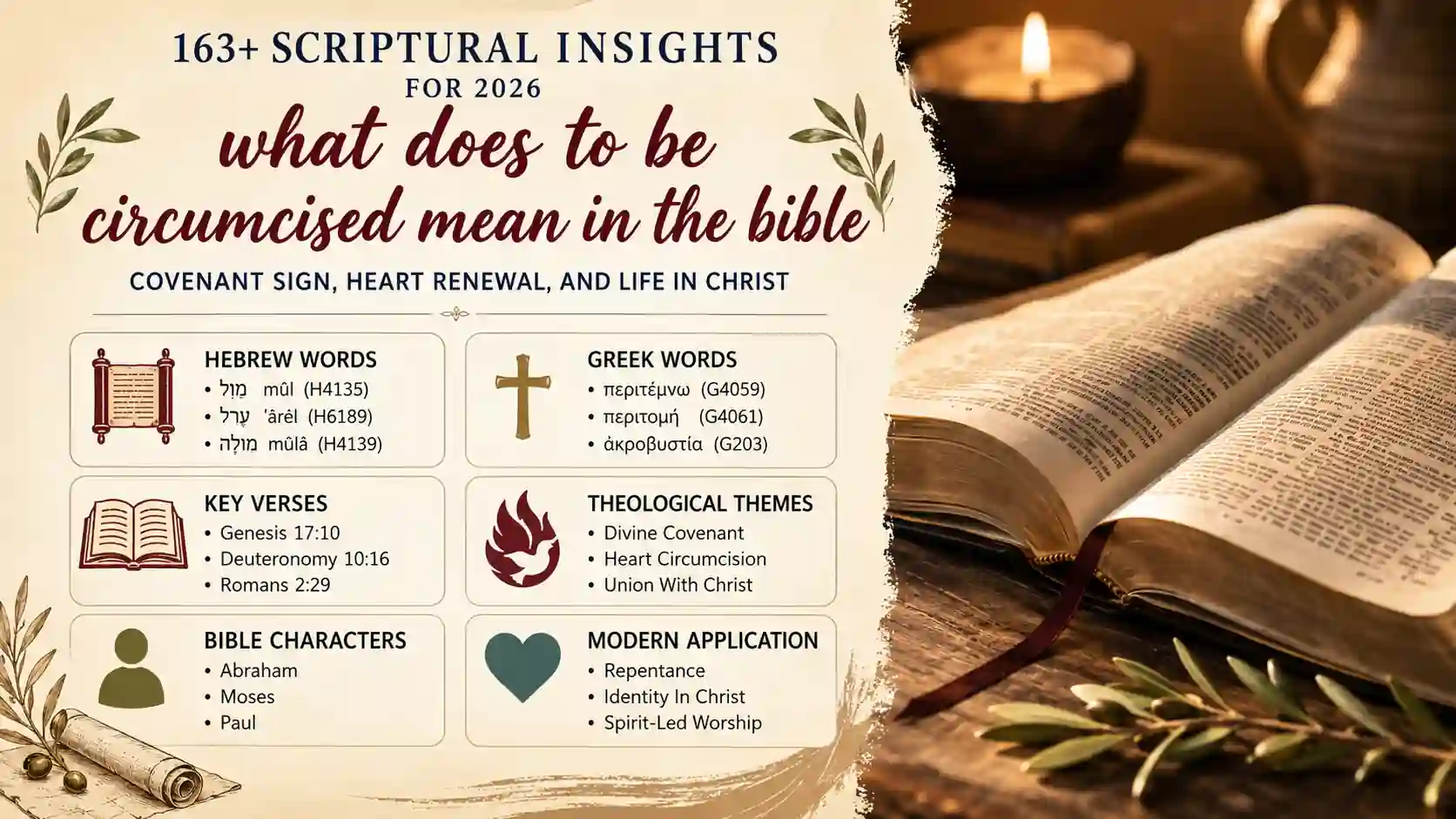
What does to be circumcised mean in the Bible? At its most literal level, circumcision is the removal of the male foreskin. God established it as the physical sign of his covenant with Abraham and Abraham’s descendants. It marked covenant membership, family identity, and obedience to God’s command.
Yet Scripture also uses circumcision spiritually. Moses, the prophets, Paul, and other biblical writers speak of circumcised hearts, ears, and lives. These expressions describe inward repentance, responsive faith, and devotion to God rather than confidence in an external religious mark.
Key Circumcision Scripture References
| Verse | Passage Snippet | Context |
|---|---|---|
| Genesis 17:10 | Every male shall be circumcised | God commands Abraham |
| Genesis 17:11 | Sign of the covenant | The physical mark explained |
| Genesis 17:12 | Eight days old | Timing for Israelite sons |
| Exodus 12:48 | Let all his males be circumcised | Requirement for Passover participation |
| Leviticus 12:3 | Flesh of his foreskin | Circumcision under Mosaic law |
| Deuteronomy 10:16 | Circumcise your heart | Call to inward obedience |
| Joshua 5:2 | Circumcise the sons of Israel | Covenant renewal in Canaan |
| Jeremiah 4:4 | Circumcise yourselves to the Lord | Prophetic call to repentance |
| Romans 2:29 | Circumcision is of the heart | Paul defines inward Jewishness |
| Colossians 2:11 | Circumcision made without hands | Union with Christ |
Genesis 17 presents circumcision as the covenant sign given to Abraham. Later passages develop its moral and spiritual significance, culminating in the New Testament teaching that belonging to God cannot be reduced to a physical operation.
Circumcision Bible Translation Comparison
| Verse | KJV | NIV | ESV | NASB |
|---|---|---|---|---|
| Genesis 17:10 | shall be circumcised | must be circumcised | shall be circumcised | shall be circumcised |
| Genesis 17:11 | token of the covenant | sign of the covenant | sign of the covenant | sign of the covenant |
| Genesis 17:12 | eight days old | eight days old | eight days old | eight days old |
| Deuteronomy 10:16 | foreskin of your heart | circumcise your hearts | foreskin of your heart | circumcise your heart |
| Jeremiah 4:4 | circumcise yourselves | circumcise yourselves | circumcise yourselves | circumcise yourselves |
| Romans 2:29 | circumcision is that of the heart | circumcision is circumcision of the heart | circumcision is a matter of the heart | circumcision is of the heart |
| Philippians 3:3 | we are the circumcision | we who are the circumcision | we are the circumcision | we are the circumcision |
| Colossians 2:11 | made without hands | not performed by human hands | made without hands | made without hands |
The translations differ mainly in style. Deuteronomy 10:16 preserves the concrete expression “foreskin of your heart” in some versions, while others communicate its sense more directly as “circumcise your heart.” The theological idea remains the removal of stubborn resistance toward God.
People and Characters Associated with Circumcision
| Person | Role | Connection |
|---|---|---|
| Abraham | Covenant patriarch | First commanded to bear the sign |
| Ishmael | Abraham’s son | Circumcised at thirteen |
| Isaac | Promised son | Circumcised on the eighth day |
| Moses | Covenant mediator | Taught heart circumcision |
| Zipporah | Wife of Moses | Circumcised her son during a crisis |
| Joshua | Israel’s leader | Renewed circumcision at Gilgal |
| Jesus | Promised Messiah | Circumcised on the eighth day |
| Peter | Apostle to Jews | Defended Gentile inclusion |
| Paul | Apostle to Gentiles | Opposed circumcision as salvation requirement |
| Timothy | Missionary coworker | Circumcised for ministry among Jews |
Abraham obeyed the command immediately, circumcising Ishmael and every male in his household. Isaac later received the sign on the eighth day, demonstrating that circumcision belonged to the covenant order established before Sinai.
Paul’s circumcision of Timothy in Acts 16 did not contradict his refusal to circumcise Titus in Galatians 2. Timothy’s circumcision removed a cultural obstacle to Jewish ministry. Titus was pressured to receive circumcision as a religious necessity, which Paul rejected.
Original Hebrew and Greek Circumcision Words
| Original Word | Transliteration | Strong’s # | Literal Meaning |
|---|---|---|---|
| מוּל | mûl | H4135 | To circumcise or cut off |
| עָרֵל | ʿārēl | H6189 | Uncircumcised |
| עָרְלָה | ʿorlâ | H6190 | Foreskin or uncircumcision |
| מוּלָה | mûlâ | H4139 | Circumcision |
| περιτέμνω | peritemnō | G4059 | To cut around |
| περιτομή | peritomē | G4061 | Circumcision |
| ἀκροβυστία | akrobystia | G203 | Foreskin or uncircumcision |
| ἀπερίτμητος | aperitmētos | G564 | Uncircumcised |
| κατατομή | katatomē | G2699 | Mutilation or cutting |
| χειροποίητος | cheiropoiētos | G5499 | Made by human hands |
The primary Hebrew verb is מוּל, mûl, Strong’s H4135. It normally refers to circumcising a male, but Deuteronomy 10:16 and Jeremiah 4:4 apply the cutting imagery to the heart. The chief Greek verb is περιτέμνω, peritemnō, Strong’s G4059, meaning “to cut around.” The related noun περιτομή, peritomē, Strong’s G4061, can describe the rite, the condition, or the circumcised people.
Paul uses the sharper word κατατομή, katatomē, in Philippians 3:2. By calling false teachers “the mutilation,” he distinguishes merely physical cutting from true covenant worship through the Spirit.
Related Biblical Circumcision Concepts
| Concept | Connection | Supporting Verse |
|---|---|---|
| Abrahamic covenant | Circumcision serves as its sign | Genesis 17:11 |
| Covenant membership | The mark identifies Abraham’s household | Genesis 17:13 |
| Obedience | Abraham acts on God’s command | Genesis 17:23 |
| Passover | Circumcision precedes participation | Exodus 12:48 |
| Heart repentance | Inner resistance must be removed | Deuteronomy 10:16 |
| Spiritual hearing | Uncircumcised ears resist God | Jeremiah 6:10 |
| Faith and righteousness | Abraham believed before circumcision | Romans 4:9–11 |
| New creation | External status cannot save | Galatians 6:15 |
| Union with Christ | Believers receive spiritual circumcision | Colossians 2:11 |
| Spirit-led worship | Christians are called the circumcision | Philippians 3:3 |
Circumcision was never intended to excuse unbelief or disobedience. Abraham was counted righteous by faith before receiving the covenant sign. Paul emphasizes this order in Romans 4 so that circumcision cannot be treated as the cause of Abraham’s justification.
The sign confirmed God’s covenant promise, but faith received that promise. In the same way, external religious identity without inward trust leaves the deeper problem of sin untouched.
Historical and Cultural Context of Circumcision
| Aspect | Detail | Biblical Source |
|---|---|---|
| Covenant origin | Commanded to Abraham | Genesis 17:9–14 |
| Household scope | Sons, servants, and purchased males | Genesis 17:12–13 |
| Required age | Eighth day after birth | Genesis 17:12 |
| Ishmael’s age | Thirteen at circumcision | Genesis 17:25 |
| Wilderness interruption | New generation remained uncircumcised | Joshua 5:5 |
| Gilgal renewal | Joshua circumcised Israel | Joshua 5:2–9 |
| Gentile distinction | Philistines called uncircumcised | 1 Samuel 17:26 |
| Second Temple debate | Gentile converts faced pressure | Acts 15:1 |
| Apostolic decision | Circumcision not required of Gentiles | Acts 15:19–29 |
| Greco-Roman setting | The mark identified Jewish males | Galatians 5:2–6 |
Circumcision existed among some ancient peoples, but Genesis gives Israel’s practice a distinct covenant meaning. For Abraham’s family, it was not merely a health custom, tribal ritual, or social tradition. God called it “my covenant” and “a sign of the covenant.”
By the first century, circumcision visibly distinguished Jewish men in the Greco-Roman world. The early church therefore faced a serious question. Must Gentiles enter Israel’s covenant life through circumcision before becoming full members of Christ’s people? Acts 15 answered no.
Theological Themes of Circumcision
| Theme | Explanation | Scripture |
|---|---|---|
| Divine covenant | God establishes the sign | Genesis 17:7–11 |
| Human obedience | The covenant command requires response | Genesis 17:23 |
| Judgment | Refusal signifies covenant breach | Genesis 17:14 |
| Inner cleansing | Sinful stubbornness must be cut away | Deuteronomy 10:16 |
| Regeneration | God transforms the heart | Deuteronomy 30:6 |
| Justification by faith | Abraham was righteous before the sign | Romans 4:10 |
| Equality in Christ | Circumcision gives no saving advantage | Galatians 3:28 |
| Freedom from legalism | The rite cannot justify sinners | Galatians 5:2–6 |
| Union with Christ | Christ performs the deeper circumcision | Colossians 2:11 |
| Spirit-led identity | God’s people worship by the Spirit | Philippians 3:3 |
Modern Application of Circumcision for Believers
| Area | Practice | Scripture |
|---|---|---|
| Faith | Trust Christ rather than religious status | Romans 4:11 |
| Repentance | Remove cherished resistance to God | Jeremiah 4:4 |
| Humility | Refuse confidence in external credentials | Philippians 3:3 |
| Obedience | Respond promptly to God’s revealed will | Genesis 17:23 |
| Worship | Serve through the Holy Spirit | Philippians 3:3 |
| Identity | Root your belonging in Christ | Colossians 2:10–11 |
| Community | Welcome believers from every background | Acts 15:19 |
| Discernment | Reject additions to the gospel | Galatians 5:2–4 |
| Holiness | Put away sinful practices | Colossians 2:11 |
| Love | Express faith through love | Galatians 5:6 |
What Does to Be Circumcised Mean in the Bible’S Covenants?
Under the Abrahamic covenant, to be circumcised meant receiving the physical sign God appointed for Abraham’s male descendants and household. The act testified that the family stood within the covenant community and was responsible to walk before God faithfully.
The sign did not automatically produce faith. Ishmael and later unbelieving Israelites could possess the mark while resisting God. Scripture therefore distinguishes between receiving an outward covenant sign and possessing the inward devotion that the sign was meant to encourage.
מוּל MûL and the Circumcision of the Heart
Moses commands Israel to “circumcise” the heart in Deuteronomy 10:16. The image portrays stubbornness as something covering and obstructing a person’s responsiveness to God. You are called to abandon pride, rebellion, and spiritual insensitivity.
Deuteronomy 30:6 adds a gracious promise. God himself will circumcise the hearts of his people so that they love him. Biblical heart circumcision therefore includes both human repentance and divine transformation. God commands the response and supplies the renewing grace.
Περιτομή Peritomē in Paul’S Gospel
Paul does not condemn the historical covenant sign or Jewish heritage. He condemns reliance upon circumcision as a means of justification. In Galatians, accepting it as necessary for salvation would imply that Christ’s work is insufficient and place the person under obligation to keep the whole law.
In Romans 2:29, Paul says true circumcision is “of the heart, by the Spirit.” In Philippians 3:3, believers in Christ are “the circumcision” because they worship by God’s Spirit, glory in Christ Jesus, and place no saving confidence in human qualifications.
The Circumcision of Christ in Colossians 2
Colossians 2:11 describes believers as circumcised with a circumcision “made without hands.” Paul is not describing a physical procedure. He speaks of a decisive spiritual putting away of the sinful flesh through union with Christ’s death and resurrection.
The phrase “circumcision of Christ” has prompted several interpretations, but its context centers on Christ’s saving action. You are complete in him, buried and raised with him through faith, forgiven of trespasses, and freed from the condemning record that stood against you.
Circumcision Questions Bible Students Ask
Does מוּל, mûl, always refer to physical circumcision?
No. Deuteronomy 10:16 and Jeremiah 4:4 use the verb figuratively for removing spiritual stubbornness.
Why was uncircumcision treated so seriously in Genesis 17:14?
Refusing God’s appointed covenant sign represented deliberate rejection of the covenant obligation given to Abraham’s household.
Does Romans 2:29 teach that the church simply replaced ethnic Israel?
The verse primarily argues that outward Jewish identity without inward obedience is insufficient, while true covenant faithfulness requires the Spirit’s work in the heart.
Why did Paul circumcise Timothy but refuse to circumcise Titus?
Timothy’s circumcision served Jewish mission, while circumcising Titus would have surrendered the truth that Gentiles are justified without adopting Jewish covenant markers.
What does περιτομή, peritomē, mean for a Christian today?
It points to an inward identity formed by the Spirit, union with Christ, faith working through love, and freedom from confidence in external religious achievements.