
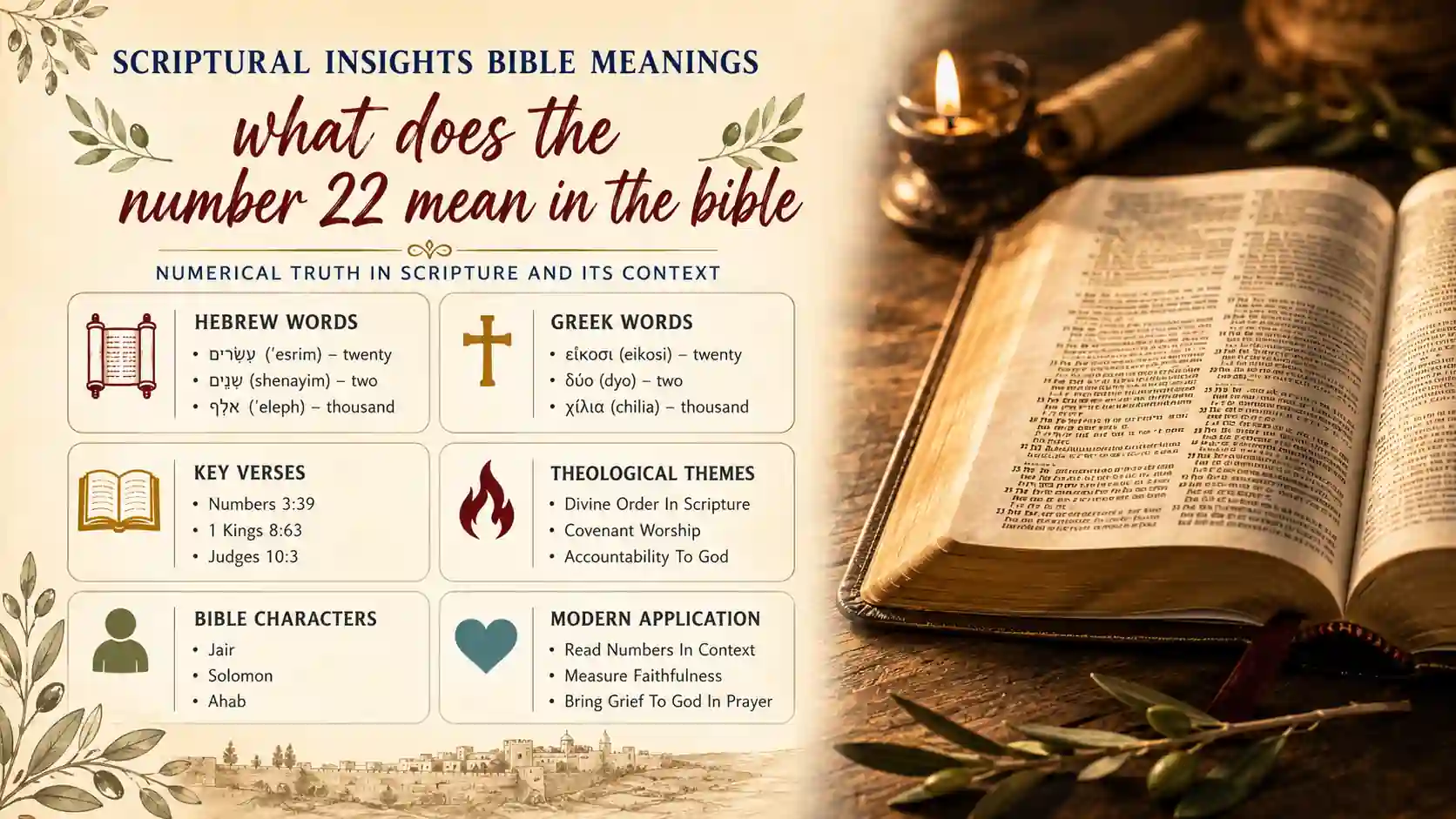
What does the number 22 mean in the Bible? Scripture never supplies a universal symbolic definition for twenty-two. Most appearances are ordinary historical measurements involving ages, reigns, censuses, and sacrifices. Therefore, you should resist interpretations that treat 22 as a secret code predicting personal events.
Yet twenty-two has genuine literary significance because the Hebrew alphabet contains twenty-two letters. Biblical writers used that alphabet to structure acrostic poems about God’s law, wisdom, judgment, and covenant faithfulness. Your study should distinguish this demonstrable literary pattern from speculative numerology.
Number 22 Key Scripture References
| Verse | Passage Snippet | Context |
|---|---|---|
| Numbers 3:39 | “twenty and two thousand” | Moses and Aaron count the Levites |
| Judges 10:3 | Jair judged twenty-two years | Period of Israel’s judges |
| 1 Kings 8:63 | Twenty-two thousand cattle | Solomon dedicates the temple |
| 1 Kings 14:20 | Jeroboam reigns twenty-two years | Northern kingdom’s first dynasty |
| 1 Kings 16:29 | Ahab reigns twenty-two years | Israel’s royal apostasy deepens |
| 2 Kings 8:26 | Ahaziah is twenty-two | A brief, wicked Judean reign |
| 2 Kings 21:19 | Amon is twenty-two | Manasseh’s son becomes king |
| 2 Chronicles 33:21 | Amon is twenty-two | Parallel account of Amon’s reign |
These passages show no single moral quality attached to twenty-two. The number describes Levites devoted to sanctuary service, sacrifices offered in worship, a judge’s administration, and several kings whose conduct ranged from limited stability to severe rebellion. The surrounding narrative, not the number alone, determines each passage’s meaning.
Number 22 Bible Translation Comparison
| Verse | KJV | NIV | ESV | NASB |
|---|---|---|---|---|
| Numbers 3:39 | Twenty and two thousand | 22,000 | 22,000 | 22,000 |
| Judges 10:3 | Judged Israel twenty and two years | Led Israel twenty-two years | Judged Israel twenty-two years | Judged Israel twenty-two years |
| 1 Kings 8:63 | Two and twenty thousand oxen | Twenty-two thousand cattle | 22,000 oxen | 22,000 oxen |
| 1 Kings 14:20 | Reigned twenty and two years | Reigned twenty-two years | Reigned twenty-two years | Reigned twenty-two years |
| 1 Kings 16:29 | Reigned twenty and two years | Reigned twenty-two years | Reigned twenty-two years | Reigned twenty-two years |
| 2 Kings 8:26 | Two and twenty years old | Twenty-two years old | Twenty-two years old | Twenty-two years old |
| 2 Kings 21:19 | Twenty and two years old | Twenty-two years old | Twenty-two years old | Twenty-two years old |
| 2 Chronicles 33:21 | Twenty and two years old | Twenty-two years old | Twenty-two years old | Twenty-two years old |
The translations agree on the numerical value. Their differences are mainly stylistic. The KJV frequently uses the older English expression “twenty and two,” while current translations generally use “twenty-two” or numerals. “Oxen” and “cattle” in 1 Kings 8:63 reflect translation choices rather than different quantities.
Number 22 People and Characters Associated
| Person | Role | Connection |
|---|---|---|
| Moses | Covenant mediator | Counted 22,000 Levites |
| Aaron | High priest | Assisted with the Levitical census |
| Jair | Judge of Israel | Governed Israel twenty-two years |
| Solomon | King and temple builder | Offered 22,000 cattle |
| Jeroboam | First northern king | Reigned twenty-two years |
| Ahab | King of Israel | Reigned twenty-two years |
| Ahaziah | King of Judah | Became king at twenty-two |
| Amon | King of Judah | Became king at twenty-two |
| Manasseh | Amon’s father | His idolatry shaped Amon |
| Josiah | Amon’s son | Reversed his father’s direction |
This group demonstrates why biblical numbers must be interpreted contextually. Jair’s twenty-two years belong to the Judges narrative, Solomon’s 22,000 animals belong to temple worship, and the kings’ twenty-two-year references belong to royal chronology. Scripture never combines these people into a special “twenty-two” category.
Number 22 Original Hebrew and Greek Words
| Original Word | Transliteration | Strong’s # | Literal Meaning |
|---|---|---|---|
| עֶשְׂרִים | ʿesrim | H6242 | Twenty |
| שְׁנַיִם | shenayim | H8147 | Two |
| שְׁתַּיִם | shettayim | H8147 | Two, feminine form |
| אֶלֶף | ʾeleph | H505 | Thousand |
| שָׁנָה | shanah | H8141 | Year |
| מָלַךְ | malakh | H4427 | To reign |
| סָפַר | saphar | H5608 | To count or record |
| תּוֹרָה | torah | H8451 | Instruction or law |
| εἴκοσι | eikosi | G1501 | Twenty |
| δύο | dyo | G1417 | Two |
In Hebrew, twenty-two is normally expressed by combining עֶשְׂרִים, ʿesrim, “twenty,” with a form of שְׁנַיִם, shenayim, “two.” Strong’s H6242 identifies the word for twenty, while H8147 identifies the cardinal number two.
The New Testament does not develop a theology of twenty-two. Greek can form the number with εἴκοσι, eikosi, “twenty,” and δύο, dyo, “two,” but these components do not function as a hidden spiritual title. Strong’s lists them as G1501 and G1417.
Number 22 Related Biblical Concepts
| Concept | Connection | Supporting Verse |
|---|---|---|
| Counting | Twenty-two records quantity | Numbers 3:39 |
| Levitical service | 22,000 Levites were counted | Numbers 3:39 |
| Worship | 22,000 cattle were sacrificed | 1 Kings 8:63 |
| Kingship | Several reigns involve twenty-two | 1 Kings 14:20 |
| Accountability | Length of rule does not equal faithfulness | 1 Kings 16:30 |
| Apostasy | Ahab’s reign promoted Baal worship | 1 Kings 16:31 |
| Generational influence | Amon followed Manasseh’s sins | 2 Kings 21:20 |
| Covenant obedience | God evaluates the king’s way | 2 Kings 21:22 |
| Alphabetic completeness | Hebrew poetry moves letter by letter | Psalm 119 |
| Ordered lament | Grief receives an alphabetic form | Lamentations 1 |
The strongest topic-specific concept is not mystical arithmetic but ordered expression. In several Hebrew poems, the alphabet allows the writer to treat a subject comprehensively. Psalm 119 develops love for God’s instruction through twenty-two alphabetic sections, while Lamentations uses similar order to voice covenant grief.
Number 22 Historical and Cultural Context
| Aspect | Detail | Biblical Source |
|---|---|---|
| Hebrew alphabet | Contains twenty-two consonantal letters | Psalm 119 headings |
| Acrostic poetry | Lines follow alphabetic order | Psalm 111 |
| Eight-line stanzas | Psalm 119 gives eight lines per letter | Psalm 119 |
| Wisdom portrait | Virtuous woman poem follows the alphabet | Proverbs 31:10-31 |
| Structured grief | Lamentations 1 has twenty-two verses | Lamentations 1 |
| Triple pattern | Lamentations 3 has sixty-six verses | Lamentations 3 |
| Royal records | Ages and reigns establish chronology | 2 Kings 21:19 |
| Census practice | Numbers organize Israel’s service | Numbers 3:39 |
| Temple sacrifice | Large totals express national worship | 1 Kings 8:63 |
| Scribal artistry | Letter patterns aided literary design | Psalm 112 |
Hebrew acrostics do not all follow an identical pattern. Psalms 111 and 112 progress through alphabetic lines, Psalm 119 assigns eight verses to each letter, and Proverbs 31:10-31 presents the excellent wife through an alphabetic sequence. Lamentations adapts the same device to Jerusalem’s devastation.
Number 22 Theological Themes
| Theme | Explanation | Scripture |
|---|---|---|
| Divine order | God’s truth can shape disciplined thought | Psalm 119:1-8 |
| Complete instruction | The alphabet frames sustained Torah meditation | Psalm 119:97 |
| Covenant worship | Solomon dedicates God’s temple | 1 Kings 8:62-63 |
| Holy service | Levites are numbered for God’s work | Numbers 3:39 |
| Moral accountability | Kings answer to the Lord | 1 Kings 16:30 |
| Human rebellion | Ahab and Amon forsake God’s ways | 2 Kings 21:22 |
| Generational responsibility | Each ruler chooses whom to follow | 2 Kings 21:20-22 |
| Judgment and grief | Sin’s consequences must be lamented | Lamentations 1:1 |
| Mercy amid sorrow | Hope rests in God’s steadfast love | Lamentations 3:22-23 |
| Scripture’s sufficiency | Meaning arises from the text’s context | Nehemiah 8:8 |
The number can appear in accounts of worship and wickedness because numbers are morally neutral. A king does not become evil because he reigns twenty-two years, and a sacrifice is not accepted merely because its quantity is 22,000. God looks at covenant faithfulness, obedient worship, and the heart’s response to his word.
Number 22 Modern Application for Believers
| Area | Practice | Scripture |
|---|---|---|
| Bible interpretation | Read every number in context | Nehemiah 8:8 |
| Discernment | Test numerical claims by Scripture | Acts 17:11 |
| Prayer | Avoid treating numbers as omens | Deuteronomy 18:10 |
| Worship | Offer yourself rather than chase signs | Romans 12:1 |
| Scripture memory | Use structure to remember truth | Psalm 119:11 |
| Leadership | Measure faithfulness, not longevity | 1 Kings 16:30 |
| Family influence | Refuse inherited patterns of sin | 2 Kings 21:21-22 |
| Grief | Bring suffering honestly before God | Lamentations 3:19-24 |
| Wisdom | Seek the whole counsel of Scripture | Psalm 119:160 |
| Hope | Rest in God’s mercy each morning | Lamentations 3:22-23 |
When you repeatedly notice 22 in daily life, Scripture does not authorize you to assume that God is sending a coded prediction. God can providentially direct his people, but biblical guidance comes through rightly understood Scripture, prayerful wisdom, godly counsel, and obedience rather than private numerological systems.
The Twenty-Two Letters of the Hebrew Alphabet Shape Biblical Poetry
The most substantial biblical association with twenty-two comes from the Hebrew alphabet. It runs from א, aleph, to ת, tav, with twenty-two letters. Biblical poets sometimes arranged lines or stanzas according to that sequence, creating what scholars call alphabetic acrostics.
Psalm 119 is the clearest example. Its 176 verses form twenty-two sections of eight verses. Each line within a section begins with the same Hebrew letter. The form reinforces the psalm’s central confession that every dimension of life should be ordered by God’s תּוֹרָה, torah, meaning instruction.
What Does the Number 22 Mean in the Bible’S Books of Lament?
Lamentations 1, 2, and 4 each contain twenty-two verses corresponding broadly to the alphabetic sequence. Lamentations 3 expands the pattern to sixty-six verses, giving three successive lines to each letter. The controlled structure holds together language of chaos, loss, judgment, and prayer.
This does not make twenty-two a symbol of destruction. The alphabet provides a vessel through which the poet expresses suffering thoroughly, almost from A to Z. Even in national catastrophe, grief is brought into ordered speech before the covenant God.
עֶשְׂרִים וּשְׁנַיִם Records History Rather than Secret Prophecy
The Hebrew expression for twenty-two joins words meaning twenty and two. In the historical books, it normally communicates straightforward information. Jair judged for twenty-two years, Jeroboam and Ahab each reigned for twenty-two years, and Amon became king at twenty-two.
Those details help establish chronology and introduce narrative context. Ahab’s twenty-two-year reign is remembered for covenant rebellion, while Jair’s tenure belongs to a brief account of leadership. The identical number does not make their spiritual significance identical.
Twenty-Two-Year Reigns Reveal the Priority of Covenant Faithfulness
Jeroboam’s reign lasted twenty-two years, yet he established patterns of false worship that damaged the northern kingdom. Ahab also ruled for twenty-two years and intensified Israel’s apostasy through Baal worship. Their longevity offered no proof of divine approval.
Amon’s age likewise carried no spiritual guarantee. He became king at twenty-two but imitated his father Manasseh’s earlier idolatry and abandoned the Lord. His son Josiah later chose another path, reminding you that inherited sin can be rejected through humble obedience to God.
Questions About the Number 22 in Scripture
Does the Hebrew phrase עֶשְׂרִים וּשְׁנַיִם give 22 a spiritual definition?
No. It literally communicates “twenty and two,” while the passage’s context supplies the theological meaning.
Why does Psalm 119 have twenty-two sections?
Its sections correspond to the twenty-two Hebrew letters and present sustained, alphabetically ordered meditation on God’s Torah.
Does Lamentations use twenty-two to symbolize judgment?
Not by itself. Its twenty-two-part patterns use the Hebrew alphabet to give comprehensive poetic form to grief and judgment.
Why do 2 Kings 8:26 and some readings of 2 Chronicles 22:2 differ about Ahaziah’s age?
The passages preserve a well-known textual difficulty, and many translations understand twenty-two as the reading consistent with the surrounding royal chronology.
Should you interpret seeing 22 repeatedly as a message from God?
Scripture gives no rule for treating repeated everyday numbers as divine codes, so seek guidance through God’s word, prayer, wisdom, and faithful obedience.