
What does desolate mean in the Bible? The word commonly describes a person, city, land, house, or sanctuary that has been emptied, abandoned, ruined, barren, or deprived of blessing. Its meaning depends on the passage. Sometimes desolation is the visible result of war, exile, or covenant judgment. In other places, it expresses loneliness, childlessness, spiritual abandonment, or grief.
Yet biblical desolation is rarely the final word. Scripture repeatedly moves from ruined cities to rebuilding, from barrenness to fruitfulness, and from judgment to restoration through God’s mercy.
Desolate Key Scripture References
| Verse | Passage Snippet | Context |
|---|---|---|
| Leviticus 26:33 | “Your land shall be desolate” | Covenant disobedience brings exile |
| Isaiah 54:1 | “Children of the desolate” | Barren Zion receives restoration |
| Jeremiah 33:10 | “This place is desolate” | Judah appears beyond recovery |
| Lamentations 1:4 | “Her gates are desolate” | Jerusalem mourns after conquest |
| Daniel 9:2 | “Desolations of Jerusalem” | Daniel studies Jeremiah’s prophecy |
| Daniel 9:27 | “He shall make it desolate” | Sanctuary judgment and desecration |
| Matthew 23:38 | “Your house is left desolate” | Jesus laments over Jerusalem |
| Revelation 18:19 | “Made desolate” | Babylon falls under divine judgment |
These passages show that desolation can be agricultural, political, relational, spiritual, or prophetic. The common thread is the removal of life, security, worship, population, or divine favor from something that once flourished.
Desolate Bible Translation Comparison
| Verse | KJV | NIV | ESV | NASB |
|---|---|---|---|---|
| Isaiah 54:1 | “the desolate” | “desolate woman” | “desolate one” | “desolate one” |
| Jeremiah 33:10 | “desolate without man” | “desolate waste” | “waste without man” | “waste, without man” |
| Lamentations 1:4 | “gates are desolate” | “gateways are desolate” | “gates are desolate” | “gates are deserted” |
| Daniel 9:27 | “make it desolate” | “causes desolation” | “one who makes desolate” | “one who makes desolate” |
| Matthew 23:38 | “left unto you desolate” | “left to you desolate” | “left to you desolate” | “left to you desolate” |
| Matthew 24:15 | “abomination of desolation” | “causes desolation” | “abomination of desolation” | “abomination of desolation” |
| Luke 13:35 | “left unto you desolate” | “left to you desolate” | “house is forsaken” | “left to you desolate” |
| Revelation 18:19 | “made desolate” | “brought to ruin” | “laid waste” | “laid waste” |
Translation differences usually reflect the range of the underlying Hebrew or Greek. “Desolate,” “deserted,” “forsaken,” “ruined,” and “laid waste” overlap, but each highlights a different feature of the same condition. Matthew 23:38, for example, speaks of a house left empty or abandoned, while Revelation 18 emphasizes sudden devastation.
Desolate People and Bible Characters
| Person | Role | Connection |
|---|---|---|
| Moses | Covenant mediator | Warned that rebellion would desolate Israel |
| Isaiah | Prophet of Judah | Promised joy to desolate Zion |
| Jeremiah | Weeping prophet | Foretold and witnessed Judah’s ruin |
| Nebuchadnezzar | Babylonian king | His armies devastated Jerusalem |
| Daniel | Exiled prophet | Prayed over Jerusalem’s desolations |
| Antiochus IV | Seleucid ruler | Desecrated the Jerusalem sanctuary |
| Jesus | Messiah and prophet | Declared Jerusalem’s house desolate |
| John | Apostolic seer | Described Babylon’s final desolation |
Desolation is not merely an abstract doctrine in Scripture. Moses warned of it, Jeremiah grieved over it, Daniel confessed sin within it, and Jesus wept as he announced it. These individuals reveal that biblical judgment should produce humility and sorrow rather than cold speculation.
Desolate Original Hebrew and Greek Words
| Original Word | Transliteration | Strong’s # | Literal Meaning |
|---|---|---|---|
| שָׁמֵם | shamem | H8074 | To be desolate or appalled |
| שְׁמָמָה | shemamah | H8077 | Desolation, devastation, horror |
| חָרְבָּה | chorbah | H2723 | Ruin or waste place |
| חָרֵב | chareb | H2717 | Dry, ruined, laid waste |
| גַּלְמוּד | galmud | H1565 | Barren, solitary, unfruitful |
| ἔρημος | erēmos | G2048 | Deserted, solitary, wilderness |
| ἐρημόω | erēmoō | G2049 | To make empty or lay waste |
| ἐρήμωσις | erēmōsis | G2050 | Desolation or devastation |
The Hebrew verb שָׁמֵם, shamem, can describe being ruined, deserted, stunned, or appalled. Its emotional range matters because a desolated place often causes observers to recoil in horror. The noun חָרְבָּה, chorbah, more specifically pictures ruins, waste places, or settlements destroyed by drought or violence.
The Greek family built around ἔρημος, erēmos, connects desolation with emptiness and isolation. It can refer to a wilderness, an uninhabited location, or something deprived of inhabitants. The noun ἐρήμωσις, erēmōsis, appears in New Testament passages concerning devastating judgment and sacrilegious desecration.
Desolate Related Biblical Concepts
| Concept | Connection | Supporting Verse |
|---|---|---|
| Exile | Desolation follows removal from the land | 2 Chronicles 36:21 |
| Barrenness | A desolate woman lacks children | Isaiah 54:1 |
| Covenant judgment | Rebellion leaves cities ruined | Leviticus 26:31 |
| Forsakenness | A house may be left abandoned | Matthew 23:38 |
| Mourning | Empty roads and gates lament | Lamentations 1:4 |
| Desecration | False worship defiles holy space | Daniel 11:31 |
| Restoration | God rebuilds ancient ruins | Isaiah 61:4 |
| Final judgment | Proud Babylon becomes waste | Revelation 18:19 |
Desolation often appears beside exile because biblical life was closely tied to land, family, city, temple, and covenant community. When these gifts were lost, the result was not simply inconvenience. It was a profound unraveling of ordinary life.
Barrenness also functions as a picture of desolation. Isaiah 54 portrays Zion as a woman without children, yet calls her to sing because God will multiply her family. The image transforms desolation from a permanent identity into a condition God can reverse.
Desolate Historical and Cultural Context
| Aspect | Detail | Biblical Source |
|---|---|---|
| Ancient warfare | Conquerors burned cities and fields | 2 Kings 25:9 |
| Forced exile | Populations were deported after defeat | 2 Kings 25:11 |
| Empty farmland | Unworked land became wilderness | Leviticus 26:34 |
| City gates | Deserted gates signified social collapse | Lamentations 1:4 |
| Temple destruction | Worship ceased when the sanctuary fell | Psalm 74:3 |
| Babylonian conquest | Jerusalem fell in the sixth century BC | 2 Chronicles 36:19 |
| Seleucid oppression | The sanctuary suffered pagan desecration | Daniel 11:31 |
| Roman destruction | Jerusalem and the temple fell in AD 70 | Luke 21:20 |
In the ancient Near East, a desolate city was more than a damaged collection of buildings. Its markets were silent, gates were empty, farms were abandoned, families were scattered, and worship might cease. Biblical descriptions of desolation therefore communicate economic, communal, religious, and emotional devastation.
Daniel’s language about the “abomination of desolation” belongs to a setting in which foreign power and idolatrous practice violated sacred space. Antiochus IV’s second-century BC persecution provides an important historical background, while Jesus’ later use of Daniel’s language points his disciples toward another crisis involving Jerusalem.
Desolate Theological Themes
| Theme | Explanation | Scripture |
|---|---|---|
| God’s holiness | Persistent rebellion cannot be ignored | Leviticus 26:31 |
| Covenant accountability | Privilege brings responsibility | Deuteronomy 28:45 |
| Sin’s consequences | Evil empties what once flourished | Jeremiah 7:34 |
| Divine absence | Judgment may involve withdrawn protection | Matthew 23:38 |
| Prophetic fulfillment | Desolation confirms God’s warnings | Daniel 9:2 |
| Compassion in judgment | Jesus weeps over the condemned city | Luke 19:41 |
| Restoration by grace | God repopulates ruined places | Isaiah 49:19 |
| Final justice | Oppressive powers will not endure | Revelation 18:20 |
Biblical desolation teaches that sin is destructive. Idolatry, violence, injustice, and covenant unfaithfulness do not produce lasting flourishing. They hollow out communities and turn places of beauty into ruins.
Yet God does not delight in destruction for its own sake. The prophets frequently place promises of restoration beside announcements of judgment. The Lord disciplines, preserves a remnant, forgives the repentant, and causes abandoned places to sing again.
Desolate Modern Application for Believers
| Area | Practice | Scripture |
|---|---|---|
| Personal grief | Bring loneliness honestly to God | Psalm 25:16 |
| Spiritual dryness | Seek God through prayer and Scripture | Psalm 63:1 |
| Repentance | Turn from habits that produce ruin | Joel 2:12 |
| Church decline | Pray for renewal and faithful witness | Revelation 2:5 |
| Broken communities | Participate in rebuilding and justice | Isaiah 58:12 |
| Compassion | Remember displaced and grieving people | Hebrews 13:3 |
| False security | Do not trust wealth or power | Revelation 18:17 |
| Hope | Believe God can restore barren places | Isaiah 54:3 |
You may experience seasons that feel desolate, but you should distinguish painful circumstances from divine rejection. Not every loneliness, illness, loss, or disappointment is a direct punishment for personal sin. Job’s suffering warns you against making that assumption.
At the same time, desolation imagery invites honest spiritual examination. You can ask whether neglect, injustice, pride, or disobedience is draining life from your relationships and worship. Where repentance is needed, God’s call is not meant to drive you into despair but to lead you home.
What Does Desolate Mean in the Bible within the Covenant?
The covenant warnings of Leviticus 26 and Deuteronomy 28 provide a major foundation for the Bible’s language of desolation. Israel received land, harvest, peace, worship, and communal life as covenant blessings. Persistent rebellion would bring the opposite condition, including famine, invasion, exile, empty cities, and neglected land.
This does not mean Israel earned God’s love through obedience. The covenant began with divine grace and deliverance. Yet the people were responsible to live as God’s holy nation. Desolation exposed the seriousness of breaking fellowship with the God who had redeemed them.
שָׁמֵם And the Shock of a Ruined Jerusalem
The word שָׁמֵם, shamem, can carry the idea of being desolate and the reaction of being horrified or appalled. That connection is fitting in passages where Jerusalem’s devastation becomes a public warning. The ruined city reveals what unchecked rebellion produces.
Jeremiah and Lamentations do not treat Jerusalem’s fall as a distant theological puzzle. They describe roads mourning, gates standing empty, priests groaning, and families suffering. You are invited to grieve sin’s damage while recognizing the justice and compassion of God.
ἐρήμωσις And the Abomination of Desolation
In Matthew 24:15, Jesus refers to the βδέλυγμα τῆς ἐρημώσεως, bdelygma tēs erēmōseōs, commonly translated “abomination of desolation.” The phrase joins an offensive, idolatrous object or act with the devastation that follows its presence.
Interpreters differ about the full prophetic reach of this saying. Some emphasize events surrounding Jerusalem’s destruction in AD 70, while others also see a final future fulfillment. Your safest approach is to honor the historical setting, recognize Jesus’ warning, and remain spiritually watchful without claiming more certainty than the text provides.
From Desolate Zion to the New Creation
Isaiah’s promises show that desolation is not stronger than God’s covenant mercy. The abandoned woman receives children, ruined foundations are rebuilt, and wilderness imagery gives way to fruitfulness. Restoration comes because the Lord remembers his people and acts for his name.
This pattern reaches its fullness in Christ. He bears judgment, gathers a people from the nations, and promises a creation where death, mourning, and devastation will not prevail. Biblical hope does not deny the ruins. It declares that God can raise life from them.
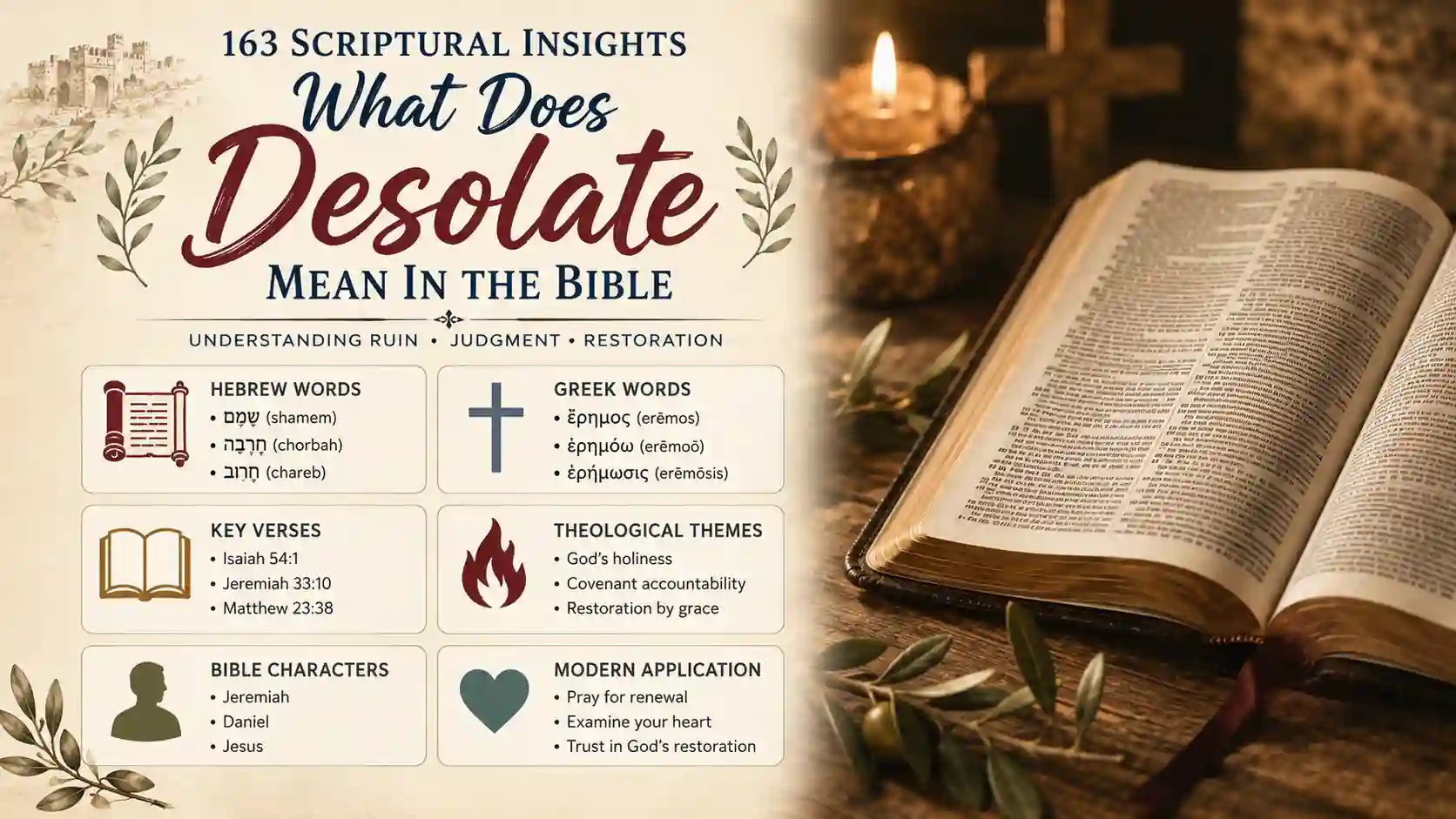
Questions About Desolate in the Bible
Does שָׁמֵם, shamem, always mean physical destruction?
No. It can describe physical ruin, abandonment, emotional horror, or stunned astonishment, depending on its context.
Why does the ESV say “forsaken” in Luke 13:35 while other versions say “desolate”?
“Forsaken” emphasizes abandonment, while “desolate” emphasizes the empty and ruined condition produced by that abandonment.
Is the abomination of desolation only about Antiochus IV?
Antiochus provides a major historical pattern, but Jesus’ use of Daniel’s language shows that the warning also extended beyond his actions.
Does Matthew 23:38 mean God permanently rejected Israel?
The verse announces severe judgment on Jerusalem, but it should be read alongside biblical promises of mercy, restoration, and God’s continuing faithfulness.
How should you respond when your life feels spiritually desolate?
Pray honestly, examine your heart, remain near Christian community, receive God’s promises, and trust that spiritual dryness need not be your final condition.