
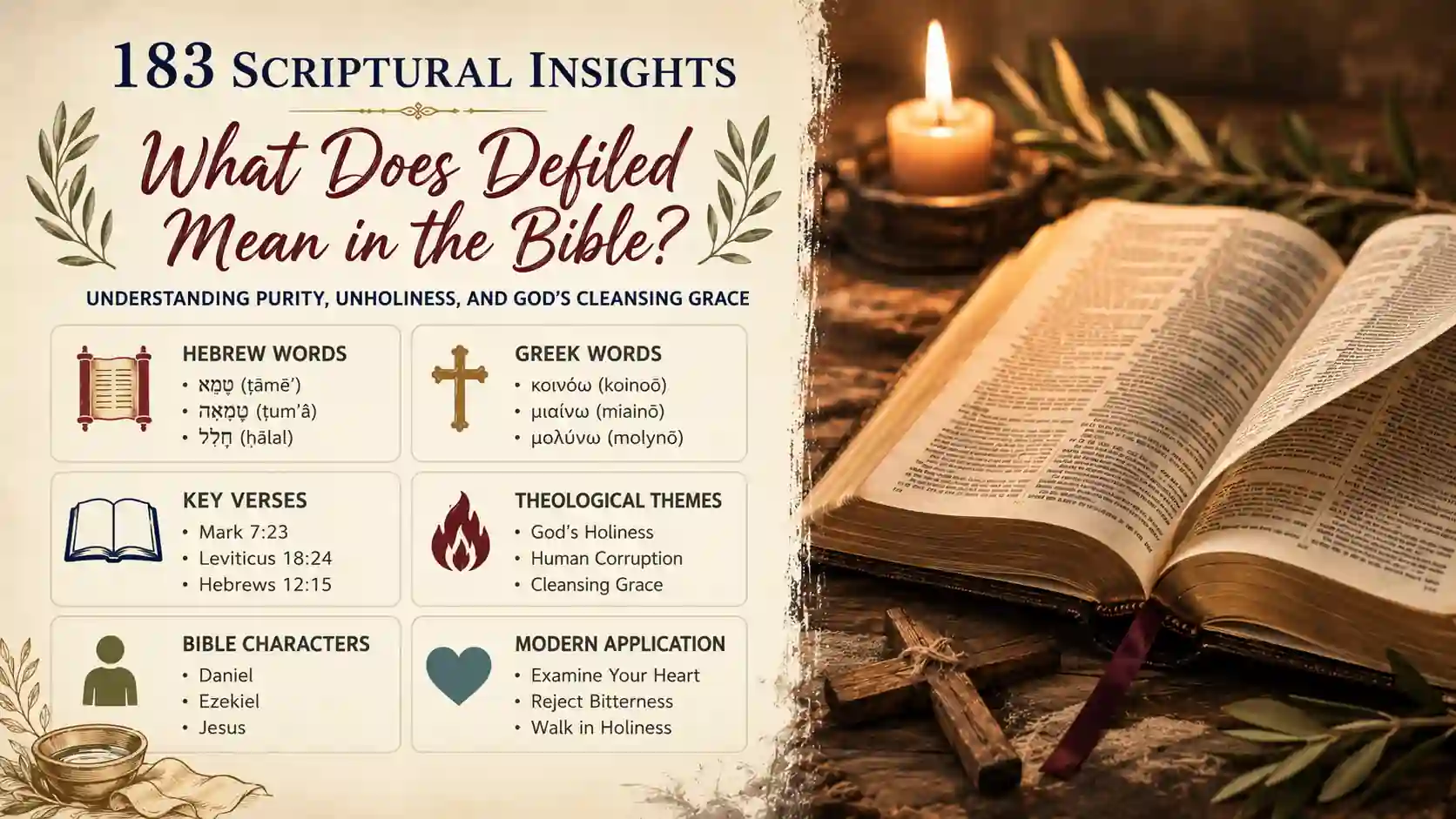
What does defiled mean in the Bible? Scripture uses the idea of defilement for something made unclean, polluted, desecrated, or morally corrupted. Depending on the passage, a person, garment, conscience, sanctuary, food, or even the land may become defiled.
The biblical meaning is broader than ordinary dirtiness. Defilement can describe ceremonial uncleanness under the law of Moses, deliberate sin, idolatry, sexual immorality, corrupted worship, or inward evil. Your study must therefore consider the covenant, setting, and original word used in each passage.
Key Defiled Scripture References
| Verse | Passage Snippet | Context |
|---|---|---|
| Leviticus 11:43 | “Defile not yourselves” | Israel must avoid unclean creatures |
| Leviticus 18:24 | “Defile not ye yourselves” | Sexual sins polluted the nations |
| Numbers 35:33 | “Ye shall not pollute the land” | Unpunished bloodshed defiled Canaan |
| Daniel 1:8 | “Not defile himself” | Daniel refused the royal provisions |
| Ezekiel 36:17 | “Defiled it by their own way” | Israel polluted the promised land |
| Matthew 15:11 | “That which cometh out” | Jesus located moral defilement within |
| Mark 7:23 | “These evil things come from within” | Sinful desires defile a person |
| Hebrews 12:15 | “Many be defiled” | Bitterness spreads spiritual corruption |
| Titus 1:15 | “Mind and conscience is defiled” | Unbelief corrupts inward judgment |
| Revelation 3:4 | “Not defiled their garments” | Faithful believers resisted compromise |
Defiled in Bible Translation Comparison
| Verse | KJV | NIV | ESV | NASB |
|---|---|---|---|---|
| Leviticus 18:24 | “Defile not ye yourselves” | “Do not defile yourselves” | “Do not make yourselves unclean” | “Do not defile yourselves” |
| Numbers 35:33 | “Defile the land” | “Pollute the land” | “Pollute the land” | “Pollute the land” |
| Daniel 1:8 | “Defile himself” | “Defile himself” | “Defile himself” | “Defile himself” |
| Matthew 15:11 | “Defileth a man” | “Defiles them” | “Defiles a person” | “Defiles the person” |
| Mark 7:15 | “Defile him” | “Defile them” | “Defile him” | “Defile the person” |
| Hebrews 12:15 | “Many be defiled” | “Defile many” | “Many become defiled” | “Many be defiled” |
| Titus 1:15 | “Conscience is defiled” | “Consciences are corrupted” | “Consciences are defiled” | “Consciences are defiled” |
| James 3:6 | “Defileth the whole body” | “Corrupts the whole body” | “Staining the whole body” | “Defiles the whole body” |
| Revelation 3:4 | “Defiled their garments” | “Soiled their clothes” | “Soiled their garments” | “Soiled their garments” |
People and Characters Associated with Defiled
| Person | Role | Connection |
|---|---|---|
| Moses | Covenant mediator | Taught Israel’s purity laws |
| Aaron | High priest | Guarded holiness in the sanctuary |
| Nadab and Abihu | Priests | Violated the holiness of worship |
| Phinehas | Priest | Opposed covenant pollution at Peor |
| Daniel | Judean exile | Refused to defile himself in Babylon |
| Ezekiel | Prophet | Described Israel defiling the land |
| Jesus | Messiah and teacher | Explained inward moral defilement |
| Pharisees | Religious leaders | Emphasized external purification traditions |
| Paul | Apostle | Warned of defiled minds and consciences |
| John | Apostle and seer | Portrayed undefiled garments in Revelation |
Original Hebrew and Greek Words for Defiled
| Original Word | Transliteration | Strong’s # | Literal Meaning |
|---|---|---|---|
| טָמֵא | ṭāmēʾ | H2930 | To become unclean |
| טָמֵא | ṭāmēʾ | H2931 | Unclean or impure |
| טֻמְאָה | ṭumʾâ | H2932 | Uncleanness or pollution |
| חָלַל | ḥālal | H2490 | Profane, pollute, desecrate |
| גָּאַל | gāʾal | H1351 | Stain or defile |
| חָנֵף | ḥānēp | H2610 | Pollute or profane |
| שָׁקַץ | šāqaṣ | H8262 | Make detestable |
| κοινόω | koinoō | G2840 | Make common or unclean |
| μιαίνω | miainō | G3392 | Stain, contaminate, defile |
| μολύνω | molynō | G3435 | Soil, stain, pollute |
Related Biblical Concepts of Defiled
| Concept | Connection | Supporting Verse |
|---|---|---|
| Uncleanness | Ritual condition limiting sacred access | Leviticus 15:31 |
| Holiness | Defilement opposes what belongs to God | Leviticus 20:7 |
| Purification | God provides cleansing from impurity | Numbers 19:9 |
| Sin | Rebellion morally pollutes people | Isaiah 59:3 |
| Idolatry | False worship defiles God’s sanctuary | Ezekiel 5:11 |
| Bloodguilt | Murder pollutes the land | Numbers 35:33 |
| Conscience | Unbelief corrupts moral perception | Titus 1:15 |
| Bitterness | Resentment spreads contamination | Hebrews 12:15 |
| Repentance | Confession seeks restored fellowship | Psalm 51:10 |
| Sanctification | God forms a holy people | 1 Thessalonians 4:3 |
Historical and Cultural Context of Defiled
| Aspect | Detail | Biblical Source |
|---|---|---|
| Tabernacle worship | Impurity restricted sanctuary access | Leviticus 15:31 |
| Clean animals | Food laws marked Israel as distinct | Leviticus 11 |
| Bodily conditions | Some natural conditions caused temporary uncleanness | Leviticus 15 |
| Corpse contact | Touching death required purification | Numbers 19:11 |
| Day of Atonement | The sanctuary was cleansed yearly | Leviticus 16:16 |
| Promised land | Sin could pollute Israel’s inheritance | Leviticus 18:25 |
| Priestly service | Priests followed stricter purity requirements | Leviticus 21:1 |
| Babylonian court | Royal food threatened Daniel’s faithfulness | Daniel 1:8 |
| Pharisaic tradition | Handwashing customs guarded ritual purity | Mark 7:3 |
| Pagan temples | Idolatrous feasts challenged Christians | 1 Corinthians 8:10 |
Theological Themes of Defiled
| Theme | Explanation | Scripture |
|---|---|---|
| God’s holiness | His presence cannot be treated casually | Leviticus 10:3 |
| Human corruption | Sin proceeds from the fallen heart | Mark 7:21 |
| Covenant responsibility | God’s people must honor his commands | Deuteronomy 7:6 |
| Sacred space | Sin desecrates what is devoted to God | Ezekiel 23:38 |
| Corporate influence | One person’s bitterness can affect many | Hebrews 12:15 |
| Cleansing grace | God washes repentant sinners | Ezekiel 36:25 |
| Christ’s purity | Jesus touches the unclean without corruption | Mark 1:41 |
| New covenant holiness | Purity reaches the heart and conscience | Hebrews 9:14 |
| Church holiness | Believers belong to God as his temple | 1 Corinthians 3:16 |
| Final purity | Nothing unclean enters the holy city | Revelation 21:27 |
Modern Application of Defiled for Believers
| Area | Practice | Scripture |
|---|---|---|
| Heart | Examine motives before God | Psalm 139:23 |
| Speech | Reject words that spread corruption | James 3:6 |
| Conscience | Let Scripture correct moral judgment | Titus 1:15 |
| Sexual conduct | Honor the body in holiness | 1 Thessalonians 4:3 |
| Worship | Approach God with reverence | Hebrews 12:28 |
| Relationships | Remove bitterness quickly | Hebrews 12:15 |
| Media choices | Dwell on what is pure | Philippians 4:8 |
| Repentance | Confess sins rather than conceal them | 1 John 1:9 |
| Community | Restore wandering believers gently | Galatians 6:1 |
| Hope | Pursue purity while awaiting Christ | 1 John 3:3 |
ṬāMēʾ and Ceremonial Defilement Under the Mosaic Covenant
The Hebrew root טָמֵא, ṭāmēʾ, describes becoming unclean or being in an unclean condition. In Leviticus and Numbers, this condition could result from touching a corpse, certain bodily discharges, skin disease, childbirth, or contact with specified animals. Ceremonial uncleanness was not always caused by personal wrongdoing.
This distinction protects you from reading every purity law as a direct accusation of moral guilt. A faithful Israelite could become unclean through ordinary life and then follow God’s prescribed washing, waiting, or sacrifice. The laws taught that mortality, disease, and disorder did not belong in the immediate sphere of God’s holy presence.
Ceremonial defilement was temporary, but it remained serious because Israel’s sanctuary represented the dwelling of the Holy One. Anyone who ignored the required purification could defile the tabernacle and be cut off from the community. The issue was not personal hygiene alone, but proper access to sacred space.
These regulations also gave Israel a visible vocabulary for holiness. Clean and unclean distinctions reminded the nation that God separated them for covenant service. Every meal, bodily condition, and approach to worship could become an occasion to remember that the Lord was holy.
What Does Defiled Mean in the Bible When Jesus Speaks of the Heart?
In Mark 7 and Matthew 15, Jesus responded to controversy concerning ceremonial handwashing. He did not teach that evil material objects somehow enter the body and create moral guilt. He declared that what proceeds from the heart is what morally defiles a person.
Jesus named evil thoughts, sexual immorality, theft, murder, adultery, greed, deceit, envy, slander, pride, and foolishness. These sins arise from within and reveal the true condition of the human heart. External religious practices cannot cleanse inward rebellion.
The Greek verb κοινόω, koinoō, means to make common or unclean. Within Jewish purity language, something “common” stood in contrast with what was holy or consecrated. Jesus used that familiar vocabulary to expose a deeper pollution than unwashed hands.
His teaching does not belittle holiness. It intensifies holiness by carrying it into your desires, intentions, words, and choices. You cannot maintain purity merely through religious appearance. You need the transforming mercy of God, who creates a clean heart and teaches obedience from within.
Miainō and the Spreading Defilement of Bitterness
Hebrews 12:15 warns that a “root of bitterness” may spring up, cause trouble, and defile many. The verb μιαίνω, miainō, pictures staining or contaminating something. Bitterness is therefore not presented as a harmless private emotion.
Resentment can reshape speech, memory, relationships, and congregational life. A wounded person may continually rehearse an offense, interpret others through suspicion, or recruit companions into hostility. In this way, an unresolved root produces fruit that affects an entire community.
The verse echoes the covenant warning of Deuteronomy 29:18, where a poisonous root describes a heart turning from the Lord toward idolatry. Hebrews applies the imagery to believers who must watch carefully that no one falls away from the grace of God.
Your response should not be denial or superficial politeness. Bring the wound honestly before God, pursue forgiveness, seek wise reconciliation, and refuse to nourish revenge. Grace does not declare evil acceptable, but it prevents evil from ruling your heart.
From Defiled Garments to Cleansed Consciences
Garments often symbolize moral or spiritual condition in Scripture. Revelation 3:4 praises believers in Sardis who had not “soiled” their garments. The Greek verb μολύνω, molynō, refers to staining or polluting, and the image describes believers who resisted the surrounding church’s spiritual compromise.
The faithful walk with Christ in white because their lives correspond to their confession. Their worthiness is not self-produced perfection. Revelation consistently grounds victory in the work of the Lamb, whose blood cleanses and whose grace enables perseverance.
The new covenant reaches deeper than ceremonial washing. Hebrews 9:14 declares that Christ’s blood purifies the conscience from dead works so that believers may serve the living God. The gospel does not merely regulate contact with uncleanness. It cleanses the worshiper inwardly.
Defilement is therefore serious, but it is not the final word for the repentant. Christ receives sinners, forgives guilt, renews the conscience, and sets his people apart for holy service. Your calling is to remain near him, confess sin promptly, and walk in the purity his Spirit produces.
Frequently Asked Questions About Defiled in the Bible
Does the Hebrew word טָמֵא, ṭāmēʾ, always mean someone has sinned?
No. It may describe temporary ceremonial uncleanness, though deliberate disobedience involving uncleanness could become sinful.
Why does Jesus say food does not defile a person in Mark 7?
Jesus distinguishes external consumption from moral corruption, teaching that sinful words and actions arise from the heart.
What is the difference between κοινόω, koinoō, and μιαίνω, miainō?
Koinoō often means making something common or ceremonially unclean, while miainō emphasizes staining or moral contamination.
How could bloodshed defile the land in Numbers 35:33?
Unpunished murder violated God’s justice and polluted the land where the holy God dwelt among his covenant people.
Can a Christian’s conscience become defiled according to Titus 1:15?
Yes. Persistent unbelief and corruption can distort moral judgment, so your conscience must be instructed by truth and cleansed through Christ.