
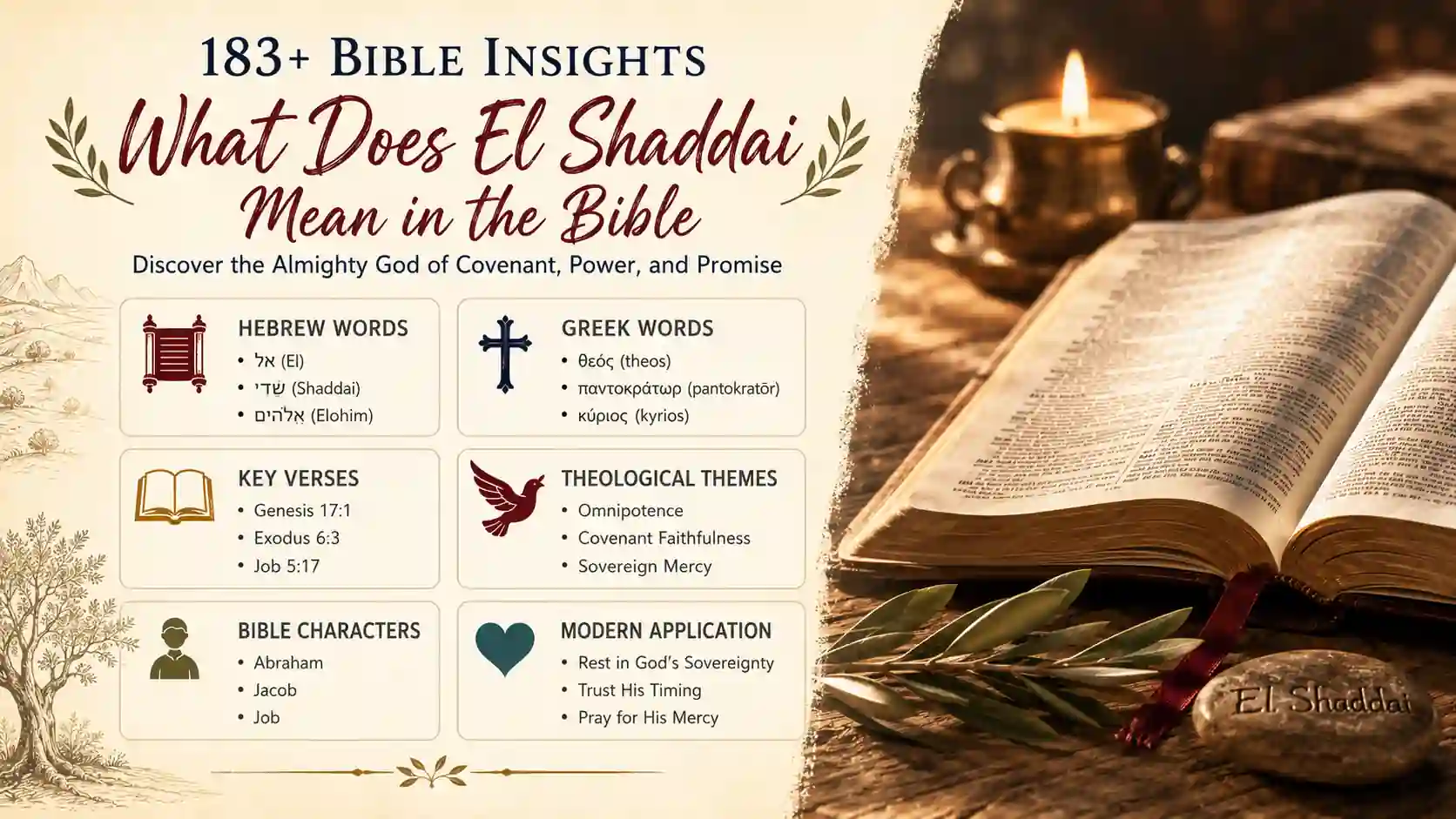
What does El Shaddai mean in the Bible? The Hebrew title אֵל שַׁדַּי, El Shaddai, is usually translated “God Almighty.” It presents the Lord as the all-sufficient, sovereign God whose power accomplishes his covenant promises, even when human circumstances make fulfillment appear impossible.
You first meet this title when God confirms his covenant with ninety-nine-year-old Abram. From Genesis through Job, El Shaddai is associated with fruitfulness, protection, judgment, suffering, blessing, and faithful provision. Studying the name helps you trust not an abstract force, but the God who binds his unlimited power to his gracious word.
El Shaddai Key Scripture References
| Verse | Passage Snippet | Context |
|---|---|---|
| Genesis 17:1 | “I am the Almighty God” | God renews his covenant with Abram |
| Genesis 28:3 | “God Almighty bless thee” | Isaac blesses Jacob before his journey |
| Genesis 35:11 | “I am God Almighty” | God confirms Jacob’s new name and calling |
| Genesis 43:14 | “God Almighty give you mercy” | Jacob entrusts his sons to God |
| Genesis 48:3 | “God Almighty appeared unto me” | Jacob recalls God’s appearance at Luz |
| Genesis 49:25 | “the Almighty, who shall bless thee” | Jacob blesses Joseph before dying |
| Exodus 6:3 | “by the name of God Almighty” | God speaks to Moses about the patriarchs |
| Ruth 1:20 | “the Almighty hath dealt” | Naomi interprets her bitter suffering |
| Job 5:17 | “the chastening of the Almighty” | Eliphaz discusses divine discipline |
| Psalm 91:1 | “shadow of the Almighty” | Worshiper rests beneath God’s protection |
El Shaddai Bible Translation Comparison
| Verse | KJV | NIV | ESV | NASB |
|---|---|---|---|---|
| Genesis 17:1 | Almighty God | God Almighty | God Almighty | God Almighty |
| Genesis 28:3 | God Almighty | God Almighty | God Almighty | God Almighty |
| Genesis 35:11 | God Almighty | God Almighty | God Almighty | God Almighty |
| Genesis 43:14 | God Almighty | God Almighty | God Almighty | God Almighty |
| Genesis 48:3 | God Almighty | God Almighty | God Almighty | God Almighty |
| Genesis 49:25 | the Almighty | the Almighty | the Almighty | the Almighty |
| Exodus 6:3 | God Almighty | God Almighty | God Almighty | God Almighty |
| Ruth 1:20 | the Almighty | the Almighty | the Almighty | the Almighty |
| Job 6:4 | the Almighty | the Almighty | the Almighty | the Almighty |
| Psalm 91:1 | the Almighty | the Almighty | the Almighty | the Almighty |
El Shaddai People and Characters Associated
| Person | Role | Connection |
|---|---|---|
| Abraham | Covenant patriarch | God reveals himself as El Shaddai |
| Sarah | Mother of the promised son | Experiences God’s power over barrenness |
| Isaac | Son of promise | Invokes God Almighty when blessing Jacob |
| Jacob | Patriarch renamed Israel | Receives promises from El Shaddai |
| Joseph | Son of Jacob | Receives blessings attributed to Shaddai |
| Benjamin | Jacob’s youngest son | Entrusted to God Almighty’s mercy |
| Moses | Deliverer of Israel | Learns how God appeared to the patriarchs |
| Naomi | Widowed Israelite | Laments what Shaddai allowed |
| Job | Suffering servant | Frequently speaks of Shaddai’s rule |
| Eliphaz | Friend of Job | Associates Shaddai with discipline |
El Shaddai Original Hebrew and Greek Words
| Original Word | Transliteration | Strong’s # | Literal Meaning |
|---|---|---|---|
| אֵל | El | H410 | God, mighty one |
| שַׁדַּי | Shaddai | H7706 | Almighty |
| אֵל שַׁדַּי | El Shaddai | H410, H7706 | God Almighty |
| אֱלֹהִים | Elohim | H430 | God, divine ruler |
| יהוה | YHWH | H3068 | The Lord’s covenant name |
| שָׁדַד | shadad | H7703 | Destroy, overpower |
| θεός | theos | G2316 | God |
| παντοκράτωρ | pantokratōr | G3841 | Ruler over all |
| παντοδύναμος | pantodynamos | No Strong’s entry | All-powerful |
| κύριος | kyrios | G2962 | Lord, master |
The origin of שַׁדַּי, Shaddai, remains debated. Strong’s traditional arrangement associates it with שָׁדַד, shadad, meaning to overpower or destroy, while other proposals connect it with ancient geographical or fertility language. Scripture itself emphasizes what the title communicates in context rather than providing a formal etymology.
El Shaddai Related Biblical Concepts
| Concept | Connection | Supporting Verse |
|---|---|---|
| Covenant | God guarantees his sworn promises | Genesis 17:1-7 |
| Fruitfulness | God gives descendants and nations | Genesis 35:11 |
| Blessing | Shaddai grants life and abundance | Genesis 49:25 |
| Mercy | Jacob seeks protection for his sons | Genesis 43:14 |
| Sovereignty | Nothing prevents God’s purpose | Job 42:2 |
| Discipline | The Almighty corrects his people | Job 5:17 |
| Refuge | Believers rest beneath his shadow | Psalm 91:1 |
| Judgment | Almighty power opposes rebellion | Isaiah 13:6 |
| Sufficiency | God supplies what his promise requires | Genesis 17:15-21 |
| Faith | God’s character supports patient trust | Romans 4:20-21 |
El Shaddai Historical and Cultural Context
| Aspect | Detail | Biblical Source |
|---|---|---|
| Patriarchal period | Title appears prominently in ancestral narratives | Genesis 17:1 |
| Nomadic life | Families depended on divine protection | Genesis 43:14 |
| Barrenness | Childlessness threatened lineage and inheritance | Genesis 17:15-19 |
| Covenant signs | Circumcision marked Abraham’s household | Genesis 17:9-14 |
| Family blessing | Fathers pronounced covenant hopes over children | Genesis 28:1-4 |
| Land promise | God pledged Canaan to Abraham’s descendants | Genesis 48:4 |
| Tribal identity | Jacob’s sons became Israel’s tribes | Genesis 49 |
| Exodus revelation | God links patriarchal revelation with Moses | Exodus 6:2-8 |
| Wisdom literature | Shaddai appears often in debates about suffering | Job 6:4 |
| Harvest society | Fruitfulness signified life and divine favor | Genesis 49:25 |
El Shaddai Theological Themes
| Theme | Explanation | Scripture |
|---|---|---|
| Omnipotence | God possesses unrestricted power | Genesis 17:1 |
| Covenant faithfulness | God completes what he promises | Genesis 17:7 |
| Life from weakness | God creates hope beyond human ability | Genesis 18:11-14 |
| Sovereign mercy | God governs danger and deliverance | Genesis 43:14 |
| Providential care | His rule includes ordinary needs | Genesis 28:3 |
| Holy judgment | His power confronts sin and pride | Isaiah 13:6 |
| Mysterious suffering | His rule may exceed human explanation | Job 23:16 |
| Fatherly discipline | Correction can serve a gracious purpose | Job 5:17 |
| Protective presence | The faithful dwell beneath his shadow | Psalm 91:1 |
| Universal kingship | God rules all creation | Revelation 19:6 |
El Shaddai Modern Application for Believers
| Area | Practice | Scripture |
|---|---|---|
| Anxiety | Rest in God’s sovereign care | Psalm 91:1-2 |
| Waiting | Trust his timing and promise | Genesis 17:15-21 |
| Family | Pray for mercy and protection | Genesis 43:14 |
| Weakness | Depend on power beyond yourself | Romans 4:19-21 |
| Calling | Walk faithfully before God | Genesis 17:1 |
| Suffering | Lament honestly without abandoning faith | Ruth 1:20-21 |
| Correction | Receive godly discipline humbly | Job 5:17 |
| Provision | Recognize God as the source of blessing | Genesis 49:25 |
| Uncertainty | Remember God’s proven faithfulness | Genesis 48:3-4 |
| Worship | Praise the Lord who reigns over all | Revelation 19:6 |
What Does El Shaddai Mean in the Bible’S Covenant with Abraham?
Genesis 17 supplies the clearest interpretive setting for El Shaddai. Abram is ninety-nine years old, Sarai has not borne the promised son, and human possibility has nearly disappeared. At that moment God declares, “I am אֵל שַׁדַּי, El Shaddai,” and commands Abram to walk faithfully before him.
The title therefore does more than describe raw strength. God’s might serves his covenant purpose. He can produce nations from an elderly, childless couple, preserve their descendants, and grant the promised inheritance. Your faith rests on the character of the One who promises, not on the apparent adequacy of your circumstances.
Shaddai in Genesis Joins Power with Fruitfulness
The Genesis passages repeatedly connect Shaddai with offspring, multiplication, and blessing. Isaac invokes God Almighty when sending Jacob away, asking that God make him fruitful. Later, God identifies himself to Jacob as El Shaddai and commands him to be fruitful and multiply.
This pattern has led some readers to define Shaddai primarily through fertility or nourishment. Such theories remain uncertain, and the title should not be reduced to a single bodily image. In Genesis, the central truth is that God sovereignly gives life, preserves the covenant family, and brings promised generations into being.
Shaddai in Job Reveals the Mystery of Almighty Rule
שַׁדַּי, Shaddai, appears far more frequently in Job than the full expression El Shaddai appears in Genesis. Job and his friends use the title while discussing suffering, justice, correction, and divine authority. The Almighty is not presented as distant from pain. He remains sovereign within a world that Job cannot explain.
Job’s speeches also warn you against using divine omnipotence as a simple answer to another person’s grief. Job knows that Shaddai rules, yet he struggles to understand God’s ways. By the book’s end, he learns that trusting the Almighty does not require possessing a complete explanation of providence.
From El Shaddai to the Greek PantokratōR
The Greek word παντοκράτωρ, pantokratōr, combines the ideas of “all” and “ruling.” It describes one who exercises dominion over everything and is commonly rendered “Almighty.” The New Testament uses it especially in Revelation, where God’s universal kingship stands behind creation, judgment, redemption, and final victory.
This Greek title does not merely reproduce every occurrence of Hebrew Shaddai in a mechanically identical way. It does, however, continue the biblical confession that the God of Abraham reigns without rival. Revelation 19:6 celebrates the Lord God Almighty reigning, bringing covenant power to its final and public fulfillment.
Questions Bible Students Ask About El Shaddai
Does El Shaddai literally mean “the many-breasted God”?
No. That popular explanation depends on a disputed etymology and should not replace the biblical emphasis on God’s almighty covenant power.
Why does Exodus 6:3 contrast El Shaddai with YHWH?
The verse emphasizes a fuller historical revelation of God’s covenant name and saving action, not the existence of two different gods.
Is Shaddai connected to the Hebrew verb שָׁדַד, shadad?
Strong’s links the words, but scholars debate the etymology, so the title’s biblical contexts provide a safer guide to its meaning.
Why does Naomi call God Shaddai when she is suffering?
In Ruth 1:20-21, Naomi confesses that even her bitter losses remain under the Almighty’s rule, though the story later reveals merciful providence.
How should knowing El Shaddai affect your prayers?
You can pray honestly about impossible circumstances while trusting that God has sufficient power, wisdom, and faithfulness to accomplish his will.