
What does kingdom of God mean in the Bible? It means God’s sovereign reign breaking into human history, revealing His authority, defeating evil, saving sinners, and restoring creation through Jesus Christ. The phrase describes more than a geographical territory. It points chiefly to the active rule of the King.
As you study Scripture, you discover a kingdom promised in the Old Testament, announced by Jesus, experienced through the Holy Spirit, and awaiting its complete revelation. This kingdom is already present among Christ’s people, yet its fullness remains future.
Kingdom Key Scripture References
| Verse | Passage Snippet | Context |
|---|---|---|
| Psalm 103:19 | His kingdom rules over all | God’s universal sovereignty |
| Daniel 2:44 | God will set up a kingdom | An indestructible future kingdom |
| Daniel 7:13-14 | Everlasting dominion | The Son of Man receives authority |
| Matthew 4:17 | Kingdom of heaven is at hand | Jesus begins public preaching |
| Mark 1:14-15 | Kingdom of God is at hand | Jesus calls for repentance and faith |
| Luke 4:43 | Preach the kingdom of God | Jesus states His mission |
| Luke 17:20-21 | Kingdom of God is among you | The King stands among His hearers |
| John 3:3 | See the kingdom of God | New birth is necessary |
| Romans 14:17 | Righteousness, peace, and joy | Kingdom life through the Spirit |
| Revelation 11:15 | Kingdom of our Lord | Final worldwide reign of Christ |
These passages present God’s kingdom as universal rule, saving intervention, ethical transformation, and future victory. Daniel’s visions especially prepare the way for Jesus’ announcement that God’s promised reign had drawn near in His own ministry.
Kingdom Bible Translation Comparison
| Verse | KJV | NIV | ESV | NASB |
|---|---|---|---|---|
| Matthew 4:17 | is at hand | has come near | is at hand | is at hand |
| Matthew 6:33 | seek ye first | seek first | seek first | seek first |
| Mark 1:15 | time is fulfilled | time has come | time is fulfilled | time is fulfilled |
| Luke 17:21 | within you | in your midst | in the midst of you | in your midst |
| John 3:3 | born again | born again | born again | born again |
| Romans 14:17 | meat and drink | eating and drinking | eating and drinking | eating and drinking |
| 1 Corinthians 4:20 | not in word | not a matter of talk | not consist in talk | not in words |
| Colossians 1:13 | kingdom of his dear Son | kingdom of the Son | kingdom of his beloved Son | kingdom of His beloved Son |
Luke 17:21 shows why translation matters. The Greek expression ἐντὸς ὑμῶν can be rendered “within you” or “in your midst.” Because Jesus was addressing Pharisees and standing among them as the royal Messiah, many interpreters understand the saying as a declaration that the kingdom was present in their midst through the King.
Kingdom People and Characters Associated
| Person | Role | Connection |
|---|---|---|
| God the Father | Supreme King | Gives the kingdom to the Son |
| Jesus Christ | Messiah and King | Announces and embodies God’s reign |
| Daniel | Prophet in exile | Sees the everlasting kingdom |
| David | Covenant king | Receives the promise of a lasting throne |
| John the Baptist | Royal herald | Announces the kingdom’s nearness |
| Peter | Apostle and witness | Receives keys of the kingdom |
| Nicodemus | Jewish teacher | Learns the necessity of new birth |
| The Twelve | Kingdom messengers | Preach and demonstrate God’s rule |
| Paul | Apostle to the nations | Teaches kingdom life and inheritance |
| John | Exiled prophet | Sees Christ’s final reign |
David’s covenant provides the royal framework for the Messiah’s kingship, while Daniel reveals that God’s kingdom will outlast every human empire. John the Baptist serves as the herald, and Jesus arrives as David’s promised Son and Daniel’s Son of Man.
Kingdom Original Hebrew and Greek Words
| Original Word | Transliteration | Strong’s # | Literal Meaning |
|---|---|---|---|
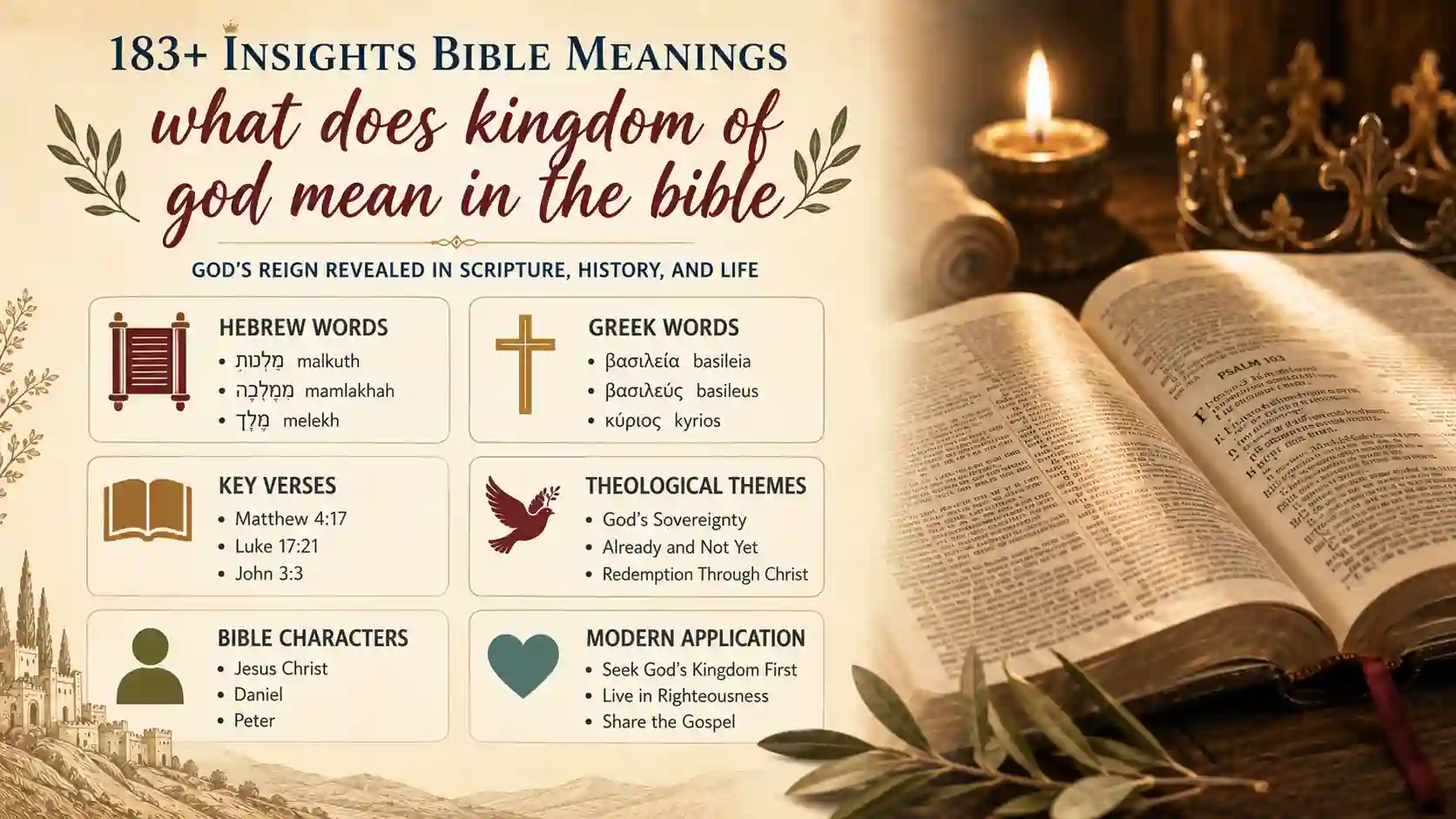
| מַלְכוּת | malkuth | H4438 | Royal power, reign, kingdom |
| מַמְלָכָה | mamlakhah | H4467 | Kingdom, dominion, royal realm |
| מֶלֶךְ | melekh | H4428 | King, royal ruler |
| מָלַךְ | malakh | H4427 | To reign or become king |
| מַלְכוּ | malku | H4437 | Kingdom or sovereignty in Aramaic |
| βασιλεία | basileia | G932 | Kingship, reign, kingdom |
| βασιλεύς | basileus | G935 | King or sovereign |
| βασιλεύω | basileuō | G936 | To reign or rule |
| κύριος | kyrios | G2962 | Lord, master, sovereign |
| Χριστός | Christos | G5547 | Anointed One, Messiah |
The Hebrew noun מַלְכוּת, malkuth, can describe royal authority, the exercise of sovereignty, a realm, or the duration of a reign. The related Aramaic מַלְכוּ, malku, appears prominently in Daniel’s visions of earthly kingdoms and God’s everlasting dominion.
The Greek βασιλεία, basileia, likewise carries the ideas of kingship, sovereignty, royal power, and the realm governed by a king. Its emphasis is often dynamic. God’s kingdom is not merely a place people enter but God’s authority actively exercised through His Messiah.
Kingdom Related Biblical Concepts
| Concept | Connection | Supporting Verse |
|---|---|---|
| Sovereignty | God rules over all creation | Psalm 103:19 |
| Covenant | God promises David an enduring throne | 2 Samuel 7:12-16 |
| Messiah | The anointed King establishes justice | Isaiah 9:6-7 |
| Son of Man | Receives everlasting dominion | Daniel 7:13-14 |
| Repentance | Proper response to the kingdom | Mark 1:15 |
| New birth | Required for kingdom entrance | John 3:3-5 |
| Discipleship | Citizens obey the King | Matthew 7:21 |
| Holy Spirit | Produces kingdom life | Romans 14:17 |
| Resurrection | Christ defeats death | 1 Corinthians 15:20-28 |
| New creation | Kingdom reaches visible fullness | Revelation 21:1-5 |
The kingdom unites themes that run across the whole biblical story. Creation establishes God as sovereign. Covenant identifies a royal people. Prophecy promises a righteous ruler. The Gospels reveal that ruler in Jesus, and Revelation displays His final victory.
Kingdom Historical and Cultural Context
| Aspect | Detail | Biblical Source |
|---|---|---|
| Ancient kingship | Kings governed lands and peoples | 1 Samuel 8:4-7 |
| Davidic dynasty | God promised David a lasting throne | 2 Samuel 7:16 |
| Divided monarchy | Unfaithfulness fractured Israel | 1 Kings 12:16-20 |
| Assyrian conquest | Northern kingdom fell under judgment | 2 Kings 17:6-18 |
| Babylonian exile | Jerusalem and the temple were lost | 2 Kings 25:8-11 |
| Imperial rule | Daniel lived under foreign kingdoms | Daniel 2:36-45 |
| Roman occupation | Judea lived under Caesar’s authority | Luke 2:1 |
| Messianic expectation | Jews awaited divine deliverance | Luke 2:25-32 |
| Royal entry | Jesus entered Jerusalem as King | Matthew 21:4-9 |
| Early church | Believers proclaimed Jesus as Lord | Acts 17:6-7 |
Jesus announced the kingdom during Roman occupation, when royal language carried political weight. Yet Second Temple Jewish hopes were diverse rather than uniform. Some expected national deliverance, while others emphasized priestly renewal, divine judgment, resurrection, or a coming messianic ruler.
Jesus fulfilled Israel’s hope while correcting distorted expectations. He did not begin by overthrowing Rome. He confronted sin, Satan, sickness, death, and unbelief. His kingdom came through humble service, sacrificial death, victorious resurrection, and the proclamation of forgiveness.
Kingdom Theological Themes
| Theme | Explanation | Scripture |
|---|---|---|
| God’s sovereignty | The kingdom belongs ultimately to God | 1 Chronicles 29:11 |
| Christ’s kingship | Jesus reigns as the promised Messiah | Luke 1:32-33 |
| Already present | God’s reign arrived in Jesus | Matthew 12:28 |
| Not yet complete | Its fullness remains future | Matthew 25:31-34 |
| Redemption | The King delivers people from darkness | Colossians 1:13-14 |
| Judgment | Evil will not remain forever | Matthew 13:40-43 |
| Grace | The kingdom is received as a gift | Luke 12:32 |
| Transformation | Kingdom citizens pursue righteousness | Matthew 5:3-10 |
| Mission | The gospel goes to all nations | Matthew 24:14 |
| Restoration | Creation will share Christ’s victory | Revelation 21:1-5 |
The kingdom is both present and future. Jesus can say that the kingdom has come because the King is present, demons are expelled, sins are forgiven, and the Spirit is at work. Yet believers still pray, “Your kingdom come,” because rebellion, suffering, and death have not disappeared.
This tension is sometimes called the “already and not yet.” You already belong to Christ’s kingdom, but you still await the day when every rival power is defeated and God’s will is done openly throughout creation.
Kingdom Modern Application for Believers
| Area | Practice | Scripture |
|---|---|---|
| Worship | Honor God as your highest King | Revelation 4:11 |
| Priorities | Seek the kingdom before possessions | Matthew 6:33 |
| Prayer | Ask for God’s will to be done | Matthew 6:10 |
| Character | Practice mercy, purity, and humility | Matthew 5:3-10 |
| Repentance | Turn from sin and trust Christ | Mark 1:15 |
| Justice | Defend truth and care for the vulnerable | Micah 6:8 |
| Community | Pursue peace and spiritual unity | Romans 14:17-19 |
| Witness | Proclaim the gospel of the kingdom | Acts 28:30-31 |
| Stewardship | Use resources under Christ’s authority | Luke 19:12-27 |
| Hope | Await the King’s appearing | 2 Timothy 4:8 |
Kingdom living means bringing every part of life under Christ’s authority. You do not build God’s kingdom by human strength as though God lacked power. You receive His kingdom, bear witness to it, embody its values, and faithfully serve its King.
Your obedience does not make Jesus King. He is already Lord. Obedience shows that you recognize His authority and trust His wisdom. Seeking the kingdom first reshapes your ambitions, relationships, finances, speech, work, worship, and treatment of vulnerable people.
What Does Kingdom of God Mean in the Bible and Jesus’ Preaching?
The kingdom of God means God’s saving and sovereign reign, especially as revealed through Jesus. Mark summarizes Christ’s message with four connected truths. The appointed time is fulfilled, the kingdom has drawn near, people must repent, and they must believe the gospel.
Jesus did not merely teach information about the kingdom. His healings, exorcisms, forgiveness, table fellowship, and authority over nature demonstrated its arrival. When He drove out demons by God’s Spirit, He declared that the kingdom had come upon His hearers.
From מַלְכוּת to βασιλεία in the Biblical Story
The Old Testament describes God as King even before Israel receives a human monarchy. He reigns over creation, nations, history, and Israel. Human kings were accountable to His covenant and could never replace His supreme authority.
Daniel intensifies this hope during exile. Violent empires rise and fall, but God grants everlasting dominion to “one like a son of man.” Jesus repeatedly applies that title to Himself, linking His suffering, authority, resurrection, and future glory to Daniel’s vision.
The Cross as the Throne of the Servant King
Jesus’ kingdom overturns ordinary assumptions about power. His crown is first made of thorns, and His royal title is displayed at His crucifixion. He conquers not by sinful violence but by bearing sin, remaining faithful, and rising from death.
The cross does not contradict Christ’s kingship. It reveals the character of His reign. The King serves, gives His life as a ransom, forgives His enemies, and creates a redeemed people whose greatness is measured through humility and service.
The Present Reign and the Coming Kingdom
Christ reigns now at the Father’s right hand, and believers have already been transferred into His kingdom. Through the Spirit, you experience righteousness, peace, joy, freedom from sin’s mastery, and fellowship with God’s people.
Still, the kingdom’s public completion awaits Christ’s return. The dead will be raised, evil will be judged, creation will be renewed, and every opposing authority will be subdued. Christian hope is therefore neither escapism nor political triumphalism. It is confidence in the returning King.
Kingdom of God Frequently Asked Questions
Does βασιλεία, basileia, mean a place or God’s rule?
It can describe a realm, but in Jesus’ preaching it often emphasizes God’s active royal rule.
Does Luke 17:21 say the kingdom is within every person?
The context likely means the kingdom was “in your midst” because Jesus the King stood among His hearers.
Why does Matthew often say kingdom of heaven instead of kingdom of God?
Matthew’s wording reflects a reverent Jewish manner of speaking about God, not a separate kingdom.
How can the kingdom be present if Christians still await it?
It is present through Christ and the Spirit, but its complete visible victory awaits Christ’s return.
How do you enter the kingdom of God?
You enter by God’s grace through repentance, faith in Jesus Christ, and the new birth produced by the Holy Spirit.