
What does ye mean in the Bible? In the King James Version, ye usually means “you,” especially when two or more people are being addressed. Unlike modern English, the older English of the KJV distinguishes between singular and plural second-person pronouns.
Recognizing this distinction can sharpen your Bible study. “Thou” usually addresses one person, while “ye” addresses a group. This grammatical detail often reveals that a command, promise, warning, or blessing belongs to an entire community rather than merely to one individual.
Key Scripture References for Ye
| Verse | Passage Snippet | Context |
|---|---|---|
| Genesis 9:7 | “And you, be ye fruitful” | Noah’s family receives a shared command |
| Exodus 19:6 | “Ye shall be unto me” | Israel is called a priestly kingdom |
| Joshua 1:11 | “Prepare you victuals” | Joshua addresses Israel’s officers |
| Psalm 100:3 | “Know ye that the LORD” | Worshipers confess their Creator |
| Isaiah 1:18 | “Come now, and let us reason” | Judah receives a call to repentance |
| Matthew 5:14 | “Ye are the light” | Jesus addresses His disciples collectively |
| Matthew 6:9 | “After this manner therefore pray ye” | The disciples receive a pattern for prayer |
| John 3:7 | “Ye must be born again” | Jesus expands His words beyond Nicodemus |
| 1 Corinthians 3:16 | “Ye are the temple of God” | The Corinthian church is God’s dwelling |
| Galatians 3:26 | “Ye are all the children of God” | Believers share one status through faith |
Bible Translation Comparison for Ye
| Verse | KJV | NIV | ESV | NASB |
|---|---|---|---|---|
| Exodus 19:6 | “Ye shall be” | “You will be” | “You shall be” | “You shall be” |
| Psalm 100:3 | “Know ye” | “Know that” | “Know that” | “Know that” |
| Matthew 5:14 | “Ye are the light” | “You are the light” | “You are the light” | “You are the light” |
| Matthew 6:9 | “Pray ye” | “You should pray” | “Pray then like this” | “Pray, then, in this way” |
| Matthew 7:7 | “Ask, and it shall be given you” | “Ask and it will be given” | “Ask, and it will be given” | “Ask, and it will be given” |
| John 3:7 | “Ye must be born again” | “You must be born again” | “You must be born again” | “You must be born again” |
| John 15:5 | “Ye are the branches” | “You are the branches” | “You are the branches” | “You are the branches” |
| 1 Corinthians 3:16 | “Ye are the temple” | “You yourselves are God’s temple” | “You are God’s temple” | “You are a temple of God” |
| Galatians 3:26 | “Ye are all” | “You are all” | “You are all” | “You are all” |
| 1 Peter 2:9 | “Ye are a chosen generation” | “You are a chosen people” | “You are a chosen race” | “You are a chosen people” |
People and Characters Associated with Ye
| Person | Role | Connection |
|---|---|---|
| Noah | Covenant recipient | God addresses his household collectively |
| Moses | Covenant mediator | He speaks to Israel as one people |
| Joshua | Israel’s leader | He commands tribes and officers together |
| David | Psalmist and king | His psalms summon communities to worship |
| Isaiah | Prophet to Judah | He addresses a rebellious covenant nation |
| Jesus | Messiah and teacher | He calls disciples to shared obedience |
| Nicodemus | Jewish teacher | Jesus uses plural language in John 3:7 |
| The Twelve | Apostolic witnesses | Many Gospel commands address them together |
| Paul | Apostle to the Gentiles | He calls churches God’s corporate temple |
| Peter | Apostle and elder | He describes believers as a chosen people |
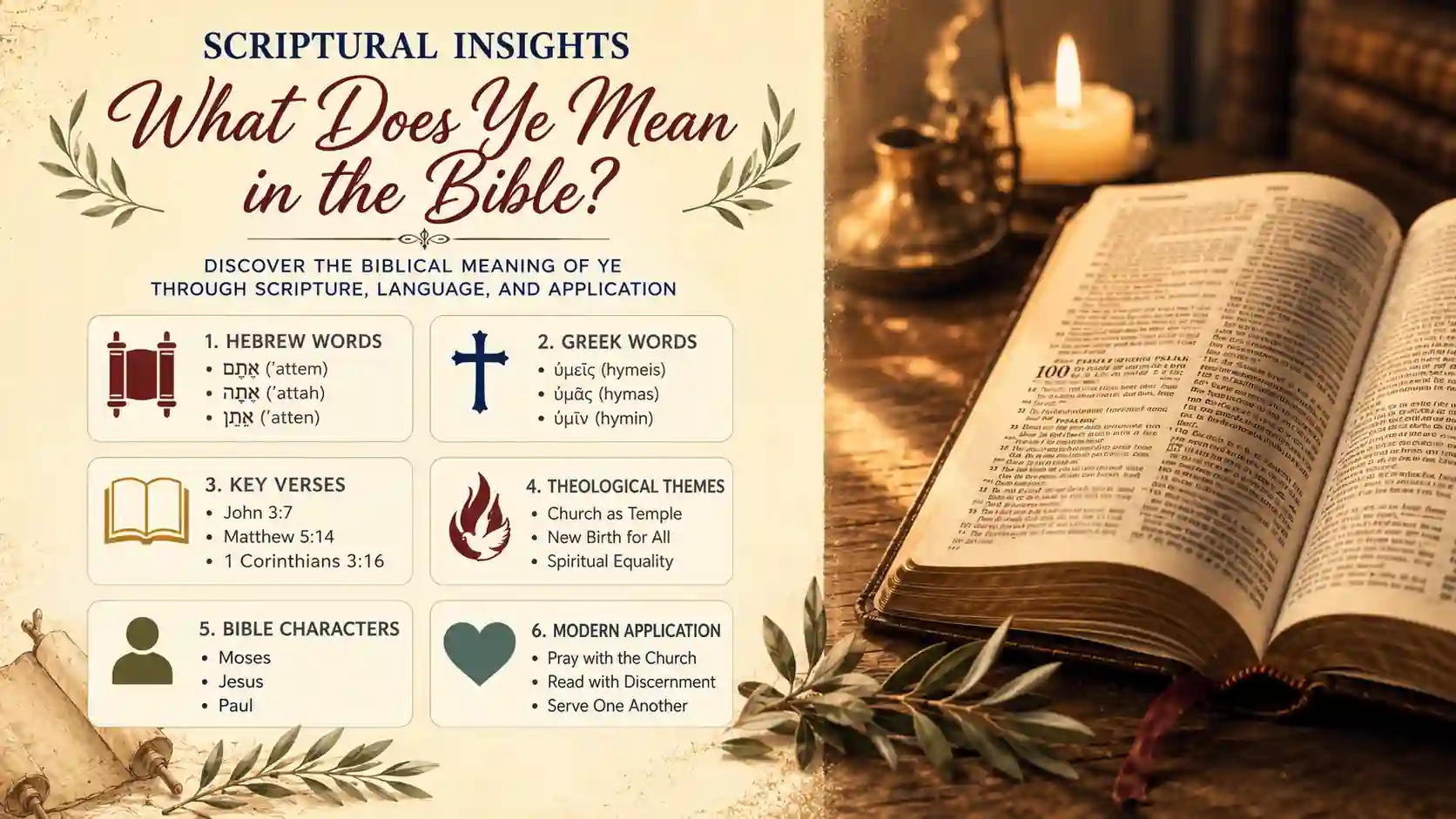
Original Hebrew and Greek Words Behind Ye
| Original Word | Transliteration | Strong’s # | Literal Meaning |
|---|---|---|---|
| אַתָּה | ʾattah | H859 | You, masculine singular |
| אַתְּ | ʾat | H859 | You, feminine singular |
| אַתֶּם | ʾattem | H859 | You, masculine plural |
| אַתֵּן | ʾatten | H859 | You, feminine plural |
| אַנְתּוּן | ʾantun | H608 | You, plural in Biblical Aramaic |
| ὑμεῖς | hymeis | G5210 | You, plural subject |
| ὑμᾶς | hymas | G5209 | You, plural object |
| ὑμῖν | hymin | G5213 | To or for you, plural |
| ὑμῶν | hymōn | G5216 | Of you or your, plural |
| σύ | sy | G4771 | You, singular subject |
Related Biblical Concepts Connected with Ye
| Concept | Connection | Supporting Verse |
|---|---|---|
| Covenant community | God addresses a people, not isolated persons | Exodus 19:5-6 |
| Corporate identity | Believers belong to one spiritual body | 1 Corinthians 12:27 |
| Shared witness | Disciples shine together before the world | Matthew 5:14-16 |
| Congregational holiness | Sin affects the gathered church | 1 Corinthians 5:6-7 |
| United prayer | Jesus teaches disciples to pray “our” | Matthew 6:9 |
| Mutual service | Christ’s followers serve one another | John 13:14 |
| Common inheritance | Believers share adoption in Christ | Galatians 3:26-29 |
| Collective responsibility | Churches must hear the Spirit’s message | Revelation 2:7 |
| Public worship | Whole assemblies praise the Lord | Psalm 100:1-3 |
| Mission | Christ sends disciples to all nations | Matthew 28:19 |
Historical and Cultural Context of Ye
| Aspect | Detail | Biblical Source |
|---|---|---|
| Early Modern English | “Ye” served as a plural subject pronoun | Matthew 5:14 KJV |
| Singular distinction | “Thou” commonly addressed one person | John 3:10 KJV |
| Plural distinction | “Ye” commonly addressed several people | John 3:7 KJV |
| Objective form | “You” often functioned as the object | Matthew 5:11 KJV |
| Hebrew grammar | Pronouns distinguish number and gender | Genesis 9:7 |
| Greek grammar | Pronouns distinguish singular and plural | John 15:5 |
| Covenant speech | Leaders addressed Israel collectively | Deuteronomy 6:1 |
| Rabbinic setting | Jesus spoke within Jewish communal life | Matthew 23:8 |
| House churches | Epistles were read to gathered believers | Colossians 4:16 |
| Oral reading | Congregations heard letters as one body | 1 Thessalonians 5:27 |
Theological Themes Revealed by Ye
| Theme | Explanation | Scripture |
|---|---|---|
| New birth | Regeneration is necessary for all | John 3:7 |
| Union with Christ | Disciples depend together upon the Vine | John 15:5 |
| Church as temple | God dwells among His gathered people | 1 Corinthians 3:16 |
| Covenant calling | God forms a holy people for Himself | Exodus 19:6 |
| Christian identity | Believers are a chosen priesthood | 1 Peter 2:9 |
| Shared holiness | The church pursues purity together | 1 Corinthians 5:7 |
| Public witness | Disciples display God’s goodness corporately | Matthew 5:14 |
| Spiritual equality | All are one in Christ Jesus | Galatians 3:28 |
| Apostolic mission | Christ commissions a community of witnesses | Acts 1:8 |
| Final accountability | Churches must hear and repent | Revelation 2:7 |
Modern Application of Ye for Believers
| Area | Practice | Scripture |
|---|---|---|
| Bible reading | Mark plural uses of “you” | John 3:7 |
| Prayer | Pray with the whole church in view | Matthew 6:9 |
| Fellowship | Refuse an isolated view of discipleship | Hebrews 10:24-25 |
| Worship | Praise God as part of His people | Psalm 100:1-3 |
| Holiness | Consider how choices affect the church | 1 Corinthians 5:6 |
| Service | Wash one another’s feet in humility | John 13:14 |
| Witness | Display Christ through communal love | John 13:35 |
| Identity | Remember that you belong to one body | 1 Corinthians 12:27 |
| Discernment | Read epistles as letters to congregations | Colossians 4:16 |
| Mission | Participate in the church’s commission | Matthew 28:19-20 |
What Does Ye Mean in the Bible and Why Does Number Matter?
In standard KJV usage, “ye” is usually the subject form of the second-person plural pronoun. It functions much like “you all” or “all of you,” although its meaning should always be confirmed by examining the Hebrew or Greek text beneath the English translation.
This distinction matters because modern English uses “you” for both one person and many people. The KJV often preserves information about number that modern readers may overlook, allowing you to see whether Scripture addresses an individual, a particular group, or an entire congregation.
John 3:7 provides a striking example. Jesus has been speaking directly to Nicodemus, yet “Marvel not that I said unto thee, Ye must be born again” moves from singular “thee” to plural “ye,” showing that the necessity of new birth extends beyond that one Pharisee.
Ὑμεῖς Hymeis and the Corporate Language of Jesus
The Greek pronoun ὑμεῖς, transliterated hymeis and numbered G5210, is the plural subject form of “you.” It stands behind many important KJV occurrences of “ye,” including Jesus’ declarations, “Ye are the salt of the earth” and “Ye are the light of the world.”
Those sayings address disciples as a community. Each believer bears personal responsibility, yet Christ’s imagery also portrays a visible people whose shared character, mercy, holiness, and faithfulness testify to the reign of God.
The same corporate emphasis appears when Jesus says, “Ye are the branches” in John 15:5. Each branch must abide in Christ, but no branch constitutes the whole vine. Your spiritual life is personal, though it was never designed to be solitary.
Reading ὑμεῖς carefully therefore guards against excessive individualism. Jesus saves particular people, joins them to Himself, and gathers them into a covenant community that worships, serves, suffers, and bears fruit together.
אַתֶּם Attem in Israel’S Covenant Calling
The Hebrew form אַתֶּם, transliterated ʾattem, is the masculine plural form associated with Strong’s H859. It appears when a group is directly addressed, especially in covenant commands, prophetic appeals, historical narratives, and speeches to Israel.
At Sinai, God tells Israel that they will be His treasured possession, kingdom of priests, and holy nation. The calling belongs to the assembled covenant people. Individual faithfulness matters, but the nation is commissioned to represent God’s holiness together.
This background helps you understand later New Testament language. When Peter calls believers “a chosen generation” and “a royal priesthood,” he applies covenant-community imagery to those united to Christ.
The continuity does not erase the differences between Israel and the church. It does show a consistent biblical pattern in which God forms a people who belong to Him, live under His Word, and declare His praise before the nations.
“Ye Are the Temple” and the Church’S Shared Holiness
First Corinthians 3:16 is easily misunderstood when modern readers assume that every “you” is singular. Paul asks the Corinthian believers whether they know that they collectively are God’s temple and that God’s Spirit dwells among them.
Paul certainly teaches elsewhere that the individual believer’s body belongs to God. Yet the immediate image in 1 Corinthians 3 concerns the congregation as God’s sacred building, founded upon Jesus Christ and built through apostolic ministry.
This corporate meaning intensifies Paul’s warning against division and destructive teaching. Damaging the unity, truth, or holiness of Christ’s church is not a minor social offense. It is an assault upon the community God has claimed as His dwelling place.
When you encounter “ye” in an older Bible, pause and identify the audience. Ask whether the passage calls you to personal obedience, shared congregational faithfulness, or both. That simple habit can uncover dimensions of Scripture hidden by modern English usage.
Frequently Asked Questions About Ye
Does ye always mean more than one person?
Usually in the KJV, yes, because “ye” is normally a plural subject pronoun, though context and the original language should confirm each occurrence.
Why does John 3:7 say “thee” and then “ye”?
“Thee” addresses Nicodemus individually, while “ye” reflects the Greek plural ὑμᾶς and broadens the necessity of new birth to others.
Is ὑμεῖς hymeis the Greek word behind every occurrence of ye?
No, ὑμεῖς is the usual plural subject form, but the KJV may also render related forms such as ὑμᾶς, ὑμῖν, and ὑμῶν with older English pronouns.
Does אַתֶּם attem have exactly the same function as ye?
It often corresponds closely because אַתֶּם addresses a masculine or mixed group, though Hebrew grammar and English grammar are not identical.
Should you mentally replace ye with “you all” while reading?
“You all” is often a helpful paraphrase, provided you still examine the verse’s grammar, audience, covenant setting, and literary context.