
What does sexual immorality mean in the Bible? Scripture uses this expression for sexual conduct that violates God’s design for covenant faithfulness, bodily holiness, and love of neighbor. The phrase often translates the Greek word πορνεία, porneia, though related Hebrew and Greek terms identify adultery, prostitution, lustful behavior, and other prohibited unions.
Your study should begin with the Bible’s own categories rather than modern assumptions. Scripture presents sexuality as God’s gift, marriage as a one-flesh covenant, and the believer’s body as belonging to the Lord.
Key Sexual Immorality Scripture References
| Verse | Passage Snippet | Context |
|---|---|---|
| Genesis 2:24 | “one flesh” | Marriage established as a covenant union |
| Exodus 20:14 | “not commit adultery” | Seventh commandment protects marriage |
| Leviticus 18:6 | “not approach” close kin | Israel receives sexual boundaries |
| Proverbs 6:32 | Adultery destroys oneself | Wisdom warns against unfaithfulness |
| Matthew 5:28 | Adultery “in his heart” | Jesus addresses lustful intention |
| Matthew 15:19 | Immorality comes from the heart | Defilement begins inwardly |
| 1 Corinthians 6:18 | “Flee sexual immorality” | The body belongs to Christ |
| 1 Thessalonians 4:3 | “abstain” from immorality | Sanctification includes sexual holiness |
| Hebrews 13:4 | Keep the marriage bed undefiled | God honors marital fidelity |
The New Testament repeatedly connects sexual holiness with discipleship, sanctification, and the believer’s union with Christ.
Sexual Immorality Bible Translation Comparison
| Verse | KJV | NIV | ESV | NASB |
|---|---|---|---|---|
| Matthew 5:32 | fornication | sexual immorality | sexual immorality | sexual immorality |
| Matthew 15:19 | fornications | sexual immorality | sexual immorality | sexual immoralities |
| Acts 15:20 | fornication | sexual immorality | sexual immorality | sexual immorality |
| 1 Corinthians 5:1 | fornication | sexual immorality | sexual immorality | sexual immorality |
| 1 Corinthians 6:18 | fornication | sexual immorality | sexual immorality | sexual immorality |
| Galatians 5:19 | adultery, fornication | sexual immorality | sexual immorality | sexual immorality |
| Ephesians 5:3 | fornication | sexual immorality | sexual immorality | sexual immorality |
| 1 Thessalonians 4:3 | fornication | sexual immorality | sexual immorality | sexual immorality |
| Revelation 2:21 | fornication | sexual immorality | sexual immorality | sexual immorality |
“Fornication” in older English often translated πορνεία, porneia. Contemporary translations usually prefer “sexual immorality” because the Greek term can describe a wider category than intercourse between unmarried persons alone. Translation wording varies, but the underlying ethical concern remains sexual conduct outside God’s revealed boundaries.
People and Characters Associated with Sexual Immorality
| Person | Role | Connection |
|---|---|---|
| Joseph | Faithful servant | Fled Potiphar’s wife |
| Judah | Patriarch | Sinned with Tamar unknowingly |
| Tamar | Judah’s daughter-in-law | Exposed Judah’s injustice |
| David | Israel’s king | Committed adultery with Bathsheba |
| Bathsheba | Wife of Uriah | Drawn into David’s abuse of power |
| Hosea | Prophet | Marriage pictured covenant unfaithfulness |
| Gomer | Hosea’s wife | Symbolized Israel’s spiritual infidelity |
| Corinthian man | Church member | Took his father’s wife |
| Jesus | Messiah and teacher | Condemned lust and sexual sin |
| Paul | Apostle | Taught believers to flee porneia |
These accounts do not present every person’s circumstances as identical. Joseph illustrates active resistance, David demonstrates sin’s destructive reach, Hosea uses marital unfaithfulness prophetically, and the Corinthian case shows why churches must not celebrate conduct Scripture condemns. Paul describes that case as a form of porneia involving a man and his father’s wife.
Original Hebrew and Greek Sexual Immorality Words
| Original Word | Transliteration | Strong’s # | Literal Meaning |
|---|---|---|---|
| זָנָה | zanah | H2181 | Commit prostitution or unfaithfulness |
| זְנוּת | zenuth | H2184 | Prostitution or whoredom |
| נָאַף | na’aph | H5003 | Commit adultery |
| נִאֻף | ni’uph | H5004 | Adultery |
| תּוֹעֵבָה | to‘evah | H8441 | Detestable or prohibited thing |
| πορνεία | porneia | G4202 | Sexual immorality or prostitution |
| πορνεύω | porneuō | G4203 | Practice sexual immorality |
| πόρνος | pornos | G4205 | Sexually immoral person |
| μοιχεία | moicheia | G3430 | Adultery |
| ἀσέλγεια | aselgeia | G766 | Sensuality or shameless conduct |
The principal New Testament word is πορνεία, porneia, Strong’s G4202. Its word family includes the verb πορνεύω, porneuō, and the noun πόρνος, pornos. Adultery is expressed more specifically by μοιχεία, moicheia, Strong’s G3430, showing that Scripture can distinguish adultery from the broader category of sexual immorality.
Related Biblical Sexual Immorality Concepts
| Concept | Connection | Supporting Verse |
|---|---|---|
| Marriage | Proper covenant setting for sexual union | Genesis 2:24 |
| Adultery | Violates an existing marriage covenant | Exodus 20:14 |
| Lust | Cultivates adultery within the heart | Matthew 5:28 |
| Holiness | Governs the believer’s bodily life | 1 Thessalonians 4:3 |
| One flesh | Sexual union joins persons bodily | 1 Corinthians 6:16 |
| Self-control | Spirit-formed mastery of desire | Galatians 5:22-23 |
| Idolatry | Often paired with covenant infidelity | Hosea 4:12 |
| Purity | Calls for clean conduct and intention | Ephesians 5:3 |
| Repentance | Turns from sin toward obedience | Revelation 2:21 |
| Restoration | Christ cleanses former sinners | 1 Corinthians 6:11 |
Sexual immorality is therefore more than rule-breaking. It contradicts covenant faithfulness, misuses the body, and can treat another person as an object rather than an image-bearer. Yet Scripture also announces cleansing. After listing serious sins, Paul tells the Corinthians that some of them had lived that way but were washed, sanctified, and justified.
Historical and Cultural Context of Sexual Immorality
| Aspect | Detail | Biblical Source |
|---|---|---|
| Ancient marriage | Joined households and covenant obligations | Genesis 24 |
| Israel’s law | Distinguished permitted and forbidden unions | Leviticus 18 |
| Adultery | Threatened family and inheritance stability | Deuteronomy 22 |
| Prostitution | Appears literally and metaphorically | Genesis 38 |
| Pagan worship | Sometimes accompanied sexual corruption | Numbers 25 |
| Corinth | Known for permissive Greco-Roman customs | 1 Corinthians 6 |
| Roman households | Marked by unequal social power | Ephesians 5 |
| Gentile converts | Told to abstain from porneia | Acts 15:20 |
| Betrothal | Carried binding marital obligations | Matthew 1:18-20 |
| Covenant imagery | Idolatry portrayed as marital betrayal | Hosea 1-3 |
The Bible arose within cultures where men commonly possessed greater legal and social power than women, slaves, or foreigners. Scripture’s sexual commands must not be used to excuse exploitation. Prophets confronted powerful men, wisdom literature warned against predatory desire, and Jesus placed responsibility on the person who looks with lust.
The Jerusalem council’s instruction that Gentile believers abstain from porneia shows that sexual holiness was not treated as an ethnic custom limited to Israel. It formed part of Christian obedience for converts entering communities shaped by the lordship of Jesus.
Theological Themes of Sexual Immorality
| Theme | Explanation | Scripture |
|---|---|---|
| Creation | God designed embodied male-female union | Genesis 1:27 |
| Covenant | Marriage calls for exclusive faithfulness | Malachi 2:14 |
| Holiness | God’s people reflect his character | Leviticus 20:7 |
| The heart | Sinful actions arise from inward desire | Mark 7:21 |
| Union with Christ | Believers’ bodies belong to the Lord | 1 Corinthians 6:15 |
| Spirit indwelling | The body is the Spirit’s temple | 1 Corinthians 6:19 |
| Judgment | God judges persistent sexual sin | Hebrews 13:4 |
| Grace | Christ washes and sanctifies sinners | 1 Corinthians 6:11 |
| Discipline | Churches address open, unrepentant sin | 1 Corinthians 5:5 |
| Resurrection | The body is destined for the Lord | 1 Corinthians 6:14 |
Christian sexual ethics are rooted in theology. Your body matters because God created it, Christ purchased it, the Holy Spirit inhabits it, and God promises to raise it. Paul’s command to flee sexual immorality rests on these truths rather than on embarrassment about sexuality.
Judgment and grace must remain together. Hebrews warns that God judges sexual immorality and adultery, while 1 Corinthians proclaims that people with sexually sinful histories can be washed and made holy. Grace does not rename sin, and holiness does not remove hope.
Modern Application of Sexual Immorality Teaching
| Area | Practice | Scripture |
|---|---|---|
| Thought life | Reject deliberately cultivated lust | Matthew 5:28 |
| Dating | Pursue honor rather than exploitation | 1 Thessalonians 4:4 |
| Marriage | Practice exclusive covenant faithfulness | Hebrews 13:4 |
| Media | Refuse content that feeds impurity | Psalm 101:3 |
| Boundaries | Avoid settings that weaken resistance | Proverbs 5:8 |
| Temptation | Flee rather than negotiate | 1 Corinthians 6:18 |
| Confession | Bring sin honestly into the light | 1 John 1:9 |
| Accountability | Seek wise and trustworthy help | James 5:16 |
| Church care | Restore gently while pursuing holiness | Galatians 6:1 |
| Identity | Remember that you belong to Christ | 1 Corinthians 6:20 |
Applying these texts requires more than asking how close you can come to a forbidden boundary. Biblical wisdom asks whether your choices honor Christ, protect another person, preserve covenant faithfulness, and cultivate a heart capable of holy love.
Sexual temptation itself is not proof that you are beyond grace. The faithful response is honest resistance, wise boundaries, confession when you fall, and renewed dependence on the Spirit. Where abuse, coercion, or manipulation has occurred, responsibility belongs to the offender, not the person who was violated.
What Does Sexual Immorality Mean in the Bible Through the Lens of Porneia?
Πορνεία, porneia, is a broad New Testament category for sexual behavior outside the boundaries recognized by biblical teaching. Its precise reference may be clarified by context, as in 1 Corinthians 5, where it describes an incestuous relationship, or Matthew 5 and 19, where it appears in discussions of marriage and divorce.
The word should neither be reduced to one modern issue nor stretched into a vague label for anything uncomfortable. You determine its sense by reading the immediate passage alongside Scripture’s teaching on marriage, adultery, prohibited unions, prostitution, holiness, and love of neighbor.
Zanah and Israel’S Language of Covenant Betrayal
The Hebrew verb זָנָה, zanah, can describe literal prostitution or illicit sexual conduct. The prophets also use it figuratively for Israel’s pursuit of idols. This metaphor works because idolatry breaks the exclusive covenant loyalty that Israel owed to the Lord.
Hosea’s marriage imagery makes the spiritual seriousness vivid. God is not claiming that sexual sin and idolatry are identical in every respect. Rather, both can involve betrayal, misplaced devotion, broken promises, and the pursuit of another in defiance of a covenant.
Why Paul Commands Believers to Flee Rather than Reason with Temptation
Paul tells you to flee porneia because sexual union is bodily and relationally significant. In 1 Corinthians 6, he appeals to Genesis 2:24 and the one-flesh reality, then reminds believers that their bodies are members of Christ and temples of the Holy Spirit.
“Flee” does not mean treating your body or sexuality as evil. It means refusing situations, fantasies, relationships, and habits that recruit God’s gift into rebellion. Joseph’s departure from Potiphar’s wife offers a fitting pattern. Sometimes spiritual courage looks like leaving immediately.
Sexual Holiness, Repentance, and the Grace of Christ
Jesus deepens the command against adultery by addressing the heart. He does not declare involuntary awareness sinful. He confronts the intentional gaze that nurtures desire to possess someone unlawfully. Sexual holiness therefore concerns both outward conduct and inward formation.
Repentance includes turning from the behavior, rejecting secrecy, making appropriate amends, and accepting wise accountability. The gospel offers more than behavior management. Christ forgives, cleanses, and gives the Spirit, so your past need not become your permanent identity.
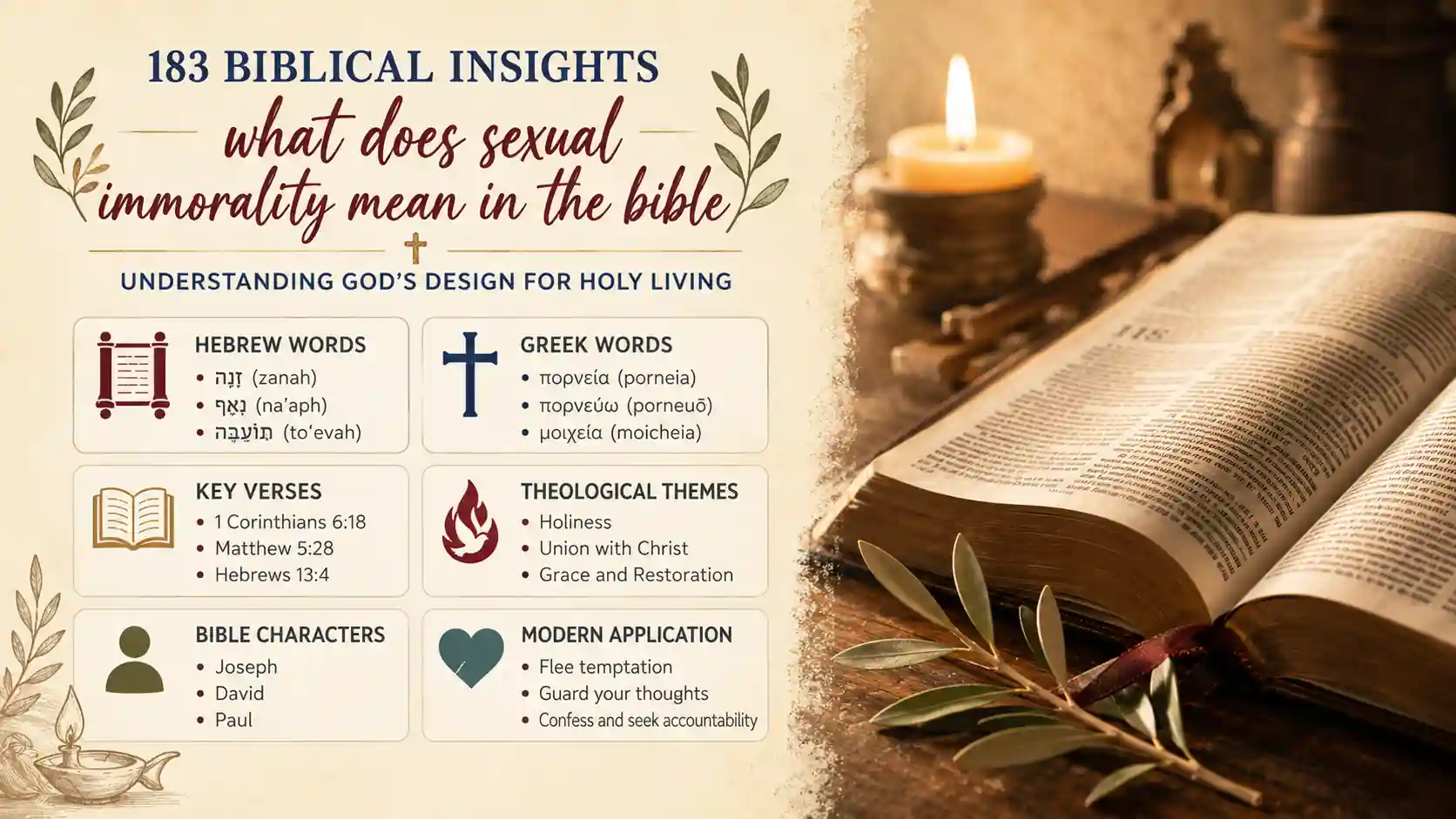
Questions About Sexual Immorality in the Bible
Does πορνεία, porneia, mean only premarital sex?
No. Its biblical uses include prostitution, incestuous unions, and a wider range of prohibited sexual conduct.
Why do some translations say “fornication” while others say “sexual immorality”?
“Fornication” reflects older English usage, while “sexual immorality” better communicates the broader range of porneia.
Are πορνεία, porneia, and μοιχεία, moicheia, the same word?
No. Porneia is broader, while moicheia specifically means adultery.
Does Matthew 5:28 teach that every experience of attraction is adultery?
No. Jesus condemns the intentional cultivation of lustful desire, not the mere recognition that another person is attractive.
Can someone with a history of sexual immorality be restored?
Yes. First Corinthians 6:11 teaches that Christ washes, sanctifies, and justifies repentant sinners.