
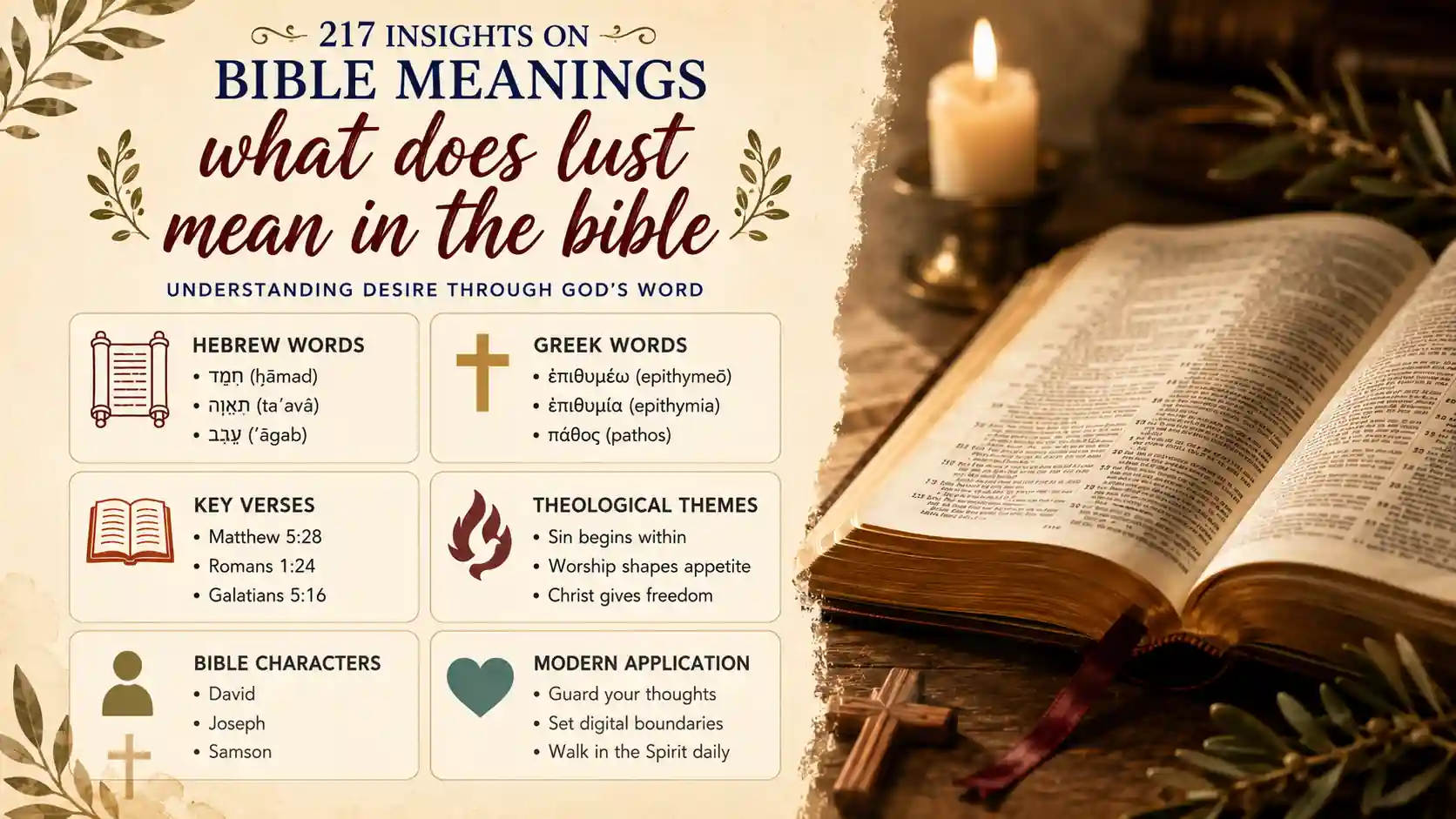
What does lust mean in the Bible? Scripture presents lust as a powerful desire that turns away from God’s wise boundaries and seeks personal satisfaction through what is forbidden, selfish, or spiritually destructive. Although lust often concerns sexual desire, the biblical idea also includes cravings for possessions, status, pleasure, and control.
The original Hebrew and Greek words usually mean desire, longing, or coveting. Context determines whether that desire is wholesome or sinful. Your study must therefore examine not only what a person wants, but also how that desire relates to God, neighbor, covenant faithfulness, and the condition of the heart.
Key Scripture References About Lust
| Verse | Passage Snippet | Context |
|---|---|---|
| Exodus 20:17 | “You shall not covet” | The tenth commandment forbids desiring what belongs to another. |
| Proverbs 6:25 | “Do not lust after her beauty” | A father warns his son against adultery beginning in the heart. |
| Matthew 5:28 | “Looks at a woman lustfully” | Jesus exposes adulterous intention beneath outward behavior. |
| Romans 1:24 | “Lusts of their hearts” | Rejected worship produces disordered desires and bodily dishonor. |
| Romans 6:12 | “Obey its lusts” | Believers must not let sin rule their mortal bodies. |
| Galatians 5:16 | “Lust of the flesh” | Walking by the Spirit opposes the cravings of fallen humanity. |
| James 1:14 | “Drawn away by his own lust” | Temptation develops when personal desire entices the heart. |
| 1 Peter 2:11 | “Abstain from fleshly lusts” | Christians resist desires that wage war against the soul. |
| 1 John 2:16 | “Lust of the flesh” | Worldly cravings are contrasted with love for the Father. |
Bible Translation Comparison of Lust Passages
| Verse | KJV | NIV | ESV | NASB |
|---|---|---|---|---|
| Proverbs 6:25 | “Lust not after her beauty” | “Do not lust in your heart” | “Do not desire her beauty” | “Do not desire her beauty” |
| Matthew 5:28 | “Looketh…to lust after her” | “Looks…lustfully” | “Looks…with lustful intent” | “Looks…with lust for her” |
| Romans 1:24 | “Lusts of their own hearts” | “Sinful desires of their hearts” | “Lusts of their hearts” | “Lusts of their hearts” |
| Romans 6:12 | “Obey it in the lusts thereof” | “Obey its evil desires” | “Obey its passions” | “Obey its lusts” |
| Romans 7:7 | “Thou shalt not covet” | “You shall not covet” | “You shall not covet” | “You shall not covet” |
| Galatians 5:16 | “Lust of the flesh” | “Desires of the flesh” | “Desires of the flesh” | “Desire of the flesh” |
| James 1:14 | “His own lust” | “Their own evil desire” | “His own desire” | “His own lust” |
| 1 Peter 2:11 | “Fleshly lusts” | “Sinful desires” | “Passions of the flesh” | “Fleshly lusts” |
| 1 John 2:16 | “Lust of the eyes” | “Lust of the eyes” | “Desires of the eyes” | “Lust of the eyes” |
People and Characters Associated with Lust
| Person | Role | Connection |
|---|---|---|
| Eve | First woman | She saw forbidden fruit as desirable and took it. |
| David | King of Israel | He desired Bathsheba and committed adultery and murder. |
| Bathsheba | Wife of Uriah | David treated her as an object of royal desire. |
| Amnon | Son of David | His consuming desire for Tamar became sexual violence. |
| Tamar | Daughter of David | She suffered because Amnon’s craving ignored covenant and dignity. |
| Samson | Judge of Israel | His attraction repeatedly overruled wisdom and calling. |
| Potiphar’s wife | Egyptian official’s wife | She persistently sought sexual relations with Joseph. |
| Joseph | Hebrew servant | He fled temptation rather than sin against God. |
| Solomon | King and wisdom teacher | His many foreign wives turned his heart toward other gods. |
Original Hebrew and Greek Words for Lust
| Original Word | Transliteration | Strong’s # | Literal Meaning |
|---|---|---|---|
| חָמַד | ḥāmad | H2530 | To desire, covet, delight in |
| אָוָה | ʾāvâ | H183 | To long for, crave, desire |
| תַּאֲוָה | taʾavâ | H8378 | Desire, craving, appetite |
| שָׁרִירוּת | sheriruth | H8307 | Stubbornness, willful inclination |
| עָגַב | ʿāgab | H5689 | To desire passionately or lust after |
| ἐπιθυμέω | epithymeō | G1937 | To desire, long for, covet |
| ἐπιθυμία | epithymia | G1939 | Desire, craving, lust |
| πάθος | pathos | G3806 | Passion, uncontrolled affection |
| ὄρεξις | orexis | G3715 | Appetite, longing, craving |
Related Biblical Concepts Connected with Lust
| Concept | Connection | Supporting Verse |
|---|---|---|
| Coveting | Lust seeks what God has not given. | Exodus 20:17 |
| Adultery | Sexual lust violates marital faithfulness inwardly or outwardly. | Matthew 5:27–28 |
| Idolatry | Desire becomes idolatrous when it rules the heart. | Colossians 3:5 |
| Temptation | Desire provides an opening for enticement. | James 1:14 |
| The flesh | Fallen human nature produces desires opposed to the Spirit. | Galatians 5:16–17 |
| Self-control | Spirit-produced restraint opposes uncontrolled appetite. | Galatians 5:22–23 |
| Holiness | God calls believers to govern their bodies honorably. | 1 Thessalonians 4:3–5 |
| Contentment | Gratitude weakens covetous and possessive desire. | Hebrews 13:5 |
| Renewal | A transformed mind learns to desire what pleases God. | Romans 12:2 |
Historical and Cultural Context of Lust
| Aspect | Detail | Biblical Source |
|---|---|---|
| Household covenant | Coveting a neighbor’s wife threatened family and community stability. | Exodus 20:17 |
| Ancient kingship | Monarchs could misuse power to seize women and property. | 2 Samuel 11:1–5 |
| Wisdom instruction | Fathers warned sons about seductive paths leading to ruin. | Proverbs 5:1–14 |
| Honor and shame | Sexual wrongdoing dishonored households and covenant relationships. | Proverbs 6:32–35 |
| Pagan worship | Some surrounding religions joined idolatry with sexual immorality. | Numbers 25:1–3 |
| Roman society | Sexual access often reflected power, status, and slavery. | 1 Thessalonians 4:3–5 |
| Marriage customs | Betrothal carried binding moral and social obligations. | Matthew 1:18–19 |
| Disciple formation | Jesus addressed inner motives, not merely public offenses. | Matthew 5:27–30 |
| Diaspora churches | Christians lived among cultures shaped by former passions. | 1 Peter 4:2–4 |
Theological Themes within the Bible’S Teaching on Lust
| Theme | Explanation | Scripture |
|---|---|---|
| Sin begins within | Lust reveals corruption before an outward act occurs. | Matthew 5:28 |
| Desire is morally directed | Strong desire may be good or evil according to its object. | Luke 22:15 |
| Worship shapes appetite | Exchanging God’s glory disorders human desire. | Romans 1:23–24 |
| Sin seeks dominion | Lust becomes enslaving when repeatedly obeyed. | Romans 6:12–14 |
| Christ gives freedom | Union with Christ breaks sin’s rightful claim. | Romans 6:6–7 |
| The Spirit transforms | The Spirit produces desires opposed to the flesh. | Galatians 5:16–24 |
| Grace trains believers | Salvation teaches the renunciation of worldly passions. | Titus 2:11–12 |
| Holiness honors others | Sanctified desire refuses to exploit another person. | 1 Thessalonians 4:3–6 |
| Final hope purifies | Hope in Christ encourages present moral purity. | 1 John 3:2–3 |
Modern Application of Biblical Teaching on Lust
| Area | Practice | Scripture |
|---|---|---|
| Thought life | Reject fantasies that turn people into objects. | Matthew 5:28 |
| Visual habits | Set wise limits on media and private viewing. | Job 31:1 |
| Digital conduct | Remove repeated sources of temptation decisively. | Matthew 5:29–30 |
| Prayer | Bring disordered desires honestly before God. | Psalm 139:23–24 |
| Scripture | Fill the mind with what is pure and honorable. | Philippians 4:8 |
| Accountability | Confess struggles to trustworthy mature believers. | James 5:16 |
| Relationships | Treat others with holiness rather than possessiveness. | 1 Timothy 5:1–2 |
| Contentment | Practice gratitude for God’s present provision. | Hebrews 13:5 |
| Spiritual vigilance | Flee youthful passions and pursue righteousness. | 2 Timothy 2:22 |
What Does Lust Mean in the Bible According To ἐπιθυμία?
The Greek noun ἐπιθυμία, transliterated epithymia, describes a strong desire, longing, or craving. The word itself does not automatically identify a sinful sexual impulse. Jesus uses related language for His earnest desire to eat the Passover with His disciples in Luke 22:15, showing that intense desire can have a holy object.
Context gives the desire its moral character. When epithymia is connected with the flesh, deceit, impurity, or the world, it describes desire that has rejected God’s order. Biblical lust is therefore not simply intensity of feeling. It is desire directed toward an unlawful object or pursued through an unfaithful, selfish, or controlling manner.
חָמַד And the Covenant Boundary of Coveting
The Hebrew verb חָמַד, transliterated ḥāmad, means to desire, take pleasure in, or covet. Genesis 2:9 uses it positively for trees that were pleasing to the sight. Yet Exodus 20:17 uses the same root in the command against coveting a neighbor’s household, wife, servants, animals, or possessions.
This covenant command reaches beyond theft or adultery to the inward movement that precedes them. You may refrain from taking another person’s property while still nurturing a possessive desire for it. The tenth commandment shows that God’s holiness concerns your heart as well as your visible conduct.
Jesus Places Lustful Intent Before the Outward Act
In Matthew 5:27–28, Jesus does not abolish the command against adultery. He reveals its full moral depth. The expression πρὸς τὸ ἐπιθυμῆσαι, pros to epithymēsai, points to looking in order to desire. His warning concerns an intentional gaze that cultivates sexual possession within the imagination.
Jesus is not teaching that every recognition of beauty, involuntary reaction, or experience of temptation equals adultery. He confronts the deliberate feeding of desire for someone outside the rightful boundaries of covenant faithfulness. His severe language about the eye and hand calls you to remove occasions of sin rather than excuse them.
The Flesh, the Spirit, and the Reordering of Desire
Paul describes the desires of the flesh as opposed to the Spirit, yet he does not teach that the physical body is inherently evil. “Flesh” often names humanity operating independently of God. Its works include sexual immorality, jealousy, anger, rivalry, envy, and drunkenness, proving that biblical lust extends beyond sexuality.
The gospel offers more than behavioral restraint. Through union with Christ, the dominion of sin is broken, and the Holy Spirit begins reshaping what you love. Christian growth involves refusing old cravings while pursuing righteousness, faith, love, peace, worship, service, and the enjoyment of God’s good gifts within His appointed boundaries.
Frequently Asked Questions About Lust in the Bible
Does ἐπιθυμία always mean sinful lust?
No. It means strong desire, and the surrounding context determines whether the desire is holy, ordinary, or sinful.
Why do some translations render Galatians 5:16 as “lust” and others as “desire”?
Both translate ἐπιθυμία, but “desire” better displays the word’s broad range while the context identifies its sinful direction.
Does Matthew 5:28 say that noticing an attractive person is adultery?
No. Jesus condemns the intentional look that welcomes and cultivates a possessive sexual desire.
How are חָמַד and the tenth commandment connected to lust?
חָמַד describes desire or coveting, and the commandment forbids setting your heart on what belongs to your neighbor.
Can a believer overcome lust without denying every strong desire?
Yes. Scripture calls you not to become desireless, but to have your desires purified, governed, and redirected by the Holy Spirit.