
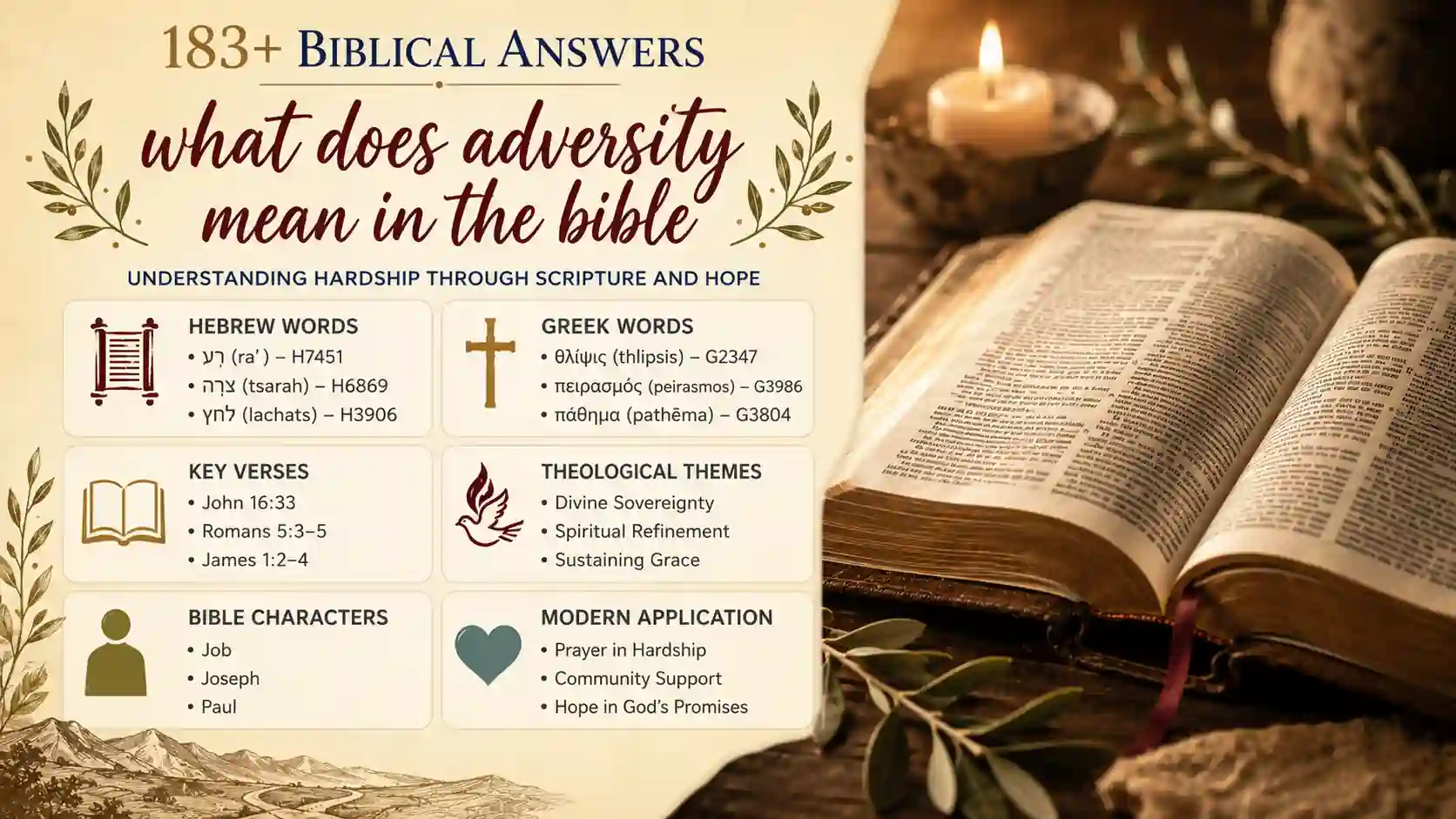
What does adversity mean in the Bible? Scripture presents adversity as distress, pressure, loss, opposition, testing, or calamity that exposes the heart and calls a person to trust God. The Bible does not reduce every hardship to one cause. Adversity may arise from living in a fallen world, human wickedness, spiritual opposition, divine discipline, or faithful obedience.
Yet adversity never places you outside God’s knowledge or authority. Through suffering, God may correct, refine, strengthen, redirect, and display his sustaining grace. Biblical faith therefore responds with lament, prayer, endurance, wisdom, obedience, and hope.
Key Scripture References About Adversity
| Verse | Passage Snippet | Context |
|---|---|---|
| Job 1:20-22 | Job worshiped after loss | Job loses children and possessions |
| Psalm 34:19 | Many afflictions of the righteous | God remains near and delivers |
| Proverbs 24:10 | Fainting reveals limited strength | Wisdom for seasons of trouble |
| Ecclesiastes 7:14 | Consider the day of adversity | Prosperity and hardship remain under God |
| Isaiah 43:2 | God is present through waters | Israel receives covenant reassurance |
| John 16:33 | You will have tribulation | Jesus prepares his disciples |
| Romans 5:3-5 | Suffering produces endurance | Affliction serves Christian formation |
| 2 Corinthians 4:8-9 | Struck down, not destroyed | Apostolic weakness displays divine power |
| James 1:2-4 | Trials test faith | Testing develops steadfast maturity |
| 1 Peter 1:6-7 | Faith refined through trials | Suffering believers await Christ’s appearing |
Bible Translation Comparison of Adversity Passages
| Verse | KJV | NIV | ESV | NASB |
|---|---|---|---|---|
| Proverbs 24:10 | day of adversity | times of trouble | day of adversity | day of distress |
| Ecclesiastes 7:14 | day of adversity | times are bad | day of adversity | day of adversity |
| Psalm 34:19 | afflictions | troubles | afflictions | adversities |
| John 16:33 | tribulation | trouble | tribulation | tribulation |
| Romans 5:3 | tribulations | sufferings | sufferings | tribulations |
| James 1:2 | temptations | trials | trials | trials |
| 1 Peter 1:6 | manifold temptations | all kinds of trials | various trials | various trials |
| 2 Corinthians 4:17 | light affliction | light troubles | light momentary affliction | momentary light affliction |
The comparison shows that English versions use several related terms. “Adversity,” “distress,” “affliction,” “trouble,” “tribulation,” and “trial” overlap, but each translation reflects the meaning of the original word within its literary setting.
People and Characters Associated with Adversity
| Person | Role | Connection |
|---|---|---|
| Job | Righteous sufferer | Endured bereavement, disease, and accusation |
| Joseph | Patriarch and governor | Betrayed, enslaved, and imprisoned |
| Moses | Covenant mediator | Faced rejection, danger, and wilderness burdens |
| Naomi | Israelite widow | Experienced famine, exile, and bereavement |
| David | King and psalmist | Fled enemies and voiced faithful lament |
| Elijah | Prophet | Faced royal hostility, fear, and exhaustion |
| Jeremiah | Prophet to Judah | Suffered rejection, confinement, and grief |
| Daniel | Judean exile | Remained faithful under imperial pressure |
| Jesus | Suffering Messiah | Endured rejection, temptation, and crucifixion |
| Paul | Apostle to the Gentiles | Bore persecution, imprisonment, and weakness |
Original Hebrew and Greek Words for Adversity
| Original Word | Transliteration | Strong’s # | Literal Meaning |
|---|---|---|---|
| רַע | raʿ | H7451 | Badness, evil, calamity |
| צָרָה | tsarah | H6869 | Distress, straits, trouble |
| עֳנִי | ʿoni | H6040 | Affliction, poverty, misery |
| לַחַץ | lachats | H3906 | Oppression, pressure, distress |
| נִסָּיוֹן | nissayon | H5254 | Trial, proving, testing |
| θλῖψις | thlipsis | G2347 | Pressure, affliction, tribulation |
| πειρασμός | peirasmos | G3986 | Trial, test, temptation |
| πάθημα | pathēma | G3804 | Suffering, painful experience |
| κακοπάθεια | kakopatheia | G2552 | Hardship, suffering of evil |
| διωγμός | diōgmos | G1375 | Pursuit, persecution |
No single Hebrew or Greek term corresponds to every use of the English word “adversity.” In Ecclesiastes 7:14, adversity translates רַע, raʿ, a broad word that can describe moral evil or experienced calamity. Context determines whether the term concerns wickedness, harm, disaster, or painful circumstances.
The New Testament often uses θλῖψις, thlipsis, for constricting pressure or tribulation. James and Peter use πειρασμός, peirasmos, for a trial that proves faith or a temptation that entices toward sin. The surrounding passage shows which sense is intended.
Related Biblical Concepts Connected to Adversity
| Concept | Connection | Supporting Verse |
|---|---|---|
| Lament | Brings grief honestly before God | Psalm 13:1-2 |
| Providence | God remains active amid suffering | Genesis 50:20 |
| Discipline | Fatherly correction produces holiness | Hebrews 12:10-11 |
| Testing | Faith is examined and strengthened | James 1:3 |
| Endurance | Steadfastness develops under pressure | Romans 5:3-4 |
| Wisdom | Hardship exposes your need for guidance | James 1:5 |
| Comfort | God consoles sufferers through his people | 2 Corinthians 1:3-4 |
| Fellowship | Believers carry one another’s burdens | Galatians 6:2 |
| Hope | Present suffering points toward future glory | Romans 8:18 |
| Deliverance | God hears those who cry to him | Psalm 34:17 |
Historical and Cultural Context of Adversity
| Aspect | Detail | Biblical Source |
|---|---|---|
| Ancient famine | Crop failure threatened entire households | Genesis 42:1-2 |
| Debt servitude | Poverty could lead to bonded service | Leviticus 25:39 |
| Clan identity | Exclusion could remove social protection | Ruth 1:16-17 |
| Wilderness travel | Scarcity tested Israel’s covenant trust | Exodus 16:2-4 |
| Foreign invasion | War brought displacement and devastation | 2 Kings 25:1-12 |
| Babylonian exile | Judah lived under foreign domination | Psalm 137:1-4 |
| Public lament | Grief was voiced through prayer and song | Lamentations 3:19-24 |
| Roman occupation | Heavy taxation and coercion shaped Judea | Luke 2:1-5 |
| Honor and shame | Public rejection carried social consequences | Hebrews 10:33 |
| Early persecution | Confessing Christ could bring loss | Acts 8:1-4 |
Biblical adversity occurred within societies lacking many modern protections. Famine could become a life-threatening crisis, widowhood could produce severe vulnerability, and exile meant losing land, temple access, political freedom, and communal stability.
New Testament believers also lived under Roman authority and within cultures where family honor, trade networks, and religious identity were closely connected. Following Jesus could therefore result in public shame, economic loss, imprisonment, or exclusion from one’s community.
Theological Themes Revealed Through Adversity
| Theme | Explanation | Scripture |
|---|---|---|
| Divine sovereignty | Trouble never escapes God’s rule | Job 42:2 |
| Human limitation | Suffering exposes dependence on God | 2 Corinthians 1:9 |
| Fallen creation | Pain reflects a world awaiting renewal | Romans 8:20-22 |
| Moral responsibility | Some suffering results from sinful choices | Galatians 6:7 |
| Righteous suffering | Faithfulness may provoke opposition | 1 Peter 3:14 |
| Fatherly discipline | God trains his children in holiness | Hebrews 12:6 |
| Spiritual refinement | Tested faith becomes precious and mature | 1 Peter 1:7 |
| Cruciform discipleship | Believers follow the suffering Christ | Mark 8:34 |
| Sustaining grace | God’s power rests upon human weakness | 2 Corinthians 12:9 |
| Final restoration | God will remove sorrow and death | Revelation 21:4 |
Modern Application of Adversity for Believers
| Area | Practice | Scripture |
|---|---|---|
| Prayer | Speak honestly without abandoning trust | Psalm 62:8 |
| Scripture | Remember God’s promises in distress | Psalm 119:50 |
| Wisdom | Ask God for guidance during trials | James 1:5 |
| Community | Receive and offer practical support | Romans 12:15 |
| Character | Let hardship cultivate endurance | Romans 5:3-4 |
| Decisions | Refuse sinful shortcuts under pressure | Matthew 4:1-10 |
| Anxiety | Present your requests with thanksgiving | Philippians 4:6-7 |
| Service | Comfort others from received comfort | 2 Corinthians 1:4 |
| Witness | Respond to hostility with gentleness | 1 Peter 3:15-16 |
| Hope | Fix your attention on eternal glory | 2 Corinthians 4:17-18 |
What Does Adversity Mean in the Bible’S Wisdom Literature?
Wisdom literature treats adversity as a serious teacher, not a pleasant experience or an automatic sign of divine rejection. Proverbs 24:10 warns that trouble reveals the measure of human strength. Ecclesiastes 7:14 tells you to consider God in both prosperity and adversity, since neither season grants complete control over the future.
Job challenges the assumption that every sufferer is being punished for a particular sin. Job’s friends defend an overly mechanical view of retribution, but God exposes the limits of their reasoning. Your study should therefore resist careless judgments about another person’s suffering while still affirming God’s justice and wisdom.
רַע And the Day of Adversity in Ecclesiastes 7
The Hebrew word רַע, raʿ, in Ecclesiastes 7:14 describes adversity as the painful counterpart to prosperity. The Teacher does not call moral evil good. Rather, he recognizes that God’s providence encompasses days of well-being and days of calamity, while human beings remain unable to master what comes next.
This verse calls you to thoughtful humility. Prosperity should be received with gratitude, but hardship should prompt reflection rather than panic. You may not discover every hidden reason behind an adverse season, yet you can acknowledge God, reject false certainty, and remain faithful within the day he has permitted.
θλῖψις And the Pressure Promised by Jesus
The Greek noun θλῖψις, thlipsis, pictures pressure, constriction, distress, or tribulation. Jesus uses it in John 16:33 when preparing his disciples for hostility in the world. His promise is not that faithful disciples will avoid pressure, but that they can possess peace in him because he has overcome the world.
Paul develops this theme without glorifying pain itself. Tribulation can produce endurance, proven character, and hope because God’s love has been poured into believers’ hearts through the Holy Spirit. The transforming power belongs to God, not to adversity considered in isolation.
Adversity, the Cross, and the Hope of Resurrection
Christian theology interprets adversity through the death and resurrection of Jesus. At the cross, human injustice, physical suffering, public shame, and divine saving purpose meet without making evil morally good. God defeats sin and death through the suffering obedience of the Messiah.
This pattern keeps biblical hope from becoming shallow optimism. You may grieve, seek relief, pursue justice, and ask for deliverance while trusting that suffering will not have the final word. Resurrection promises that faithful endurance is not wasted and that God will finally restore his creation.
Frequently Asked Questions About Adversity in the Bible
Does רַע, raʿ, mean that God creates moral evil in Ecclesiastes 7:14?
In that context, raʿ refers to calamity or adversity, not to God committing wickedness.
What is the difference between θλῖψις, thlipsis, and πειρασμός, peirasmos?
Thlipsis emphasizes distressing pressure, while peirasmos describes testing or temptation according to context.
Does James 1:2 teach believers to enjoy painful adversity?
No. James calls you to regard trials with joy because of what God produces through tested faith.
Is every adversity a punishment for personal sin?
No. Job, Jesus, and 1 Peter show that righteous people may suffer without a specific personal sin causing their hardship.
How should you respond when the reason for adversity remains unknown?
You can lament honestly, seek wisdom, receive help, obey what Scripture makes clear, and entrust unanswered questions to God.