
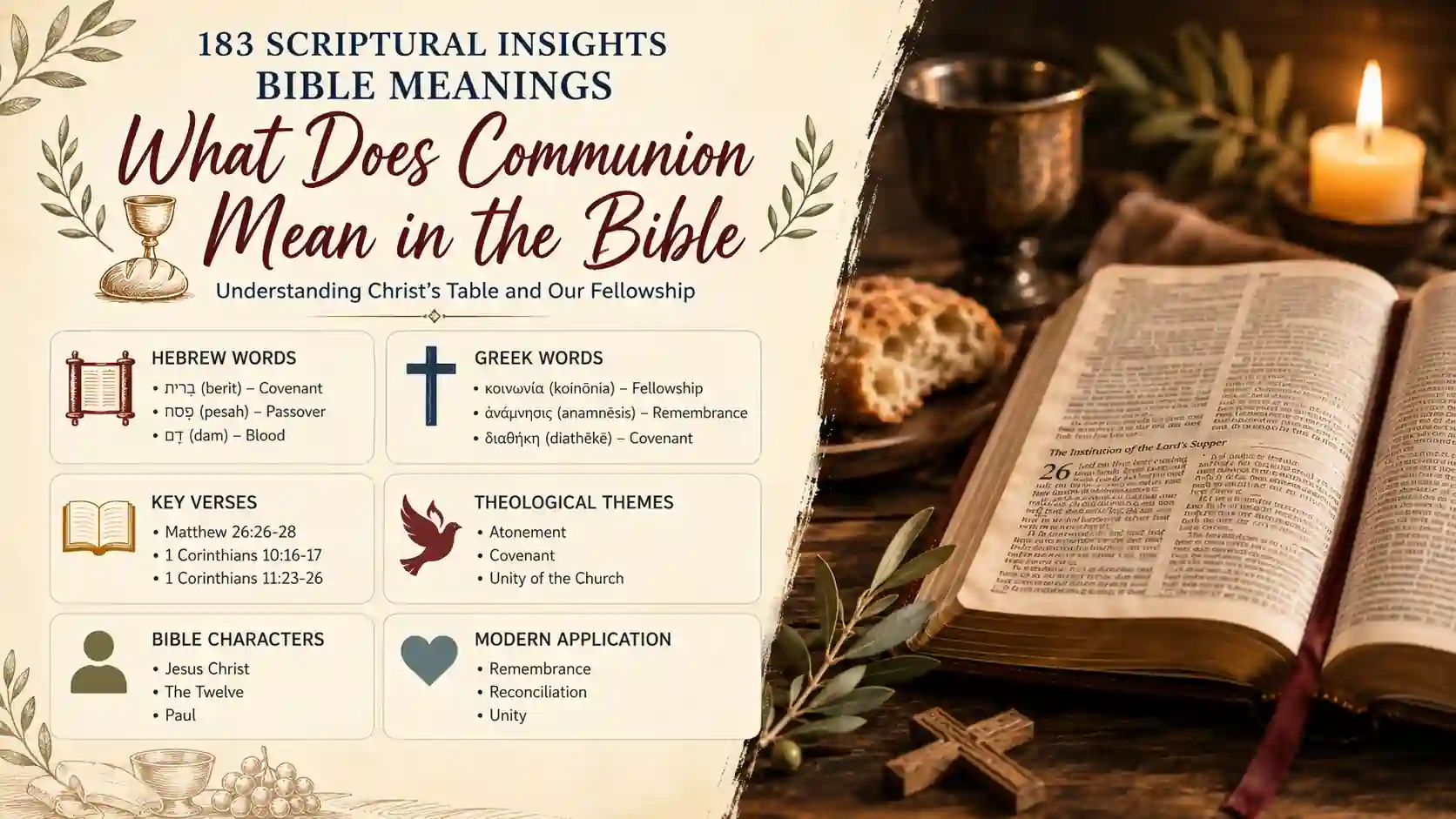
What does communion mean in the Bible? Communion is the sacred sharing of bread and the cup instituted by Jesus on the night before His crucifixion. It remembers His sacrificial death, proclaims the gospel, confirms participation in the new covenant, and expresses the unity of His people.
The biblical meaning reaches beyond a private devotional moment. Communion joins remembrance, thanksgiving, fellowship, self-examination, covenant loyalty, and hope. As you study its Passover setting and apostolic teaching, you see a meal centered on Christ’s body, blood, church, and promised return.
Key Communion Scripture References
| Verse | Passage Snippet | Context |
|---|---|---|
| Matthew 26:26-28 | “Take, eat; this is my body” | Jesus institutes the meal during Passover |
| Mark 14:22-24 | “This is my blood of the covenant” | The Twelve receive bread and the cup |
| Luke 22:19-20 | “Do this in remembrance of me” | Jesus identifies the cup with the new covenant |
| John 6:53-56 | “Eat the flesh of the Son of Man” | Jesus teaches dependence on His life-giving sacrifice |
| Acts 2:42 | “The breaking of bread” | The Jerusalem church practices shared fellowship |
| Acts 20:7 | “We came together to break bread” | Believers gather on the first day of the week |
| 1 Corinthians 10:16-17 | “Participation in the blood of Christ” | Paul connects communion with spiritual fellowship and unity |
| 1 Corinthians 11:23-26 | “Proclaim the Lord’s death” | Paul repeats the tradition received from Christ |
| 1 Corinthians 11:27-29 | “Examine himself” | Careless participation brings serious accountability |
| Revelation 19:9 | “Marriage supper of the Lamb” | Earthly communion anticipates the final messianic feast |
Communion Bible Translation Comparison
| Verse | KJV | NIV | ESV | NASB |
|---|---|---|---|---|
| Matthew 26:26 | “Take, eat” | “Take and eat” | “Take, eat” | “Take, eat” |
| Matthew 26:28 | “Blood of the new testament” | “Blood of the covenant” | “Blood of the covenant” | “Blood of the covenant” |
| Luke 22:19 | “In remembrance of me” | “In remembrance of me” | “In remembrance of me” | “In remembrance of Me” |
| Acts 2:42 | “Fellowship” | “Fellowship” | “Fellowship” | “Fellowship” |
| 1 Corinthians 10:16 | “Communion of the blood” | “Participation in the blood” | “Participation in the blood” | “Sharing in the blood” |
| 1 Corinthians 10:17 | “One bread, and one body” | “One loaf, we are one body” | “One bread, we who are many” | “One loaf, we who are many” |
| 1 Corinthians 11:26 | “Shew the Lord’s death” | “Proclaim the Lord’s death” | “Proclaim the Lord’s death” | “Proclaim the Lord’s death” |
| 1 Corinthians 11:28 | “Examine himself” | “Examine themselves” | “Examine himself” | “Examine himself” |
| 1 Corinthians 11:29 | “Not discerning the Lord’s body” | “Without discerning the body” | “Without discerning the body” | “Without recognizing the body” |
People and Characters Associated with Communion
| Person | Role | Connection |
|---|---|---|
| Jesus Christ | Host and covenant mediator | Institutes the meal and gives it its meaning |
| The Twelve | First participants | Receive the bread and cup at the Last Supper |
| Judas Iscariot | Betrayer among the disciples | His presence highlights covenant betrayal and human sin |
| Paul | Apostle and teacher | Explains communion to the Corinthian church |
| Corinthian believers | Troubled congregation | Their divisions distort the meaning of the shared meal |
| Moses | Old covenant mediator | Sprinkles covenant blood in Exodus 24 |
| Melchizedek | Priest-king of Salem | Brings bread and wine to Abraham |
| Cleopas | Disciple at Emmaus | Recognizes Jesus in the breaking of bread |
| Jerusalem believers | Earliest church community | Continue in teaching, fellowship, prayer, and shared meals |
| Early Gentile believers | Members of one body | Share equally in Christ without ethnic distinction |
Original Hebrew and Greek Communion Words
| Original Word | Transliteration | Strong’s # | Literal Meaning |
|---|---|---|---|
| κοινωνία | koinōnia | G2842 | Fellowship, participation, sharing |
| κοινωνός | koinōnos | G2844 | Partner, sharer, companion |
| κλάσις | klasis | G2800 | Breaking, especially breaking bread |
| ἀνάμνησις | anamnēsis | G364 | Remembrance, memorial recollection |
| εὐχαριστέω | eucharisteō | G2168 | To give thanks |
| διαθήκη | diathēkē | G1242 | Covenant, testament, binding arrangement |
| ἄρτος | artos | G740 | Bread, loaf, food |
| ποτήριον | potērion | G4221 | Cup or its contents |
| בְּרִית | berit | H1285 | Covenant, binding agreement |
| פֶּסַח | pesaḥ | H6453 | Passover, passing over |
Related Biblical Communion Concepts
| Concept | Connection | Supporting Verse |
|---|---|---|
| Passover | The Last Supper occurs in Israel’s deliverance setting | Luke 22:15 |
| New covenant | The cup signifies covenant established through Christ’s blood | Luke 22:20 |
| Remembrance | The church intentionally recalls Jesus and His sacrifice | 1 Corinthians 11:24 |
| Proclamation | Eating and drinking visibly announce the Lord’s death | 1 Corinthians 11:26 |
| Fellowship | Participants share in the benefits of Christ’s sacrifice | 1 Corinthians 10:16 |
| Church unity | One loaf signifies one body composed of many believers | 1 Corinthians 10:17 |
| Thanksgiving | Jesus gives thanks before distributing bread and the cup | Matthew 26:27 |
| Self-examination | Believers test their conduct and attitude before participating | 1 Corinthians 11:28 |
| Covenant blood | Jesus fulfills the pattern of blood confirming covenant | Exodus 24:8 |
| Future hope | The meal looks toward Christ’s return and kingdom feast | Matthew 26:29 |
Historical and Cultural Context of Communion
| Aspect | Detail | Biblical Source |
|---|---|---|
| Passover setting | Jesus eats with His disciples near the feast | Matthew 26:17-20 |
| Unleavened bread | Passover bread recalls Israel’s hurried departure | Exodus 12:15-20 |
| Shared cup | A common cup expresses shared covenant participation | Mark 14:23 |
| Reclining posture | Guests recline according to first-century meal custom | Luke 22:14 |
| Household meals | Early believers often gather and eat in homes | Acts 2:46 |
| First day gathering | Disciples assemble to break bread on Sunday | Acts 20:7 |
| Love feast setting | Communion is connected with a larger congregational meal | 1 Corinthians 11:20-22 |
| Social inequality | Wealthy members shame poorer believers in Corinth | 1 Corinthians 11:21-22 |
| Covenant formula | Blood language recalls Sinai’s covenant ratification | Exodus 24:6-8 |
| Messianic banquet | Jesus promises renewed fellowship in His Father’s kingdom | Matthew 26:29 |
Theological Themes within Communion
| Theme | Explanation | Scripture |
|---|---|---|
| Atonement | Christ’s body and blood point to His substitutionary death | Matthew 26:28 |
| Incarnation | The physical elements recall that the Son truly became flesh | John 1:14 |
| Covenant | Jesus establishes the promised new covenant through His blood | Jeremiah 31:31-34 |
| Participation | Believers share in Christ and the benefits of His sacrifice | 1 Corinthians 10:16 |
| Remembrance | The meal keeps Christ’s saving work before the church | Luke 22:19 |
| Proclamation | Communion preaches through visible actions and spoken truth | 1 Corinthians 11:26 |
| Ecclesiology | One bread displays the spiritual unity of Christ’s body | 1 Corinthians 10:17 |
| Holiness | Participants must reject contempt, division, and unrepentant conduct | 1 Corinthians 11:27-32 |
| Eschatology | The meal anticipates Christ’s return and coming kingdom | 1 Corinthians 11:26 |
| Grace | The table directs faith toward Christ rather than human merit | Ephesians 2:8-9 |
Modern Communion Application for Believers
| Area | Practice | Scripture |
|---|---|---|
| Remembrance | Recall Christ’s cross with gratitude and reverence | 1 Corinthians 11:24 |
| Repentance | Confess known sin and seek restored obedience | 1 John 1:9 |
| Reconciliation | Pursue peace with believers you have wronged | Matthew 5:23-24 |
| Unity | Refuse pride, favoritism, and social division | 1 Corinthians 11:18 |
| Worship | Thank God for redemption through Christ | Luke 22:19 |
| Gospel witness | Treat the meal as a proclamation of Jesus’ death | 1 Corinthians 11:26 |
| Discernment | Recognize the sacred meaning of Christ’s body | 1 Corinthians 11:29 |
| Fellowship | Receive other believers as members of one body | Romans 15:7 |
| Hope | Look toward Christ’s return rather than only backward | 1 Corinthians 11:26 |
| Service | Let covenant fellowship produce practical care for others | Acts 2:44-45 |
What Does Communion Mean in the Bible Through κοινωνία?
The word most directly associated with communion is κοινωνία, koinōnia, Strong’s G2842. It describes fellowship, sharing, contribution, or participation. In 1 Corinthians 10:16, Paul asks whether the cup is a κοινωνία in Christ’s blood and whether the bread is a κοινωνία in Christ’s body. His question expects an affirmative answer.
Paul is not describing ordinary social contact. At the Lord’s Table, you publicly identify with Jesus Christ and receive the meal as one who depends upon His saving death. Communion declares that your spiritual life, forgiveness, and standing before God come through the crucified and risen Lord.
The Passover Covenant Behind the Bread and Cup
Jesus instituted communion in the setting of Passover, Israel’s memorial of deliverance from Egypt. The original Passover involved a sacrificed lamb, protective blood, unleavened bread, divine judgment, and liberation from slavery. Jesus takes this established pattern and centers its fulfillment upon Himself.
When He calls the cup “the new covenant in my blood,” He joins Exodus 24 with Jeremiah 31. Moses had spoken of covenant blood at Sinai, while Jeremiah promised a covenant marked by forgiveness and inwardly written law. Jesus announces that His approaching death will secure that promised covenant blessing.
The Greek word διαθήκη, diathēkē, Strong’s G1242, can be translated “covenant” or “testament.” “Covenant” often communicates the biblical setting more clearly because Jesus is describing a divinely established relationship confirmed through sacrificial blood, not merely a document distributing property after death.
Ἀνάμνησις And the Command to Remember Christ
Jesus commands, “Do this in remembrance of me.” The Greek noun ἀνάμνησις, anamnēsis, Strong’s G364, refers to remembrance or a memorial. Biblical remembrance is more than recalling historical information. It brings God’s saving act before the worshiping community so that faith, gratitude, and obedience are renewed.
You do not repeat Christ’s sacrifice when you receive communion. Hebrews teaches that Jesus offered Himself once for all. The bread and cup direct you back to that completed work, while 1 Corinthians 11:26 also directs you forward. You proclaim His death “until he comes.”
Communion therefore holds past, present, and future together. You remember the cross, participate in the fellowship of Christ’s people, and await the kingdom banquet. The meal is solemn because it announces a death, joyful because that death brings forgiveness, and hopeful because the crucified Lord is risen and returning.
Discerning the Body in Corinth’S Divided Church
Paul’s warning about eating and drinking “in an unworthy manner” addresses the conduct of the Corinthian congregation. Some members eat excessively while others remain hungry. Their humiliation of poorer believers contradicts the meaning of one bread and one body.
The warning does not mean that only morally flawless people may participate. No believer approaches Christ’s table through personal worthiness. The adverb translated “unworthily” concerns a manner of participation that treats the sacred meal and Christ’s people with contempt.
To discern the body includes recognizing the significance of Christ’s sacrificial body. In the immediate Corinthian context, it also calls you to recognize the church as Christ’s body. Self-examination should therefore include repentance, faith, reconciliation, love, and concern for fellow believers.
Communion is personal, but never merely private. You receive the elements alongside others who depend on the same Savior. The table confronts superiority because every participant comes as a sinner sustained by grace, and it creates unity because all share one Lord, one gospel, and one hope.
Communion Questions from Bible Students
Does κοινωνία mean communion or fellowship in 1 Corinthians 10:16?
It includes both ideas because Paul describes a real sharing or participation in Christ expressed through the communal meal.
Why does the KJV say “new testament” while other translations say “new covenant”?
The Greek διαθήκη can carry either sense, but “new covenant” directly reflects the biblical background of Exodus 24 and Jeremiah 31.
Does “this is my body” mean the bread physically becomes Christ’s body?
Christians interpret the precise relationship differently, but the text clearly requires reverent reception centered on Christ’s sacrificial body.
What does it mean to take communion in an unworthy manner?
It means participating irreverently or selfishly in a way that contradicts Christ’s sacrifice and the unity of His church.
Why should you proclaim Christ’s death “until he comes”?
Communion remembers the completed cross while directing your hope toward Christ’s promised return and kingdom feast.