
If you have ever wondered what does sanctify mean in the Bible, you are asking a question that reaches into the heart of God’s plan for His people. Throughout Scripture, sanctification describes God’s work of setting people, places, and things apart for His holy purposes.
It is both a completed reality and a lifelong journey for believers. As you study the biblical meaning of sanctify, you will discover rich Hebrew and Greek vocabulary, covenant themes, and practical truths that deepen your understanding of God’s holiness and your calling to live for Him.
Key Scripture References for Sanctify
| Verse | Passage Snippet | Context |
|---|---|---|
| Genesis 2:3 | God sanctified the seventh day | Sabbath established |
| Exodus 13:2 | Sanctify every firstborn | Israel dedicated to God |
| Exodus 19:10 | Sanctify the people | Preparation before Sinai |
| Leviticus 20:8 | I am the Lord who sanctifies you | Covenant holiness |
| Psalm 51:10 | Create a clean heart | Inner renewal |
| John 17:17 | Sanctify them through Your truth | Jesus’ prayer |
| Acts 20:32 | Among those sanctified | Inheritance of believers |
| 1 Thessalonians 5:23 | Sanctify you completely | Whole person devoted |
| Hebrews 10:10 | Sanctified through Christ | Christ’s sacrifice |
Bible Translation Comparison for Sanctify
| Verse | KJV | NIV | ESV | NASB |
|---|---|---|---|---|
| Exodus 19:10 | Sanctify | Consecrate | Consecrate | Consecrate |
| Leviticus 20:8 | Sanctify | Make holy | Sanctify | Sanctify |
| John 17:17 | Sanctify | Sanctify | Sanctify | Sanctify |
| Acts 26:18 | Sanctified | Sanctified | Sanctified | Sanctified |
| Romans 15:16 | Sanctified | Made acceptable | Sanctified | Sanctified |
| 1 Corinthians 1:2 | Sanctified | Sanctified | Sanctified | Sanctified |
| Hebrews 2:11 | Sanctifies | Makes holy | Sanctifies | Sanctifies |
| Hebrews 10:14 | Sanctified | Made holy | Sanctified | Sanctified |
| 1 Thessalonians 5:23 | Sanctify | Sanctify | Sanctify | Sanctify |
People & Characters Associated with Sanctify
| Person | Role | Connection |
|---|---|---|
| Moses | Covenant mediator | Sanctified Israel before Sinai |
| Aaron | High priest | Consecrated for priestly service |
| Joshua | Israel’s leader | Called people to sanctify themselves |
| David | King | Desired inward holiness |
| Isaiah | Prophet | Witnessed God’s holiness |
| Jesus | Messiah | Sanctified Himself for believers |
| Paul | Apostle | Taught progressive sanctification |
| Peter | Apostle | Called believers to holy living |
| Believers | God’s people | Set apart in Christ |
Original Hebrew & Greek Words for Sanctify
| Original Word | Transliteration | Strong’s # | Literal Meaning |
|---|---|---|---|
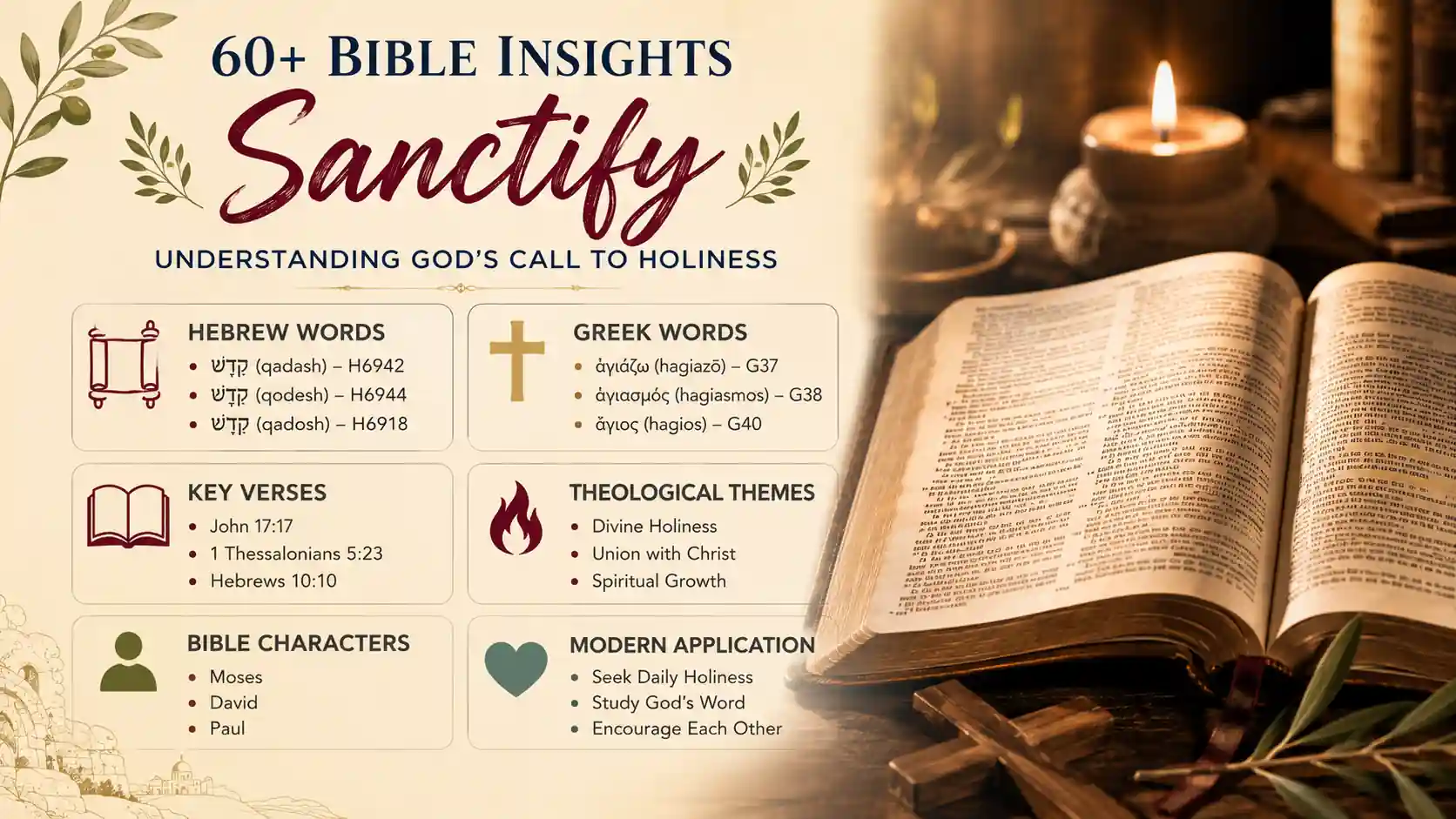
| קָדַשׁ | qadash | H6942 | Set apart, make holy |
| קֹדֶשׁ | qodesh | H6944 | Holiness |
| מִקְדָּשׁ | miqdash | H4720 | Holy place |
| קָדוֹשׁ | qadosh | H6918 | Holy, sacred |
| ἁγιάζω | hagiazō | G37 | Sanctify, make holy |
| ἅγιος | hagios | G40 | Holy, saint |
| ἁγιασμός | hagiasmos | G38 | Sanctification |
| ἁγιότης | hagiotēs | G41 | Holiness |
| καθαρίζω | katharizō | G2511 | Cleanse, purify |
Related Biblical Concepts for Sanctify
| Concept | Connection | Supporting Verse |
|---|---|---|
| Holiness | God’s character | Leviticus 19:2 |
| Justification | Declared righteous | Romans 5:1 |
| Redemption | Purchased by Christ | Ephesians 1:7 |
| Purification | Cleansing from sin | 1 John 1:9 |
| Covenant | Belonging to God | Exodus 19:5 to 6 |
| Priesthood | Dedicated service | 1 Peter 2:9 |
| Temple | Holy dwelling | 1 Corinthians 3:16 |
| Obedience | Fruit of holiness | John 14:15 |
| Glory | Reflecting God’s nature | 2 Corinthians 3:18 |
Historical & Cultural Context for Sanctify
| Aspect | Detail | Biblical Source |
|---|---|---|
| Sabbath | Day set apart | Genesis 2:3 |
| Tabernacle | Holy worship place | Exodus 40 |
| Priests | Consecrated by anointing | Exodus 29 |
| Temple vessels | Dedicated objects | Numbers 7 |
| Sacrifices | Holy offerings | Leviticus 1 |
| Sinai covenant | Nation consecrated | Exodus 19 |
| Festivals | Sacred appointments | Leviticus 23 |
| Firstborn | Dedicated to God | Exodus 13 |
| New Covenant | Hearts transformed | Jeremiah 31:33 |
Theological Themes for Sanctify
| Theme | Explanation | Scripture |
|---|---|---|
| Divine holiness | God alone is perfectly holy | Isaiah 6:3 |
| Election | God sets apart His people | Ephesians 1:4 |
| Union with Christ | Sanctified in Christ | 1 Corinthians 1:2 |
| Spiritual growth | Lifelong transformation | Philippians 2:12 to 13 |
| Truth | God’s Word sanctifies | John 17:17 |
| Spirit’s work | Holy Spirit transforms | 2 Thessalonians 2:13 |
| Worship | Holy lives honor God | Romans 12:1 |
| Hope | Final perfection awaits | 1 John 3:2 |
Modern Application for Believers
| Area | Practice | Scripture |
|---|---|---|
| Prayer | Seek daily holiness | 1 Thessalonians 5:23 |
| Bible study | Learn God’s truth | John 17:17 |
| Family | Reflect Christ at home | Ephesians 5:1 to 2 |
| Church | Encourage one another | Hebrews 10:24 to 25 |
| Work | Serve faithfully | Colossians 3:23 |
| Speech | Speak with grace | Ephesians 4:29 |
| Relationships | Forgive freely | Colossians 3:13 |
| Witness | Live distinctly | Matthew 5:16 |
| Perseverance | Continue in faith | Hebrews 12:14 |
The Hebrew Root Qadash and What Does Sanctify Mean in the Bible
The primary Old Testament word translated “sanctify” is קָדַשׁ (qadash). Strong’s H6942 carries the idea of setting apart something or someone for God. Rather than describing moral perfection alone, it first points to belonging exclusively to the Lord. A day, a priest, a nation, or even a piece of furniture in the tabernacle could be sanctified because God claimed it for His purpose.
This covenant language appears throughout the Law. Israel was called to be a holy nation because the Lord had chosen them. Holiness was not earned before they belonged to God. Instead, because they belonged to Him, they were expected to live differently. Sanctification therefore combines divine grace with faithful obedience.
Hagiazō in the New Testament and Christ’s Work of Sanctification
The New Testament centers on the Greek verb ἁγιάζω (hagiazō), Strong’s G37, and the related noun ἁγιασμός (hagiasmos), Strong’s G38. These words describe God’s ongoing work of making believers holy through Jesus Christ. They appear frequently in Paul’s letters, Hebrews, and the Gospel of John.
Jesus prayed in John 17:17, “Sanctify them through Your truth; Your word is truth.” He also declared that He sanctified Himself for His disciples so they might be sanctified in truth. His sacrificial death secured the believer’s standing before God, while His continuing ministry shapes believers into His likeness through the Holy Spirit and the Scriptures.
What Does Sanctify Mean in the Bible Through the New Covenant
The Bible presents sanctification in three complementary ways. First, you are sanctified positionally when you trust in Christ. God sets you apart as His own because of Christ’s finished work. Hebrews celebrates this completed aspect by declaring believers sanctified through the offering of Jesus Christ once for all.
Second, sanctification is progressive. The Holy Spirit steadily transforms your character, attitudes, and actions. This lifelong growth does not earn salvation. Instead, it demonstrates the reality of new life. As you yield to God’s Word, your thoughts, desires, and habits increasingly reflect the holiness of Christ.
Finally, Scripture points to future sanctification. One day every believer will stand before God fully conformed to the image of His Son. Sin, temptation, and weakness will be gone forever. This future hope encourages faithful living in the present, reminding you that God’s work will reach its perfect completion.
Sanctification in Daily Christian Life and Biblical Worship
Sanctification is not reserved for pastors, missionaries, or biblical scholars. Every believer is called to pursue holiness in ordinary life. Whether you work, study, raise a family, or serve your church, every area of life becomes an opportunity to honor God. Romans 12 describes presenting your entire life as a living sacrifice, an act of spiritual worship.
The pursuit of holiness should never be confused with legalism. The Bible teaches that sanctification flows from God’s grace rather than human achievement. Because Christ has redeemed you, the Holy Spirit empowers you to grow in obedience. Prayer, Scripture reading, fellowship, repentance, and faithful service become means through which God continues His sanctifying work.
As you study the Bible, you also notice that sanctification always points back to God’s own character. He is קָדוֹשׁ (qadosh), the Holy One. His people are called to reflect His holiness, not by withdrawing from the world, but by living within it as faithful witnesses. Holiness becomes a testimony that God’s transforming grace is real and active.
The Bible also reminds you that sanctification is communal as well as personal. The church is described as a holy people, a royal priesthood, and God’s temple. Believers encourage one another, correct one another in love, and grow together toward maturity. Sanctification is therefore both an individual journey and a shared calling within the body of Christ.
FAQs
Does sanctify always mean becoming morally perfect?
No. The biblical words קָדַשׁ (qadash) and ἁγιάζω (hagiazō) first mean being set apart for God’s purpose, with moral transformation flowing from that relationship.
Why do some translations use “consecrate” instead of “sanctify”?
Because the Hebrew קָדַשׁ (qadash) can emphasize dedicating someone or something to God’s special service.
Is Hebrews 10:10 teaching completed or ongoing sanctification?
It highlights the believer’s completed standing through Christ’s sacrifice while other passages describe continuing spiritual growth.
What is the difference between justification and sanctification?
Justification declares you righteous before God, while sanctification progressively shapes you into Christ’s likeness.
How can you cooperate with the Holy Spirit in sanctification?
By regularly seeking God through Scripture, prayer, repentance, worship, and faithful obedience to His Word.