
If you have ever wondered what does ruddy mean in the Bible, you are asking about a word that appears only a handful of times but carries rich meaning. Rather than describing moral character, “ruddy” usually refers to a healthy, reddish complexion or appearance.
In Scripture, this physical description often introduces important people whom God uses for His purposes. As you study the Hebrew language, biblical culture, and key passages, you will discover that this simple adjective highlights beauty, vitality, youthfulness, and even God’s surprising choice of unlikely servants.
Key Scripture References for Ruddy
| Verse | Passage Snippet | Context |
|---|---|---|
| 1 Samuel 16:12 | “He was ruddy” | David chosen by Samuel |
| 1 Samuel 17:42 | “Only a ruddy youth” | Goliath despises David |
| Song of Solomon 5:10 | “My beloved is white and ruddy” | Poetic description of the beloved |
| Genesis 25:25 | “The first came out red” | Esau’s birth appearance |
| Genesis 25:30 | “That red stew” | Esau receives the name Edom |
| Lamentations 4:7 | “Their bodies were more ruddy” | Former health of Jerusalem’s nobles |
| Zechariah 1:8 | “A man riding a red horse” | Symbolic prophetic vision |
| Zechariah 6:2 | “Red horses” | Vision of divine judgment |
| Isaiah 63:2 | “Why are your garments red?” | Symbolic picture of judgment |
Bible Translation Comparison for Ruddy
| Verse | KJV | NIV | ESV | NASB |
|---|---|---|---|---|
| 1 Samuel 16:12 | ruddy | glowing with health | ruddy | ruddy |
| 1 Samuel 17:42 | ruddy | handsome | ruddy | handsome |
| Song of Solomon 5:10 | ruddy | radiant | ruddy | ruddy |
| Genesis 25:25 | red | red | red | red |
| Lamentations 4:7 | more ruddy | ruddier | ruddy | ruddy |
| Zechariah 1:8 | red | red | red | red |
| Zechariah 6:2 | red | red | red | red |
| Isaiah 63:2 | red | red | red | red |
People and Characters Associated with Ruddy
| Person | Role | Connection |
|---|---|---|
| David | Shepherd and king | Personally described as ruddy |
| Goliath | Philistine champion | Mocked David’s youthful appearance |
| Samuel | Prophet | Anointed ruddy David |
| Jesse | Father of David | Presented David to Samuel |
| Esau | Son of Isaac | Born red and linked to Edom |
| Solomon’s beloved | Poetic figure | Called white and ruddy |
| Jerusalem’s nobles | Covenant people | Compared as formerly ruddy |
| Messiah figure | Prophetic king | Symbolically connected with red imagery |
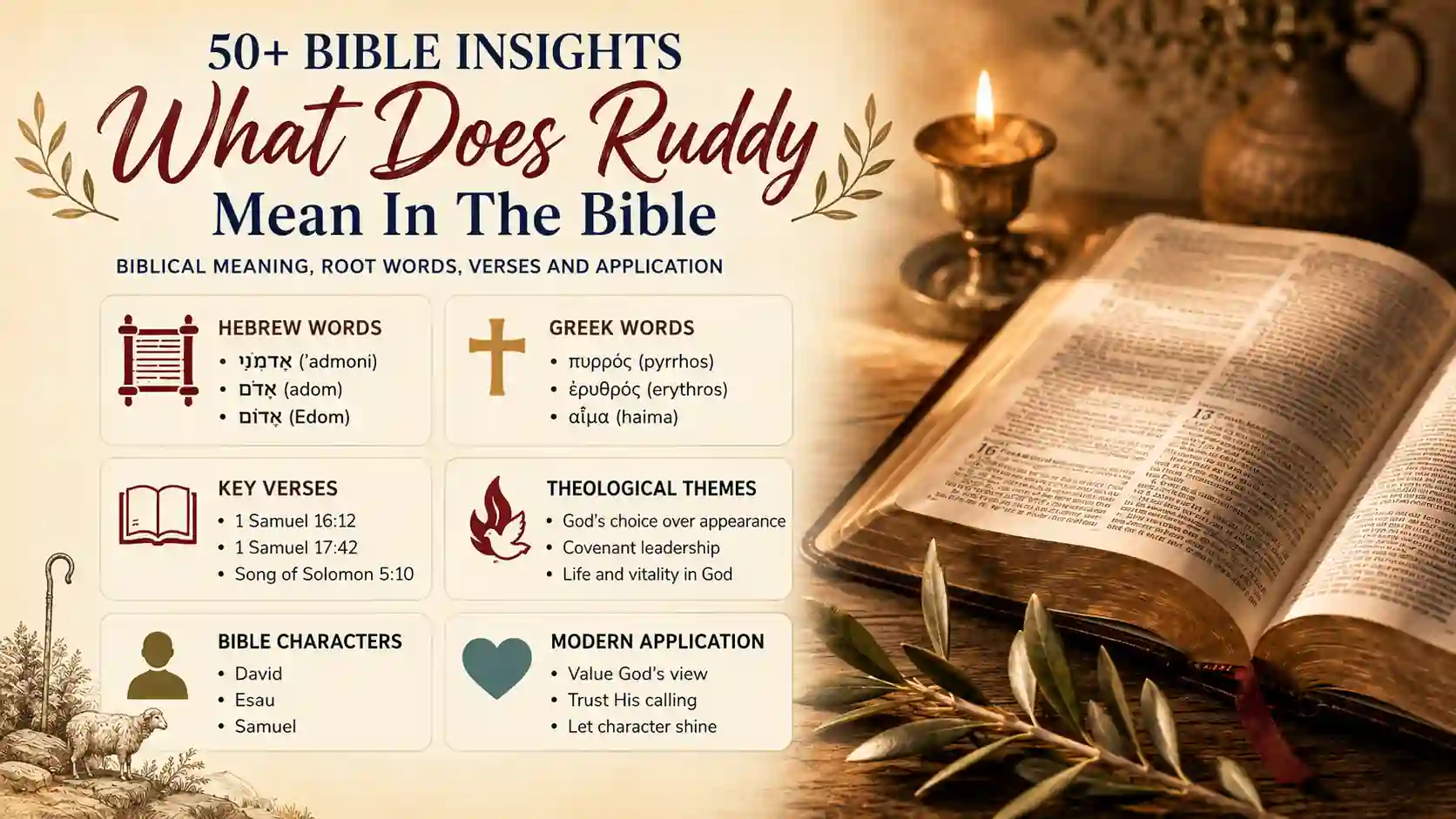
Original Hebrew and Greek Words for Ruddy
| Original Word | Transliteration | Strong’s # | Literal Meaning |
|---|---|---|---|
| אַדְמוֹנִי | ʾadmoni | H132 | Ruddy, reddish |
| אָדֹם | adom | H122 | Red |
| אֱדוֹם | Edom | H123 | Red land, Esau’s nation |
| אָדָם | adam | H120 | Man, humanity |
| דָּם | dam | H1818 | Blood |
| πυρρός | pyrrhos | G4450 | Fiery red |
| ἐρυθρός | erythros | G2063 | Red |
| αἷμα | haima | G129 | Blood |
Related Biblical Concepts for Ruddy
| Concept | Connection | Supporting Verse |
|---|---|---|
| Divine election | David chosen despite appearance | 1 Samuel 16:7 |
| Youth | David’s early life | 1 Samuel 17:42 |
| Health | Healthy complexion | Lamentations 4:7 |
| Beauty | Physical attractiveness | Song of Solomon 5:10 |
| Humanity | Linked with adam and red earth | Genesis 2:7 |
| Covenant kingship | David’s anointing | 1 Samuel 16:13 |
| Blood | Shared Hebrew root | Leviticus 17:11 |
| Edom | Name associated with red | Genesis 25:30 |
Historical and Cultural Context for Ruddy
| Aspect | Detail | Biblical Source |
|---|---|---|
| Shepherd life | Outdoor work produced healthy color | 1 Samuel 16 |
| Ancient beauty | Healthy complexion admired | Song of Solomon 5 |
| Royal selection | God rejected appearance alone | 1 Samuel 16:7 |
| Family identity | Physical traits remembered | Genesis 25 |
| Hebrew symbolism | Red linked with blood and life | Leviticus 17:11 |
| Agriculture | Red earth shaped vocabulary | Genesis 2:7 |
| Poetry | Color expressed admiration | Song of Solomon |
| Prophecy | Red signified judgment or warfare | Zechariah 1 |
Theological Themes for Ruddy
| Theme | Explanation | Scripture |
|---|---|---|
| God’s choice | God values the heart above appearance | 1 Samuel 16:7 |
| Covenant leadership | David prepared for kingship | 1 Samuel 16:13 |
| Human weakness | Youth did not limit God’s power | 1 Samuel 17 |
| Beauty under God | Physical beauty is secondary | Proverbs 31:30 |
| Life | Red recalls blood and vitality | Leviticus 17:11 |
| Worship | God forms people for His glory | Isaiah 43:7 |
| Hope | God restores what fades | Lamentations 4 |
| Messiah | David points toward Christ | Luke 1:32 |
Modern Application for Believers
| Area | Practice | Scripture |
|---|---|---|
| Identity | Value God’s view above appearance | 1 Samuel 16:7 |
| Leadership | Trust God’s calling | 1 Timothy 4:12 |
| Humility | Remember outward looks can mislead | James 2:1 |
| Health | Care for the body wisely | 1 Corinthians 6:19 |
| Worship | Celebrate God’s creative design | Psalm 139:14 |
| Service | Let character shine first | Matthew 5:16 |
| Faith | Depend on God’s strength | Philippians 4:13 |
| Hope | Look beyond temporary appearance | 2 Corinthians 4:16 |
The Hebrew Root אַדְמוֹנִי and What Does Ruddy Mean in the Bible
The primary Hebrew word translated “ruddy” is אַדְמוֹנִי (ʾadmoni, H132). It comes from the same family of words as אָדֹם (adom, H122), meaning “red.” This connection reaches into several familiar biblical words, including אָדָם (adam, H120), the name of the first man, and אֱדוֹם (Edom, H123), the nation descended from Esau.
This shared vocabulary reminds you that biblical Hebrew often connects ideas through word families. Red earth, human life, blood, and a healthy complexion all belong to the same network of imagery. The Bible is not suggesting that every use carries the same meaning, but the language naturally evokes life, humanity, and earthly existence.
David’s Appearance and God’s Choice in First Samuel
The best known example of “ruddy” appears when Samuel visits Jesse’s house. David enters after his older brothers have been rejected. Scripture says he was ruddy, had beautiful eyes, and was handsome. Yet the narrative quickly shifts your attention from David’s appearance to God’s evaluation of his heart.
Immediately before David is introduced, the Lord tells Samuel that people look at outward appearance while God looks at the heart. The description of David is therefore not a contradiction but a literary contrast. David possessed an attractive appearance, yet that was never the reason for his anointing. God’s sovereign choice rested upon His own gracious purpose.
The same theme continues when Goliath sees David. The giant notices only a ruddy young shepherd and assumes victory will come easily. His judgment reflects the world’s habit of measuring strength by visible standards. David, however, trusted the Lord rather than his own abilities.
For your own study, this passage teaches an enduring lesson. Physical qualities may be gifts from God, but they never replace faith, obedience, or spiritual character. God’s kingdom advances through hearts surrendered to Him.
Red Imagery from Esau to Song of Solomon
The Bible uses red imagery in several different ways. Esau’s birth is described with the adjective אָדֹם (adom), emphasizing his reddish appearance. Later he trades his birthright for red stew, leading to the name Edom. Here the color becomes part of his personal and national identity.
In contrast, Song of Solomon praises the beloved as “white and ruddy.” This poetic language celebrates health, vigor, and attractiveness. Ancient Hebrew poetry frequently used vivid physical descriptions to express admiration without implying spiritual superiority.
Lamentations provides another perspective. Before Jerusalem’s destruction, the nobles were described as more ruddy than coral. Their healthy appearance symbolized prosperity before judgment came upon the city. The loss of that healthy complexion reflected the devastating effects of famine and exile.
These passages demonstrate that color imagery changes according to context. Sometimes it refers to appearance, sometimes to identity, and sometimes to blessing or judgment. Careful reading prevents you from assigning one meaning everywhere.
Red Symbolism Across the Old and New Testaments
Although the Greek New Testament rarely uses a direct equivalent for “ruddy,” it employs words such as πυρρός (pyrrhos, G4450) and ἐρυθρός (erythros, G2063) for the color red. These words often appear in prophetic or symbolic settings, especially in the Book of Revelation.
Red can symbolize blood, warfare, sacrifice, divine judgment, or life itself. These meanings arise from the broader biblical symbolism of color rather than from the adjective “ruddy.” As a result, you should distinguish between descriptive language about a person’s complexion and symbolic visions filled with prophetic imagery.
When you read about David being ruddy, the emphasis is ordinary description. When you read about red horses or a red dragon, the emphasis is symbolic vision. Context determines meaning.
The deeper theological lesson remains remarkably consistent throughout Scripture. God frequently works through people whom others underestimate. David’s youthful, ruddy appearance did not prevent him from becoming Israel’s greatest king and the covenant ancestor of the Messiah. His story ultimately points beyond himself to Jesus Christ, the greater Son of David, whose kingdom is established not through outward impressiveness but through faithful obedience, sacrificial love, and resurrection power.
As you continue your Bible study, remember that descriptive words often serve larger narrative purposes. “Ruddy” is not merely a note about skin tone. It introduces readers to a shepherd whom God transformed into a king. It reminds you that the Lord sees beyond appearances and accomplishes His purposes through those whose hearts belong to Him.
FAQs
Does the Hebrew word אַדְמוֹנִי (ʾadmoni) always mean red skin?
No. It generally describes a healthy reddish complexion or appearance, with the exact nuance determined by context.
Why is David called ruddy if God looks at the heart?
The description identifies David’s appearance, while the surrounding passage makes clear that God chose him because of his heart, not his looks.
Is there a difference between אַדְמוֹנִי (ʾadmoni) and אָדֹם (adom)?
Yes. ʾAdmoni usually describes a ruddy person, while adom is the broader adjective meaning “red.”
Does Song of Solomon 5:10 use “ruddy” symbolically or literally?
Primarily literally within poetic language, portraying the beloved as healthy, attractive, and vigorous.
Can believers apply the meaning of ruddy spiritually today?
Yes. The lasting lesson is not about appearance but about trusting God’s evaluation of the heart above outward impressions.