
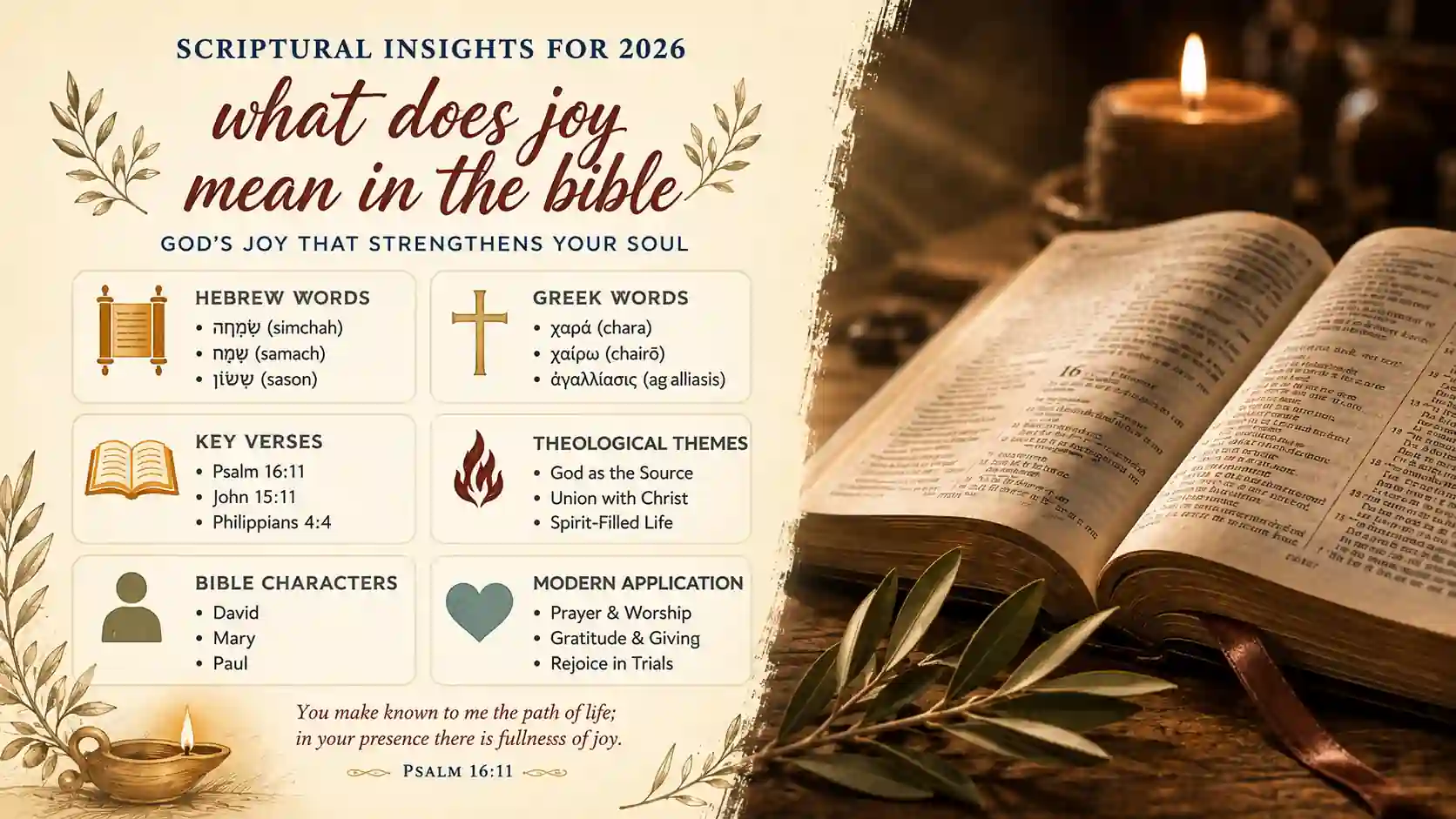
What does joy mean in the Bible? Scripture presents joy as a deep, God-centered gladness produced by his presence, salvation, faithfulness, and future promises. Biblical joy may include cheerful emotion, but it is stronger than a passing feeling or pleasant circumstance.
In your study, you will find joy expressed through worship, obedience, fellowship, answered prayer, and hope. You will also see believers rejoicing amid sorrow because their confidence rests in God. From Israel’s festival celebrations to the joy of Christ and the fruit of the Spirit, biblical joy responds to who God is and what he has done.
Joy in Key Scripture References
| Verse | Passage Snippet | Context |
|---|---|---|
| Psalm 16:11 | Fullness of joy in God’s presence | David trusts God as his lasting portion |
| Psalm 30:5 | Joy comes with the morning | Deliverance follows a season of weeping |
| Psalm 51:12 | Restore the joy of salvation | David repents after serious sin |
| Nehemiah 8:10 | The Lord’s joy gives strength | Israel hears the Law and renews worship |
| Isaiah 35:10 | Everlasting joy crowns the redeemed | Exiles are promised restoration |
| Habakkuk 3:18 | Rejoicing in the saving God | Faith continues despite agricultural ruin |
| John 15:11 | Christ gives complete joy | Jesus teaches his disciples to abide |
| Romans 15:13 | God fills believers with joy | Faith produces hope through the Spirit |
| Philippians 4:4 | Rejoice in the Lord always | Paul writes while enduring imprisonment |
| 1 Peter 1:8 | Inexpressible, glorious joy | Christians love Christ without seeing him |
Joy in Bible Translation Comparison
| Verse | KJV | NIV | ESV | NASB |
|---|---|---|---|---|
| Psalm 16:11 | Fullness of joy | Fill me with joy | Fullness of joy | Fullness of joy |
| Psalm 30:5 | Joy cometh | Rejoicing comes | Joy comes | Shout of joy |
| Psalm 51:12 | Joy of thy salvation | Joy of your salvation | Joy of your salvation | Joy of your salvation |
| Nehemiah 8:10 | Joy of the Lord | Joy of the Lord | Joy of the Lord | Joy of the Lord |
| Habakkuk 3:18 | Joy in the God | Joyful in God | Joy in God | Rejoice in God |
| John 15:11 | Joy might remain | My joy may be | My joy may be | My joy may be |
| Romans 15:13 | Fill you with all joy | Fill you with all joy | Fill you with all joy | Fill you with all joy |
| Philippians 4:4 | Rejoice alway | Rejoice always | Rejoice always | Rejoice always |
| James 1:2 | Count it all joy | Consider it pure joy | Count it all joy | Consider it all joy |
| 1 Peter 1:8 | Joy unspeakable | Inexpressible joy | Inexpressible joy | Inexpressible joy |
Joy and the People Who Embody It
| Person | Role | Connection |
|---|---|---|
| David | King and psalmist | Found joy in God’s presence and salvation |
| Hannah | Mother and worshiper | Rejoiced in God after receiving Samuel |
| Ezra | Priest and scribe | Helped Israel recover covenant joy |
| Nehemiah | Governor | Directed mourners toward the Lord’s joy |
| Mary | Mother of Jesus | Rejoiced in God her Savior |
| John the Baptist | Forerunner | Rejoiced at the Bridegroom’s arrival |
| Jesus Christ | Messiah and Son | Gives his own joy to disciples |
| Paul | Apostle | Rejoiced in Christ during imprisonment |
| Barnabas | Missionary encourager | Rejoiced when he saw God’s grace |
| Early disciples | Christian witnesses | Rejoiced despite persecution and loss |
Joy in the Original Hebrew and Greek Words
| Original Word | Transliteration | Strong’s # | Literal Meaning |
|---|---|---|---|
| שִׂמְחָה | simchah | H8057 | Joy, gladness, festal pleasure |
| שָׂמַח | samach | H8055 | To rejoice or be glad |
| שָׂשׂוֹן | sason | H8342 | Exultation, rejoicing |
| גִּיל | gil | H1524 | Rejoicing, exultation |
| רָנַן | ranan | H7442 | To cry or sing joyfully |
| חֶדְוָה | chedvah | H2304 | Gladness or rejoicing |
| χαρά | chara | G5479 | Joy, delight, gladness |
| χαίρω | chairō | G5463 | To rejoice or be glad |
| ἀγαλλίασις | agalliasis | G20 | Exultation, great gladness |
| ἀγαλλιάω | agalliaō | G21 | To rejoice exceedingly |
Joy and Related Biblical Concepts
| Concept | Connection | Supporting Verse |
|---|---|---|
| God’s presence | True joy flourishes near God | Psalm 16:11 |
| Salvation | Redemption awakens rejoicing | Psalm 51:12 |
| Worship | Joy is voiced through praise | Psalm 100:1-2 |
| Obedience | Abiding in Christ completes joy | John 15:10-11 |
| Holy Spirit | Joy is fruit produced by the Spirit | Galatians 5:22 |
| Hope | Trusting God fills believers with joy | Romans 15:13 |
| Fellowship | Shared faith increases joy | Philippians 1:25 |
| Suffering | Trials can mature steadfast faith | James 1:2-4 |
| Generosity | Willing giving becomes joyful worship | 2 Corinthians 9:7 |
| Resurrection | Christ’s victory turns grief into joy | John 16:20-22 |
Joy in Historical and Cultural Context
| Aspect | Detail | Biblical Source |
|---|---|---|
| Harvest celebrations | Israel rejoiced over God’s provision | Deuteronomy 16:13-15 |
| Passover | Deliverance was remembered with sacred feasting | Exodus 12:14 |
| Feast of Weeks | Firstfruits inspired communal rejoicing | Deuteronomy 16:9-11 |
| Feast of Booths | Families celebrated wilderness preservation | Leviticus 23:39-43 |
| Temple worship | Music and sacrifice expressed covenant joy | 2 Chronicles 29:27-30 |
| Royal accession | A righteous king prompted public gladness | 1 Kings 1:39-40 |
| Wedding customs | Bridegroom imagery communicated celebration | John 3:29 |
| Return from exile | Restoration brought laughter and songs | Psalm 126:1-3 |
| Shared meals | Early Christians ate with glad hearts | Acts 2:46 |
| Persecution | Disciples rejoiced at suffering for Christ | Acts 5:41 |
Joy and Its Theological Themes
| Theme | Explanation | Scripture |
|---|---|---|
| God as the source | Joy begins in God, not possessions | Psalm 43:4 |
| Covenant faithfulness | God’s promises sustain his people | Isaiah 55:12 |
| Messianic salvation | Jesus’ arrival brings good news and joy | Luke 2:10-11 |
| Union with Christ | Abiding in Jesus produces complete joy | John 15:4-11 |
| Spirit-filled life | The Spirit cultivates holy gladness | Galatians 5:22 |
| Kingdom reality | God’s reign includes joy in the Spirit | Romans 14:17 |
| Joy through suffering | Affliction cannot cancel gospel hope | 2 Corinthians 6:10 |
| Communal rejoicing | Believers share one another’s joy | Romans 12:15 |
| Eschatological hope | Final redemption brings lasting gladness | Revelation 19:6-7 |
| Glory of God | Joy directs praise toward God’s goodness | Jude 24-25 |
Joy in Modern Christian Practice
| Area | Practice | Scripture |
|---|---|---|
| Prayer | Ask God to restore spiritual gladness | Psalm 51:12 |
| Scripture | Receive God’s words as heart-deep joy | Jeremiah 15:16 |
| Worship | Serve the Lord with gladness | Psalm 100:2 |
| Gratitude | Remember God’s works with thanksgiving | Psalm 92:4 |
| Trials | View hardship through maturing faith | James 1:2-4 |
| Relationships | Rejoice with those who rejoice | Romans 12:15 |
| Service | Find joy in faithful gospel labor | Philippians 2:17-18 |
| Giving | Offer resources willingly and cheerfully | 2 Corinthians 9:7 |
| Witness | Celebrate repentance and salvation | Luke 15:7 |
| Hope | Fix your expectation on Christ’s return | 1 Peter 1:6-9 |
שִׂמְחָה And the Covenant Joy of Israel
The Hebrew noun שִׂמְחָה, simchah, describes joy, gladness, and festive celebration. It often appears where God’s people gather around his gifts. Harvests, marriages, worship, royal events, and covenant renewal could all become occasions for simchah because Israel understood good things as blessings from the Lord.
This joy was never meant to encourage careless pleasure. Deuteronomy repeatedly joins rejoicing with worship, generosity, and remembrance. Israelites celebrated before God while including servants, Levites, foreigners, orphans, and widows. Covenant joy received God’s provision gratefully and shared it generously.
Related Hebrew words deepen the picture. שָׂמַח, samach, means to rejoice or become glad, while שָׂשׂוֹן, sason, often describes exultant gladness. רָנַן, ranan, can refer to a joyful cry or ringing song. Biblical joy therefore moves from the heart into singing, feasting, testimony, and compassionate community.
The prophets also connected joy with restoration. Isaiah pictured the redeemed returning to Zion with everlasting joy, while Jeremiah described mourning being turned into gladness. Israel’s joy could be interrupted by sin, judgment, and exile, but God promised that sorrow would not have the final word.
What Does Joy Mean in the Bible Through χαρά?
The principal New Testament noun for joy is χαρά, chara. It describes joy, gladness, delight, or an occasion for rejoicing. Its related verb χαίρω, chairō, means to rejoice. These words appear frequently around the gospel, answered prayer, Christian fellowship, faithful service, and the expectation of Christ’s return.
New Testament joy is decisively centered on Jesus. The announcement of his birth was good news of great joy. John the Baptist rejoiced to hear the Bridegroom, the disciples rejoiced at the risen Lord, and Jesus promised that no one would permanently take away the joy created by his resurrection.
In John 15, Jesus speaks of “my joy” being in his disciples. This language shows that Christian joy is not self-generated optimism. It is participation in the Son’s delight as you remain in his love, receive his words, and obey his commands. Christ’s joy accompanies fellowship with Christ.
Luke also uses ἀγαλλίασις, agalliasis, and ἀγαλλιάω, agalliaō, for intense or exultant joy. Mary rejoiced in God her Savior, and the unborn John responded joyfully to the presence of the Messiah. Such joy recognizes that God is fulfilling his saving promises.
The Holy Spirit Makes Joy Stronger than Circumstances
Paul names joy as fruit of the Holy Spirit in Galatians 5:22. Fruit is the result of divine life at work, not a mood you manufacture through willpower. As the Spirit directs your heart toward Christ, he forms a glad confidence rooted in grace, truth, reconciliation, and hope.
Romans 14:17 places joy beside righteousness and peace within God’s kingdom. Joy is therefore moral and relational, not merely emotional. It flourishes where people live under God’s gracious rule, pursue peace, abandon selfish rivalry, and serve one another in love.
This explains how Paul could rejoice while imprisoned. He did not deny pain, danger, disappointment, or injustice. His joy rested in the progress of the gospel, the presence of Christ, the prayers of believers, and the certainty that Christ would be honored whether Paul lived or died.
Habakkuk displays the same pattern before the New Testament era. Even if crops failed and livestock disappeared, he would rejoice in the God of his salvation. Biblical joy can lament honestly while still confessing that God remains faithful, worthy, and sufficient.
Joy in Psalms, Prophets, Gospels, and Epistles
The Psalms teach you to seek joy in God’s presence, salvation, steadfast love, and mighty works. They never pretend that worshipers are always cheerful. Lament and joy frequently stand close together because prayer brings grief into communion with the faithful God.
The prophets place joy within the hope of redemption. Desolate lands will blossom, captives will return, mourning will end, and God’s people will sing. Prophetic joy looks beyond immediate ruin toward the Lord’s promised renewal of his people and creation.
The Gospels reveal that promised joy arriving in Jesus. His birth, teaching, miracles, death, resurrection, and ascension advance God’s saving kingdom. Although the cross produces grief, the resurrection transforms that grief into a joy grounded in victory over sin and death.
The Epistles call you to practice this joy through faith, prayer, unity, generosity, and hope. “Rejoice always” does not command emotional pretense. It summons you to return continually to the Lord as the unchanging reason for confidence, even while tears remain.
Questions About Biblical Joy
Does שִׂמְחָה, simchah, mean only an inward feeling?
No. It can describe inner gladness expressed through worship, feasting, singing, generosity, and communal celebration.
Why does James tell believers to count trials as joy?
James 1:2-4 teaches that trials become occasions for joy because tested faith produces endurance and spiritual maturity.
Is χαρά, chara, different from ordinary happiness?
Chara may include happy emotion, but New Testament joy is especially grounded in God’s salvation, Christ’s presence, and enduring hope.
Can a Christian experience sorrow and joy simultaneously?
Yes. Paul describes believers as sorrowful yet always rejoicing because grief and confidence in God can coexist.
How can you recover joy when you feel spiritually dry?
Follow David’s example in Psalm 51 by confessing sin, seeking renewed fellowship with God, and asking him to restore the joy of salvation.