
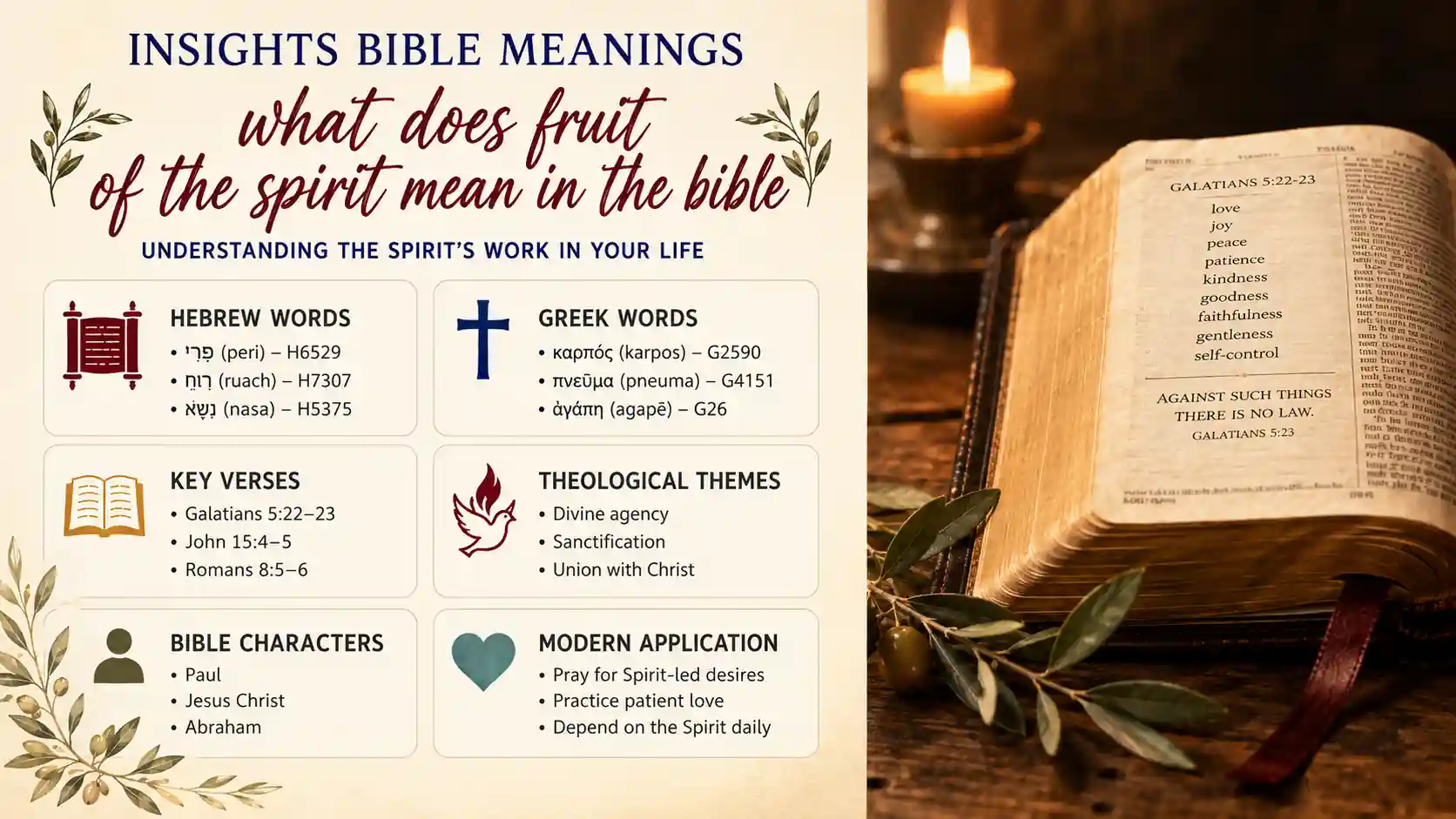
What does fruit of the spirit mean in the bible? The phrase describes the Spirit-produced character that grows in people who belong to Jesus Christ. In Galatians 5:22–23, Paul names nine qualities that stand in direct contrast to the destructive works of fallen human nature.
The image is organic rather than mechanical. Fruit develops through living union, patient growth, and divine nurture. As you walk by the Holy Spirit, he reshapes your desires, relationships, decisions, and conduct so that the character of Christ becomes increasingly visible in you.
Key Fruit Scripture References
| Verse | Passage Snippet | Context |
|---|---|---|
| Galatians 5:16 | Walk by the Spirit | Command preceding the fruit list |
| Galatians 5:18 | Led by the Spirit | Freedom from law’s condemnation |
| Galatians 5:22 | Fruit of the Spirit | Seven qualities begin the list |
| Galatians 5:23 | Gentleness and self-control | Final qualities and legal harmony |
| Galatians 5:24 | Crucified the flesh | Believers reject sinful passions |
| Galatians 5:25 | Live by the Spirit | Spiritual life shapes daily conduct |
| John 15:4–5 | Bear much fruit | Fruit comes through abiding in Christ |
| Romans 8:5–6 | Mind set on the Spirit | Spiritual desires produce life and peace |
| Ephesians 5:9 | Fruit of the light | Goodness, righteousness, and truth |
| Philippians 1:11 | Fruit of righteousness | Christ produces conduct honoring God |
Fruit Bible Translation Comparison
| Verse | KJV | NIV | ESV | NASB |
|---|---|---|---|---|
| Galatians 5:22 | love | love | love | love |
| Galatians 5:22 | joy | joy | joy | joy |
| Galatians 5:22 | peace | peace | peace | peace |
| Galatians 5:22 | longsuffering | forbearance | patience | patience |
| Galatians 5:22 | gentleness | kindness | kindness | kindness |
| Galatians 5:22 | goodness | goodness | goodness | goodness |
| Galatians 5:22 | faith | faithfulness | faithfulness | faithfulness |
| Galatians 5:23 | meekness | gentleness | gentleness | gentleness |
| Galatians 5:23 | temperance | self-control | self-control | self-control |
The KJV’s “gentleness” represents χρηστότης, while most recent translations use “kindness.” Its “faith” can also mean faithfulness in this ethical list, and “temperance” refers to mastery over one’s desires.
People and Characters Associated with Fruit
| Person | Role | Connection |
|---|---|---|
| Paul | Apostle and author | Teaches the Spirit’s fruit in Galatians |
| Holy Spirit | Divine producer | Creates the qualities Paul names |
| Jesus Christ | Redeemer and pattern | His character embodies the entire fruit |
| Galatian believers | Original readers | Called to reject fleshly rivalry |
| Abraham | Man of faith | Illustrates promise received through faith |
| Sarah | Free woman | Represents freedom and divine promise |
| Hagar | Enslaved woman | Illustrates bondage in Paul’s argument |
| Isaac | Child of promise | Pictures life created by God’s promise |
| Peter | Fellow apostle | Corrected when conduct obscured gospel unity |
| Barnabas | Paul’s coworker | Influenced during the Antioch conflict |
Original Hebrew and Greek Fruit Words
| Original Word | Transliteration | Strong’s # | Literal Meaning |
|---|---|---|---|
| פְּרִי | peri | H6529 | fruit, produce, offspring |
| רוּחַ | ruach | H7307 | breath, wind, spirit |
| καρπός | karpos | G2590 | fruit, harvest, result |
| πνεῦμα | pneuma | G4151 | spirit, breath, wind |
| ἀγάπη | agapē | G26 | self-giving love |
| χαρά | chara | G5479 | joy, gladness |
| εἰρήνη | eirēnē | G1515 | peace, wholeness |
| μακροθυμία | makrothymia | G3115 | patience, long temper |
| χρηστότης | chrēstotēs | G5544 | kindness, moral goodness |
| ἐγκράτεια | enkrateia | G1466 | self-mastery, restraint |
The governing Greek expression is ὁ καρπὸς τοῦ πνεύματος, ho karpos tou pneumatos, meaning “the fruit of the Spirit.” Paul uses the singular καρπός, presenting these virtues as one integrated harvest produced by the Spirit.
Related Biblical Fruit Concepts
| Concept | Connection | Supporting Verse |
|---|---|---|
| Abiding in Christ | Union with Christ enables fruitfulness | John 15:4–5 |
| Walking by the Spirit | Daily dependence resists sinful desire | Galatians 5:16 |
| New creation | Grace forms a renewed way of life | Galatians 6:15 |
| Sanctification | God progressively transforms believers | 2 Corinthians 3:18 |
| Love of neighbor | Love summarizes relational obedience | Galatians 5:14 |
| Crucifying the flesh | Sinful passions lose rightful rule | Galatians 5:24 |
| Sowing to the Spirit | Spiritual choices yield eternal harvest | Galatians 6:8 |
| Spiritual freedom | Freedom serves others through love | Galatians 5:13 |
| Christlike character | The Spirit forms Jesus’ likeness | Romans 8:29 |
| Good works | Renewed character produces useful action | Colossians 1:10 |
Historical and Cultural Fruit Context
| Aspect | Detail | Biblical Source |
|---|---|---|
| Galatian audience | Several churches received one circular letter | Galatians 1:2 |
| Gentile mission | Many readers entered faith apart from Judaism | Galatians 4:8 |
| Circumcision dispute | Teachers pressed Gentiles toward circumcision | Galatians 5:2–6 |
| Mosaic law debate | Paul opposed law-keeping as justification | Galatians 3:10–14 |
| Spirit reception | Believers received the Spirit through faith | Galatians 3:2–5 |
| Freedom language | Christian liberty was not permission for sin | Galatians 5:13 |
| Moral lists | Works of flesh contrast with spiritual fruit | Galatians 5:19–23 |
| Community conflict | Biting and envy threatened congregational life | Galatians 5:15, 26 |
| Agricultural imagery | Sowing and reaping explain moral consequences | Galatians 6:7–9 |
| Mission background | Paul preached in cities of Asia Minor | Acts 13–14 |
Galatians addresses pressure placed upon Gentile Christians to adopt circumcision and related observances as necessary marks of covenant membership. Paul answers that justification and the gift of the Spirit come through faith in Christ, not through becoming Jewish proselytes.
Theological Fruit Themes
| Theme | Explanation | Scripture |
|---|---|---|
| Divine agency | The Spirit produces what flesh cannot | Galatians 5:22 |
| Grace before obedience | Life in Christ precedes spiritual conduct | Galatians 2:20 |
| Justification by faith | Acceptance with God is not earned | Galatians 2:16 |
| Sanctification | The gospel transforms behavior and desire | Galatians 5:16 |
| Union with Christ | Believers share Christ’s crucified life | Galatians 2:20 |
| Christian freedom | Liberty becomes loving service | Galatians 5:13 |
| Moral unity | One fruit contains many related qualities | Galatians 5:22–23 |
| Fulfillment of love | Neighbor-love expresses the law’s intention | Galatians 5:14 |
| Flesh and Spirit | Two opposing powers shape human conduct | Galatians 5:17 |
| Persevering harvest | Faithful sowing eventually bears fruit | Galatians 6:9 |
Modern Fruit Application for Believers
| Area | Practice | Scripture |
|---|---|---|
| Prayer | Ask for Spirit-governed desires | Luke 11:13 |
| Relationships | Choose patient, active love | 1 Corinthians 13:4 |
| Conflict | Answer gently rather than retaliating | Proverbs 15:1 |
| Anxiety | Bring concerns to God in prayer | Philippians 4:6–7 |
| Temptation | Depend on the Spirit and practice restraint | Galatians 5:16 |
| Speech | Use words that strengthen others | Ephesians 4:29 |
| Service | Use freedom to serve through love | Galatians 5:13 |
| Endurance | Continue doing good without surrender | Galatians 6:9 |
| Community | Restore struggling believers gently | Galatians 6:1 |
| Self-examination | Evaluate patterns rather than appearances | Matthew 7:16–20 |
What Does Fruit of the Spirit Mean in the Bible’S Greek Text?
Paul’s word καρπός, karpos, refers literally to fruit or produce and figuratively to the outcome revealed by a living source. The phrase does not describe religious decoration added to an unchanged life. It describes visible evidence that God’s Spirit is actively working within a believer.
The singular “fruit” is significant. Love, joy, peace, patience, kindness, goodness, faithfulness, gentleness, and self-control belong together as dimensions of one Spirit-formed character. You may mature unevenly, but you cannot rightly cherish kindness while excusing habitual faithlessness or claim joy while refusing love.
Walking by Πνεῦμα in the Freedom of Galatians
The immediate command is not “manufacture fruit,” but “walk by the Spirit.” The verb pictures an ongoing manner of life. You yield your mind, desires, habits, and relationships to the Holy Spirit, trusting him to oppose the desires of the flesh and to direct you toward what pleases God.
This teaching belongs within Paul’s defense of gospel freedom. The Galatians were not to seek justification through circumcision, yet neither were they to turn liberty into self-indulgence. Life under the Spirit is neither legalistic bondage nor moral carelessness. It is freedom expressed through loving service.
The Ninefold Harvest Reveals the Character of Christ
Every quality in the list appears perfectly in Jesus. His love gives itself for sinners, his joy rests in the Father, and his peace steadies fearful disciples. He shows patience toward weakness, kindness toward outsiders, goodness against evil, faithfulness unto death, gentleness toward the burdened, and self-control under temptation.
For that reason, the fruit is not merely a personality profile. Quiet believers do not possess gentleness automatically, and cheerful believers do not necessarily possess biblical joy. The Spirit takes your natural temperament, confronts its sinful distortions, and conforms your whole person to the holy character of Christ.
Why No Law Stands Against This Fruit
Paul closes the list by saying that “against such things there is no law.” God’s law never condemns genuine love, faithfulness, kindness, or self-control. The Spirit produces the kind of life toward which God’s righteous commands were always pointing, without making law-keeping the basis of acceptance with him.
This protects you from two errors. You should not treat spiritual fruit as a ladder by which you earn salvation, and you should not use grace to excuse loveless conduct. Fruit is not the root of your justification. It is the growing evidence that you have received life in Christ and are learning to keep in step with his Spirit.
Questions About the Fruit of the Spirit
Why does Galatians use the singular καρπός instead of “fruits”?
The singular emphasizes one unified Spirit-produced character expressed through nine interconnected qualities.
Why does the KJV translate χρηστότης as “gentleness” instead of “kindness”?
Older English usage allowed “gentleness” to describe gracious kindness, while modern translations distinguish it from πραΰτης, prautēs, in verse 23.
Does πίστις mean “faith” or “faithfulness” in Galatians 5:22?
Both meanings are possible, but “faithfulness” best fits a list describing observable qualities of dependable character.
Does “against such things there is no law” mean Christians have no moral commands?
No, it means that the Spirit’s fruit agrees with God’s moral will and is never condemned by righteous law.
Can you produce the fruit of the Spirit through personal discipline alone?
Discipline has a real place, but biblical fruit grows through dependence on the Spirit, abiding in Christ, and obedient participation in his work.