
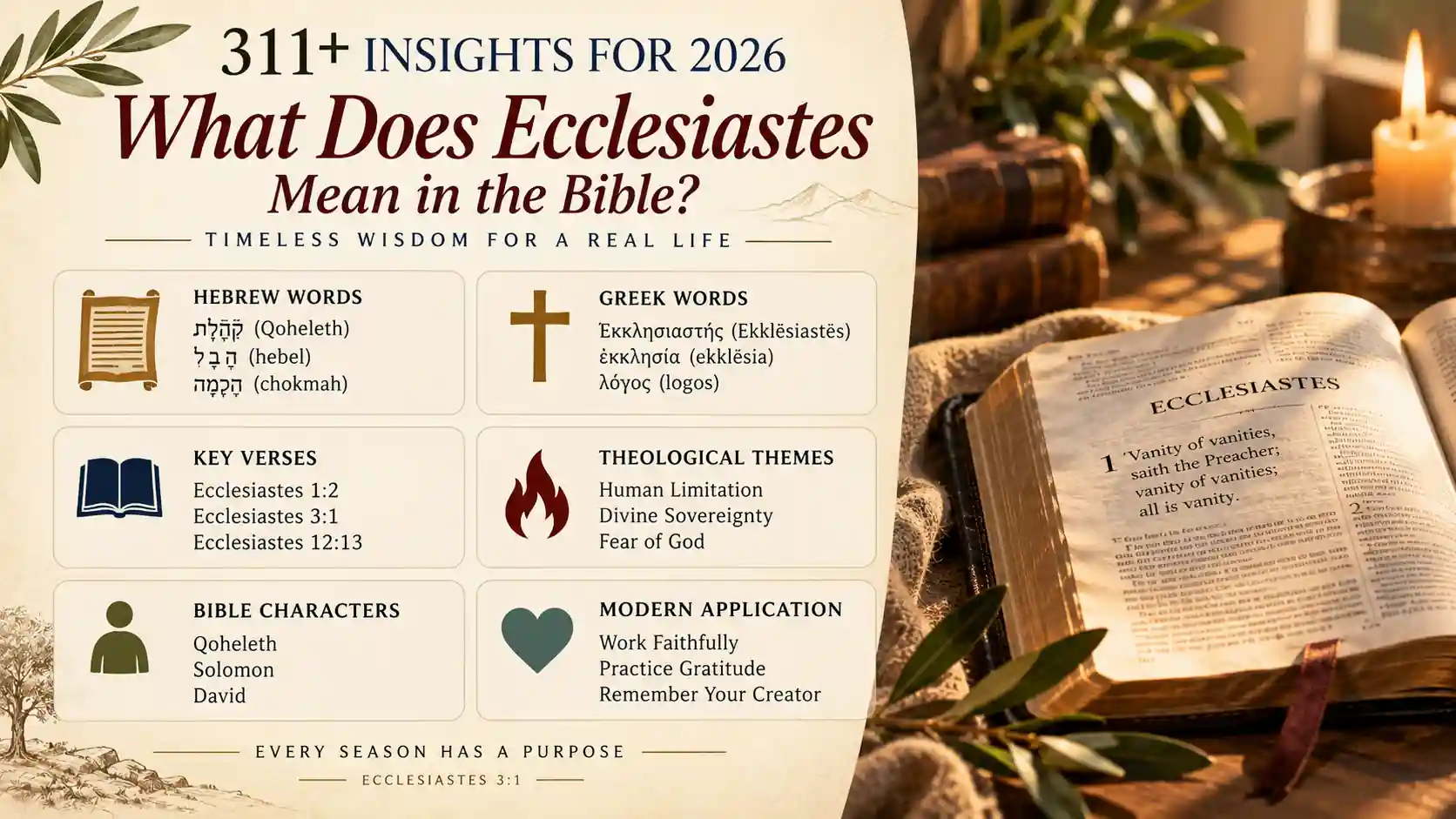
What does Ecclesiastes mean in the Bible? The book asks you to face life as it actually appears in a fallen, temporary world. Its Hebrew speaker is קֹהֶלֶת, Qoheleth, commonly rendered “Preacher” or “Teacher,” and its repeated word הֶבֶל, hebel, describes life as vapor-like, fleeting, and difficult to grasp.
Ecclesiastes does not teach hopelessness. It exposes the limits of human achievement, pleasure, wealth, and wisdom so that you learn to receive God’s gifts gratefully, live wisely, remember your Creator, fear God, and recognize that every life finally stands before His judgment.
Ecclesiastes Key Scripture References
| Verse | Passage Snippet | Context |
|---|---|---|
| Ecclesiastes 1:1 | “words of the Preacher” | Introduces קֹהֶלֶת, Qoheleth, the book’s teaching voice |
| Ecclesiastes 1:2 | “vanity of vanities” | הֶבֶל, hebel, establishes the book’s central problem |
| Ecclesiastes 1:3 | “under the sun” | Asks what lasting gain human labor finally produces |
| Ecclesiastes 2:24 | enjoy labor as God’s gift | Pleasure becomes meaningful when received from God |
| Ecclesiastes 3:1 | a season for everything | Human life unfolds within appointed times |
| Ecclesiastes 3:11 | eternity in their heart | God’s work exceeds humanity’s ability to comprehend it |
| Ecclesiastes 5:2 | God is in heaven | Worship requires humility rather than careless speech |
| Ecclesiastes 7:20 | no one always does good | Human sin limits claims to personal righteousness |
| Ecclesiastes 11:9 | God brings judgment | Joy and moral accountability belong together |
| Ecclesiastes 12:13 | fear God, keep commandments | The epilogue states the book’s practical conclusion |
Ecclesiastes Bible Translation Comparison
| Verse | KJV | NIV | ESV | NASB |
|---|---|---|---|---|
| 1:1 | Preacher | Teacher | Preacher | Preacher |
| 1:2 | vanity | meaningless | vanity | futility |
| 1:14 | vexation of spirit | chasing after wind | striving after wind | striving after wind |
| 2:17 | vanity | meaningless | vanity | futility |
| 3:11 | world | eternity | eternity | eternity |
| 5:10 | silver | money | money | money |
| 7:29 | inventions | schemes | schemes | devices |
| 9:10 | might | might | might | strength |
| 12:8 | vanity | meaningless | vanity | futility |
| 12:13 | whole duty of man | duty of all mankind | whole duty of man | applies to every person |
The differences are interpretive rather than contradictory. Especially important is הֶבֶל, hebel. “Vanity,” “meaningless,” and “futility” overlap, but the underlying Hebrew literally evokes breath or vapor, something real yet temporary, elusive, and impossible to hold permanently.
Ecclesiastes People and Characters Associated
| Person | Role | Connection |
|---|---|---|
| Qoheleth | Teacher or Preacher | Main speaking voice of Ecclesiastes |
| David | Israel’s king | Qoheleth is introduced as “son of David” |
| Solomon | Son of David and wisdom king | Traditionally associated with the royal portrait |
| God | Sovereign Creator | Gives life, work, enjoyment, times, and judgment |
| Wise person | Recurring character | Recognizes wisdom’s value and limits |
| Fool | Recurring contrast | Lives carelessly and speaks without discernment |
| Worker | Human laborer | Represents toil performed “under the sun” |
| Rich person | Possessor of wealth | Shows wealth cannot guarantee satisfaction |
| Youth | Hearer of instruction | Told to rejoice while remembering judgment |
| Creator | Divine title | Youth are commanded to remember Him in 12:1 |
Ecclesiastes 1 presents its speaker as “son of David, king in Jerusalem,” which naturally evokes Solomon, whose biblical reputation centers on extraordinary wisdom and royal prosperity. The precise authorship and dating of Ecclesiastes have nevertheless been debated throughout the history of interpretation.
Ecclesiastes Original Hebrew and Greek Words
| Original Word | Transliteration | Strong’s # | Literal Meaning |
|---|---|---|---|
| קֹהֶלֶת | Qoheleth | H6953 | assembler, speaker, preacher |
| קָהַל | qahal | H6950 | to assemble, gather |
| הֶבֶל | hebel | H1892 | breath, vapor, vanity |
| חָכְמָה | chokmah | H2451 | wisdom, skill |
| עָמָל | amal | H5999 | toil, labor, trouble |
| יִתְרוֹן | yitron | H3504 | advantage, profit, gain |
| יָרֵא | yare | H3372 | fear, revere |
| אֱלֹהִים | Elohim | H430 | God |
| קָהָל | qahal | H6951 | assembly, congregation |
| ἐκκλησία | ekklēsia | G1577 | assembly, congregation |
The Greek title Ἐκκλησιαστής, Ekklēsiastēs, used in the Septuagint tradition, reflects the idea of someone addressing or connected with an assembly. The related Greek noun ἐκκλησία, ekklēsia, is Strong’s G1577 and means an assembly or congregation.
Ecclesiastes Related Biblical Concepts
| Concept | Connection | Supporting Verse |
|---|---|---|
| Wisdom | Valuable but unable to explain everything | Ecclesiastes 7:19, 23 |
| Creation | God orders times beyond human control | Ecclesiastes 3:1-11 |
| Fallenness | Life includes frustration, injustice, and death | Ecclesiastes 4:1 |
| Mortality | Death reaches wise and foolish alike | Ecclesiastes 2:14-16 |
| Work | Labor can become exhausting and temporary | Ecclesiastes 2:18-23 |
| Gift | Food, work, and enjoyment come from God | Ecclesiastes 3:12-13 |
| Providence | God’s work cannot be mastered by humans | Ecclesiastes 8:17 |
| Worship | God must be approached reverently | Ecclesiastes 5:1-2 |
| Judgment | God evaluates human conduct | Ecclesiastes 11:9 |
| Fear of God | Proper response to human limitation | Ecclesiastes 12:13 |
These concepts keep you from reading Ecclesiastes as simple pessimism. The Teacher repeatedly describes painful realities, yet he also tells you that ordinary goods such as food, work, companionship, and joy can be received as gifts from the hand of God.
Ecclesiastes Historical and Cultural Context
| Aspect | Detail | Biblical Source |
|---|---|---|
| Location | Jerusalem dominates the royal setting | Ecclesiastes 1:1, 12 |
| Royal imagery | Speaker describes kingly experience | Ecclesiastes 1:12 |
| Wisdom tradition | Investigation uses observation and reflection | Ecclesiastes 1:13 |
| Agriculture | Sowing, harvest, wind, and rain shape illustrations | Ecclesiastes 11:4-6 |
| Commerce | Wealth and possessions receive sustained attention | Ecclesiastes 5:10-15 |
| Government | Kings and officials appear repeatedly | Ecclesiastes 8:2-4 |
| Courts | Injustice may occur where justice is expected | Ecclesiastes 3:16 |
| Worship | Temple conduct and vows are addressed | Ecclesiastes 5:1-6 |
| Family life | Companionship is praised over isolation | Ecclesiastes 4:9-12 |
| Old age | Aging is portrayed through poetic imagery | Ecclesiastes 12:1-7 |
Ecclesiastes belongs to Israel’s wisdom literature alongside books such as Proverbs and Job. Its Hebrew contains features that many scholars associate with a later stage of biblical Hebrew, although proposals concerning authorship and date remain disputed.
Its social world includes kings, officials, workers, landowners, the wealthy, the oppressed, worshipers, and the poor. That range allows Qoheleth to examine life across social boundaries rather than restricting his observations to one occupation or class.
Ecclesiastes Theological Themes
| Theme | Explanation | Scripture |
|---|---|---|
| Human limitation | You cannot fully comprehend God’s ordering of life | Ecclesiastes 3:11 |
| Transience | Earthly achievements cannot be permanently possessed | Ecclesiastes 1:2-4 |
| Divine sovereignty | God determines times and circumstances | Ecclesiastes 3:1-14 |
| Enjoyment | Daily blessings should be received gratefully | Ecclesiastes 5:18-20 |
| Mortality | Death exposes the limits of earthly greatness | Ecclesiastes 9:2-6 |
| Wisdom | Wisdom helps, but it is not omniscience | Ecclesiastes 8:1, 17 |
| Justice | Present injustice does not erase divine judgment | Ecclesiastes 3:16-17 |
| Reverence | Proper worship begins with humility before God | Ecclesiastes 5:1-2 |
| Accountability | Human choices remain morally significant | Ecclesiastes 11:9 |
| Fear of God | Reverent obedience anchors faithful living | Ecclesiastes 12:13-14 |
One of Ecclesiastes’ most important tensions is that human life is both fleeting and meaningful. Your achievements cannot defeat death or guarantee permanent earthly gain, but your life still matters because it is lived before the sovereign God who gives gifts and judges deeds.
Ecclesiastes Modern Application for Believers
| Area | Practice | Scripture |
|---|---|---|
| Work | Labor faithfully without making career your ultimate hope | Ecclesiastes 2:22-24 |
| Money | Refuse to expect wealth to satisfy your soul | Ecclesiastes 5:10 |
| Gratitude | Receive ordinary pleasures as gifts from God | Ecclesiastes 3:12-13 |
| Worship | Approach God thoughtfully and reverently | Ecclesiastes 5:1-2 |
| Speech | Avoid careless promises before God | Ecclesiastes 5:4-6 |
| Friendship | Cultivate faithful companionship | Ecclesiastes 4:9-12 |
| Suffering | Admit that life includes mysteries you cannot solve | Ecclesiastes 8:16-17 |
| Youth | Enjoy life without forgetting accountability | Ecclesiastes 11:9 |
| Aging | Remember your Creator before strength fades | Ecclesiastes 12:1 |
| Obedience | Let reverence for God guide daily decisions | Ecclesiastes 12:13 |
Ecclesiastes encourages neither indulgence nor withdrawal. You are called to work, rejoice, eat, drink, love, worship, and live wisely while refusing to treat any created blessing as though it could provide the permanence that belongs to God alone.
קֹהֶלֶת Qoheleth Explains What Ecclesiastes Means in the Bible
The English name “Ecclesiastes” comes through the Greek tradition, but the Hebrew book identifies its central speaker as קֹהֶלֶת, Qoheleth. Strong’s H6953 connects the term with the Hebrew gathering root קהל, so translations such as “Preacher,” “Teacher,” “Convener,” or “Assembler” attempt to capture a person who gathers people or sayings for instruction.
That title helps you read the book correctly. Ecclesiastes is not merely a private diary of despair. Qoheleth speaks as a wisdom teacher who has investigated pleasure, labor, wealth, knowledge, injustice, aging, and death and now places his observations before a listening community.
הֶבֶל Hebel Is More than Saying Life Is Meaningless
The repeated Hebrew word הֶבֶל, hebel, Strong’s H1892, is essential to understanding Ecclesiastes. Literally associated with breath, mist, or vapor, it can communicate transience, elusiveness, absurdity, frustration, or lack of lasting gain depending on context. That explains why major English translations vary between “vanity,” “meaningless,” and “futility.”
Picture vapor leaving your mouth on a cold morning. You genuinely see it, yet you cannot seize it or preserve it. Ecclesiastes often describes earthly life similarly. Work, youth, beauty, wealth, reputation, and even wisdom are real goods, but none can be held forever or made into a substitute for God.
Life Under the Sun and the Limits of Human Wisdom
The phrase “under the sun” gives Ecclesiastes its distinctive field of observation. Qoheleth repeatedly studies what happens within ordinary mortal existence. Generations pass, workers die, fortunes change owners, injustice appears, wise people encounter circumstances they cannot control, and death eventually levels social distinctions.
Yet Ecclesiastes does not claim that wisdom is worthless. Wisdom is better than folly in several passages, but wisdom cannot make you sovereign. You cannot discover every purpose of God, control the future, escape mortality through intelligence, or guarantee outcomes simply by behaving prudently.
Fear God and Remember Your Creator
Ecclesiastes reaches its pastoral center when reverence replaces the illusion of control. “Fear God” does not mean treating the Lord as unpredictable or cruel. Biblical fear combines awe, humility, moral seriousness, and recognition that the Creator is God and you are His creature.
That perspective illuminates the calls to enjoy life. Ecclesiastes 12:1 tells you to remember your Creator, while 12:13-14 joins reverence, obedience, and judgment. Joy therefore becomes neither escapism nor self-indulgence. You receive life gratefully because it is God’s gift, and you live responsibly because it remains God’s world.
Questions About Ecclesiastes
Does קֹהֶלֶת, Qoheleth, mean Solomon?
Qoheleth is a title meaning something like Preacher or Teacher, while the book’s royal, Davidic description has traditionally led many readers to associate the speaker with Solomon.
Does הֶבֶל, hebel, really mean that everything is meaningless?
Not in every context. Hebel literally evokes vapor or breath and can emphasize life’s brevity, elusiveness, frustration, or inability to provide permanent gain.
Why does the KJV say “vanity” while the NIV often says “meaningless”?
Both attempt to interpret hebel, but “vanity” preserves an older traditional rendering while “meaningless” emphasizes perceived futility, and “vapor” better displays the Hebrew word picture.
How can Ecclesiastes praise enjoyment while also warning about judgment?
The book presents enjoyment as a gift from God, not an excuse for moral autonomy, so gratitude and accountability belong together in Ecclesiastes 11:9 and 12:13-14.
What does “fear God” in Ecclesiastes 12:13 mean for your daily life?
It means living with reverent humility, obeying God rather than trusting temporary achievements, and receiving ordinary life as a gift from the Creator.