
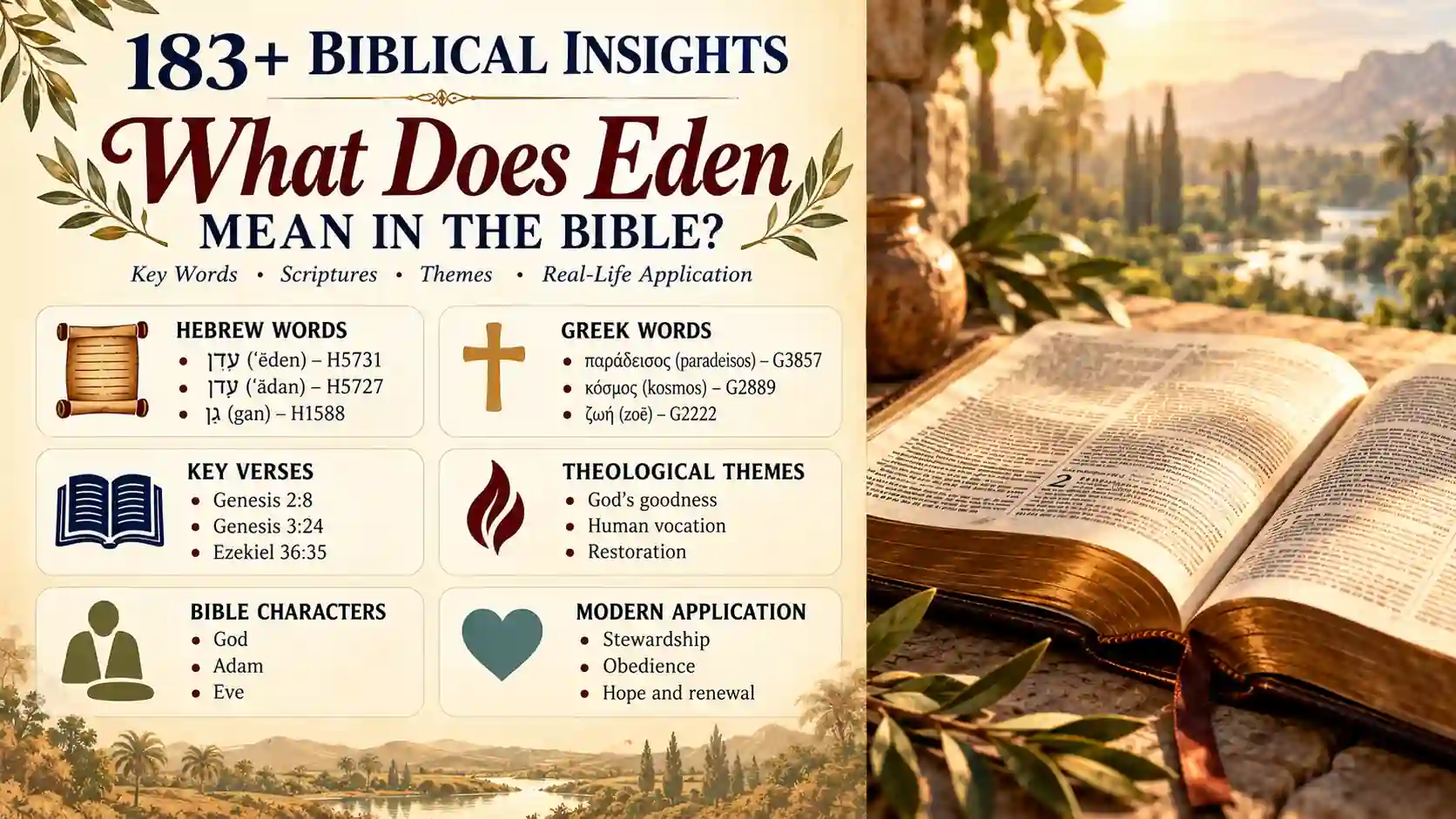
What does eden mean in the bible? The Hebrew name עֵדֶן, ʿēden, carries the sense of delight, pleasure, or abundance. In Genesis, Eden is the region where God plants a garden for the first human pair, making it both a real place in the biblical story and a powerful picture of life in God’s presence.
As you follow Eden through Scripture, you discover that its meaning reaches beyond Genesis. Prophets use Eden to describe extraordinary beauty and restoration, while the New Testament language of paradise develops related themes of fellowship, life, and final restoration.
Eden in the Key Scripture References
| Verse | Passage Snippet | Context |
|---|---|---|
| Genesis 2:8 | “garden eastward in Eden” | God plants the garden for humanity |
| Genesis 2:10 | “river went out of Eden” | Eden supplies water to the garden |
| Genesis 2:15 | “dress it and keep it” | Adam receives sacred responsibility |
| Genesis 3:23 | sent from Eden | Humanity leaves the garden after sin |
| Genesis 3:24 | cherubim guard the way | Access to the tree of life is restricted |
| Isaiah 51:3 | “like Eden” | Zion‘s restoration resembles God’s garden |
| Ezekiel 28:13 | “Eden the garden of God” | Eden symbolizes extraordinary splendor |
| Ezekiel 31:9 | “trees of Eden” | Eden represents unmatched created beauty |
| Ezekiel 36:35 | “like the garden of Eden” | Devastated land becomes fruitful again |
| Joel 2:3 | “garden of Eden before them” | Eden contrasts with approaching devastation |
Eden Across Major Bible Translations
| Verse | KJV | NIV | ESV | NASB |
|---|---|---|---|---|
| Genesis 2:8 | garden eastward | garden in the east | garden in Eden | garden toward the east |
| Genesis 2:10 | river out of Eden | river watering garden | river flowed out | river flowed out |
| Genesis 2:15 | dress and keep | work and care | work and keep | cultivate and keep |
| Genesis 3:23 | sent him forth | banished him | sent him out | sent him out |
| Isaiah 51:3 | like Eden | like Eden | like Eden | like Eden |
| Ezekiel 28:13 | garden of God | garden of God | garden of God | garden of God |
| Ezekiel 36:35 | garden of Eden | garden of Eden | garden of Eden | garden of Eden |
| Joel 2:3 | garden of Eden | garden of Eden | garden of Eden | garden of Eden |
People and Characters Connected with Eden
| Person | Role | Connection |
|---|---|---|
| God | Creator and Lord | Plants the garden and gives commands |
| Adam | First man | Placed in the garden to serve and guard |
| Eve | First woman | Lives with Adam in the garden |
| Serpent | Tempter | Challenges God’s command |
| Cherubim | Heavenly guardians | Guard the way to the tree of life |
| Isaiah | Prophet | Uses Eden as an image of restored Zion |
| Ezekiel | Prophet | Uses Eden in judgments and restoration imagery |
| Pharaoh | Egyptian ruler | Compared indirectly with Eden’s majestic trees |
| Prince of Tyre | Judged ruler | Addressed through Eden imagery |
| Joel | Prophet | Contrasts Eden’s beauty with devastation |
Eden in the Original Hebrew and Greek Words
| Original Word | Transliteration | Strong’s # | Literal Meaning |
|---|---|---|---|
| עֵדֶן | ʿēden | H5731 | delight, pleasure |
| עָדַן | ʿādan | H5727 | to delight, luxuriate |
| גַּן | gan | H1588 | garden, enclosed garden |
| עֵץ | ʿēts | H6086 | tree, wood |
| נָהָר | nāhār | H5104 | river, stream |
| כְּרוּב | keruv | H3742 | cherub |
| אָדָם | ʾādām | H120 | man, humanity |
| אֲדָמָה | ʾadāmāh | H127 | ground, soil |
| παράδεισος | paradeisos | G3857 | garden, paradise |
Biblical Concepts Closely Related to Eden
| Concept | Connection | Supporting Verse |
|---|---|---|
| Creation | Eden belongs to God’s ordered creation | Genesis 2:8 |
| Divine presence | God personally relates to humanity there | Genesis 3:8 |
| Life | The tree of life stands in the garden | Genesis 2:9 |
| Work | Adam receives meaningful cultivation | Genesis 2:15 |
| Stewardship | Humanity must tend and guard God’s garden | Genesis 2:15 |
| Marriage | Man and woman share life before God | Genesis 2:22-24 |
| Command | God defines moral boundaries | Genesis 2:16-17 |
| Sin | Rebellion disrupts Edenic fellowship | Genesis 3:6 |
| Exile | Humanity is expelled from the garden | Genesis 3:23 |
| Restoration | Prophets describe renewal in Edenic terms | Isaiah 51:3 |
Eden in Its Historical and Cultural Context
| Aspect | Detail | Biblical Source |
|---|---|---|
| Ancient setting | Eden is presented within primeval history | Genesis 2 |
| Eastern location | The garden is planted eastward in Eden | Genesis 2:8 |
| River system | One river divides into four branches | Genesis 2:10 |
| Pishon | Associated with Havilah | Genesis 2:11 |
| Gihon | Associated with Cush | Genesis 2:13 |
| Tigris | Described near Assyria | Genesis 2:14 |
| Euphrates | Fourth named river | Genesis 2:14 |
| Agriculture | Adam cultivates and guards the garden | Genesis 2:15 |
| Precious materials | Gold, bdellium, and onyx are mentioned | Genesis 2:12 |
| Sacred boundary | Cherubim protect access after the fall | Genesis 3:24 |
Theological Themes Revealed Through Eden
| Theme | Explanation | Scripture |
|---|---|---|
| God’s goodness | Eden displays generous divine provision | Genesis 2:8-9 |
| Human vocation | Work belongs to creation before the fall | Genesis 2:15 |
| Moral freedom | Humanity receives a genuine command | Genesis 2:16-17 |
| Fellowship | Human life begins under God’s presence | Genesis 3:8 |
| Rebellion | Sin rejects God’s trustworthy word | Genesis 3:1-6 |
| Judgment | Disobedience brings death and exile | Genesis 3:19-24 |
| Lost access | The tree of life becomes inaccessible | Genesis 3:24 |
| Restoration | Eden becomes prophetic language for renewal | Ezekiel 36:35 |
| Paradise | New Testament imagery recalls garden fellowship | Luke 23:43 |
| New creation | Life with God reaches fulfillment in Revelation | Revelation 22:1-5 |
Eden and Modern Application for Believers
| Area | Practice | Scripture |
|---|---|---|
| Worship | Receive creation as God’s gift | Genesis 2:8-9 |
| Work | Treat ordinary labor as meaningful service | Genesis 2:15 |
| Stewardship | Care responsibly for what God entrusts | Genesis 2:15 |
| Obedience | Take God’s commands seriously | Genesis 2:16-17 |
| Marriage | Honor covenant companionship | Genesis 2:24 |
| Temptation | Test deceptive words against God’s word | Genesis 3:1-3 |
| Repentance | Refuse to hide from God after sin | Genesis 3:8-10 |
| Hope | Remember God’s promise of restoration | Isaiah 51:3 |
| Renewal | Trust God to bring life from desolation | Ezekiel 36:35 |
| Eternal hope | Look toward restored access to God’s life | Revelation 22:1-5 |
What Does Eden Mean in the Bible Through the Hebrew עֵדֶן
The Hebrew noun עֵדֶן, ʿēden, Strong’s H5731, is associated with delight, pleasure, and luxuriance. That meaning fits Genesis 2 remarkably well. Eden is characterized by beautiful trees, abundant food, flowing water, precious resources, human companionship, and direct relationship with the Creator.
Yet Genesis carefully distinguishes Eden from the garden within it. Genesis 2:8 says God planted a garden “in Eden,” while Genesis 2:10 describes a river flowing “out of Eden” to water the garden. Eden therefore appears to be the broader region, with the garden functioning as a specially prepared place within it.
Why the Garden of Eden Functions Like Sacred Space
Genesis presents the garden as more than pleasant countryside. God places Adam there to “work” and “keep” it, using Hebrew verbs עָבַד, ʿāvad, and שָׁמַר, shāmar. Elsewhere in the Pentateuch, these verbs can describe service and guarding connected with Israel’s sanctuary responsibilities.
The comparison should not erase the unique features of Genesis, but it helps explain why many readers recognize sacred-space themes in Eden. God’s presence, divine commands, cherubim, precious materials, life-giving provision, and guarded access all anticipate ideas that later appear around Israel’s tabernacle and temple.
Eden, Exile, and the Prophets’ Promise of Restoration
The tragedy of Eden is not that creation itself was evil. Genesis presents God’s world as good, but human rebellion changes humanity’s relationship with God, the ground, one another, and life itself. Adam and Eve are driven eastward from the garden, while cherubim guard access to the tree of life.
The prophets later reverse that imagery when speaking of divine restoration. Isaiah 51:3 says Zion’s wilderness will become like Eden. Ezekiel 36:35 pictures ruined land becoming like the garden of Eden. Eden therefore becomes biblical vocabulary for God’s power to transform desolation into fruitful, ordered life.
From Eden to παράδεισος and the Biblical Hope of Paradise
The Greek word παράδεισος, paradeisos, Strong’s G3857, means a garden or paradise and was used in the Greek Old Testament for the garden associated with Eden. In the New Testament, Jesus tells the repentant criminal that he will be with Him in paradise, and Paul also speaks of paradise in 2 Corinthians 12:4.
Revelation completes the garden pattern without simply repeating Genesis. The tree of life appears again, the river of the water of life flows from God’s throne, the curse is removed, and God’s servants see His face. Your study of Eden therefore begins with creation, passes through exile, and points toward restored fellowship with God.
Questions Bible Students Ask About Eden
Does עֵדֶן, ʿēden, literally mean paradise?
Not exactly. עֵדֶן primarily carries the sense of delight or pleasure, while παράδεισος, paradeisos, is the Greek term commonly translated “paradise.”
Is Eden the same thing as the Garden of Eden?
Genesis 2:8 suggests a distinction because God plants a garden “in Eden,” indicating that Eden is the region and the garden is within it.
Why does Ezekiel 28:13 mention Eden when speaking about the ruler of Tyre?
Ezekiel uses Eden imagery to portray extraordinary beauty, privilege, and subsequent judgment within his prophetic message against Tyre.
Can the exact geographical location of Eden be identified from Genesis 2?
Genesis names the Tigris and Euphrates along with Pishon and Gihon, but the biblical description does not provide enough uncontested information to locate Eden with certainty today.
How does Revelation connect paradise with the Eden story?
Revelation 2:7 and 22:1-5 restore Eden-like themes through the tree of life, life-giving water, God’s presence, and the removal of the curse.