
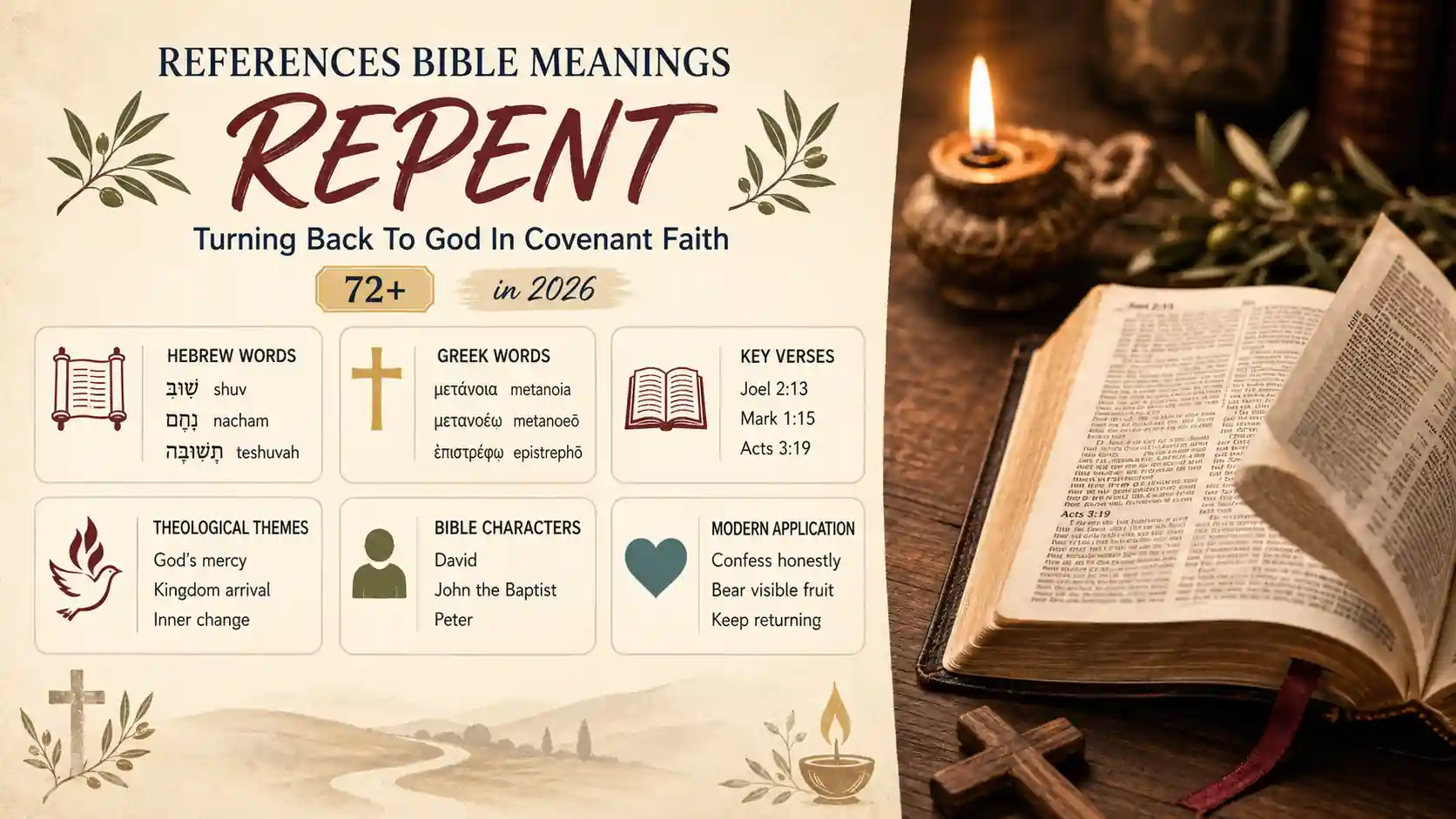
What does repent mean in the Bible? In Scripture, repentance is not a vague feeling of regret. It is a Godward turning of the heart, mind, will, and life. The Bible presents repentance as sorrow for sin, but also as a decisive return to the Lord.
In your study, you will see repentance in Hebrew covenant language, prophetic preaching, John the Baptist’s wilderness call, Jesus’ kingdom announcement, and the apostolic summons to faith, forgiveness, and new obedience.
Repent Key Scripture References
| Verse | Passage Snippet | Context |
|---|---|---|
| 2 Chronicles 7:14 | “turn from their wicked ways” | Covenant restoration |
| Psalm 51:17 | “a broken and contrite heart” | David’s confession |
| Isaiah 55:7 | “let the wicked forsake his way” | Prophetic invitation |
| Jeremiah 3:12 | “Return, faithless Israel” | Call to covenant return |
| Ezekiel 18:30 | “Repent and turn” | Personal responsibility |
| Joel 2:13 | “rend your hearts” | Sincere national repentance |
| Matthew 3:2 | “Repent, for the kingdom” | John’s preaching |
| Mark 1:15 | “repent and believe” | Jesus’ kingdom message |
| Acts 2:38 | “Repent and be baptized” | Pentecost response |
Repent Bible Translation Comparison
| Verse | KJV | NIV | ESV | NASB |
|---|---|---|---|---|
| Matthew 3:2 | “Repent ye” | “Repent” | “Repent” | “Repent” |
| Mark 1:15 | “repent ye” | “Repent” | “repent” | “repent” |
| Luke 13:3 | “except ye repent” | “unless you repent” | “unless you repent” | “unless you repent” |
| Acts 2:38 | “Repent” | “Repent” | “Repent” | “Repent” |
| Acts 3:19 | “Repent ye therefore” | “Repent, then” | “Repent therefore” | “repent and return” |
| Acts 17:30 | “commandeth all men” | “commands all people” | “commands all people” | “commands all people” |
| 2 Corinthians 7:10 | “repentance to salvation” | “repentance that leads” | “repentance that leads” | “repentance without regret” |
| Revelation 2:5 | “repent” | “repent” | “repent” | “repent” |
| Revelation 3:19 | “be zealous therefore” | “be earnest and repent” | “be zealous and repent” | “be zealous and repent” |
Repent People & Characters Associated
| Person | Role | Connection |
|---|---|---|
| David | King of Israel | Confessed sin after Nathan |
| Manasseh | Judah’s king | Humbled himself in exile |
| Ninevites | Gentile city | Turned at Jonah’s warning |
| Jonah | Prophet | Preached judgment reluctantly |
| John the Baptist | Forerunner | Called Israel to repent |
| Peter | Apostle | Preached repentance at Pentecost |
| Paul | Apostle | Proclaimed repentance to nations |
| Prodigal son | Parable figure | Returned to his father |
| Laodiceans | Church audience | Called to zealous repentance |
Repent Original Hebrew & Greek Words
| Original Word | Transliteration | Strong’s # | Literal Meaning |
|---|---|---|---|
| שׁוּב | shuv | H7725 | turn, return |
| נָחַם | nacham | H5162 | relent, be sorry |
| תְּשׁוּבָה | teshuvah | H8666 | return, answer |
| מְשׁוּבָה | meshuvah | H4878 | turning away, apostasy |
| מֶטָνοια | metanoia | G3341 | change of mind |
| μετανοέω | metanoeō | G3340 | repent, change mind |
| ἀμεταμέλητος | ametamelētos | G278 | without regret |
| μεταμέλομαι | metamelomai | G3338 | regret, feel remorse |
| ἐπιστρέφω | epistrephō | G1994 | turn back, return |
Repent Related Biblical Concepts
| Concept | Connection | Supporting Verse |
|---|---|---|
| Faith | Repentance joins belief | Mark 1:15 |
| Confession | Sin is named before God | Psalm 32:5 |
| Forgiveness | God pardons the repentant | Acts 3:19 |
| Conversion | Turning to the Lord | Acts 26:20 |
| Humility | Pride yields to God | 2 Chronicles 7:14 |
| Godly sorrow | Grief leads to life | 2 Corinthians 7:10 |
| Fruit | Repentance becomes visible | Matthew 3:8 |
| Renewal | Heart and spirit changed | Ezekiel 36:26 |
| Restoration | Fellowship is repaired | Joel 2:25 |
Repent Historical & Cultural Context
| Aspect | Detail | Biblical Source |
|---|---|---|
| Covenant language | Return to Yahweh | Deuteronomy 30:2 |
| Prophetic lawsuit | Israel accused of breach | Jeremiah 2:9 |
| Temple prayer | Repentance linked to mercy | 1 Kings 8:47 |
| Sackcloth | Outward grief sign | Jonah 3:5 |
| Fasting | Humbling before God | Joel 2:12 |
| Baptism of John | Public readiness for Messiah | Matthew 3:6 |
| Synagogue preaching | Repentance proclaimed from Scripture | Acts 13:24 |
| Gentile mission | Nations commanded to repent | Acts 17:30 |
| Church discipline | Churches called back to holiness | Revelation 2:5 |
Repent Theological Themes
| Theme | Explanation | Scripture |
|---|---|---|
| God’s mercy | He receives returners | Isaiah 55:7 |
| Human responsibility | Sinners must turn | Ezekiel 18:30 |
| Divine initiative | God grants repentance | 2 Timothy 2:25 |
| Kingdom arrival | Repentance answers Jesus’ reign | Mark 1:15 |
| Judgment warning | Refusal brings ruin | Luke 13:3 |
| Inner change | Heart, not ritual only | Joel 2:13 |
| Saving grace | Repentance leads to life | Acts 11:18 |
| Ongoing holiness | Churches must repent | Revelation 3:19 |
| Joy in heaven | God rejoices over return | Luke 15:7 |
Repent Modern Application for Believers
| Area | Practice | Scripture |
|---|---|---|
| Prayer | Confess honestly | Psalm 51:10 |
| Worship | Bring a contrite heart | Psalm 51:17 |
| Relationships | Seek reconciliation | Matthew 5:24 |
| Habits | Forsake sinful ways | Isaiah 55:7 |
| Church life | Hear correction humbly | Revelation 3:19 |
| Evangelism | Call people to Christ | Acts 17:30 |
| Discipleship | Bear visible fruit | Matthew 3:8 |
| Assurance | Trust God’s mercy | 1 John 1:9 |
| Perseverance | Keep returning to God | Hebrews 12:1 |
שׁוּב Shuv Shows That Repentance Is a Return to the Lord
The main Old Testament idea behind repentance is שׁוּב, shuv, which means to turn or return. This word appears in covenant settings where God’s people have wandered into idolatry, injustice, or unbelief. Repentance is not merely turning away from sin. It is turning back to the God who first called, loved, and claimed his people.
That is why the prophets often sound like wounded covenant messengers. Jeremiah cries, “Return, faithless Israel,” and Joel calls the people to return with all their heart. Biblical repentance is relational before it is procedural. Sin is departure from God, and repentance is the grace-shaped journey home.
What Does Repent Mean in the Bible When Jesus Says μετανοέω Metanoeō?
In the New Testament, the central verb is μετανοέω, metanoeō, and the noun is μετάνοια, metanoia. These words point to a changed mind, but Scripture never treats that change as merely intellectual. When Jesus says, “Repent and believe in the gospel,” he calls people to rethink reality under the reign of God.
This repentance includes new allegiance. The kingdom has come near in the person and work of Christ, so old loyalties must be surrendered. You do not repent by polishing your self-image. You repent by agreeing with God’s verdict on sin and receiving his mercy in the Messiah.
John the Baptist and the Fruit Worthy of Repentance
John the Baptist preached repentance in the wilderness, not as religious theater but as preparation for the Lord. His baptism exposed the need for cleansing, and his message confronted presumption. Descendants of Abraham still needed changed hearts, because covenant privilege was never a substitute for covenant faithfulness.
John also demanded “fruit in keeping with repentance.” That phrase protects you from reducing repentance to a private emotion. True repentance begins inwardly, but it does not remain invisible. It reshapes speech, money, power, justice, habits, and neighbor-love.
Peter, Paul, and Repentance as Grace for Israel and the Nations
At Pentecost, Peter told pierced hearts to repent and be baptized in the name of Jesus Christ. In Acts 3, he said, “Repent therefore, and turn back, that your sins may be blotted out.” Apostolic repentance is tied to Jesus’ death, resurrection, forgiveness, and the gift of the Spirit.
Paul preached the same call among Gentiles. In Athens, he announced that God commands all people everywhere to repent because judgment has been fixed through the risen Christ. Repentance is not a narrow ethnic ritual. It is God’s summons to the whole world to leave idols and live before him.
Questions Bible Students Ask About Repent
Does שׁוּב mean repentance even when English translations say “return”?
Yes, because in covenant contexts שׁוּב often means returning from sin to the Lord.
Is μετάνοια only a change of mind?
No, the New Testament uses μετάνοια for a transformed mind that turns into changed allegiance and conduct.
Why does Acts 2:38 connect repentance with baptism?
Peter presents baptism as the public response of those who repent and confess Jesus as Messiah.
What is the difference between μεταμέλομαι and μετανοέω?
Μεταμέλομαι can mean regret, while μετανοέω points to the deeper turning God requires.
Can a believer still need repentance after conversion?
Yes, Revelation 2 and 3 show Jesus calling churches, not only unbelievers, to repent.