
When you ask what does elizabeth mean in the bible, you meet a woman whose name and whose story point in one direction. She appears in the opening chapter of Luke as a righteous wife, a daughter of Aaron, and the mother of John the Baptist. Her name carries a promise about God, and her life shows that promise kept after waiting.
You do not need to read her as a distant figure only. Her story speaks to prayer that seems unanswered, to faithfulness in ordinary priestly life, and to joy that arrives late and still arrives on time.
Key Scripture References for Elizabeth
| Verse | Passage Snippet | Context |
|---|---|---|
| Luke 1:5 | Zechariah and Elizabeth in the days of Herod | Sets the priestly household in Judea |
| Luke 1:6 | Both righteous before God | Describes their faithful conduct |
| Luke 1:7 | They had no child and both were advanced in years | States the painful fact plainly |
| Luke 1:13 | Your prayer has been heard | Gabriel answers Zechariah in the temple |
| Luke 1:24 | Elizabeth conceived and hid herself for five months | Marks a private season after the promise |
| Luke 1:25 | The Lord has taken away my disgrace | Records her own words of relief |
| Luke 1:36 | Your relative Elizabeth has conceived a son | Gabriel tells Mary the sign |
| Luke 1:41 | The baby leaped in her womb and she was filled with the Holy Spirit | Happens at Mary’s greeting |
| Luke 1:57 | The time came for Elizabeth to give birth | Brings John into the story |
Bible Translation Comparison for Elizabeth
| Verse | KJV | NIV | ESV | NASB |
|---|---|---|---|---|
| Luke 1:6 | righteous before God | righteous in the sight of God | righteous before God | righteous in the sight of God |
| Luke 1:7 | well stricken in years | well advanced in years | advanced in years | advanced in years |
| Luke 1:13 | thy prayer is heard | your prayer has been heard | your prayer has been heard | your prayer has been heard |
| Luke 1:25 | taken away my reproach | taken away my disgrace | taken away my reproach | taken away my disgrace |
| Luke 1:36 | thy cousin Elisabeth | your relative Elizabeth | your relative Elizabeth | your relative Elizabeth |
| Luke 1:41 | filled with the Holy Ghost | filled with the Holy Spirit | filled with the Holy Spirit | filled with the Holy Spirit |
| Luke 1:42 | blessed art thou among women | blessed are you among women | blessed are you among women | blessed are you among women |
| Luke 1:57 | time came that she should be delivered | time came for her to give birth | time came for her to give birth | time came for her to give birth |
People and Characters Associated with Elizabeth
| Person | Role | Connection |
|---|---|---|
| Elizabeth | Mother of John the Baptist | Central figure of Luke 1 |
| Zechariah | Priest and husband | Shares her household and her hope |
| Mary | Relative and visitor | Comes to Elizabeth after the annunciation |
| John the Baptist | Son and forerunner | Born to prepare the way of the Lord |
| Gabriel | Messenger angel | Announces John’s birth to Zechariah |
| Aaron | Ancestor | Elizabeth descends from his priestly line |
| Priests of Abijah | Fellow servants | Zechariah belongs to this division |
| Relatives at the circumcision | Witnesses | Gather when John is named |
| Neighbours | Community voices | Rejoice with Elizabeth at the birth |
Original Hebrew and Greek Words for Elizabeth
| Original Word | Transliteration | Strong’s # | Literal Meaning |
|---|---|---|---|
| אֱלִישֶׁבַע | Elisheva | H472 | God is my oath |
| אֵל | El | H410 | God |
| שֶׁבַע | Sheva | H7651 | Oath or seven |
| זְכַרְיָה | Zekharyah | H2148 | Yahweh remembers |
| יוֹחָנָן | Yochanan | H3110 | Yahweh is gracious |
| Ἐλισάβετ | Elisabet | G1666 | Elizabeth |
| Ζαχαρίας | Zacharias | G2197 | Zechariah |
| Ἰωάννης | Ioannes | G2491 | John |
| χάρις | Charis | G5485 | Grace |
| ἔλεος | Eleos | G1656 | Mercy |
Related Biblical Concepts for Elizabeth
| Concept | Connection | Supporting Verse |
|---|---|---|
| Covenant faithfulness | God keeps promises across generations | Luke 1:6 |
| Barrenness reversed | Long childlessness ends in a son | Luke 1:7 |
| Priestly service | Her household serves in the temple order | Luke 1:5 |
| Visitation | Mary visits and both women rejoice | Luke 1:39 |
| Prophetic blessing | Elizabeth speaks by the Spirit | Luke 1:41 |
| The forerunner | John prepares the way before Jesus | Luke 1:17 |
| Grace to the aged | God acts late in life | Luke 1:36 |
| Community joy | Neighbours share the good news | Luke 1:58 |
| Naming by God | John receives a God given name | Luke 1:13 |
Historical and Cultural Context for Elizabeth
| Aspect | Detail | Biblical Source |
|---|---|---|
| Priestly division | Zechariah served in the division of Abijah | Luke 1:5 |
| Temple lot | Zechariah was chosen by lot to burn incense | Luke 1:9 |
| Aaronic descent | Elizabeth came from the daughters of Aaron | Luke 1:5 |
| Childlessness | Barrenness brought social reproach in that world | Luke 1:25 |
| Seclusion | Elizabeth kept herself apart for five months | Luke 1:24 |
| Circumcision day | Naming took place on the eighth day | Luke 1:59 |
| Kinship visit | Mary travelled to a town in the hill country | Luke 1:39 |
| Herodian setting | The story opens in the days of Herod | Luke 1:5 |
| Household piety | Both spouses walked in the commandments blamelessly | Luke 1:6 |
Theological Themes for Elizabeth
| Theme | Explanation | Scripture |
|---|---|---|
| God remembers | Zechariah and Elizabeth show remembered prayer | Luke 1:13 |
| Grace before merit | Righteousness does not earn the child | Luke 1:6 |
| Joy after sorrow | Reproach gives way to rejoicing | Luke 1:58 |
| The Spirit speaks | Elizabeth blesses Mary by the Spirit | Luke 1:42 |
| Hidden preparation | God prepares John before public ministry | Luke 1:80 |
| Humility in blessing | Elizabeth honours Mary as mother of her Lord | Luke 1:43 |
| Faith in old age | Age does not close God’s working | Luke 1:36 |
| Promise and sign | Elizabeth’s pregnancy confirms Gabriel’s word | Luke 1:36 |
| Ordinary faithfulness | Daily obedience frames the miracle | Luke 1:6 |
Modern Application for Believers from Elizabeth
| Area | Practice | Scripture |
|---|---|---|
| Waiting | Keep praying when answers are slow | Luke 1:13 |
| Marriage | Share faithfulness in a shared household | Luke 1:6 |
| Hospitality | Welcome God’s people with open joy | Luke 1:39 |
| Encouragement | Bless others before seeking blessing yourself | Luke 1:42 |
| Speech | Speak words shaped by the Spirit | Luke 1:41 |
| Community | Let neighbours share your good news | Luke 1:58 |
| Humility | Honour what God does in others | Luke 1:43 |
| Trust | Accept God’s timing over your own plan | Luke 1:36 |
| Worship | Turn relief into praise and thanks | Luke 1:25 |
Elisheva and the Oath Behind What Does Elizabeth Mean in the Bible
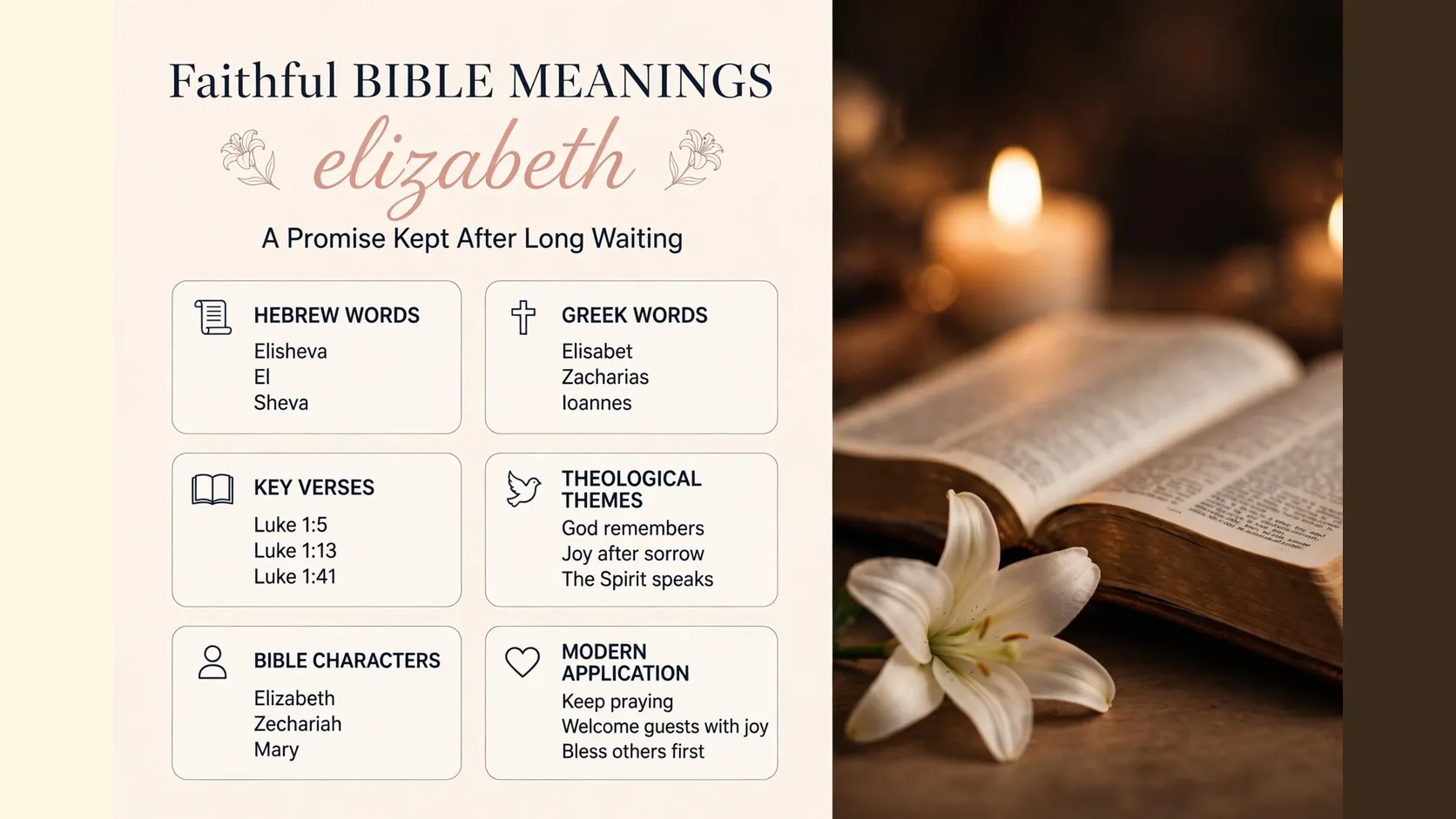
The name Elizabeth comes from the Hebrew Elisheva, a name built from El, meaning God, and sheva, linked to oath. You can hear the promise in the name itself, since it says in effect that God is my oath. That reading fits Luke well, because the whole opening chapter turns on a promise made, a prayer remembered, and a child given.
Her Greek name in Luke is Elisabet, and it keeps the same roots in a new tongue. You should not treat the name as a lucky charm or a hidden code. It is better read as a small confession, since a household that trusted God’s oath now sees that oath take flesh in a son.
A Priestly Household in the Days of Herod
Luke places Elizabeth in a priestly world, since she descends from Aaron and her husband serves in the division of Abijah. Their home is not a palace or a place of power, but a household shaped by temple rhythms, commandments, and prayer. Luke still calls both of them righteous before God, which shows that faithfulness can live quietly for years without public reward.
That quiet setting makes the angel’s news sharper, because Zechariah hears it while burning incense in the temple. You can picture a routine day of service interrupted by a word that changes a family and, through John, prepares a nation. The miracle does not erase their ordinary life, since it grows out of it.
The Visitation and the Blessing Spoken Aloud
When Mary arrives, Elizabeth does not compete with her younger relative or guard her own miracle. She greets Mary, the child leaps in her womb, and she is filled with the Holy Spirit. Her blessing names Mary blessed among women and blesses the fruit of her womb, and then she asks why the mother of her Lord should come to her.
That moment teaches you how blessing works in Luke, since it moves outward before it settles on the speaker. Elizabeth honours what God is doing in Mary, and in doing so she helps Mary hear her own calling confirmed. You can learn from that order, since encouragement often sounds clearest when it comes from someone who has waited too.
Waiting That Ends in a Name Given by God
Elizabeth’s waiting is not vague, since Luke names the facts of childlessness and advanced years. Her relief in Luke 1:25 is therefore specific, because she says the Lord has taken away her disgrace among people. The birth itself does not end the story, since the eighth day brings a dispute about the child’s name.
When Zechariah writes that his name is John, speech returns and neighbours grow in awe. You can see why the name matters, since John means Yahweh is gracious, and grace is the note on which both births sound. Elizabeth’s story ends not with a claim about herself, but with a community praising God for what he has done.
Frequently Asked Questions About Elizabeth
What does the Hebrew name Elisheva behind Elizabeth mean?
It joins El, meaning God, with sheva, linked to oath, so the name reads as God is my oath.
Why does Luke stress that Elizabeth was barren and advanced in years?
Luke names the facts so the birth of John reads as God’s reversal, not as an ordinary late birth.
Does the Greek form Elisabet change the meaning of the name?
No, Elisabet in Luke carries the same Hebrew roots into Greek, so the oath meaning stays intact.
Why do translations differ on Luke 1:7 and Luke 1:25?
Some translations keep older words like reproach and well stricken in years, while others use disgrace and advanced in years for modern readers.
How can Elizabeth’s waiting shape your own prayer today?
You can keep praying, keep serving in ordinary faithfulness, and let God’s timing, not your calendar, set the outcome.