
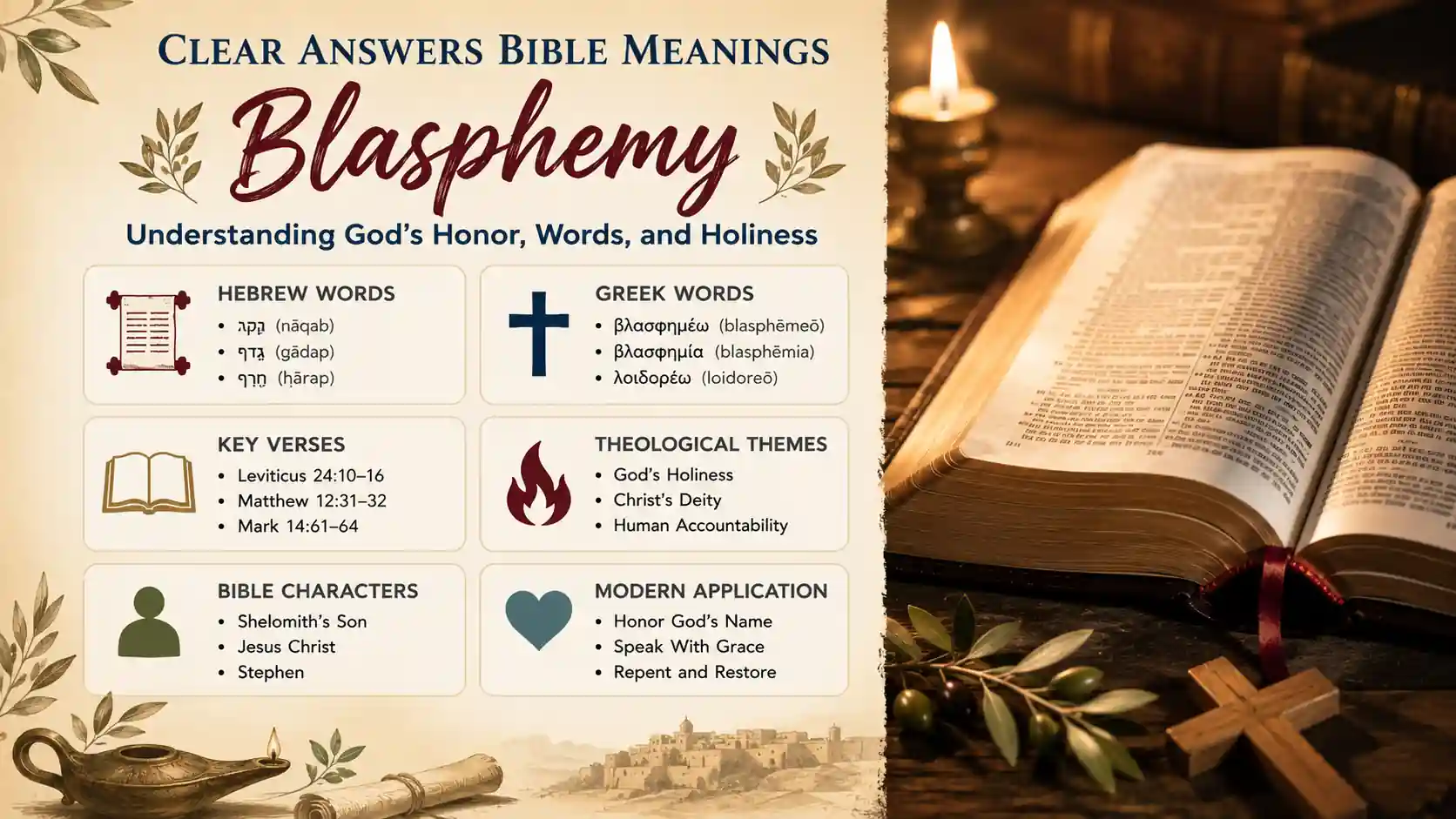
What does blasphemy mean in the Bible? At its heart, blasphemy is speech or conduct that dishonors God, attacks His holy character, misuses His name, or contemptuously rejects His revealed work. Scripture also uses related language for slandering human beings, since malicious speech violates God’s standards of truth and love.
As you study this subject, you will encounter Hebrew words for cursing, reviling, and treating God with contempt, along with the Greek word βλασφημία, blasphēmia. The biblical teaching reaches beyond careless vocabulary to the deeper posture of the heart toward God.
Key Blasphemy Scripture References
| Verse | Passage Snippet | Context |
|---|---|---|
| Leviticus 24:10-16 | The offender blasphemed the Name | Israel’s covenant law |
| 2 Kings 19:6 | Assyrian servants blasphemed God | Hezekiah faces invasion |
| Psalm 74:10 | The enemy reviles God’s name | Lament over desecration |
| Isaiah 37:23 | “Whom have you reproached?” | God confronts Assyria |
| Matthew 12:31-32 | Blasphemy against the Spirit | Pharisees accuse Jesus |
| Mark 2:5-7 | “Who can forgive sins but God?” | Jesus forgives a paralytic |
| Mark 14:61-64 | The council charges blasphemy | Trial of Jesus |
| Luke 22:63-65 | Jesus’ captors blaspheme Him | Mockery before crucifixion |
| Acts 6:11-13 | Stephen is falsely accused | Conflict in Jerusalem |
| Revelation 13:5-6 | The beast speaks blasphemies | Rebellion against God |
Blasphemy Bible Translation Comparison
| Verse | KJV | NIV | ESV | NASB |
|---|---|---|---|---|
| Leviticus 24:11 | “blasphemed the name” | “blasphemed the Name” | “blasphemed the Name” | “blasphemed the Name” |
| 2 Kings 19:6 | “blasphemed me” | “blasphemed me” | “reviled me” | “blasphemed Me” |
| Psalm 74:10 | “blaspheme thy name” | “revile your name” | “revile your name” | “spurn Your name” |
| Isaiah 37:23 | “reproached and blasphemed” | “ridiculed and blasphemed” | “mocked and reviled” | “taunted and blasphemed” |
| Matthew 12:31 | “blasphemy” | “blasphemy” | “blasphemy” | “blasphemy” |
| Mark 3:29 | “blaspheme” | “blasphemes” | “blasphemes” | “blasphemes” |
| Mark 14:64 | “blasphemy” | “blasphemy” | “blasphemy” | “blasphemy” |
| Acts 6:11 | “blasphemous words” | “blasphemous words” | “blasphemous words” | “blasphemous words” |
| 1 Timothy 1:13 | “blasphemer” | “blasphemer” | “blasphemer” | “blasphemer” |
| Revelation 13:6 | “blasphemy against God” | “blaspheme God” | “blasphemies against God” | “blasphemies against God” |
People and Characters Associated with Blasphemy
| Person | Role | Connection |
|---|---|---|
| Shelomith’s son | Israelite camp member | Blasphemed the divine Name |
| Sennacherib | Assyrian king | Defied Israel’s living God |
| Rabshakeh | Assyrian spokesman | Publicly reviled the Lord |
| Jesus Christ | Son of God | Falsely condemned for blasphemy |
| Certain scribes | Religious teachers | Accused Jesus of blasphemy |
| Pharisees | Religious opponents | Misattributed Jesus’ works |
| Stephen | Christian witness | Falsely accused of blasphemy |
| Paul | Apostle and former persecutor | Confessed he had been a blasphemer |
| Hymenaeus | False teacher | Handed over to learn restraint |
| The beast | Apocalyptic ruler | Speaks arrogant blasphemies |
Original Hebrew and Greek Blasphemy Words
| Original Word | Transliteration | Strong’s # | Literal Meaning |
|---|---|---|---|
| נָקַב | nāqab | H5344 | Pierce, designate, pronounce |
| קָלַל | qālal | H7043 | Treat lightly, curse |
| גָּדַף | gādap | H1442 | Revile, blaspheme |
| נָאַץ | nāʾaṣ | H5006 | Spurn, despise, reject |
| חָרַף | ḥārap | H2778 | Reproach, taunt, defy |
| βλασφημέω | blasphēmeō | G987 | Slander, revile, blaspheme |
| βλασφημία | blasphēmia | G988 | Slanderous or profane speech |
| βλάσφημος | blasphēmos | G989 | Abusive, blasphemous |
| δυσφημία | dysphēmia | G1426 | Evil report, defamation |
| λοιδορέω | loidoreō | G3058 | Insult, revile verbally |
Related Biblical Blasphemy Concepts
| Concept | Connection | Supporting Verse |
|---|---|---|
| Misusing God’s name | Treats the divine name irreverently | Exodus 20:7 |
| Cursing God | Direct verbal contempt | Leviticus 24:15 |
| Idolatry | Transfers God’s honor to another | Isaiah 42:8 |
| False accusation | Slanders God or neighbor | Exodus 20:16 |
| Hardened unbelief | Resists revealed truth | John 12:37-40 |
| Apostasy | Publicly repudiates known truth | Hebrews 6:4-6 |
| Persecution | Reviles Christ and His people | Acts 9:4-5 |
| Profanity | Makes holy things common | Ezekiel 22:26 |
| False teaching | Misrepresents God’s character | 2 Peter 2:1-2 |
| Slander | Uses destructive speech against others | Colossians 3:8 |
Historical and Cultural Context of Blasphemy
| Aspect | Detail | Biblical Source |
|---|---|---|
| Divine Name | God’s covenant name was holy | Exodus 3:14-15 |
| Sinai covenant | Israel bore God’s name publicly | Exodus 19:5-6 |
| Public offense | Witnesses established the charge | Leviticus 24:14 |
| Equal accountability | Native and sojourner shared responsibility | Leviticus 24:16 |
| Assyrian propaganda | Military threats mocked Israel’s God | 2 Kings 18:28-35 |
| Jewish legal concern | Divine claims could prompt charges | John 10:33 |
| Roman occupation | Jewish death sentences faced limits | John 18:31 |
| Honor culture | Public insults attacked identity and authority | Mark 15:29-32 |
| Synagogue discipline | Confessing Jesus could bring exclusion | John 9:22 |
| Imperial worship | Refusing false worship marked believers | Revelation 13:15-17 |
Theological Themes within Blasphemy
| Theme | Explanation | Scripture |
|---|---|---|
| God’s holiness | His name and character deserve reverence | Isaiah 6:3 |
| Divine uniqueness | No creature shares God’s rightful glory | Isaiah 42:8 |
| Christ’s deity | Jesus’ authority reveals His identity | Mark 2:5-12 |
| Spirit’s testimony | The Spirit bears witness to Christ | John 15:26 |
| Human accountability | Words reveal the heart | Matthew 12:34-37 |
| Deliberate rejection | Greater light brings greater responsibility | John 15:22-24 |
| Mercy for ignorance | Grace reached Paul despite his past | 1 Timothy 1:13-16 |
| Final rebellion | Blasphemy persists under judgment | Revelation 16:9-11 |
| Vindication of God | God answers those who revile Him | 2 Kings 19:20-22 |
| Sanctified speech | Believers put away abusive language | Colossians 3:8 |
Modern Blasphemy Application for Believers
| Area | Practice | Scripture |
|---|---|---|
| Worship | Speak God’s name with reverence | Psalm 29:2 |
| Prayer | Honor the Father’s name | Matthew 6:9 |
| Conversation | Reject slander and abusive speech | Ephesians 4:29-31 |
| Teaching | Represent God’s Word accurately | 2 Timothy 2:15 |
| Witness | Answer opposition with gentleness | 1 Peter 3:15-16 |
| Repentance | Confess careless and sinful words | 1 John 1:9 |
| Discernment | Test claims about spiritual power | 1 John 4:1-3 |
| Social media | Refuse mockery, rage, and defamation | Colossians 4:6 |
| Suffering | Bless rather than retaliate | 1 Peter 2:21-23 |
| Assurance | Trust Christ’s mercy toward the repentant | 1 Timothy 1:15-16 |
What Does Blasphemy Mean in the Bible’S Hebrew Context?
The Old Testament does not rely on only one technical term for blasphemy. Its vocabulary includes נָקַב, nāqab, in Leviticus 24, along with verbs such as גָּדַף, gādap, “revile,” and חָרַף, ḥārap, “reproach” or “defy.” Together, these words describe treating God, His name, or His authority with contempt.
Leviticus 24:10-16 presents the clearest legal case. The offense was not merely pronouncing a particular sequence of sounds. The man used the divine Name in a curse, publicly attacking the honor of Israel’s covenant Lord. His speech expressed rebellion against the God who had placed His holy name among His people.
βλασφημία And the New Testament Use of Slanderous Speech
The Greek noun βλασφημία, blasphēmia, and the verb βλασφημέω, blasphēmeō, can refer to evil speech directed against God, Christ, sacred truth, or another person. Context determines whether English translations use “blasphemy,” “slander,” “reviling,” or “speaking evil.”
This range explains why Colossians 3:8 may translate βλασφημία as “slander,” while Matthew 12:31 uses “blasphemy.” Biblical blasphemy is therefore not limited to profanity. It includes maliciously misrepresenting God’s works, insulting His revealed character, and using speech to tear down people made in His image.
Jesus, Divine Authority, and the Charge of Blasphemy
The Gospels repeatedly connect blasphemy accusations with Jesus’ identity. In Mark 2:5-12, scribes reason that only God can forgive sins. Their premise about divine forgiveness was serious, but they failed to recognize that Jesus’ authority to forgive revealed who He truly was.
At His trial, Jesus’ confession concerning the Son of Man led the high priest to declare that He had spoken blasphemy. The council treated His claim as an insult to God. The resurrection, however, vindicated Jesus. He was not a sinful man stealing divine honor, but the Son who rightly shared the Father’s authority.
Blasphemy Against the Holy Spirit and the Danger of Hardened Rejection
Matthew 12:22-32 and Mark 3:22-30 provide the essential context for blasphemy against the Holy Spirit. Religious leaders saw Jesus liberate a demon-oppressed man, yet attributed the Spirit’s work to Satan. Their response was not an anxious remark from a tender conscience, but a knowing, hostile reversal of moral truth.
The warning concerns settled resistance to the Spirit’s testimony about Christ. Ordinary doubts, intrusive thoughts, or words later confessed with genuine repentance do not match that hardened posture. Paul had been a blasphemer and persecutor, yet received mercy because Christ transformed him through faith and repentance.
Frequently Asked Questions About Biblical Blasphemy
Does נָקַב, nāqab, mean that merely saying God’s name is blasphemy?
No. In Leviticus 24, the word appears within a deliberate curse that treated the covenant Name with contempt.
Why do translations render βλασφημία as both “blasphemy” and “slander”?
The Greek word describes harmful, defamatory speech, and the target determines which English term best communicates its meaning.
Did Jesus commit blasphemy when He claimed authority to forgive sins?
No. His miracles, resurrection, and divine identity validate His authority rather than exposing His claim as false.
Can a Christian accidentally commit the unforgivable sin in Mark 3:29?
The passage describes persistent, informed hostility toward the Spirit’s witness to Christ, not an accidental sentence or unwanted thought.
How should you respond after speaking irreverently about God?
Confess the sin, receive God’s promised forgiveness in Christ, and cultivate speech shaped by worship, truth, and reverence.