
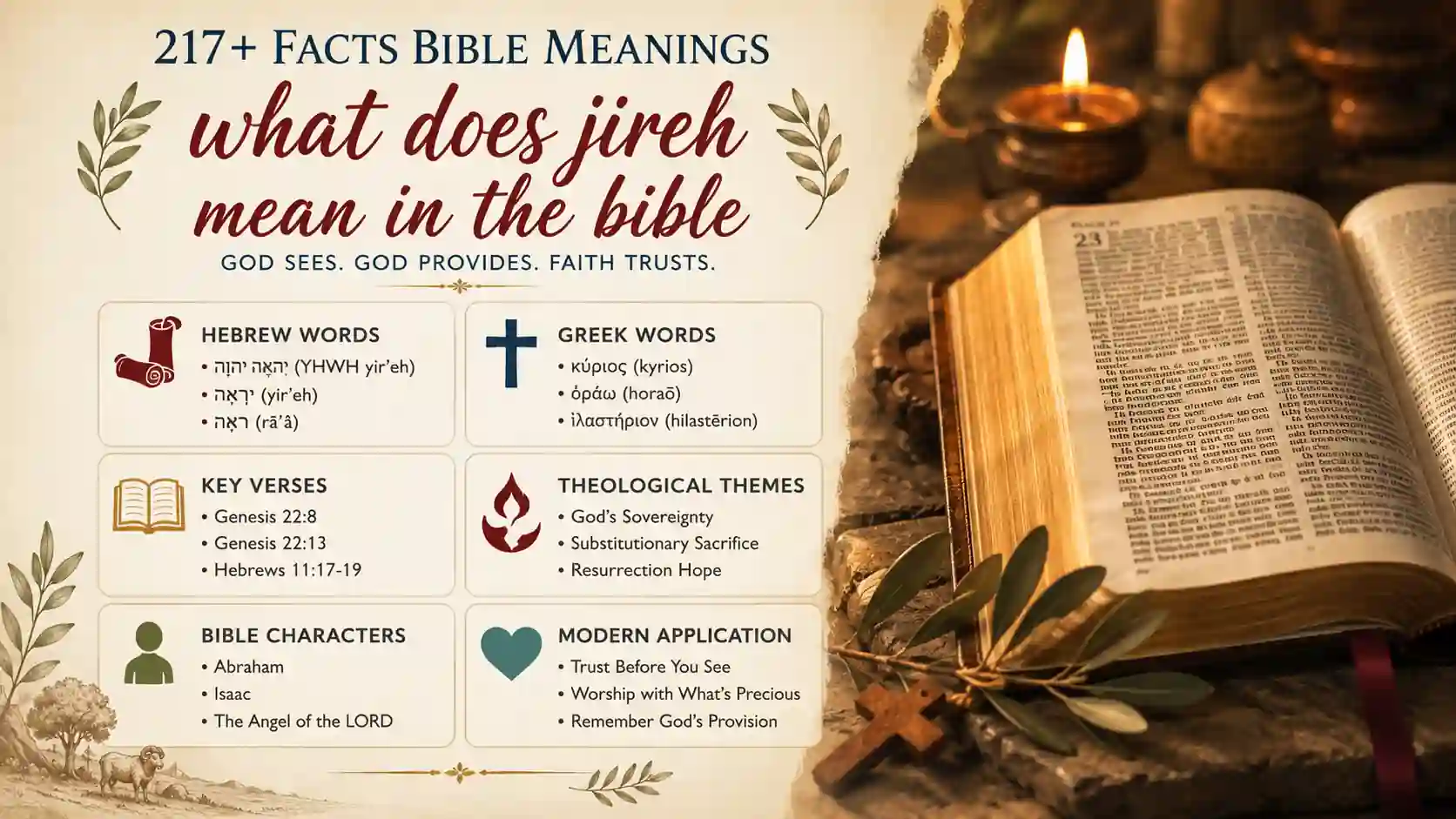
What does jireh mean in the Bible? “Jireh” comes from the Hebrew verb רָאָה, rāʾâ, meaning “to see.” In Genesis 22, however, seeing includes attending to a need and providing for it. Abraham names the place יְהוָה יִרְאֶה, YHWH yirʾeh, commonly rendered “The LORD Will Provide.”
The name emerges from Abraham’s testing on Mount Moriah, where God supplies a ram in Isaac’s place. As you study Jireh, you encounter divine foresight, covenant faithfulness, substitutionary sacrifice, obedient faith, and worship shaped by God’s gracious provision.
Jireh Key Scripture References
| Verse | Passage Snippet | Context |
|---|---|---|
| Genesis 22:1 | “God tested Abraham” | The sacrifice narrative begins |
| Genesis 22:2 | “Take your son, your only son” | Isaac is the promised heir |
| Genesis 22:5 | “We will come back” | Abraham speaks with faith |
| Genesis 22:7 | “Where is the lamb?” | Isaac identifies the central need |
| Genesis 22:8 | “God will provide” | Abraham trusts God’s provision |
| Genesis 22:12 | “Now I know” | Abraham’s reverence is demonstrated |
| Genesis 22:13 | “A ram caught” | God supplies a substitute |
| Genesis 22:14 | “The LORD Will Provide” | Abraham names the location |
| Genesis 22:16-18 | “Because you have obeyed” | Covenant promises are reaffirmed |
| Hebrews 11:17-19 | “God could raise the dead” | Abraham’s faith is interpreted |
Jireh Bible Translation Comparison
| Verse | KJV | NIV | ESV | NASB |
|---|---|---|---|---|
| Genesis 22:2 | “only son Isaac” | “only son, whom you love” | “only son Isaac” | “only son, whom you love” |
| Genesis 22:5 | “come again to you” | “come back to you” | “come again to you” | “return to you” |
| Genesis 22:7 | “Where is the lamb?” | “Where is the lamb?” | “Where is the lamb?” | “Where is the lamb?” |
| Genesis 22:8 | “God will provide” | “God himself will provide” | “God will provide” | “God will provide for Himself” |
| Genesis 22:12 | “thou fearest God” | “you fear God” | “you fear God” | “you fear God” |
| Genesis 22:13 | “a ram caught” | “a ram caught” | “a ram, caught” | “a ram caught” |
| Genesis 22:14 | “Jehovahjireh” | “The LORD Will Provide” | “The LORD will provide” | “The LORD Will Provide” |
| Genesis 22:14 | “In the mount” | “On the mountain” | “On the mount” | “On the mountain” |
| Hebrews 11:17 | “offered up Isaac” | “offered Isaac” | “offered up Isaac” | “offered up Isaac” |
| Hebrews 11:19 | “raise him up” | “raise the dead” | “raise him from the dead” | “raise people from the dead” |
People and Characters Associated with Jireh
| Person | Role | Connection |
|---|---|---|
| God | Covenant Lord | Tests Abraham and provides the ram |
| Abraham | Patriarch | Names the place YHWH Yirʾeh |
| Isaac | Promised son | Bound on the altar but spared |
| Sarah | Covenant mother | Isaac is her promised offspring |
| The angel of the LORD | Divine messenger | Stops Abraham and renews the promise |
| The two servants | Journey companions | Remain behind during the sacrifice |
| The ram | Substitutionary offering | Dies in Isaac’s place |
| Moses | Genesis narrator | Records the name and its proverb |
| Israel | Covenant people | Descends through Isaac |
| Jesus Christ | Beloved Son | Fulfills the pattern of sacrifice |
Jireh Original Hebrew and Greek Words
| Original Word | Transliteration | Strong’s # | Literal Meaning |
|---|---|---|---|
| יְהוָה יִרְאֶה | YHWH yirʾeh | H3070 | The LORD will see or provide |
| יְהוָה | YHWH | H3068 | The covenant name of God |
| יִרְאֶה | yirʾeh | H7200 | He will see |
| רָאָה | rāʾâ | H7200 | To see, perceive, inspect |
| אֱלֹהִים | ʾĕlōhîm | H430 | God |
| שֶׂה | śeh | H7716 | Lamb or young flock animal |
| אַיִל | ʾayil | H352 | Ram |
| עֹלָה | ʿōlâ | H5930 | Burnt offering |
| κύριος | kyrios | G2962 | Lord or master |
| ὁράω | horaō | G3708 | To see or perceive |
Jireh Related Biblical Concepts
| Concept | Connection | Supporting Verse |
|---|---|---|
| Divine provision | God supplies what sacrifice requires | Genesis 22:8 |
| Divine foresight | God sees the need before Abraham does | Genesis 22:13 |
| Obedient faith | Abraham acts on God’s command | Genesis 22:3 |
| Fear of God | Reverence becomes visible through obedience | Genesis 22:12 |
| Substitution | The ram is offered instead of Isaac | Genesis 22:13 |
| Covenant promise | Isaac carries the promised line | Genesis 21:12 |
| Resurrection faith | Abraham trusts God beyond death | Hebrews 11:19 |
| Atonement | One life is accepted in another’s place | Leviticus 17:11 |
| Father and son | Abraham and Isaac travel together | Genesis 22:6 |
| Worship | The journey’s stated purpose is worship | Genesis 22:5 |
Jireh Historical and Cultural Context
| Aspect | Detail | Biblical Source |
|---|---|---|
| Patriarchal era | Abraham lives before Israel’s monarchy | Genesis 12-25 |
| Covenant setting | Isaac is the promised covenant heir | Genesis 17:19 |
| Burnt offering | The whole animal is offered to God | Genesis 22:2 |
| Wood carried by Isaac | The intended victim bears the wood | Genesis 22:6 |
| Three-day journey | Abraham travels before seeing the place | Genesis 22:4 |
| Mount Moriah | The testing occurs in Moriah’s region | Genesis 22:2 |
| Temple connection | Solomon builds on Mount Moriah | 2 Chronicles 3:1 |
| Human sacrifice rejected | God stops Isaac’s death | Genesis 22:12 |
| Animal substitution | A ram replaces the promised son | Genesis 22:13 |
| Memorial naming | Abraham names the site after God’s act | Genesis 22:14 |
Jireh Theological Themes
| Theme | Explanation | Scripture |
|---|---|---|
| God’s sovereignty | God directs the test and its outcome | Genesis 22:1 |
| God’s knowledge | God sees both heart and circumstance | Genesis 22:12 |
| Covenant faithfulness | God preserves the promised line | Genesis 22:17 |
| Costly obedience | Abraham withholds nothing from God | Genesis 22:12 |
| Gracious intervention | God stops the raised knife | Genesis 22:11-12 |
| Substitutionary sacrifice | The ram dies instead of Isaac | Genesis 22:13 |
| Faith beyond sight | Abraham obeys without seeing the solution | Hebrews 11:17 |
| Resurrection hope | Abraham reasons that God can restore life | Hebrews 11:19 |
| Messianic pattern | A beloved son is associated with sacrifice | John 3:16 |
| Divine self-provision | God supplies the acceptable offering | Genesis 22:8 |
Jireh Modern Application for Believers
| Area | Practice | Scripture |
|---|---|---|
| Anxiety | Pray before assuming God has abandoned you | Philippians 4:6 |
| Material needs | Seek God’s kingdom with trust | Matthew 6:31-33 |
| Obedience | Follow clear Scripture before seeing results | Genesis 22:3 |
| Worship | Offer God what is precious, not merely convenient | Romans 12:1 |
| Decision-making | Trust God’s wisdom above your limited sight | Proverbs 3:5-6 |
| Waiting | Remember that provision may appear late | Genesis 22:10-13 |
| Stewardship | Receive resources as gifts for faithful use | 1 Peter 4:10 |
| Suffering | Refuse to equate hardship with divine absence | Romans 8:35-39 |
| Gratitude | Memorialize God’s faithful care | Genesis 22:14 |
| Gospel faith | Rest in the Son God truly gave | Romans 8:32 |
What Does Jireh Mean in the Bible’S Hebrew Narrative?
The expression יְהוָה יִרְאֶה, YHWH yirʾeh, is traditionally pronounced “Jehovah Jireh” in English Christian usage. More precisely, it means “YHWH will see.” The form יִרְאֶה, yirʾeh, is derived from רָאָה, rāʾâ, the ordinary Hebrew verb for seeing, observing, or perceiving.
Yet Genesis 22 shows that God’s seeing is active rather than detached. God sees Abraham, Isaac, the altar, and the unresolved need for a sacrifice. Because God sees fully, He attends to the need. This explains why major English translations appropriately communicate the phrase as “The LORD will provide.”
Yhwh YirʾEh and the Testing of Abraham
Genesis 22 must be read within Abraham’s covenant story. God had promised that Abraham’s offspring would be established through Isaac. The command to offer Isaac therefore appears to place God’s promise and God’s instruction in unbearable tension.
Abraham obeys without possessing a complete explanation. Hebrews 11:17-19 reveals that he reasoned God could raise Isaac from the dead. His faith was not confidence that nothing painful would happen. It was confidence that God could not finally fail to fulfill His covenant word.
The RAM on Moriah and God’S Substitutionary Provision
When Isaac asks about the lamb, Abraham answers, אֱלֹהִים יִרְאֶה־לּוֹ, ʾĕlōhîm yirʾeh-lô, meaning that God will see or provide for Himself the offering. Abraham does not know how the need will be met, but he entrusts that need to God.
At the decisive moment, the angel of the LORD stops Abraham. A ram appears caught by its horns, and Abraham offers it תַּחַת בְּנוֹ, taḥat benô, “instead of his son.” Jireh therefore concerns not only material supply, but also a substitute graciously appointed by God.
From Moriah to Christ the Beloved Son
Genesis 22 is not a direct prediction in every narrative detail, yet its pattern prepares you to understand the gospel. Isaac is Abraham’s beloved son, carries the sacrificial wood, and approaches the place of offering. Unlike Isaac, however, Jesus is not spared from death.
God provides a ram for Abraham, but in the fullness of redemption He gives His own Son. Romans 8:32 declares that the Father did not spare His Son but gave Him for His people. The deepest revelation of Jireh is therefore God’s provision for reconciliation, forgiveness, and eternal life.
Frequently Asked Questions About Jireh
Does Jireh literally mean “provider” in Hebrew?
Not exactly. יִרְאֶה, yirʾeh, literally means “he will see,” but Genesis 22 gives it the contextual sense of seeing to a need or providing.
Is Jehovah Jireh the most accurate pronunciation of יְהוָה יִרְאֶה?
“Jehovah Jireh” is traditional English usage, while “YHWH Yirʾeh” more closely represents the Hebrew wording and pronunciation.
Why does Genesis 22:14 differ between “the LORD will provide” and “the LORD will be seen”?
The Hebrew root רָאָה, rāʾâ, can support wordplay involving God seeing, providing, appearing, or being seen at the appointed mountain.
Was the ram in Genesis 22 a substitute for Isaac?
Yes. Genesis 22:13 explicitly says Abraham offered the ram “instead of his son,” making substitution central to the passage.
Does Jireh promise that believers will always receive material prosperity?
No. Jireh reveals God’s faithful care and redemptive provision, but Scripture does not promise every believer wealth, comfort, or freedom from suffering.