
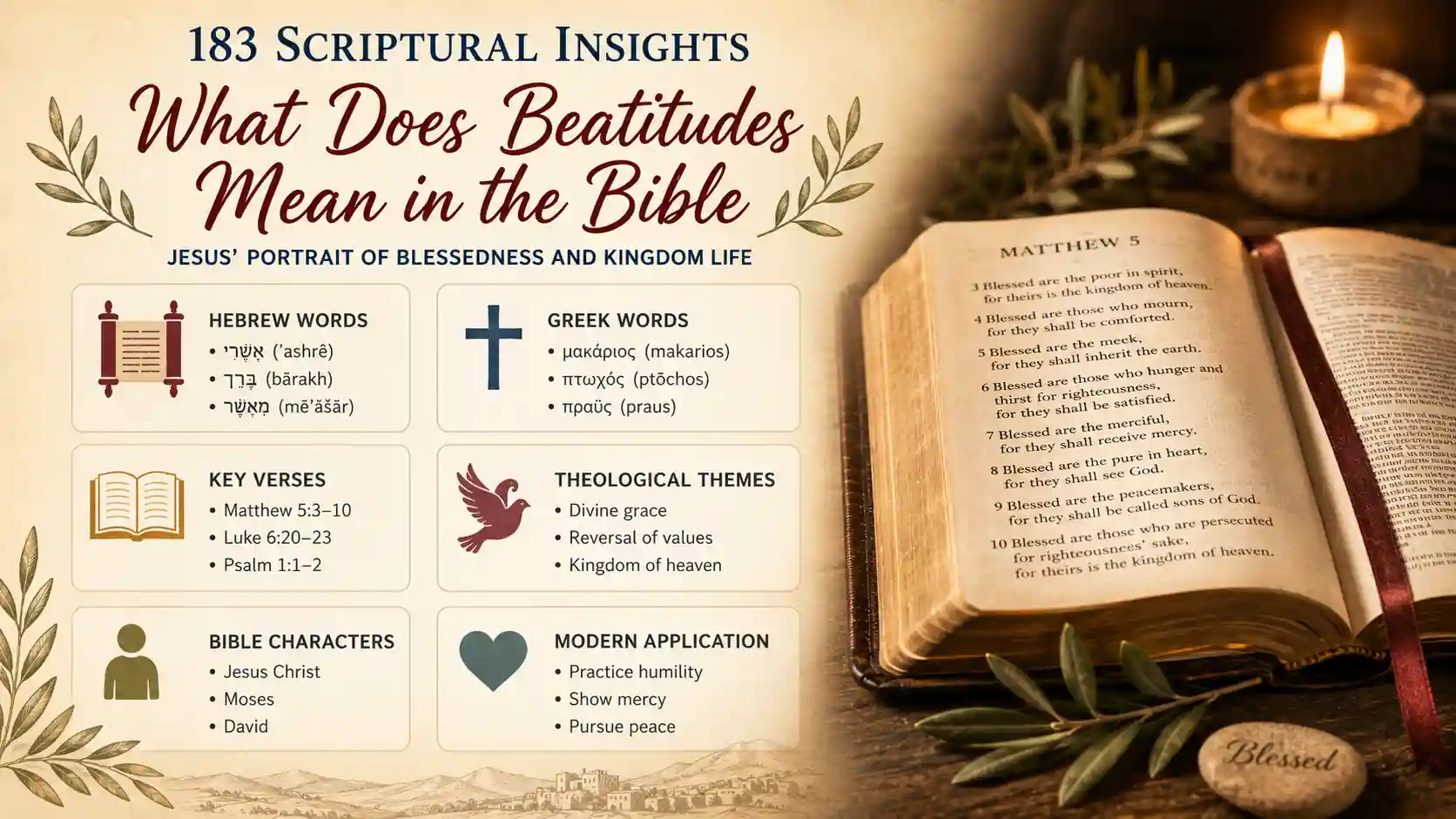
What does beatitudes mean in the Bible? The Beatitudes are Jesus’ declarations of blessedness at the opening of the Sermon on the Mount in Matthew 5. They describe the people who enjoy God’s favor and reveal the character of those who belong to his kingdom.
The word “Beatitudes” comes from the Latin beatus, meaning blessed or happy. Yet Jesus speaks of something deeper than pleasant circumstances. He announces God-given well-being, future restoration, and covenant hope for people who trust him and reflect his righteous reign.
Beatitudes Key Scripture References
| Verse | Passage Snippet | Context |
|---|---|---|
| Matthew 5:1-2 | Jesus taught his disciples | Opening of the Sermon on the Mount |
| Matthew 5:3 | Blessed are the poor in spirit | The kingdom belongs to the spiritually needy |
| Matthew 5:4 | Blessed are those who mourn | God promises comfort to the sorrowful |
| Matthew 5:5 | Blessed are the meek | The humble will inherit the earth |
| Matthew 5:6 | Hunger and thirst for righteousness | God satisfies those longing for justice |
| Matthew 5:7 | Blessed are the merciful | Mercy given reflects mercy received |
| Matthew 5:8 | Blessed are the pure in heart | Inner purity prepares a person to see God |
| Matthew 5:9 | Blessed are the peacemakers | They display the family likeness of God |
| Matthew 5:10 | Persecuted for righteousness | The kingdom belongs to faithful sufferers |
| Luke 6:20-23 | Blessed are you who are poor | Luke records blessings addressed directly to disciples |
Beatitudes Bible Translation Comparison
| Verse | KJV | NIV | ESV | NASB |
|---|---|---|---|---|
| Matthew 5:3 | poor in spirit | poor in spirit | poor in spirit | poor in spirit |
| Matthew 5:4 | they that mourn | those who mourn | those who mourn | those who mourn |
| Matthew 5:5 | the meek | the meek | the meek | the gentle |
| Matthew 5:6 | hunger and thirst after righteousness | hunger and thirst for righteousness | hunger and thirst for righteousness | hunger and thirst for righteousness |
| Matthew 5:7 | the merciful | the merciful | the merciful | the merciful |
| Matthew 5:8 | pure in heart | pure in heart | pure in heart | pure in heart |
| Matthew 5:9 | the peacemakers | the peacemakers | the peacemakers | the peacemakers |
| Matthew 5:10 | persecuted for righteousness’ sake | persecuted because of righteousness | persecuted for righteousness’ sake | persecuted for the sake of righteousness |
| Matthew 5:11 | revile you | insult you | revile you | insult you |
| Luke 6:20 | blessed be ye poor | blessed are you who are poor | blessed are you who are poor | blessed are you who are poor |
People and Characters Associated with the Beatitudes
| Person | Role | Connection |
|---|---|---|
| Jesus Christ | Teacher and Messiah | Proclaims the Beatitudes with divine authority |
| The Twelve | Disciples | Receive instruction for kingdom life |
| The Galilean crowds | Hearers | Witness Jesus’ teaching and healing ministry |
| Moses | Covenant mediator | His mountain ministry forms a background to Matthew 5 |
| David | King and psalmist | Describes the blessed person in Psalms 1 and 32 |
| Isaiah | Prophet | Foretells comfort, righteousness, and good news for the poor |
| Abraham | Covenant patriarch | Receives blessing intended to reach all nations |
| Job | Righteous sufferer | Demonstrates faithfulness amid mourning and loss |
| Persecuted prophets | Covenant witnesses | Provide examples of suffering for God’s truth |
| Kingdom disciples | Heirs of promise | Embody the qualities Jesus praises |
Beatitudes Original Hebrew and Greek Words
| Original Word | Transliteration | Strong’s # | Literal Meaning |
|---|---|---|---|
| μακάριος | makarios | G3107 | Blessed, favored, deeply fortunate |
| μακαρίζω | makarizō | G3106 | To call or count blessed |
| πτωχός | ptōchos | G4434 | Poor, destitute, dependent |
| πνεῦμα | pneuma | G4151 | Spirit, breath |
| πενθέω | pentheō | G3996 | To mourn or lament |
| πραΰς | praus | G4239 | Meek, gentle, controlled |
| δικαιοσύνη | dikaiosynē | G1343 | Righteousness, justice |
| ἐλεήμων | eleēmōn | G1655 | Merciful, compassionate |
| καθαρός | katharos | G2513 | Clean, pure, unmixed |
| εἰρηνοποιός | eirēnopoios | G1518 | One who makes peace |
| אַשְׁרֵי | ʾashrê | H835 | Blessedness, happiness |
| בָּרַךְ | bārakh | H1288 | To bless, praise, bestow favor |
Beatitudes Related Biblical Concepts
| Concept | Connection | Supporting Verse |
|---|---|---|
| Kingdom of heaven | Frames the first and final Beatitudes | Matthew 5:3, 10 |
| Spiritual poverty | Recognizes complete dependence upon God | Isaiah 66:2 |
| Godly mourning | Grieves sin, suffering, and brokenness | Isaiah 61:2-3 |
| Meekness | Submits strength to God’s rule | Psalm 37:11 |
| Righteousness | Seeks God’s will and restorative justice | Matthew 6:33 |
| Mercy | Extends compassion to the guilty and suffering | Micah 6:8 |
| Purity of heart | Describes undivided devotion to God | Psalm 24:3-4 |
| Peacemaking | Pursues reconciliation rooted in truth | Romans 12:18 |
| Persecution | Tests loyalty to Christ and his kingdom | 2 Timothy 3:12 |
| Eternal reward | Points beyond present suffering | Matthew 5:12 |
Beatitudes Historical and Cultural Context
| Aspect | Detail | Biblical Source |
|---|---|---|
| Galilean setting | Jesus teaches after ministering throughout Galilee | Matthew 4:23-25 |
| Mountain location | Jesus sits in the posture of an authoritative teacher | Matthew 5:1 |
| Jewish discipleship | Students gathered near a rabbi to receive instruction | Matthew 5:1-2 |
| Wisdom tradition | Blessing sayings described the God-favored life | Psalm 1:1 |
| Roman occupation | Hearers lived under foreign political power | Luke 2:1 |
| Economic hardship | Debt, taxation, and poverty burdened many families | Matthew 18:23-35 |
| Honor and shame | Public insult could damage social standing | Matthew 5:11 |
| Prophetic expectation | Israel awaited comfort and righteous restoration | Isaiah 40:1 |
| Covenant language | Blessing recalled God’s promises to Israel | Deuteronomy 28:1-6 |
| Messianic hope | Good news to the poor signaled God’s anointed king | Isaiah 61:1 |
Beatitudes Theological Themes
| Theme | Explanation | Scripture |
|---|---|---|
| Divine grace | God’s favor reaches people conscious of their need | Matthew 5:3 |
| Present and future kingdom | The kingdom is received now and fulfilled later | Matthew 5:3-10 |
| Reversal of values | Those pitied by society may be honored by God | Luke 6:20-23 |
| Christlike character | The qualities reflect the life of Jesus himself | Matthew 11:29 |
| Inner transformation | God seeks purity within, not mere outward conformity | Matthew 5:8 |
| Eschatological hope | Comfort and satisfaction anticipate final restoration | Revelation 21:4 |
| Covenant fulfillment | Jesus brings Israel’s Scriptures toward fulfillment | Matthew 5:17 |
| Costly discipleship | Loyalty to Christ may provoke hostility | Matthew 5:11 |
| Adoption | Peacemakers are recognized as God’s children | Matthew 5:9 |
| Inheritance | The meek receive the renewed earth as God’s gift | Matthew 5:5 |
Beatitudes Modern Application for Believers
| Area | Practice | Scripture |
|---|---|---|
| Prayer | Approach God with humble dependence | Matthew 5:3 |
| Repentance | Mourn personal and communal sin | Matthew 5:4 |
| Relationships | Respond gently rather than seeking control | Matthew 5:5 |
| Justice | Pursue what is right with sustained desire | Matthew 5:6 |
| Forgiveness | Show mercy because God has shown mercy | Matthew 5:7 |
| Integrity | Cultivate pure motives before God | Matthew 5:8 |
| Conflict | Work patiently toward truthful reconciliation | Matthew 5:9 |
| Witness | Remain faithful when obedience brings opposition | Matthew 5:10 |
| Encouragement | Comfort sufferers with God’s promised future | 2 Corinthians 1:3-4 |
| Hope | Measure blessing by God’s verdict, not circumstances | Matthew 5:12 |
What Does Beatitudes Mean in the Bible and Why Does Jesus Begin with Blessing?
The English name “Beatitudes” refers to the repeated expression “Blessed are” in Matthew 5:3-11. Each saying begins with μακάριος, makarios, a Greek adjective describing someone who stands in an enviable position because of God’s favor. Jesus is not giving eight techniques for creating a cheerful mood. He is declaring who is truly fortunate under God’s reign.
This explains why the Beatitudes can call mourners, the persecuted, and the spiritually poor blessed. Their pain is not itself good, and Jesus does not romanticize suffering. They are blessed because God’s kingdom belongs to them, God sees their faithfulness, and God promises comfort, satisfaction, inheritance, mercy, revelation, and reward.
Μακάριος And אַשְׁרֵי in the Biblical Language of Blessedness
The Greek μακάριος, makarios, often corresponds to the Hebrew blessing formula אַשְׁרֵי, ʾashrê. Psalm 1 begins with this Hebrew expression and identifies the blessed person as one who rejects wicked counsel and delights in God’s instruction. Psalm 32 uses it for the person whose sin has been forgiven.
This background shows that biblical blessedness is rooted in a right relationship with God. It is distinct from בָּרַךְ, bārakh, which often describes an act of blessing performed by God or spoken by a person. אַשְׁרֵי celebrates the condition of the one whose life rests under God’s approval.
The Beatitudes as Kingdom Promises in Matthew’S Gospel
The first and eighth Beatitudes share the same promise, “theirs is the kingdom of heaven.” This forms a literary frame around the sayings. The promises between them generally look toward the future, while the kingdom statement is presented as a present possession. Jesus’ disciples already belong to his reign, though they still await its complete manifestation.
The Beatitudes therefore hold together present grace and future hope. You may mourn now, hunger for justice now, or endure rejection now, yet God’s verdict has already been spoken over faithful disciples. The coming comfort, inheritance, satisfaction, and vision of God are certain because they rest upon the King’s authority.
Poor in Spirit, Meek, and Persecuted as a Portrait of Jesus
Each Beatitude reveals something visible in Jesus. He depends upon the Father, mourns over Jerusalem, describes himself as meek, embodies perfect righteousness, shows mercy, remains pure in heart, makes peace through his sacrifice, and suffers for obedience. The Beatitudes are therefore more than an ethical list. Together they form a portrait of the Messiah.
As you follow Christ, the Spirit shapes these qualities within you. Spiritual poverty keeps you dependent upon grace. Meekness directs your strength away from self-promotion. Mercy moves you toward wounded people. Purity brings your motives under God’s searching light, while peacemaking calls you to pursue reconciliation without compromising truth.
Questions About the Beatitudes
Does μακάριος mean that believers should always feel happy?
No. Makarios describes God-given favor and spiritual well-being, even when a disciple is grieving or persecuted.
Why does Matthew say “poor in spirit” while Luke says “poor”?
Matthew emphasizes humble dependence upon God, while Luke stresses the real poverty experienced by many disciples and God’s coming reversal.
Is Matthew 5:5 connected to Psalm 37:11?
Yes. Jesus draws upon the promise that the meek will inherit the land, expanding it toward the kingdom’s renewed creation.
Does hungering for δικαιοσύνη mean personal holiness or social justice?
It includes both, since biblical righteousness concerns faithful conduct, right relationships, and conformity to God’s just will.
How can you practice peacemaking without ignoring wrongdoing?
You pursue truthful reconciliation, protect the vulnerable, reject revenge, and seek restoration under the righteous rule of Christ.