
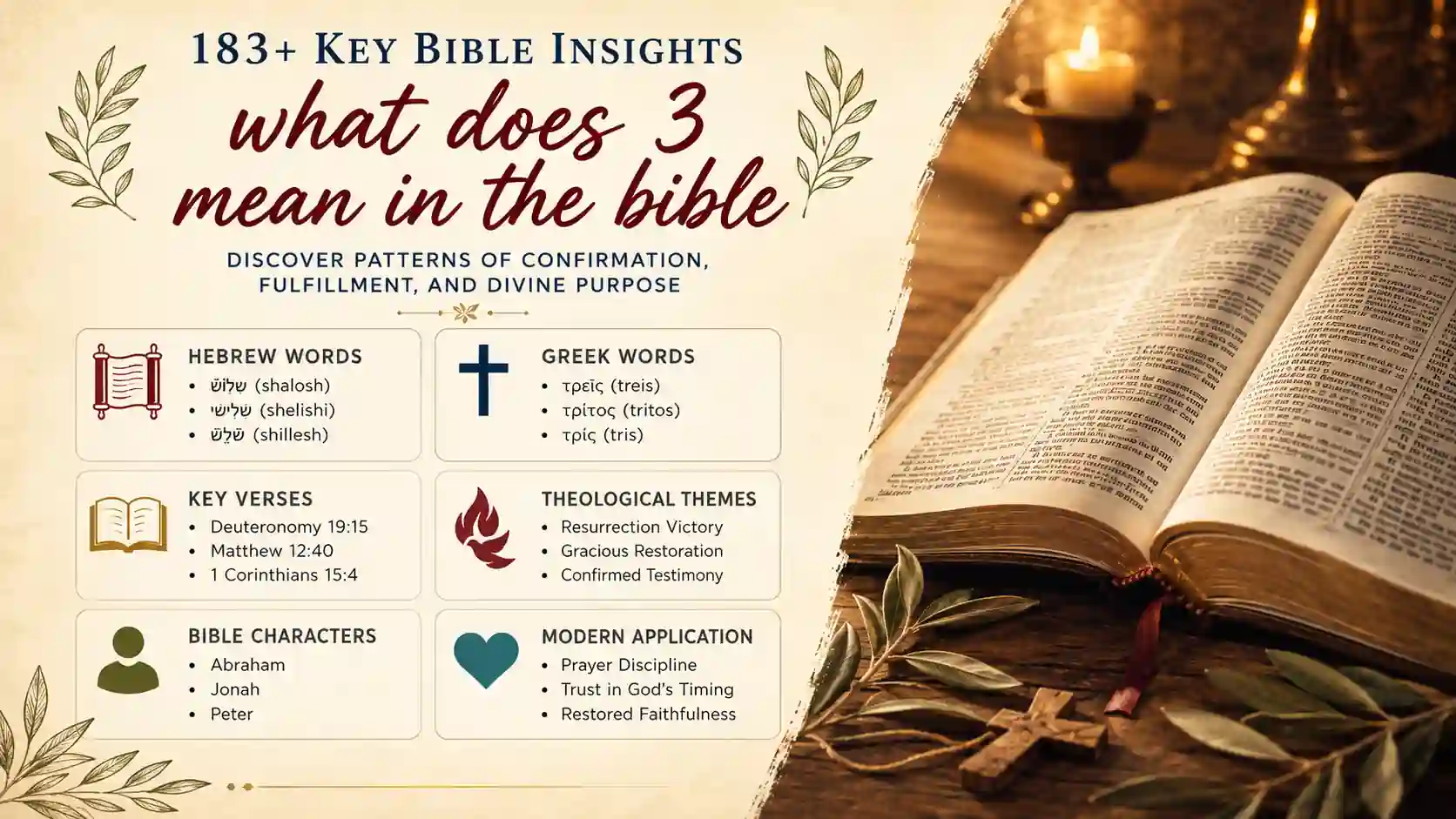
What does 3 mean in the Bible? Scripture does not assign a single hidden definition to every appearance of the number three. Yet biblical writers repeatedly use three in narratives, laws, prophecies, worship, and apostolic teaching to mark confirmation, completeness, decisive action, and divinely appointed fulfillment.
Your study should begin with context rather than numerology. Three witnesses establish testimony, three days often form a critical period, and Jesus Christ rises on the third day. These patterns gain meaning from God’s revealed acts, not from the number considered by itself.
Key Scripture References for Three
| Verse | Passage Snippet | Context |
|---|---|---|
| Genesis 18:2 | Three men stood nearby | Abraham receives heavenly visitors |
| Genesis 40:12 | Three branches are three days | Joseph interprets the cupbearer’s dream |
| Exodus 19:11 | Ready for the third day | Israel prepares to meet God |
| Deuteronomy 19:15 | Two or three witnesses | Testimony requires confirmation |
| Joshua 1:11 | Within three days | Israel prepares to cross Jordan |
| Jonah 1:17 | Three days and three nights | Jonah remains inside the great fish |
| Matthew 12:40 | Three days and three nights | Jesus applies Jonah’s sign to himself |
| Matthew 26:34 | Deny me three times | Peter’s failure is foretold |
| 1 Corinthians 15:4 | Raised on the third day | Paul summarizes the gospel |
| Revelation 4:8 | Holy, holy, holy | Heavenly beings praise God continually |
Bible Translation Comparison for Three
| Verse | KJV | NIV | ESV | NASB |
|---|---|---|---|---|
| Deuteronomy 19:15 | two witnesses, or three | two or three witnesses | two witnesses or of three | two witnesses or three |
| Ecclesiastes 4:12 | threefold cord | cord of three strands | threefold cord | cord of three strands |
| Jonah 1:17 | three days and three nights | three days and three nights | three days and three nights | three days and three nights |
| Matthew 12:40 | three days and three nights | three days and three nights | three days and three nights | three days and three nights |
| Matthew 18:20 | two or three | two or three | two or three | two or three |
| Matthew 26:34 | deny me thrice | disown me three times | deny me three times | deny Me three times |
| John 2:19 | in three days | in three days | in three days | in three days |
| Acts 10:16 | done thrice | happened three times | happened three times | happened three times |
| 1 Corinthians 13:13 | these three | these three remain | these three | these three |
| 1 John 5:8 | these three agree in one | three are in agreement | these three agree | three are in agreement |
People and Characters Associated with Three
| Person | Role | Connection |
|---|---|---|
| Abraham | Patriarch | Receives three visitors at Mamre |
| Joseph | Interpreter | Explains three branches and baskets |
| Moses | Covenant mediator | Leads Israel to third-day preparation |
| Joshua | Israel’s leader | Announces a three-day crossing period |
| Jonah | Prophet | Remains three days in the fish |
| Daniel | Exile and prophet | Prays three times daily |
| Jesus | Messiah | Rises on the third day |
| Peter | Apostle | Denies Jesus three times |
| Paul | Apostle | Pleads three times about his thorn |
| John | Apostle | Records threefold heavenly praise |
Original Hebrew and Greek Words for Three
| Original Word | Transliteration | Strong’s # | Literal Meaning |
|---|---|---|---|
| שָׁלוֹשׁ | shalosh | H7969 | three |
| שְׁלֹשָׁה | sheloshah | H7969 | three, masculine form |
| שָׁלִישׁ | shalish | H7991 | third man, officer |
| שְׁלִישִׁי | shelishi | H7992 | third |
| שִׁלֵּשׁ | shillesh | H8027 | do a third time |
| תְּלָת | telath | H8532 | three, Aramaic |
| τρεῖς | treis | G5140 | three |
| τρία | tria | G5140 | three, neuter form |
| τρίτος | tritos | G5154 | third |
| τρίς | tris | G5151 | three times |
Related Biblical Concepts of Three
| Concept | Connection | Supporting Verse |
|---|---|---|
| Confirmed testimony | Three witnesses strengthen a legal claim | Deuteronomy 19:15 |
| Divine encounter | Israel meets God on the third day | Exodus 19:11 |
| Resurrection | Christ rises on the third day | 1 Corinthians 15:4 |
| Prayer discipline | Daniel prays three times daily | Daniel 6:10 |
| Repeated warning | Peter is warned of three denials | Matthew 26:34 |
| Restored discipleship | Peter answers Jesus three times | John 21:15-17 |
| Persistent petition | Paul pleads three times | 2 Corinthians 12:8 |
| Enduring virtues | Faith, hope, and love remain | 1 Corinthians 13:13 |
| Corporate fellowship | Christ is among two or three | Matthew 18:20 |
| Heavenly holiness | Holy is repeated three times | Revelation 4:8 |
Historical and Cultural Context of Three
| Aspect | Detail | Biblical Source |
|---|---|---|
| Legal testimony | Multiple witnesses protected justice | Deuteronomy 19:15 |
| Covenant preparation | Three days allowed ceremonial readiness | Exodus 19:10-11 |
| Ancient travel | Journeys were often counted by days | Joshua 1:11 |
| Burial reckoning | Partial days could count inclusively | Matthew 27:63-64 |
| Jewish prayer | Regular prayer occurred at set times | Daniel 6:10 |
| Rabbinic address | Repetition could emphasize seriousness | John 21:15-17 |
| Prophetic signs | Numbered periods conveyed divine timing | Jonah 1:17 |
| Wedding customs | Cana’s third day frames a celebration | John 2:1 |
| Roman execution | Crucifixion preceded guarded burial | Matthew 27:62-66 |
| Oral teaching | Repetition aided memory and emphasis | Matthew 26:34 |
Theological Themes Connected with Three
| Theme | Explanation | Scripture |
|---|---|---|
| God’s holiness | Threefold praise intensifies adoration | Isaiah 6:3 |
| Reliable truth | Confirmed testimony restrains false judgment | Deuteronomy 19:15 |
| Death and life | The third day reveals resurrection victory | Luke 24:46 |
| Promise fulfilled | Jesus rises according to Scripture | 1 Corinthians 15:4 |
| Human weakness | Peter’s three denials expose fear | Luke 22:54-62 |
| Gracious restoration | Jesus recommissions Peter three times | John 21:15-17 |
| Sufficient grace | Paul’s third request receives God’s answer | 2 Corinthians 12:8-9 |
| Persevering faith | Three Hebrews remain faithful in Babylon | Daniel 3:16-18 |
| Christian maturity | Faith, hope, and love shape discipleship | 1 Corinthians 13:13 |
| Divine triunity | Father, Son, and Spirit share one name | Matthew 28:19 |
Modern Application of Three for Believers
| Area | Practice | Scripture |
|---|---|---|
| Bible interpretation | Read each occurrence in context | Nehemiah 8:8 |
| Decision-making | Seek confirmed and truthful evidence | Deuteronomy 19:15 |
| Prayer | Develop regular, disciplined prayer | Daniel 6:10 |
| Suffering | Trust that grace can be sufficient | 2 Corinthians 12:8-9 |
| Failure | Receive Christ’s restoring mercy | John 21:15-17 |
| Witness | Center your faith on the risen Christ | 1 Corinthians 15:3-4 |
| Community | Gather confidently in Jesus’ name | Matthew 18:20 |
| Character | Practice faith, hope, and love | 1 Corinthians 13:13 |
| Worship | Honor God’s perfect holiness | Revelation 4:8 |
| Discernment | Reject superstitious number reading | 2 Timothy 2:15 |
שָׁלוֹשׁ Shalosh and Threefold Confirmation in Israel’S Scriptures
The principal Hebrew term for three is שָׁלוֹשׁ, shalosh, Strong’s H7969. Its grammatical form changes according to the gender of the noun it modifies, but its ordinary meaning remains numerical. The Old Testament does not teach that every group of three contains a secret spiritual code.
Still, three often structures a complete or sufficiently established event. Under Israel’s law, one witness could not secure a conviction. A matter was confirmed by two or three witnesses, protecting the community from careless accusations and showing that biblical truth must rest on reliable testimony.
Three also appears in periods of preparation and transition. Israel consecrated itself before God descended on Sinai on the third day. Joshua gave the people three days to prepare before crossing the Jordan. In both accounts, the numbered period heightens expectation before a decisive act of God.
What Does 3 Mean in the Bible When the Third Day Brings Deliverance?
The “third day” frequently marks the point when waiting gives way to action. Abraham sees Mount Moriah on the third day, Joseph releases his brothers on the third day, Esther approaches the king on the third day, and Jonah emerges after his appointed period in the fish.
These passages do not all use three identically, but together they create a recognizable scriptural rhythm. Crisis is followed by God’s intervention, judgment gives way to mercy, or hidden preparation reaches its appointed conclusion. The pattern becomes clearest in the resurrection of Jesus.
Paul declares that Christ “was raised on the third day according to the Scriptures.” This is not abstract symbolism. It is the historical center of the gospel. Jesus truly died, was buried, and rose bodily, fulfilling the divine plan testified to throughout Scripture.
Τρεῖς Treis in the Gospels and Peter’S Threefold Restoration
The common Greek word for three is τρεῖς, treis, Strong’s G5140. The ordinal “third” is τρίτος, tritos, Strong’s G5154, while τρίς, tris, Strong’s G5151, means “three times.” These words carry their usual numerical senses, while each passage supplies the theological significance.
Peter’s story gives three a deeply pastoral function. He denies Jesus three times during the night of the trial. After the resurrection, Jesus asks him three times, “Do you love me?” The repeated question grieves Peter, but it also meets his failure with a corresponding commission.
Christ does not merely remind Peter of his shame. He entrusts him with the care of his sheep. In your own discipleship, this scene teaches that serious failure need not be the final word. Repentance, love for Christ, and renewed obedience belong together.
Father, Son, and Holy Spirit without Careless Numerology
Christ commands baptism “in the name of the Father and of the Son and of the Holy Spirit.” The singular “name” accompanies three personal designations. Alongside many other passages, this contributes to the biblical foundation for confessing one God eternally known as Father, Son, and Holy Spirit.
Yet the Trinity should not be reduced to the idea that three automatically means divine perfection. Christian belief in the Trinity comes from the whole witness of Scripture, including the Father’s deity, the Son’s deity, the Spirit’s deity, their personal distinctions, and the oneness of God.
Your safest conclusion is therefore measured. Three may signal established testimony, emphatic repetition, completion within a narrative, or a divinely appointed turning point. Its richest use is connected with Christ’s resurrection, but its meaning must always be drawn from the passage itself.
Frequently Asked Questions About Three in Scripture
Does שָׁלוֹשׁ, shalosh, always symbolize completeness?
No. It normally means the number three, while context determines whether completeness or emphasis is present.
Why does Paul say Jesus rose on the third day?
He is proclaiming a historical resurrection that fulfilled Scripture and formed the heart of the apostolic gospel.
Do “three days and three nights” require exactly seventy-two hours?
Not necessarily. Biblical and Jewish inclusive reckoning could count portions of days within a three-day period.
Why did Jesus ask Peter three times, “Do you love me?”
The three questions correspond to Peter’s three denials and publicly restore him to pastoral service.
Is every occurrence of three a reference to the Trinity?
No. The Trinity is revealed through Scripture’s teaching about Father, Son, and Spirit, not through every appearance of the number three.