
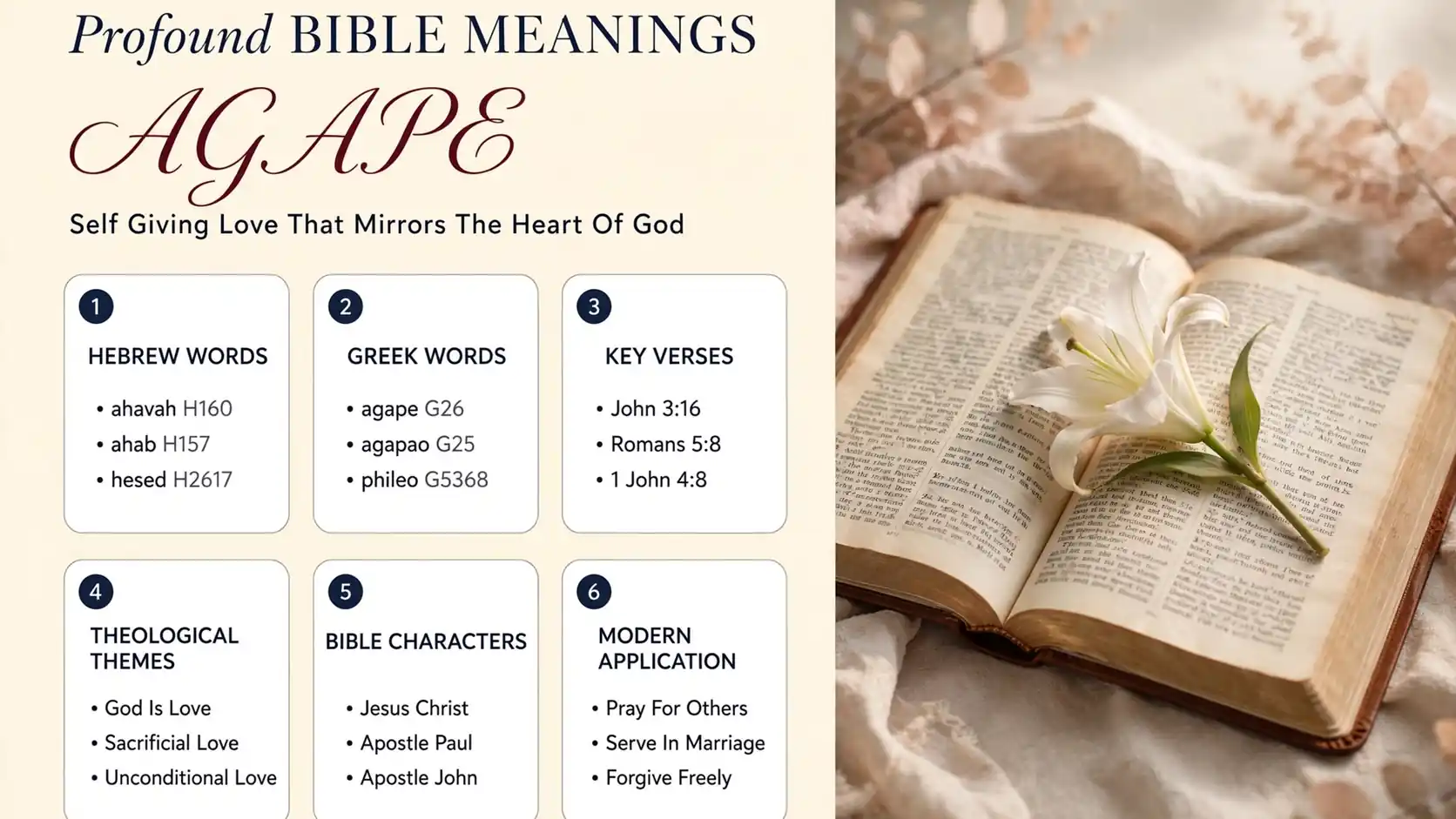
When you ask what does agape mean in the bible, you are asking about the highest kind of love Scripture describes, a love that seeks the good of another at real cost to itself. It is the word used for the love of God toward people who did not earn it, and for the love Jesus commands his followers to show each other and even their enemies in daily life.
This guide traces it through key verses, Greek and Hebrew words, and Peter restored, so your love grows steadier and more faithful.
Key Scripture References for Agape
| Verse | Passage Snippet | Context |
|---|---|---|
| John 3:16 | God so loved the world that he gave his Son | God gives his Son for the world |
| Romans 5:8 | While we were still sinners, Christ died for us | Love shown before we changed |
| 1 Corinthians 13:4-7 | Love is patient and kind, it does not envy | Paul describes love in action |
| 1 John 4:8 | God is love | Love is part of God’s nature |
| 1 John 4:19 | We love because he first loved us | Our love answers God’s love |
| John 15:13 | Greater love has no one than to lay down life | Jesus defines love by sacrifice |
| Romans 8:38-39 | Nothing can separate us from the love of God | Paul assures believers of security |
| Galatians 2:20 | The Son of God loved me and gave himself | Personal faith in a giving Savior |
| Ephesians 5:25 | Husbands, love your wives, as Christ loved | Marriage shaped by the cross |
| John 21:15 | Do you love me more than these | Jesus restores Peter with a question |
Bible Translation Comparison for Agape
| Verse | KJV | NIV | ESV | NASB |
|---|---|---|---|---|
| John 3:16 | God so loved the world | God so loved the world | God so loved the world | God so loved the world |
| Romans 5:8 | God commendeth his love | God demonstrates his own love | God shows his love for us | God demonstrates His own love |
| 1 Corinthians 13:4 | Charity suffereth long, is kind | Love is patient, love is kind | Love is patient and kind | Love is patient, love is kind |
| 1 John 4:8 | God is love | God is love | God is love | God is love |
| John 15:13 | Greater love hath no man | Greater love has no one | Greater love has no one | Greater love has no one |
| 1 John 4:19 | We love him, because he first loved | We love because he first loved | We love because he first loved | We love, because He first loved |
| Ephesians 5:25 | Husbands, love your wives | Husbands, love your wives | Husbands, love your wives | Husbands, love your wives |
| Romans 8:39 | Nor height, nor depth separate us | Neither height nor depth separate | Neither height nor depth separate | Neither height nor depth separate |
People and Characters Associated with Agape
| Person | Role | Connection |
|---|---|---|
| God the Father | Giver of the Son | Loves the world and sends Jesus in John 3 |
| Jesus Christ | Crucified Savior | Lays down his life as the measure of love |
| Apostle Paul | Letter writer | Writes the love chapter in 1 Corinthians 13 |
| Apostle John | Gospel writer | Records John 21 and writes that God is love |
| Peter | Restored disciple | Hears the agape question three times in John 21 |
| The Prodigal Father | Parable figure | Runs to welcome a lost son home in Luke 15 |
| The Good Samaritan | Parable figure | Shows costly mercy to a wounded stranger |
| Mary Magdalene | Follower of Jesus | Loves much because she was forgiven much |
| Early Church Believers | First community | Share meals and goods in Acts 2 with glad hearts |
Original Hebrew and Greek Words for Agape
| Original Word | Transliteration | Strong’s # | Literal Meaning |
|---|---|---|---|
| ἀγάπη | agape | G26 | Self giving love that seeks another’s good |
| ἀγαπάω | agapao | G25 | To love with choice and deep regard |
| φιλέω | phileo | G5368 | To love with warm friendship and affection |
| φιλία | philia | G5373 | Friendship and fond regard for another |
| φιλαδελφία | philadelphia | G5360 | Brotherly love within the family of faith |
| אַהֲבָה | ahavah | H160 | Love, affection and deep attachment |
| אָהַב | ahab | H157 | To love, desire and cling to |
| חֶסֶד | hesed | H2617 | Steadfast covenant love and mercy |
| רַחֲמִים | rachamim | H7356 | Deep compassion that moves to action |
Related Biblical Concepts to Agape
| Concept | Connection | Supporting Verse |
|---|---|---|
| Grace | Love given freely to the undeserving | Ephesians 2:8 |
| Mercy | Love that withholds deserved judgment | Luke 6:36 |
| Covenant | Love bound by promise and faithfulness | Deuteronomy 7:9 |
| Sacrifice | Love that gives itself for another | John 15:13 |
| Forgiveness | Love that releases a real debt | Colossians 3:13 |
| Holiness | Love that is pure and set apart | 1 Peter 1:16 |
| Enemy Love | Love extended to those who oppose you | Matthew 5:44 |
| Fruit of the Spirit | Love listed first among Spirit fruit | Galatians 5:22 |
| Eternal Life | Love that invites people to lasting life | John 3:16 |
Historical and Cultural Context of Agape
| Aspect | Detail | Biblical Source |
|---|---|---|
| Greek Language World | Greek had several words for love with different shades | John 21:15-17 |
| Agape Feasts | Early believers shared love feasts as fellowship meals | Jude 1:12 |
| Roman Patronage | Gifts often expected a return, unlike God’s free gift | Romans 5:8 |
| Jewish Shema | Israel was called to love God with whole heart | Deuteronomy 6:5 |
| Household Codes | Love reshaped marriage and family duties at home | Ephesians 5:25 |
| Crucifixion Shame | The cross was a sign of disgrace in Roman eyes | 1 Corinthians 1:18 |
| Shepherd Culture | A shepherd risked his life for his sheep daily | John 10:11 |
| Banquet Customs | Table fellowship showed welcome and belonging | Luke 15:23 |
Theological Themes in Agape
| Theme | Explanation | Scripture |
|---|---|---|
| God Is Love | Love is not only what God does, it is who he is | 1 John 4:8 |
| Sacrificial Love | True love gives itself at personal cost | John 15:13 |
| Unconditional Love | God loves sinners before they change or repent | Romans 5:8 |
| Initiating Love | God moves first and our love responds to his | 1 John 4:19 |
| Inseparable Love | No power in creation can cut believers off | Romans 8:38-39 |
| Commanded Love | Love is a duty you practice, not only a feeling | John 13:34 |
| Enemy Love | Love reaches people who do not return it | Matthew 5:44 |
| Perfecting Love | Mature love drives out fear of judgment | 1 John 4:18 |
Modern Application of Agape for Believers
| Area | Practice | Scripture |
|---|---|---|
| Prayer | Pray daily for people who are hard to love | Matthew 5:44 |
| Marriage | Choose one costly act of service each week | Ephesians 5:25 |
| Forgiveness | Release one old grievance in prayer this week | Colossians 3:13 |
| Friendship | Show up in person when a friend is suffering | John 15:13 |
| Church Life | Welcome a newcomer to your table after service | Romans 15:7 |
| Giving | Give quietly to a need you did not create | 2 Corinthians 9:7 |
| Speech | Refuse gossip and speak one true encouragement | Ephesians 4:29 |
| Family | Apologize first, even when you were partly right | 1 Corinthians 13:5 |
The Greek Root Agape and a Love That Chooses the Good of Another
The noun agape, Strong’s G26, comes from the verb agapao, G25, and in the New Testament it points to a love of choice and will. You do not simply fall into it the way you fall into a passing feeling. You decide to seek the good of a person, and you keep deciding it on hard days.
That choice is why agape can be commanded in Scripture in a way that warm affection cannot. Jesus could tell you to love your enemies because agape is an action before it is an emotion. Feelings often follow faithfulness, and your steady obedience can slowly warm a cold heart toward the people God places near you.
What Does Agape Mean in the Bible When Jesus Restores Peter in John 21
After the resurrection, Jesus asked Peter three times if he loved him, and John 21 plays two Greek words against each other with care. Jesus used agapao in his first two questions, while Peter answered with phileo, G5368, the word for warm friendship love, as if he no longer trusted his own grand promises.
On the third question Jesus came down to Peter’s own word, phileo, and Peter was grieved because the Lord met him where he honestly was. Then Jesus gave him work, feed my sheep, showing you that restored love is proved in care for people. Agape here is tender, truthful, and willing to begin again.
Agape in 1 Corinthians 13 and the Portrait of Patient Love
Paul wrote 1 Corinthians 13 to a gifted church that was proud, divided, and short on love, so his famous chapter is a correction and not only a wedding reading. He says agape is patient and kind, it does not envy or boast, and it keeps no record of wrongs. Each line names a choice you can practice at home this week.
Notice that Paul never says love is a strong feeling that carries you along without effort. He describes love under pressure, love when you are overlooked, corrected, or tired. That is agape in real congregations and real kitchens, where your patience with one difficult person can preach louder than your gifts, knowledge, or public success ever will.
Covenant Agape from the Shema to the Cross of Christ
Long before Greek writers used agape, Israel sang of ahavah, H160, and of hesed, H2617, the steadfast covenant love of God for his people. The Shema in Deuteronomy 6 called you to love the Lord your God with all your heart, soul, and strength. Covenant love in the Old Testament was loyal, promised, and stubborn in mercy.
The cross gathers both testaments into one picture for your faith. In Jesus, covenant promise and self giving agape meet, as God keeps his word to Abraham and also gives himself for sinners. When you read agape across Scripture, you are reading one long story of a God who binds himself to people and will not let his love fail.
Frequently Asked Questions About Agape
Is agape, G26, a stronger word than phileo, G5368, in John 21?
Agape stresses chosen, self giving love, while phileo stresses warm friendship, and Jesus graciously meets Peter at the level of phileo on the third question.
Why does the KJV use the word charity in 1 Corinthians 13 instead of love?
The KJV translators used charity to stress love expressed in generous action, while modern versions use love because agape covers both deep affection and costly deeds.
Did Greek speakers use agape often before the New Testament was written?
No, agape was fairly rare in everyday Greek, and early Christians filled this uncommon word with rich meaning shaped by the cross and by God’s own character.
How is Hebrew hesed, H2617, related to Greek agape in your study?
Hesed names steadfast covenant loyalty in Hebrew, and the Greek translators often linked that loyal love to agape, so both words show a love that keeps its promises.
Can you practice agape toward an enemy if you do not feel warm toward them?
Yes, agape begins as a chosen act of good, such as praying for them and refusing revenge, and warmer feelings may follow as you keep obeying Christ.