
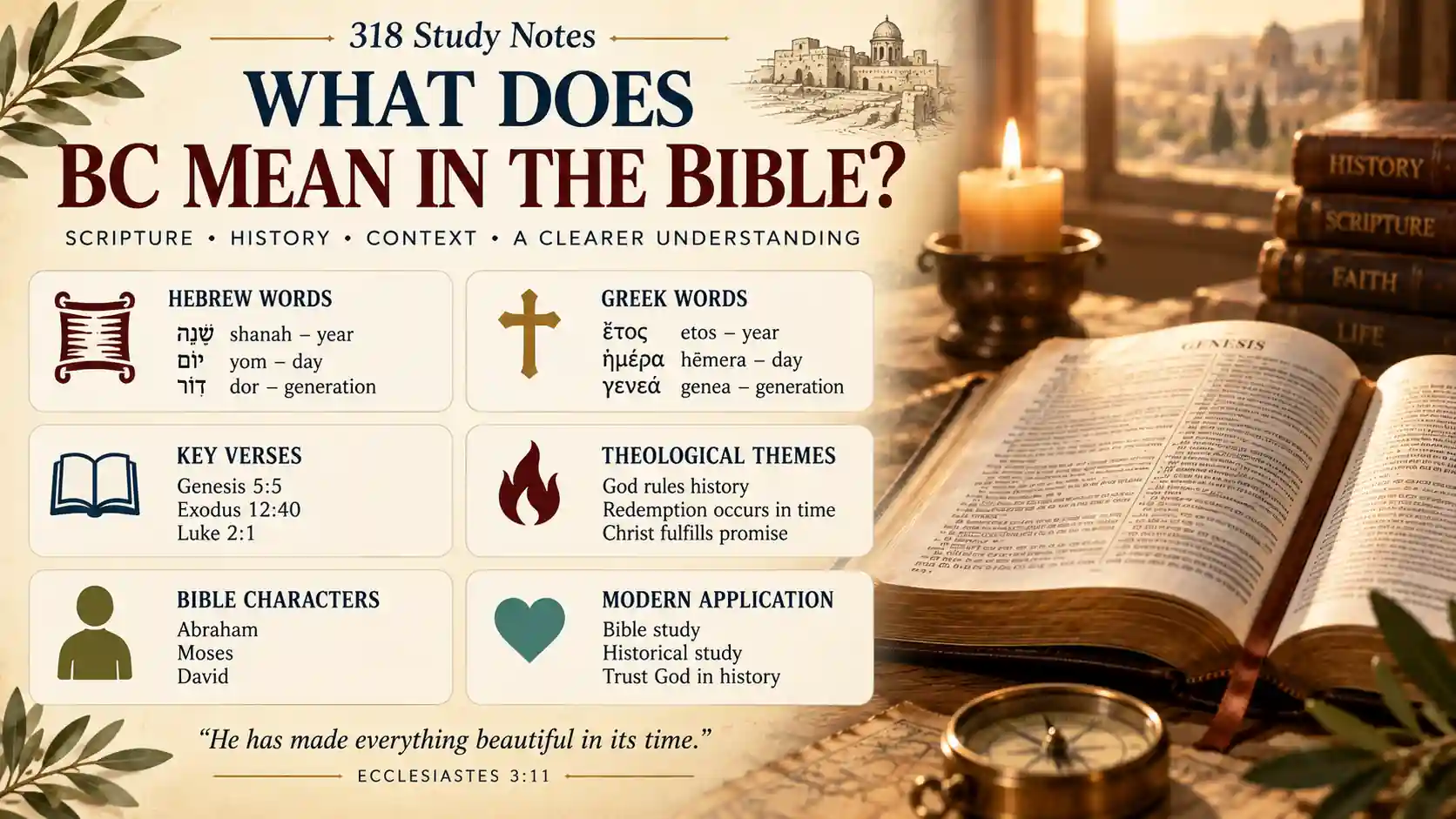
When you ask what does BC mean in the Bible, the simplest answer is that BC means “Before Christ.” It is a historical dating label used for years before the traditional date assigned to the birth of Jesus Christ. The letters BC themselves do not appear in the Hebrew or Greek manuscripts of Scripture.
Biblical writers dated events through reigns, generations, festivals, ages, and numbered years. Understanding those biblical methods helps you distinguish inspired chronology from the later BC dating system used by historians and Bible publishers.
BC Key Scripture References
| Verse | Passage Snippet | Context |
|---|---|---|
| Genesis 1:5 | “the first day” | Creation time is counted by days, not BC dates. |
| Genesis 5:5 | “nine hundred and thirty years” | Genealogical ages provide chronological information. |
| Genesis 7:11 | “six hundredth year” | Noah’s age dates the flood narrative. |
| Exodus 12:40 | “four hundred and thirty years” | Israel’s sojourn is measured as elapsed time. |
| 1 Kings 6:1 | “four hundred and eightieth year” | The temple is dated from the Exodus. |
| 2 Kings 18:1 | “third year of Hoshea” | Kings’ reigns function as calendar markers. |
| Daniel 1:1 | “third year of the reign” | Babylonian events are tied to royal chronology. |
| Luke 2:1-2 | “Quirinius was governor” | Jesus’ birth is placed in Roman historical context. |
| Luke 3:1 | “fifteenth year of Tiberius” | John’s ministry is dated by rulers. |
| Galatians 4:4 | “fullness of time” | Christ’s coming has theological and historical timing. |
BC Bible Translation Comparison
| Verse | KJV | NIV | ESV | NASB |
|---|---|---|---|---|
| Genesis 5:5 | “nine hundred and thirty years” | “930 years” | “930 years” | “nine hundred and thirty years” |
| Exodus 12:40 | “four hundred and thirty years” | “430 years” | “430 years” | “four hundred and thirty years” |
| 1 Kings 6:1 | “four hundred and eightieth year” | “480th year” | “480th year” | “four hundred and eightieth year” |
| 2 Kings 18:1 | “third year of Hoshea” | “third year of Hoshea” | “third year of Hoshea” | “third year of Hoshea” |
| Daniel 1:1 | “third year” | “third year” | “third year” | “third year” |
| Luke 2:1 | “all the world should be taxed” | “census” | “registered” | “census” |
| Luke 2:2 | “Cyrenius” | “Quirinius” | “Quirinius” | “Quirinius” |
| Luke 3:1 | “fifteenth year” | “fifteenth year” | “fifteenth year” | “fifteenth year” |
| Galatians 4:4 | “fulness of the time” | “set time had fully come” | “fullness of time” | “fullness of the time” |
BC People and Characters Associated
| Person | Role | Connection |
|---|---|---|
| Adam | First man | His descendants are dated by ages and generations. |
| Noah | Flood patriarch | Genesis dates events according to his age. |
| Abraham | Patriarch | His life belongs to the period later labeled BC. |
| Moses | Covenant mediator | Exodus chronology becomes a major biblical time marker. |
| David | King of Israel | Later events are often understood relative to his dynasty. |
| Solomon | King and temple builder | Temple construction is dated from the Exodus. |
| Nebuchadnezzar | Babylonian king | His reign anchors events in Daniel and Kings. |
| Herod the Great | Judean king | His reign provides historical context for Jesus’ birth. |
| Caesar Augustus | Roman emperor | Luke places Jesus’ birth during his rule. |
| Jesus Christ | Messiah | The traditional BC and AD system centers on his birth. |
BC Original Hebrew and Greek Words
BC has no direct Hebrew or Greek equivalent because it is a later chronological abbreviation. These biblical words are the actual terms Scripture uses when speaking about years, days, generations, kings, and Christ.
| Original Word | Transliteration | Strong’s # | Literal Meaning |
|---|---|---|---|
| שָׁנָה | shanah | H8141 | year |
| יוֹם | yom | H3117 | day |
| דּוֹר | dor | H1755 | generation |
| עוֹלָם | olam | H5769 | long duration, age |
| מֶלֶךְ | melekh | H4428 | king |
| ἔτος | etos | G2094 | year |
| ἡμέρα | hēmera | G2250 | day |
| γενεά | genea | G1074 | generation |
| αἰών | aiōn | G165 | age |
| Χριστός | Christos | G5547 | Christ, Anointed One |
BC Related Biblical Concepts
| Concept | Connection | Supporting Verse |
|---|---|---|
| Creation | Scripture begins with ordered time. | Genesis 1:1-5 |
| Generations | Genealogies structure early biblical history. | Genesis 5:1 |
| Patriarchal ages | Lifespans provide chronological data. | Genesis 25:7 |
| Exodus chronology | Later events are dated from Israel’s departure. | 1 Kings 6:1 |
| Royal reigns | Kings provide historical reference points. | 2 Kings 18:1 |
| Exile | Prophetic history follows national chronology. | Jeremiah 25:11 |
| Empires | Daniel connects revelation with world rulers. | Daniel 1:1 |
| Incarnation | Christ enters history at an appointed time. | Galatians 4:4 |
| Roman rule | Luke identifies contemporary rulers. | Luke 3:1 |
| Genealogy of Christ | Jesus is placed within Israel’s history. | Matthew 1:1-17 |
BC Historical and Cultural Context
| Aspect | Detail | Biblical Source |
|---|---|---|
| Ancient dating | Israel did not number years as BC. | 1 Kings 6:1 |
| Regnal years | Events could be dated by a king’s reign. | 2 Kings 18:1 |
| Family chronology | Genealogies preserved generations and ages. | Genesis 5 |
| Festival calendar | Months and sacred feasts ordered Israel’s year. | Leviticus 23 |
| Exodus memory | Israel reckoned major events from redemption. | Exodus 12:2 |
| Babylonian setting | Daniel uses royal reigns as markers. | Daniel 1:1 |
| Persian setting | Ezra dates events by Persian kings. | Ezra 7:7 |
| Roman setting | Luke names emperors and governors. | Luke 2:1-2 |
| BC system | Developed centuries after New Testament times. | Not a biblical system |
| Christ-centered dating | Later Christians reckoned eras around Christ. | Compare Galatians 4:4 |
BC Theological Themes
| Theme | Explanation | Scripture |
|---|---|---|
| God rules history | Biblical time unfolds under divine sovereignty. | Daniel 2:21 |
| Creation has order | Time belongs to God’s created world. | Genesis 1:14 |
| Covenant unfolds historically | God works through real generations. | Genesis 17:7 |
| Redemption occurs in time | The Exodus is a dated historical act. | Exodus 12:40-42 |
| Promise precedes fulfillment | Messianic expectation develops through history. | Micah 5:2 |
| Christ fulfills promise | Jesus arrives in the fullness of time. | Galatians 4:4 |
| Incarnation is historical | Jesus enters identifiable political circumstances. | Luke 2:1-7 |
| God remembers generations | Scripture joins history with covenant faithfulness. | Psalm 105:8 |
| Christ is history’s center | All things find their unity in him. | Ephesians 1:10 |
| Hope points forward | Biblical time moves toward consummation. | Revelation 22:20 |
BC Modern Application for Believers
| Area | Practice | Scripture |
|---|---|---|
| Bible study | Distinguish biblical dates from modern labels. | Luke 3:1 |
| Chronology | Compare reigns, ages, and historical events carefully. | 1 Kings 6:1 |
| Genealogies | Read them as theological and historical records. | Matthew 1:1 |
| Old Testament study | Remember that “BC” is an editorial aid. | Genesis 12:1 |
| Historical study | Compare Scripture with known ancient rulers. | Daniel 1:1 |
| Christology | See Jesus as entering real human history. | John 1:14 |
| Prophecy | Respect historical setting before applying a passage. | Micah 5:2 |
| Worship | Recognize God’s sovereignty over generations. | Psalm 90:1-2 |
| Teaching | Explain BC without calling it a biblical abbreviation. | 2 Timothy 2:15 |
| Faith | Trust the God who acts within history. | Galatians 4:4 |
What Does BC Mean in the Bible and Why Is It Not Found in the Text?
BC means Before Christ, but it is not a word, phrase, or abbreviation used by Moses, the prophets, the apostles, or any other biblical author. When a study Bible says that Abraham lived around a certain year BC, that date comes from later historical reconstruction.
This distinction matters for your study. The biblical text gives chronological information, but modern editors convert that information into familiar dating systems. A heading such as “David reigns around 1000 BC” can help orient you, yet the letters BC themselves are not part of the inspired Hebrew text.
שָׁנָה Shanah and ἔτος Etos Show How Scripture Actually Speaks About Years
The Hebrew noun שָׁנָה (shanah, H8141) means “year.” Genesis repeatedly uses years when recording ages, lifespans, and significant events. The Old Testament also dates events according to a king’s regnal year, as you see throughout Kings, Chronicles, Ezra, and the prophets.
The Greek ἔτος (etos, G2094) likewise means “year.” Luke’s Gospel shows how New Testament chronology works by locating events during the reigns of identifiable political rulers. Scripture therefore speaks historically without ever using the later BC abbreviation.
From Royal Reigns to Caesar Augustus and Tiberius
Ancient writers commonly dated events through rulers rather than through a universal year-numbering system. Second Kings can identify an event by the year of an Israelite or Judean king, while Daniel connects events with Babylonian rulers.
Luke follows a comparable historical practice. Jesus’ birth is placed during the rule of Caesar Augustus, while John the Baptist’s ministry is introduced in the fifteenth year of Tiberius Caesar. These references anchor the gospel story within political history rather than a BC calendar.
Χριστός Christos and the Christian Meaning Behind BC
The “C” in BC comes from Christ, related to the Greek Χριστός (Christos, G5547). Christos means “Anointed One” and corresponds to the Hebrew concept of the Messiah. The dating abbreviation therefore reflects the enormous historical importance later Christian civilization assigned to Jesus.
Yet the traditional calendar does not prove the precise year of Jesus’ birth. The system was developed centuries later, and historical calculations place Herod the Great’s reign within the period traditionally labeled BC. For Bible study, the safest distinction is clear. BC is a useful historical convention, while Scripture itself provides chronology through generations, reigns, years, and identifiable events.
Questions About BC in Bible Study
Does BC appear anywhere in the original Hebrew or Greek Bible?
No. BC is a later abbreviation meaning “Before Christ,” not a biblical Hebrew or Greek expression.
Is שָׁנָה shanah H8141 the Hebrew word for BC?
No. שָׁנָה means “year,” while BC is a later system for numbering years before the traditional date of Christ’s birth.
Why does Luke 3:1 use Tiberius Caesar instead of a BC or AD date?
Luke follows ancient historical convention by dating John the Baptist’s ministry according to the reign of a known ruler.
Does Χριστός Christos G5547 literally mean the “Christ” in BC?
Χριστός means “Christ” or “Anointed One,” and the English abbreviation BC uses “Christ” as its chronological reference point.
Should you treat BC dates printed in a study Bible as inspired Scripture?
No. They can be valuable historical aids, but the inspired text itself uses biblical chronological markers such as years, generations, reigns, and historical events.