
If you have ever read Matthew 12 and felt a sudden fear, you are not alone in that response. Many readers wonder what does blasphemy against the holy spirit mean in the bible, and they worry that a careless word or a passing doubt has placed them beyond forgiveness.
This study walks through the passages slowly, and it keeps the focus on what Jesus actually said in context. You will see the original words, the people involved, the warnings in Hebrews, and the pastoral hope that runs through the rest of Scripture.
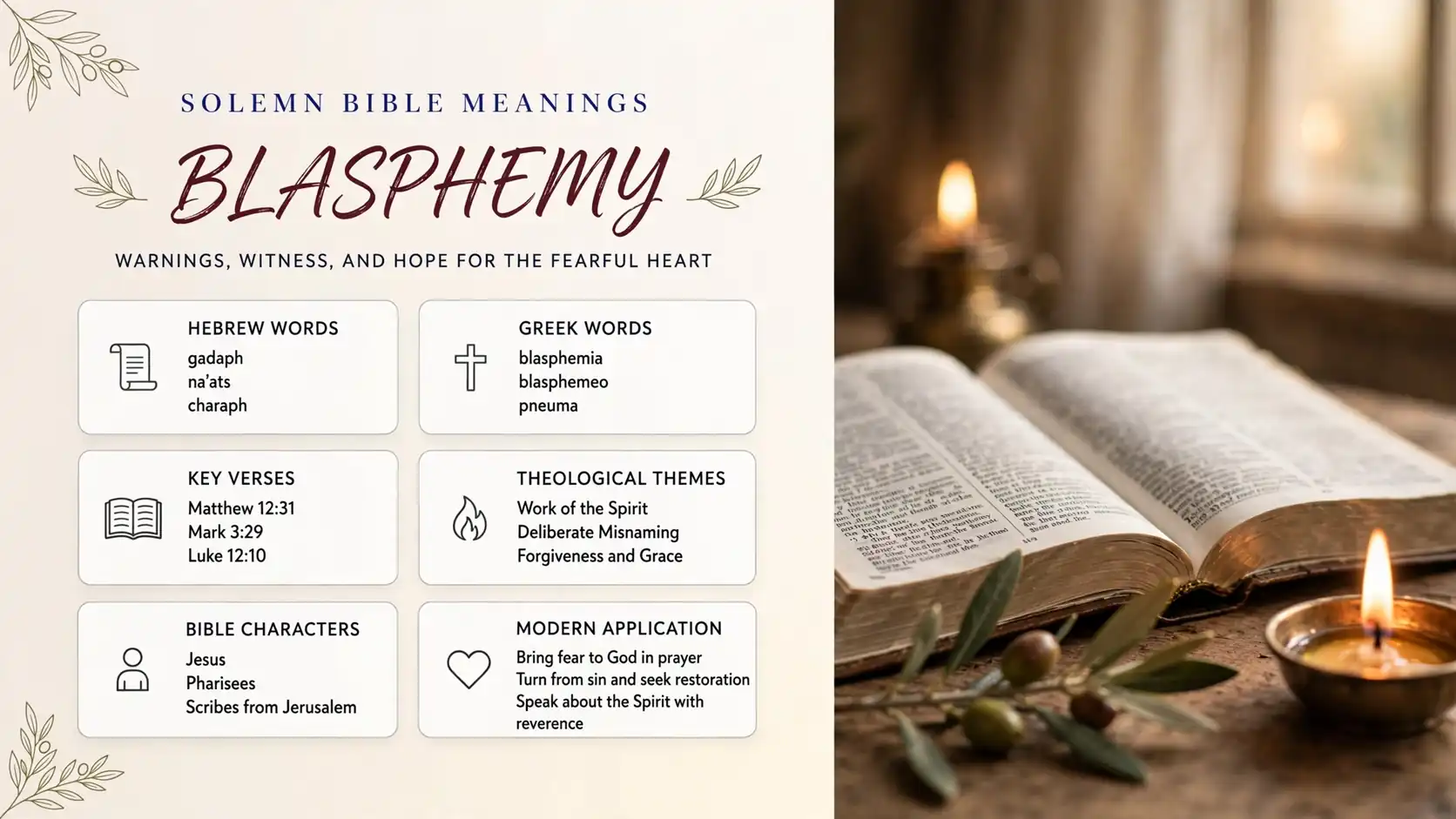
Blasphemy Against the Holy Spirit in Key Scripture References
| Verse | Passage Snippet | Context |
|---|---|---|
| Matthew 12:31 | Every sin and blasphemy will be forgiven | Jesus speaks after a healing |
| Matthew 12:32 | Whoever speaks against the Holy Spirit | Warning follows the Beelzebul claim |
| Mark 3:28 | All sins will be forgiven | Jesus teaches the crowds and his disciples |
| Mark 3:29 | Whoever blasphemes against the Holy Spirit | The statement is set beside an eternal sin |
| Mark 3:30 | He said they had an unclean spirit | Mark explains the charge against Jesus |
| Luke 12:10 | Everyone who speaks against the Son of Man | Luke places it among witness teachings |
| Hebrews 6:4 | Those once enlightened and tasting the heavenly gift | Author warns readers who turn away |
| Hebrews 6:6 | They are crucifying the Son of God again | Passage describes settled rejection |
| Hebrews 10:29 | Insulting the Spirit of grace | Warning follows deliberate sin |
Blasphemy Against the Holy Spirit in Bible Translation Comparison
| Verse | KJV | NIV | ESV | NASB |
|---|---|---|---|---|
| Matthew 12:31 | All sin shall be forgiven | Every sin can be forgiven | Every sin will be forgiven | Every sin shall be forgiven |
| Matthew 12:32 | Not forgiven in this world | Not forgiven in this age | Not forgiven in this age | Not forgiven in this age |
| Mark 3:28 | All sins shall be forgiven | All sins will be forgiven | All sins will be forgiven | All sins will be forgiven |
| Mark 3:29 | In danger of eternal damnation | Guilty of an eternal sin | Guilty of an eternal sin | Guilty of an eternal sin |
| Mark 3:30 | He hath an unclean spirit | He has an impure spirit | He has an unclean spirit | He has an unclean spirit |
| Luke 12:10 | Shall be forgiven him | Will be forgiven | Will be forgiven | Will be forgiven |
| Hebrews 10:29 | Despite unto the Spirit of grace | Insulted the Spirit of grace | Outraged the Spirit of grace | Insulted the Spirit of grace |
| 1 John 5:16 | There is a sin unto death | A sin that leads to death | Sin that leads to death | A sin leading to death |
Blasphemy Against the Holy Spirit in People and Characters Associated
| Person | Role | Connection |
|---|---|---|
| Jesus | Teacher and healer | He gives the warning in Matthew and Mark |
| Pharisees | Religious leaders | They attribute the healing to Beelzebul |
| Scribes from Jerusalem | Teachers of the law | They claim Jesus acts by an unclean spirit |
| Blind and mute man | Person healed by Jesus | His healing prompts the dispute in Matthew 12 |
| Disciples | Followers of Jesus | They hear the teaching on witness in Luke 12 |
| Beelzebul | Name for a ruler of demons | The accusers use this name for the source |
| Holy Spirit | Third person of the Trinity | His work is misnamed as evil here |
| Satan | Accuser and adversary | The divided kingdom argument answers this charge |
| Stephen | Witness in Acts | His accusers resist the Spirit in Acts 7 |
Blasphemy Against the Holy Spirit in Original Hebrew and Greek Words
| Original Word | Transliteration | Strong’s # | Literal Meaning |
|---|---|---|---|
| גָּדַף | gadaph | H1442 | To revile or blaspheme |
| נָאַץ | na’ats | H5006 | To despise or spurn |
| חָרַף | charaph | H2778 | To reproach or taunt |
| רוּחַ | ruach | H7307 | Spirit, wind, or breath |
| βλασφημία | blasphemia | G988 | Slander or blasphemous speech |
| βλασφημέω | blasphemeo | G987 | To speak evil or blaspheme |
| πνεῦμα | pneuma | G4151 | Spirit, wind, or breath |
| ἅγιος | hagios | G40 | Holy or set apart |
Blasphemy Against the Holy Spirit in Related Biblical Concepts
| Concept | Connection | Supporting Verse |
|---|---|---|
| Forgiveness | Most sins are forgivable | Matthew 12:31 |
| Repentance | Turning back leads to restoration | Acts 3:19 |
| Hardness of heart | Settled refusal closes the ear | Hebrews 3:8 |
| Grieving the Spirit | Believers can grieve the Spirit | Ephesians 4:30 |
| Quenching the Spirit | The Spirit can be resisted | 1 Thessalonians 5:19 |
| Resisting the Spirit | Stephen names this resistance | Acts 7:51 |
| Witness of the Spirit | The Spirit testifies about Jesus | John 15:26 |
| Conviction of sin | The Spirit convicts about sin | John 16:8 |
| Eternal sin | Mark uses a lasting term | Mark 3:29 |
Blasphemy Against the Holy Spirit in Historical and Cultural Context
| Aspect | Detail | Biblical Source |
|---|---|---|
| First century healing | Healing signalled authority | Matthew 12:22 |
| Demon possession language | Possession language described affliction | Mark 3:22 |
| Beelzebul charge | Opponents named a demonic source | Matthew 12:24 |
| Scribal authority | Scribes guarded public teaching | Mark 3:22 |
| Divided kingdom argument | Jesus shows Satan would not defeat himself | Matthew 12:26 |
| Finger of God language | Luke uses divine power language | Luke 11:20 |
| Spirit in the Old Testament | The Spirit empowered judges and prophets | Judges 14:6 |
| Blasphemy in the law | Old Testament law treated blasphemy seriously | Leviticus 24:16 |
| Public accusation | Charge was made before crowds | Mark 3:22 |
Blasphemy Against the Holy Spirit in Theological Themes
| Theme | Explanation | Scripture |
|---|---|---|
| Work of the Spirit | The Spirit reveals the work of Jesus | John 16:14 |
| Deliberate misnaming | Calling holy work evil reverses its source | Mark 3:30 |
| Forgiveness and grace | Scripture presents forgiveness as wide | Matthew 12:31 |
| Persistence in refusal | Warning fits settled rejection | Hebrews 6:6 |
| Fear and assurance | Fear often signals a tender conscience | 1 John 3:20 |
| Judgment and mercy | Judgment sits beside invitations to repent | Acts 17:30 |
| Person of the Spirit | The Spirit is a person | Ephesians 4:30 |
| Witness and truth | Truthful witness honors the Spirit | John 15:26 |
| Pastoral care | Care for the fearful belongs here | Psalm 51:11 |
Blasphemy Against the Holy Spirit in Modern Application for Believers
| Area | Practice | Scripture |
|---|---|---|
| Personal fear | Bring fear to God in prayer | Psalm 51:10 |
| Repentance | Turn from sin and seek restoration | 1 John 1:9 |
| Speech about God | Speak about the Spirit with reverence | Ephesians 4:29 |
| Discernment | Test spiritual claims with Scripture | 1 John 4:1 |
| Church teaching | Teach this passage in context | 2 Timothy 2:15 |
| Pastoral counsel | Listen before naming a final verdict | Galatians 6:1 |
| Prayer life | Ask the Spirit for help in weakness | Romans 8:26 |
| Community life | Encourage one another in faith | Hebrews 10:24 |
| Public witness | Confess Christ openly when required | Luke 12:8 |
Blasphemia and the Work Jesus Attributed to the Spirit
In Matthew 12, the healing of a blind and mute man leaves the crowds amazed, and the Pharisees answer that amazement with a charge. They say the power comes from Beelzebul, and Jesus answers with a kingdom argument that exposes the charge as incoherent. Here blasphemia is not a private thought.
You can read the passage as a public and deliberate reversal, where a clear work of mercy is named as the work of evil. That reading explains the strong warning without trapping every anxious believer. The Spirit in the Gospels brings healing, truth, and freedom, and the accusation tries to rename that freedom as bondage.
How You Can Understand What Does Blasphemy Against the Holy Spirit Mean in the Bible Today
Many readers ask whether doubt or a past period of unbelief counts as this sin, and the texts point toward a narrower pattern. Doubt is often answered with patience, and Peter denied Jesus yet was restored, so struggle is not final rejection. The warning in Mark is tied to people who saw the evidence, heard the teaching, and still called the source evil.
That distinction does not make the passage easy, and it should not be used to dismiss fear with a quick slogan. If you are worried, that worry can show you still want to turn toward God, so pray, talk with a trusted pastor, and reread Matthew 12, Mark 3, and Luke 12 in full. Scripture pairs this warning with wide promises of forgiveness, and you should hold both truths together.
Pneuma, Ruach, and the Spirit in Old and New Testaments
Ruach in Hebrew and pneuma in Greek both mean wind and breath, and that image helps you follow the Spirit through the Bible. In the Old Testament, ruach empowers Samson, rests on prophets, and is grieved when Israel turns away, so the Spirit is never presented as a vague power without a personal presence. In the New Testament, pneuma is the Spirit who descends at the baptism of Jesus, leads him in the wilderness, and empowers the church at Pentecost.
When the scribes in Mark 3 say Jesus has an unclean spirit, they claim the holy pneuma at work in Jesus is unclean. That is why hagios matters, because it marks the Spirit as set apart and holy, and the accusation tries to strip that holiness away. Your study grows steadier when you trace ruach and pneuma across both Testaments rather than isolating one verse.
Frequently Asked Questions About Blasphemy Against the Holy Spirit
Does the Greek word blasphemia always mean the unforgivable sin?
No, blasphemia can describe slander or evil speech in general, and only the Gospel context ties it to this specific warning about the Holy Spirit.
Is doubt the same as blasphemy against the Holy Spirit?
No, doubt, questions, and even anger expressed in prayer differ from the public and settled misnaming of the Spirit’s work as evil.
Why do Matthew, Mark, and Luke phrase the warning differently?
Each Gospel writer places the warning in a distinct teaching setting, and the differences in wording reflect their audiences and narrative contexts rather than a contradiction.
How does Hebrews 6 relate to what Jesus said in Mark 3?
Hebrews addresses a community tempted to abandon Christ after knowledge and experience, while Mark addresses accusers who called the Spirit’s work unclean, so the passages overlap in seriousness but not in every detail.
What should I do if I fear I have committed this sin?
Seek prayer, read Matthew 12 and Mark 3 in full, and speak with a trusted pastor, because fear that seeks God is very different from settled rejection of God.