
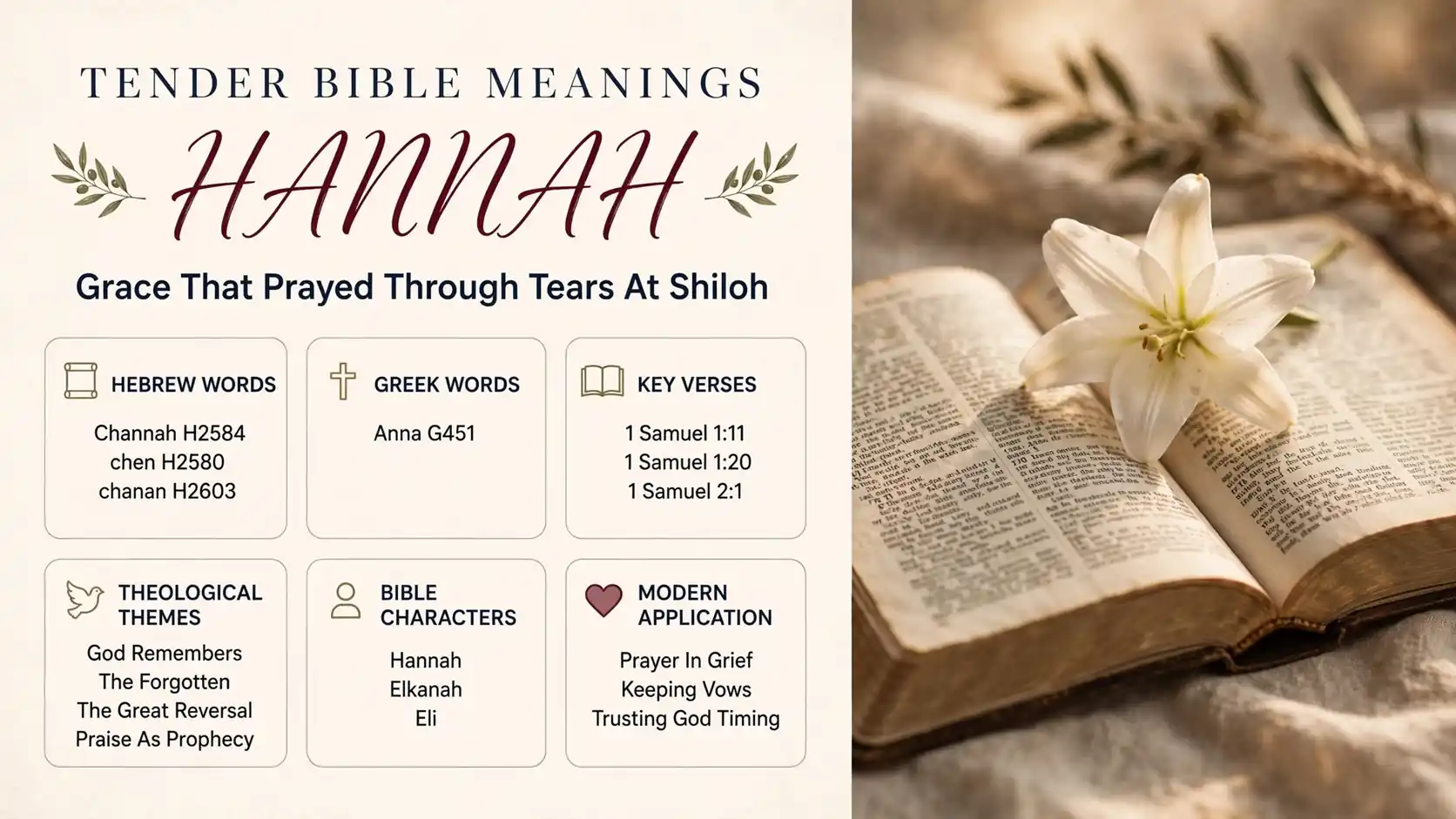
When you ask what does hannah mean in the bible, you meet a woman whose very name carries the answer to her long sorrow. Hannah, called Channah in Hebrew, means grace or favor, and her story fills the opening chapters of First Samuel. Barren for years and mocked by a rival wife, she carried her grief to the tabernacle at Shiloh and poured out her heart before the Lord. God remembered her, gave her Samuel, and turned her tears into one of the great songs of praise in all of Scripture for your study.
Hannah Key Scripture References
| Verse | Passage Snippet | Context |
|---|---|---|
| 1 Samuel 1:2 | Hannah had no children | Elkanah and his two wives |
| 1 Samuel 1:5 | The Lord had closed her womb | Double portion given in love |
| 1 Samuel 1:10 | She wept and prayed in bitterness | Prayer at the Shiloh tabernacle |
| 1 Samuel 1:11 | Remember me and give a son | Her vow of dedication |
| 1 Samuel 1:15 | I have poured out my soul | Her answer to Eli the priest |
| 1 Samuel 1:20 | She bore a son called Samuel | God heard her request |
| 1 Samuel 1:28 | I have lent him to the Lord | Samuel given back to God |
| 1 Samuel 2:1 | My heart rejoices in the Lord | Her song of praise begins |
| 1 Samuel 2:21 | She bore three sons and two daughters | Blessing after Samuel was given |
Hannah Bible Translation Comparison
| Verse | KJV | NIV | ESV | NASB |
|---|---|---|---|---|
| 1 Samuel 1:11 | Remember me and give unto thine handmaid a man child | Will remember me and not forget your servant | Remember me and not forget your servant | Remember me and do not forget Your maidservant |
| 1 Samuel 1:15 | I have poured out my soul before the Lord | I was pouring out my soul to the Lord | I have been pouring out my soul before the Lord | I have poured out my soul before the Lord |
| 1 Samuel 1:20 | She bare a son and called his name Samuel | She gave birth to a son and named him Samuel | She bore a son and she called his name Samuel | She gave birth to a son and she named him Samuel |
| 1 Samuel 1:27 | The Lord hath given me my petition | I prayed for this child and the Lord has granted me | For this child I prayed and the Lord has granted me | For this boy I prayed and the Lord has given me |
| 1 Samuel 2:1 | My heart rejoiceth in the Lord | My heart rejoices in the Lord | My heart exults in the Lord | My heart exults in the Lord |
| 1 Samuel 2:5 | The barren hath born seven | The barren woman now has seven sons | The barren has borne seven | The barren gives birth to seven |
| 1 Samuel 2:8 | He raiseth up the poor out of the dust | He raises the poor from the dust | He raises the poor from the dust | He raises the poor from the dust |
| 1 Samuel 2:10 | He shall give strength unto his king | He will give strength to his king | He will give strength to his king | He will give strength to His king |
Hannah People and Characters Associated
| Person | Role | Connection |
|---|---|---|
| Hannah | Mother of Samuel | Prayed at Shiloh and kept her vow |
| Elkanah | Husband of Hannah | Loved her and gave a double portion |
| Peninnah | Rival wife | Provoked Hannah over her barrenness |
| Eli | High priest at Shiloh | Blessed Hannah and later raised Samuel |
| Samuel | Son of Hannah | Judge and prophet who anointed kings |
| Hophni | Son of Eli | Corrupt priest judged by God |
| Phinehas | Son of Eli | Corrupt priest serving at the tabernacle |
| The Lord of Hosts | God addressed in her vow | Title first sounded at Shiloh worship |
| Mary | Mother of Jesus | Sang a song echoing the praise of Hannah |
Hannah Original Hebrew and Greek Words
| Original Word | Transliteration | Strong’s # | Literal Meaning |
|---|---|---|---|
| חַנָּה | Channah | H2584 | Grace or favor, her own name |
| חֵן | chen | H2580 | Grace, favor, charm |
| חָנַן | chanan | H2603 | To show favor, be gracious |
| Ἄννα | Anna | G451 | Greek form of the name Channah |
| פָּלַל | palal | H6419 | To pray or intercede |
| שָׁאַל | sha’al | H7592 | To ask or request |
| נֶדֶר | neder | H5088 | A vow made to God |
| שָׁמַע | shama | H8085 | To hear and respond |
| שְׁמוּאֵל | Shemuel | H8050 | Heard by God, name of Samuel |
| זָכַר | zakar | H2142 | To remember |
Hannah Related Biblical Concepts
| Concept | Connection | Supporting Verse |
|---|---|---|
| Grace | Her name and her whole story | 1 Samuel 1:18 |
| Barrenness | A closed womb opened by God | 1 Samuel 1:5 |
| Persistent Prayer | She kept praying year after year | 1 Samuel 1:7 |
| The Vow | Promising Samuel back to God | 1 Samuel 1:11 |
| Dedication | A child lent to the Lord | 1 Samuel 1:28 |
| Remembrance | God remembered Hannah | 1 Samuel 1:19 |
| Reversal | The barren mother exalted above the proud | 1 Samuel 2:5 |
| Praise After Answer | A song sung at the dedication | 1 Samuel 2:1 |
| Nazirite Pattern | No razor would touch the head of Samuel | 1 Samuel 1:11 |
| Divine Sovereignty | The Lord kills and makes alive | 1 Samuel 2:6 |
Hannah Historical and Cultural Context
| Aspect | Detail | Biblical Source |
|---|---|---|
| Time Period | Days of the judges before any king | Judges 21:25 |
| Shiloh Shrine | The tabernacle stood at Shiloh | 1 Samuel 1:3 |
| Annual Feast | The family went up yearly to worship | 1 Samuel 1:3 |
| Polygamy | Elkanah had two wives in one house | 1 Samuel 1:2 |
| Sacrifice Portions | Meat portions were given to each wife | 1 Samuel 1:4 |
| Double Portion | Hannah received a worthy share in love | 1 Samuel 1:5 |
| Silent Prayer | Her lips moved with no voice heard | 1 Samuel 1:13 |
| Weaning Custom | A child was weaned before staying at Shiloh | 1 Samuel 1:22 |
| Yearly Robe | Hannah brought a little robe each year | 1 Samuel 2:19 |
| Priestly Corruption | The sons of Eli abused the offerings | 1 Samuel 2:12 |
Hannah Theological Themes
| Theme | Explanation | Scripture |
|---|---|---|
| God Remembers the Forgotten | He heard the prayer of a barren woman | 1 Samuel 1:19 |
| Grace Precedes the Gift | Her name means favor before Samuel came | 1 Samuel 1:18 |
| The Great Reversal | God lifts the poor from the dust | 1 Samuel 2:8 |
| God Answers Persistent Prayer | Years of tears ended in joy | 1 Samuel 1:27 |
| Surrender of the Best Gift | Samuel was given back in worship | 1 Samuel 1:28 |
| Praise as Prophecy | Her song foretells a coming king | 1 Samuel 2:10 |
| God Opposes the Proud | The bows of the mighty are broken | 1 Samuel 2:4 |
| Fertility Rests With God | He opens and closes the womb | 1 Samuel 1:5 |
| The Lord of Hosts Reigns | That mighty title frames her prayer | 1 Samuel 1:11 |
| Faith Formed in the Home | A praying mother shaped a prophet | 1 Samuel 2:19 |
Hannah Modern Application for Believers
| Area | Practice | Scripture |
|---|---|---|
| Prayer in Grief | Pour out your soul honestly before God | 1 Samuel 1:15 |
| Waiting Seasons | Keep returning to God year after year | 1 Samuel 1:7 |
| Keeping Vows | Fulfill the promises you made in prayer | 1 Samuel 1:28 |
| Raising Children | Dedicate your children to the Lord early | 1 Samuel 1:27 |
| Handling Provocation | Answer mockery with prayer, not revenge | 1 Samuel 1:6 |
| Worship After Breakthrough | Sing praise when God answers you | 1 Samuel 2:1 |
| Marriage Kindness | Receive love well in hard seasons | 1 Samuel 1:8 |
| Serving Faithfully | Support ministry with steady small gifts | 1 Samuel 2:19 |
| Trusting God Timing | Believe that God remembers you | 1 Samuel 1:19 |
Chanan and the Grace Hidden Inside the Name Channah
The name Channah grows out of chanan, the Hebrew verb for showing favor to someone who cannot earn it. Her parents named her grace long before she had any sign that grace would visit her own house. That order matters for your study, because the name was a confession before it became an experience.
When Hannah finally rose from prayer, her face was no longer sad, even before Samuel was conceived. Scripture says she went her way, ate, and hoped to find favor in the eyes of God. Grace had already done its first work in her heart at Shiloh, steadying her while the answer was still on the way.
What Does Hannah Mean in the Bible at the Doorstep of Shiloh
Year after year the family climbed to Shiloh for the feast, and year after year Peninnah turned that holy trip into a wound. Elkanah gave Hannah a double portion because he loved her, yet his kindness could not open a closed womb. The story places her sorrow right at the door of the tabernacle, where God would meet it.
Her prayer there was so inward that only her lips moved, and Eli assumed she was drunk. When she explained that she had poured out her soul, the old priest blessed her instead. You can learn from that moment that God hears the prayers other people misread, and He often answers through a blessing spoken over your tears.
The Song of Hannah in First Samuel 2 and the Echo Mary Later Sang
The prayer of Hannah in chapter 2 is one of the great poems of the Old Testament, built on reversal from start to finish. The barren woman has seven, the hungry are filled, and the poor are lifted from the dust to sit with princes. She sang about a king and an anointed one centuries before Israel crowned either.
Mary clearly knew this song when she sang her own praise in Luke chapter 1. Both women were lowly, both were surprised by grace, and both declared that God scatters the proud and lifts the humble. When you read the two songs side by side, Hannah becomes a teacher of Mary, and a teacher of your praise as well.
Frequently Asked Questions About Hannah
Does the name Channah really come from chanan and chen?
Yes, Channah with Strong H2584 rests on chen, grace, and on the verb chanan, to show favor, which her whole story displays.
Why did Eli think Hannah was drunk at Shiloh?
Her lips moved in silent prayer with no voice, a rare sight in that day, so Eli misread her deep grief as drunkenness.
How is the name Samuel tied to the prayer of Hannah?
She named him Samuel, Shemuel, because she had asked him of the Lord, and shama means God truly heard her request.
How many children did Hannah have after Samuel?
First Samuel 2 verse 21 says the Lord visited Hannah and she bore three more sons and two daughters after Samuel.
Did the song of Hannah shape the Magnificat of Mary?
Yes, the themes, images, and even phrases of her song return in Luke chapter 1, where Mary praises the same great reversal.