
When you ask what does luke mean in the bible, you meet a name tied to light, healing, and careful witness. Luke was a physician, a traveling companion of Paul, and the writer of a Gospel and the book of Acts. His name points you toward mercy for people who felt far from God.
Luke also shows you how faith holds up under close study. He checked eyewitness accounts, ordered his record with care, and stayed with Paul when others had left. His story invites your study to be both warmhearted and well grounded.
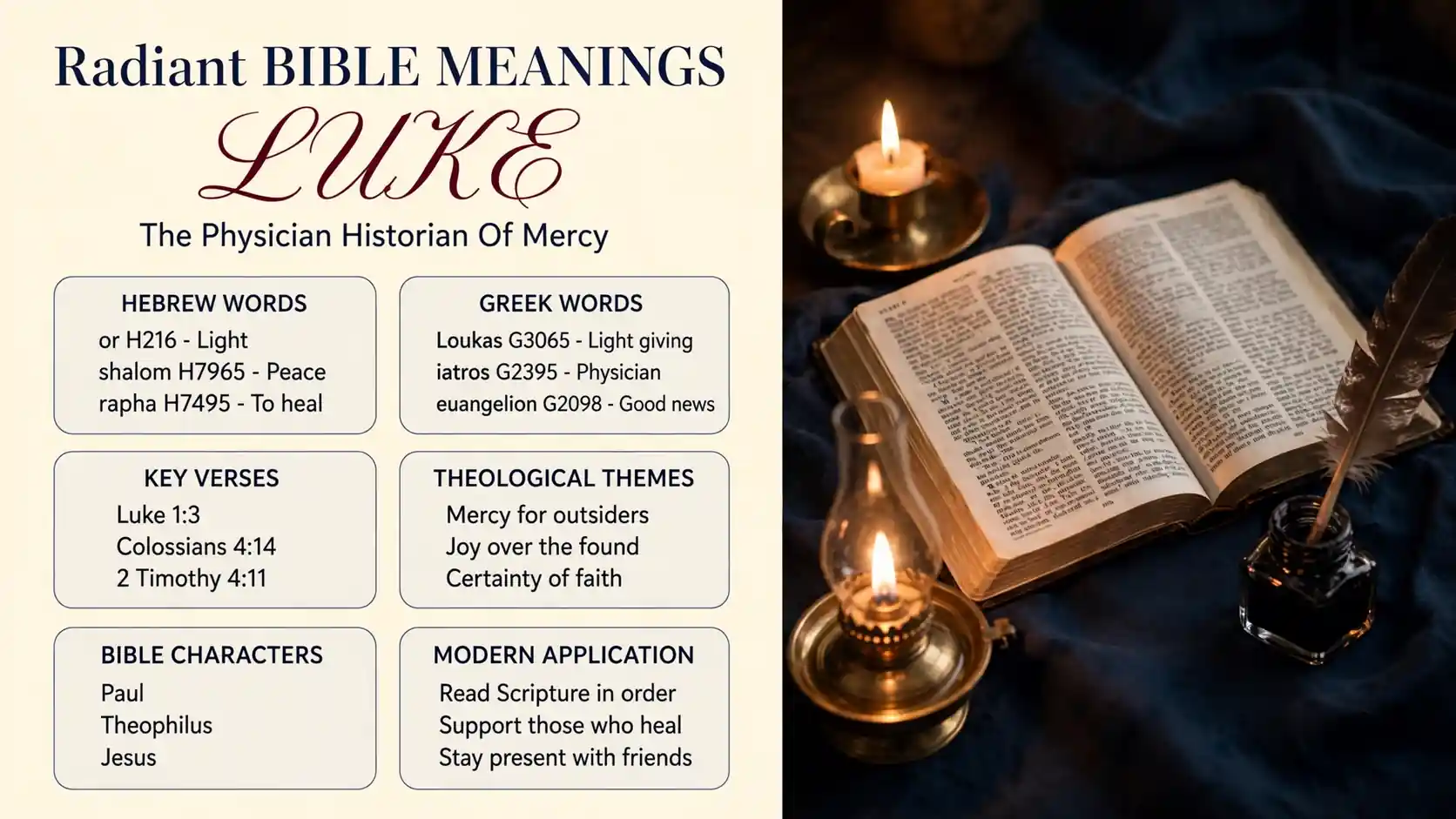
Key Scripture References About Luke
| Verse | Passage Snippet | Context |
|---|---|---|
| Luke 1:3 | I decided to write an orderly account | Luke explains his careful research method |
| Luke 1:4 | Certainty concerning the things taught | Purpose stated for reader Theophilus |
| Colossians 4:14 | Luke the beloved physician | Paul names Luke by his healing work |
| 2 Timothy 4:11 | Only Luke is with me | Luke stays loyal near Paul’s end |
| Philemon 24 | Luke, my fellow worker | Luke listed among Paul’s trusted team |
| Acts 1:1 | In the first book, O Theophilus | Acts continues the story from the Gospel |
| Luke 15:20 | His father ran and embraced him | Prodigal Son told only in Luke |
| Luke 10:33 | A Samaritan had compassion | Good Samaritan told only in Luke |
| Luke 2:32 | A light for revelation to the Gentiles | Simeon declares the wide scope of salvation |
Bible Translation Comparison for Luke
| Verse | KJV | NIV | ESV | NASB |
|---|---|---|---|---|
| Luke 1:3 | It seemed good to me also | I myself have carefully investigated | It seemed good to me also | It seemed fitting for me as well |
| Luke 1:4 | Thou mightest know the certainty | You may know the certainty | You may have certainty | You may know the exact truth |
| Colossians 4:14 | Luke, the beloved physician | Our dear friend Luke, the doctor | Luke the beloved physician | Luke, the beloved physician |
| 2 Timothy 4:11 | Only Luke is with me | Only Luke is with me | Luke alone is with me | Only Luke is with me |
| Luke 15:7 | Joy shall be in heaven | There will be rejoicing in heaven | There will be joy in heaven | There will be joy in heaven |
| Luke 10:33 | He had compassion on him | He took pity on him | He had compassion | He felt compassion for him |
| Luke 19:10 | The Son of man is come to seek | The Son of Man came to seek | The Son of Man came to seek | The Son of Man has come to seek |
| Acts 1:8 | Ye shall receive power | You will receive power | You will receive power | You will receive power |
| Luke 2:32 | A light to lighten the Gentiles | A light for revelation to the Gentiles | A light for revelation to the Gentiles | A light for revelation to the Gentiles |
People and Characters Associated with Luke
| Person | Role | Connection |
|---|---|---|
| Paul | Apostle and missionary | Luke traveled with him and stayed loyal |
| Theophilus | Honored reader | Both Luke and Acts are addressed to him |
| Jesus | Savior and teacher | Central figure of Luke’s Gospel record |
| Mary | Mother of Jesus | Her song and early stories feature in Luke |
| Zechariah | Priest and father | John the Baptist’s birth opens Luke |
| Elizabeth | Mother of John | Her joy frames the first chapter |
| Simeon | Righteous elder in temple | He blesses the infant Jesus in Luke 2 |
| Zacchaeus | Tax collector in Jericho | Jesus seeks him out in Luke 19 |
| Anna | Prophetess in the temple | She speaks of the child Jesus in Luke 2 |
Original Hebrew and Greek Words Behind Luke
| Original Word | Transliteration | Strong’s # | Literal Meaning |
|---|---|---|---|
| Λουκᾶς | Loukas | G3065 | Light giving, luminous one |
| ἰατρός | iatros | G2395 | Physician, one who heals |
| εὐαγγέλιον | euangelion | G2098 | Good news, glad tidings |
| ἔλεος | eleos | G1656 | Mercy, compassion in action |
| אוֹר | or | H216 | Light, brightness, dawn |
| שָׁלוֹם | shalom | H7965 | Peace, wholeness, well being |
| רָפָא | rapha | H7495 | To heal, to restore health |
| חֶסֶד | chesed | H2617 | Steadfast love, loyal mercy |
Related Biblical Concepts Linked to Luke
| Concept | Connection | Supporting Verse |
|---|---|---|
| Light | Loukas sits in the family of light words | John 8:12 |
| Healing | Luke’s work as physician shapes his care | Colossians 4:14 |
| Mercy | Outsiders receive compassion in his Gospel | Luke 10:33 |
| Eyewitness history | Luke grounds faith in checked accounts | Luke 1:2 |
| Repentance | Lost people are found and restored | Luke 15:7 |
| Prayer | Jesus prays often across Luke’s record | Luke 11:1 |
| Joy | Heaven and earth rejoice at God’s saving work | Luke 15:7 |
| The Holy Spirit | The Spirit guides from birth to Acts | Acts 1:8 |
| Salvation for all | Good news reaches Gentiles and outcasts | Luke 2:32 |
Historical and Cultural Context of Luke
| Aspect | Detail | Biblical Source |
|---|---|---|
| Gentile authorship | Luke is widely seen as the only Gentile writer | Colossians 4:11 |
| Greek writing style | Polished Greek opens with a formal preface | Luke 1:1 |
| Roman world travel | Sea voyages and cities fill the Acts record | Acts 27:1 |
| Medical language | Precise terms for fevers and healing appear | Luke 4:38 |
| Temple life | Priests, sacrifices, and festivals frame scenes | Luke 1:9 |
| Tax collectors | Roman taxation made collectors despised figures | Luke 19:2 |
| Samaritans | Deep hostility shaped hearers of the parable | Luke 10:33 |
| Patron dedication | Books were often dedicated to a patron reader | Luke 1:3 |
| Widows in society | Widows held a fragile place and needed protection | Luke 21:2 |
Theological Themes in the Story of Luke
| Theme | Explanation | Scripture |
|---|---|---|
| Mercy for outsiders | Grace reaches Samaritans, women, and the poor | Luke 10:33 |
| Joy over the found | Heaven rejoices when the lost return home | Luke 15:7 |
| Certainty of faith | Belief rests on a trustworthy eyewitness record | Luke 1:4 |
| Jesus as Savior for all | Salvation is offered beyond Israel’s borders | Luke 2:32 |
| Compassionate healing | Jesus restores bodies and restores people | Luke 7:13 |
| Faithful presence | Staying with God’s servants in hard seasons matters | 2 Timothy 4:11 |
| Spirit led mission | The church moves outward by the Spirit’s power | Acts 1:8 |
| Table fellowship | Jesus eats with sinners and welcomes them close | Luke 15:2 |
| Persistent prayer | God hears his people who cry out day and night | Luke 18:7 |
Modern Application for Believers from Luke
| Area | Practice | Scripture |
|---|---|---|
| Study habits | Check the sources and read Scripture in order | Luke 1:3 |
| Care for the sick | Visit, pray for, and support those who heal | Colossians 4:14 |
| Loyalty | Stay present with friends in hard seasons | 2 Timothy 4:11 |
| Compassion | Cross a barrier to help a hurting stranger | Luke 10:33 |
| Welcome | Make room at your table for outsiders | Luke 15:2 |
| Repentance | Return to the Father quickly and honestly | Luke 15:20 |
| Witness | Share the good news beyond your own circle | Acts 1:8 |
| Prayer life | Follow the praying pattern of Jesus daily | Luke 11:9 |
| Generosity | Share resources with neighbors in real need | Luke 3:11 |
Loukas and the Light Link Behind the Name
The name Loukas, Strong’s G3065, is linked with light through Lucas in Latin and the Greek leukos family of bright words. That link fits a writer who brings hidden things into clear view for his readers. Luke does not leave you guessing about Jesus, because he sets names, places, and rulers in a real timeline.
This light theme also reaches back to Hebrew words such as or, Strong’s H216, for light in the first pages of Scripture. Luke opens with darkness breaking as John and Jesus are born into a waiting world. For your study, the name itself becomes a small picture of what his Gospel does.
The Physician Historian Who Checked Every Account
Luke introduces himself through his method before he tells you his name in other letters. In Luke 1:1 to 4 he says he followed all things closely and wrote an orderly account for Theophilus. That careful work gives your faith a record you can reread, test, and trust.
Paul calls him the beloved physician in Colossians 4:14, using iatros, Strong’s G2395, for one who heals. A doctor’s eye for detail shows in the healings, fevers, and recoveries Luke records with extra care. His healing work and his writing work serve the same Lord with the same steady hands.
What Does Luke Mean in the Bible for Paul’s Last Companion
Near the end of Paul’s life, the apostle writes a line that says more than a long biography could say. In 2 Timothy 4:11 Paul writes that only Luke is with me, while others have gone to other places. Luke’s loyalty was not loud, but it lasted when comfort and safety pulled other people away.
Philemon 24 also lists Luke among Paul’s fellow workers, placing him inside a trusted mission team. For you, this side of Luke challenges a faith that only shows up when things are easy. Real companionship in Christ means staying, serving, and encouraging when the season turns hard.
Luke’s Mercy for Outsiders, the Lost, and the Overlooked
Luke’s Gospel gives you stories found nowhere else, and many of them center on people others passed by. The Good Samaritan crosses an old hatred to bind wounds, and the Prodigal Son runs into a father’s embrace after wasting everything. Women, shepherds, tax collectors, and the poor all receive close and tender attention.
That pattern grows from euangelion, Strong’s G2098, the good news Luke was sent to record for all peoples. Simeon calls Jesus a light for revelation to the Gentiles in Luke 2:32, and the whole Gospel keeps that wide door open. When you read Luke, you are invited to welcome the very people Jesus welcomed.
FAQ About Luke
Was Luke a Gentile or a Jew in the Bible?
Luke is widely understood as a Gentile, since Paul lists him apart from the circumcision group in Colossians 4:10 to 14.
What does Loukas mean and what is its Strong’s number?
Loukas is Strong’s G3065 and is linked to light, often rendered as light giving or luminous.
Was Luke really a physician in Colossians 4:14?
Yes, Paul calls Luke the beloved physician in Colossians 4:14, using iatros, Strong’s G2395, for a healer.
Why does Luke 1:3 say he wrote an orderly account?
Luke 1:3 shows he carefully investigated eyewitness reports so Theophilus could know the certainty of what he was taught.
Did Luke write both a Gospel and the book of Acts?
Yes, Luke wrote the Gospel of Luke and Acts, and Acts 1:1 refers back to his first book for Theophilus.