
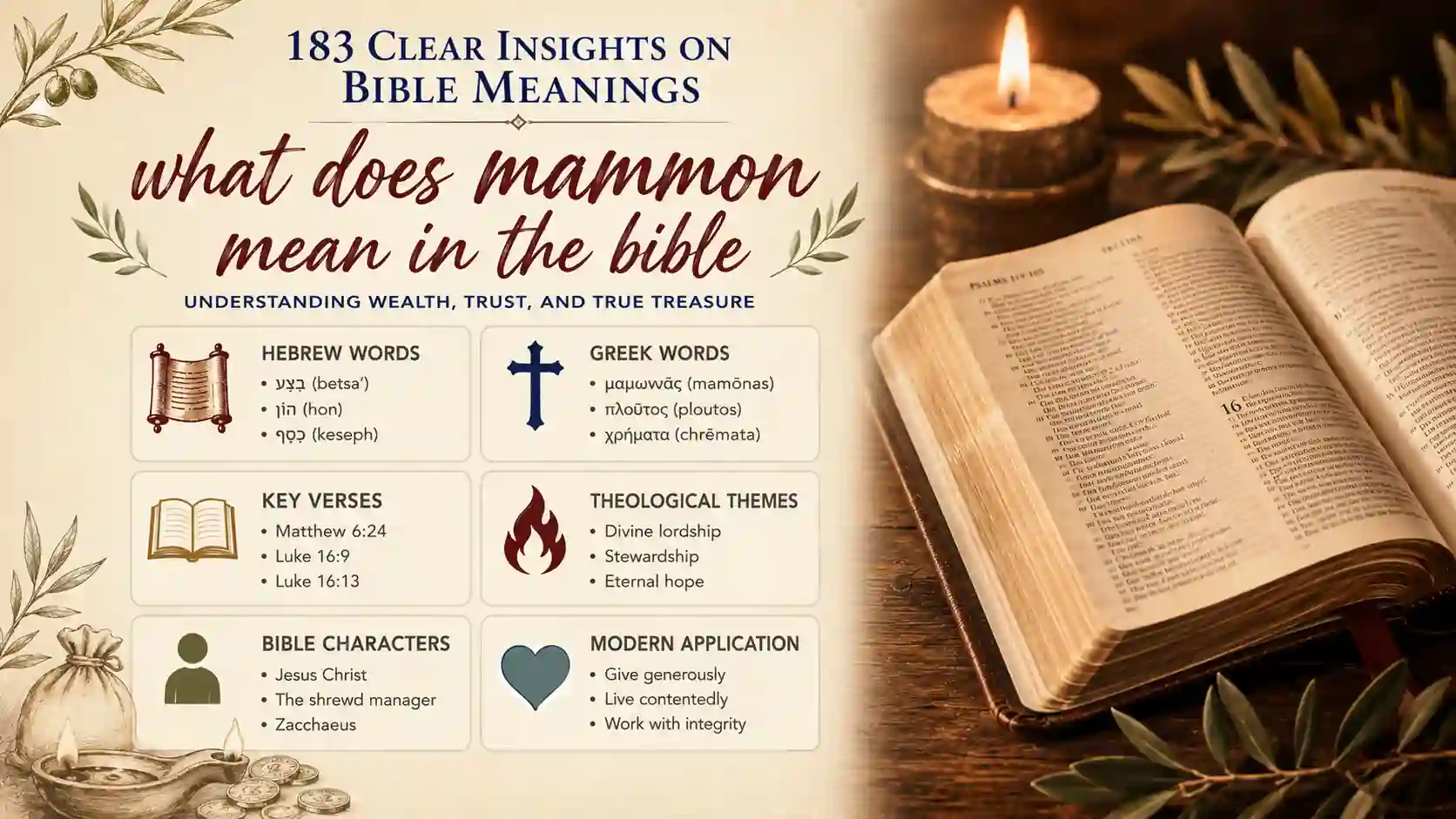
What does mammon mean in the Bible? Mammon is the Greek form of an Aramaic word referring to money, wealth, possessions, or material resources. Jesus uses it to expose the spiritual authority wealth can claim over the human heart.
Mammon is not merely cash in your pocket. It is wealth viewed as a rival master, a source of security, or an object of devotion. Your study of mammon therefore concerns worship, trust, stewardship, generosity, justice, and undivided loyalty to God.
Mammon Key Scripture References
| Verse | Passage Snippet | Context |
|---|---|---|
| Matthew 6:19 | “Treasures upon earth” | Earthly wealth is temporary |
| Matthew 6:20 | “Treasures in heaven” | Eternal investment is commanded |
| Matthew 6:21 | “There will your heart be” | Treasure reveals inner allegiance |
| Matthew 6:24 | “God and mammon” | Two masters cannot be served |
| Luke 12:15 | “Beware of covetousness” | Life exceeds possessions |
| Luke 16:9 | “Mammon of unrighteousness” | Wealth should serve eternal purposes |
| Luke 16:11 | “Faithful in unrighteous mammon” | Money tests trustworthiness |
| Luke 16:13 | “God and mammon” | Jesus repeats the two-master warning |
| 1 Timothy 6:10 | “Love of money” | Craving wealth damages faith |
| Hebrews 13:5 | “Without covetousness” | Contentment rests in God’s presence |
Jesus places mammon within teachings about treasure, anxiety, stewardship, and loyalty. Matthew 6:24 appears at the climax of a discussion in which earthly treasure decays, the heart follows its treasure, and the eye affects the whole person.
Mammon Bible Translation Comparison
| Verse | KJV | NIV | ESV | NASB |
|---|---|---|---|---|
| Matthew 6:19 | Treasures upon earth | Treasures on earth | Treasures on earth | Treasures on earth |
| Matthew 6:20 | Treasures in heaven | Treasures in heaven | Treasures in heaven | Treasures in heaven |
| Matthew 6:21 | Your heart be also | Your heart will be | Your heart will be | Your heart will be |
| Matthew 6:24 | God and mammon | God and money | God and money | God and wealth |
| Luke 16:9 | Mammon of unrighteousness | Worldly wealth | Unrighteous wealth | Wealth of unrighteousness |
| Luke 16:10 | Faithful in least | Trusted with little | Faithful in little | Faithful in little |
| Luke 16:11 | Unrighteous mammon | Worldly wealth | Unrighteous wealth | Unrighteous wealth |
| Luke 16:13 | God and mammon | God and money | God and money | God and wealth |
The translations do not describe different Greek words in these mammon passages. “Mammon,” “money,” and “wealth” represent the same underlying term, μαμωνᾶς, mamōnas. The KJV preserves the traditional transliteration, while many modern versions communicate its ordinary meaning.
People and Characters Associated with Mammon
| Person | Role | Connection |
|---|---|---|
| Jesus Christ | Divine Teacher | Warns against serving mammon |
| The disciples | Primary hearers | Taught faithful stewardship |
| The Pharisees | Money-loving critics | Ridicule Jesus’ teaching |
| The rich man | Property owner | Entrusts goods to a manager |
| The shrewd manager | Steward | Uses resources strategically |
| The debtors | Recipients of mercy | Benefit from reduced accounts |
| The rich fool | Prosperous landowner | Trusts stored possessions |
| The poor widow | Faithful giver | Gives from poverty |
| Zacchaeus | Repentant tax collector | Uses wealth in restitution |
| Judas Iscariot | Betraying disciple | Accepts silver for Jesus |
Luke identifies the Pharisees as lovers of money shortly after Jesus teaches about mammon. Their reaction shows that the issue is not abstract economics. Jesus’ words uncover a heart that may appear religious while treating wealth as its real source of status and security.
Mammon Original Hebrew and Greek Words
| Original Word | Transliteration | Strong’s # | Literal Meaning |
|---|---|---|---|
| μαμωνᾶς | mamōnas | G3126 | Wealth, possessions |
| πλοῦτος | ploutos | G4149 | Riches, abundance |
| χρήματα | chrēmata | G5536 | Money, possessions |
| ἀργύριον | argyrion | G694 | Silver, money |
| θησαυρός | thēsauros | G2344 | Treasure, storehouse |
| φιλαργυρία | philargyria | G5365 | Love of money |
| בֶּצַע | betsaʿ | H1215 | Unjust gain, profit |
| הוֹן | hon | H1952 | Wealth, substance |
| כֶּסֶף | keseph | H3701 | Silver, money |
| אוֹצָר | otsar | H214 | Treasure, storehouse |
The precise New Testament term is μαμωνᾶς, mamōnas, Strong’s G3126. It is a Semitic loanword, probably derived through Aramaic, meaning riches, money, or possessions. “Mammon” itself does not occur as a standard biblical Hebrew word in the Old Testament, so no separate Old Testament Strong’s number belongs to it.
Mammon Related Biblical Concepts
| Concept | Connection | Supporting Verse |
|---|---|---|
| Worship | Mammon can become a master | Matthew 6:24 |
| Treasure | Wealth directs the heart | Matthew 6:21 |
| Covetousness | Desire turns possessions into idols | Luke 12:15 |
| Stewardship | Resources belong to another | Luke 16:12 |
| Faithfulness | Small financial choices reveal character | Luke 16:10 |
| Generosity | Wealth should bless others | 1 Timothy 6:18 |
| Contentment | God replaces financial obsession | Hebrews 13:5 |
| Justice | Dishonest gain harms neighbors | Micah 2:2 |
| Anxiety | Trust in God answers material fear | Matthew 6:31 |
| Eternal reward | Giving stores heavenly treasure | Luke 12:33 |
Scripture does not teach that possessing money is automatically sinful. Abraham, Job, David, Lydia, Joseph of Arimathea, and others possessed significant resources. The danger appears when wealth governs your loyalty, defines your identity, excuses injustice, or becomes the foundation of your confidence.
Mammon Historical and Cultural Context
| Aspect | Detail | Biblical Source |
|---|---|---|
| Language | Mammon came from a Semitic term | Matthew 6:24 |
| Roman rule | Taxes shaped daily economic life | Matthew 22:17 |
| Coinage | Silver and copper circulated widely | Mark 12:15 |
| Estate management | Stewards administered property | Luke 16:1 |
| Debt | Debtors could face severe pressure | Matthew 18:25 |
| Agriculture | Wealth included crops and land | Luke 12:16 |
| Patronage | Gifts created social obligations | Luke 16:9 |
| Almsgiving | Giving aided the poor | Matthew 6:2 |
| Temple economy | Offerings supported worship | Mark 12:41 |
| Social honor | Wealth often brought influence | James 2:2 |
In the world of Jesus, wealth was not limited to currency. It included land, stored grain, livestock, household goods, debts owed, and relationships of patronage. The manager in Luke 16 handled his master’s accounts and possessed authority to negotiate obligations.
Jesus’ audience understood that a servant owed exclusive allegiance to a household master. His statement that no servant can serve two masters therefore sounded stronger than a warning about poor budgeting. It described incompatible claims of ownership.
Mammon Theological Themes
| Theme | Explanation | Scripture |
|---|---|---|
| Divine lordship | God alone deserves ultimate loyalty | Matthew 6:24 |
| Idolatry | Wealth can claim God’s place | Colossians 3:5 |
| Human dependence | Life is sustained by God | Matthew 6:26 |
| Stewardship | Possessions are entrusted, not absolute | Luke 16:12 |
| Moral testing | Money reveals faithfulness | Luke 16:10 |
| Kingdom reversal | The poor may be spiritually rich | Luke 6:20 |
| Judgment | Selfish wealth faces accountability | James 5:1 |
| Grace | Giving reflects God’s generosity | 2 Corinthians 8:9 |
| Providence | The Father knows material needs | Matthew 6:32 |
| Eternal hope | Earthly wealth eventually fails | Luke 16:9 |
Mammon becomes spiritually dangerous because it offers counterfeit promises. It promises safety, freedom, importance, and control. Yet Jesus says wealth fails. It cannot prevent death, secure acceptance before God, cleanse guilt, or guarantee tomorrow.
The gospel redirects your confidence to the Father, who knows what you need. Christian stewardship begins when you stop asking, “How much belongs to God?” and recognize that everything you possess is already under his authority.
Mammon Modern Application for Believers
| Area | Practice | Scripture |
|---|---|---|
| Income | Earn honestly | Ephesians 4:28 |
| Budgeting | Plan with humility | Luke 14:28 |
| Giving | Give willingly and generously | 2 Corinthians 9:7 |
| Saving | Prepare without hoarding | Proverbs 6:6 |
| Spending | Resist status-driven consumption | Luke 12:15 |
| Debt | Honor financial obligations | Romans 13:8 |
| Work | Serve Christ above profit | Colossians 3:23 |
| Contentment | Receive God’s provision gratefully | Philippians 4:11 |
| Justice | Pay workers fairly | James 5:4 |
| Hospitality | Use possessions to welcome others | 1 Peter 4:9 |
You do not defeat mammon merely by possessing less. A poor person can be ruled by money just as surely as a wealthy person. Mammon’s mastery concerns trust, desire, fear, and obedience rather than the size of an account.
Your financial habits can become practices of discipleship. Honest work, thoughtful saving, restrained spending, cheerful generosity, fair dealing, and care for vulnerable people all confess that money is a servant and God is your Lord.
What Does Mammon Mean in the Bible and Why Does Jesus Call It a Master?
When Jesus says, “You cannot serve God and mammon,” he uses the language of slavery or household service. The verb δουλεύω, douleuō, means to serve as one bound to a master. Jesus does not picture God and money as two interests that need better balance.
He presents them as rival authorities. Both demand trust, shape priorities, and promise a form of security. You may use wealth faithfully, but you cannot grant it the obedience, hope, and devotion that belong to God alone.
Μαμωνᾶς And the Meaning of Unrighteous Wealth in Luke 16
The phrase “mammon of unrighteousness” does not mean that every coin is acquired dishonestly. It describes wealth belonging to a fallen age, where possessions are easily entangled with injustice, pride, inequality, and self-interest. The ESV renders the phrase “unrighteous wealth,” while the NIV uses “worldly wealth.”
Jesus commands his disciples to use temporary resources with eternal wisdom. Luke 16:9 is not permission to buy salvation or manipulate friendships. It calls you to turn perishable wealth toward mercy, hospitality, generosity, and relationships shaped by God’s kingdom.
Treasure, Trust, and the Sermon on the Mount
Matthew places Jesus’ mammon warning between teaching about treasure and teaching about anxiety. What you treasure influences your heart, your spiritual vision, and your daily concerns. Mammon gains power when accumulated possessions become the answer to fear.
Jesus directs you toward your heavenly Father. Birds are fed and flowers are clothed without serving wealth as master. This does not condemn responsible labor or planning. It frees you to work diligently without treating financial control as your savior.
Faithful Stewardship without Worshiping Wealth
Luke 16 teaches that money is a test, not the ultimate treasure. Faithfulness in ordinary possessions prepares you to receive “true riches.” Earthly resources are temporary and, in a deep sense, belong to another. You manage them briefly before giving an account.
Generosity therefore becomes more than charity. It is an act of spiritual resistance. Every gift offered in love declares that mammon does not own you. Every honest decision says that your conscience is not for sale and your security rests in God.
Frequently Asked Questions About Mammon
Is μαμωνᾶς, mamōnas, the name of a literal demon?
In Scripture it means wealth or possessions personified as a rival master, not a named demon explicitly identified in the biblical text.
Why does the KJV say “mammon” while the NIV says “money”?
The KJV transliterates the Greek loanword, while the NIV translates its ordinary meaning for modern readers.
Does Luke 16:9 teach that you can purchase eternal life with money?
No. Jesus teaches wise, generous stewardship of temporary wealth, not salvation through financial gifts.
Is all wealth “unrighteous mammon” according to Jesus?
Wealth is not inherently sinful, but it belongs to a fallen world and can easily become connected with injustice, pride, or misplaced trust.
How can you know whether mammon has become your master?
Examine whether financial gain controls your obedience, identity, peace, generosity, relationships, or willingness to do what God commands.