
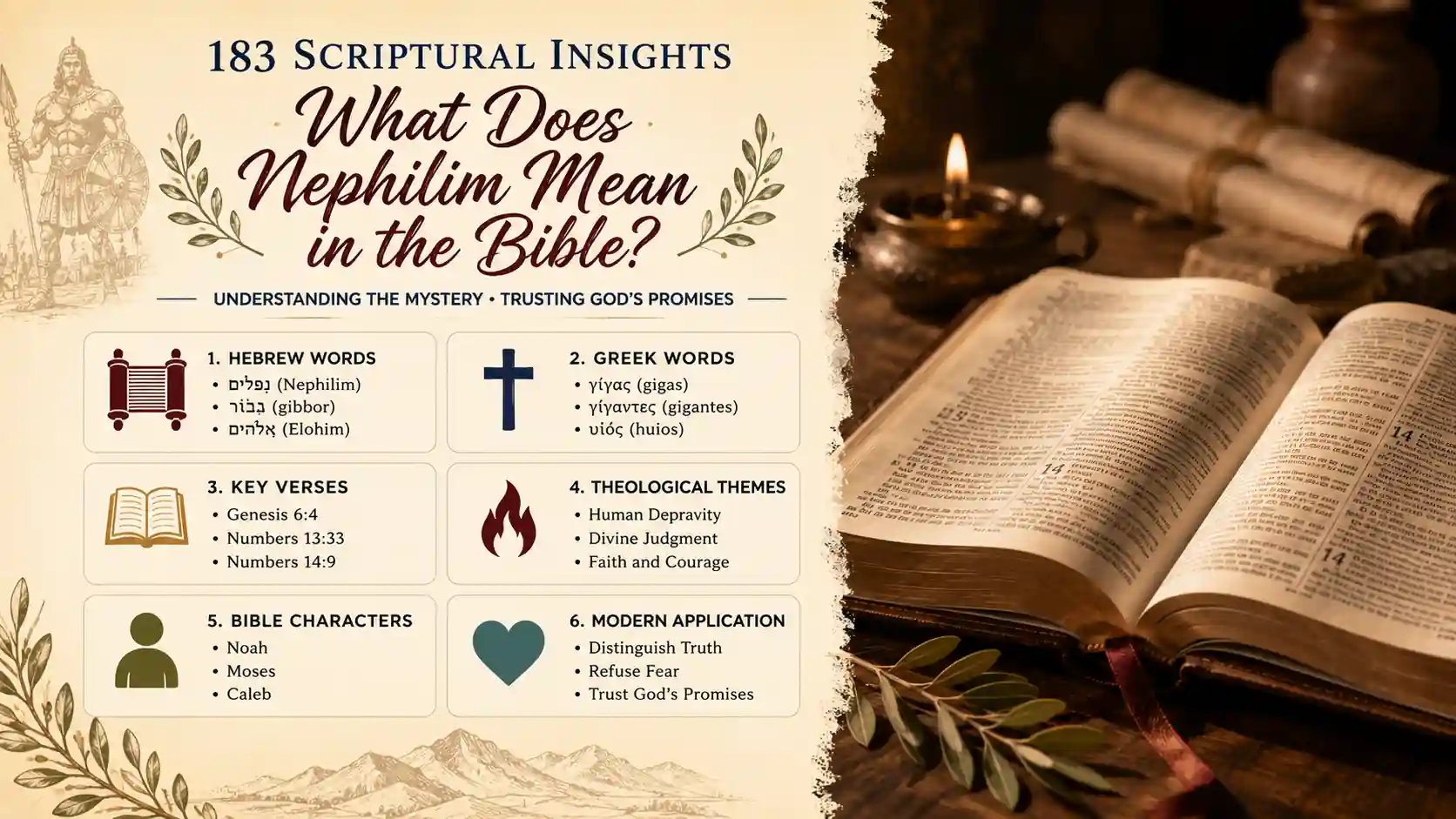
What does Nephilim mean in the Bible? The Hebrew term describes mysterious figures mentioned directly in only two passages, Genesis 6:4 and Numbers 13:33. Their identity has generated centuries of discussion because Scripture gives few details about their origin, appearance, or relationship to the “sons of God.”
Your study should begin with what the biblical text actually says. The Nephilim are associated with extraordinary strength, ancient renown, human wickedness, the Anakites, and Israel’s fear, but many popular claims about them go beyond Scripture.
Key Nephilim Scripture References
| Verse | Passage Snippet | Context |
|---|---|---|
| Genesis 6:1 | Humanity multiplied | Setting before the Flood |
| Genesis 6:2 | “Sons of God” took wives | Identity is debated |
| Genesis 6:3 | Humanity called flesh | Divine judgment announced |
| Genesis 6:4 | Nephilim were on earth | First direct reference |
| Genesis 6:4 | Mighty men of old | Known for strength and fame |
| Genesis 6:5 | Human wickedness was great | Main reason for judgment |
| Numbers 13:28 | Anak’s descendants observed | Spies survey Canaan |
| Numbers 13:32 | People of great stature | Fearful report spreads |
| Numbers 13:33 | Nephilim allegedly seen | Second direct reference |
| Numbers 14:9 | “Do not fear them” | Caleb and Joshua answer fear |
Nephilim Bible Translation Comparison
| Verse | KJV | NIV | ESV | NASB |
|---|---|---|---|---|
| Genesis 6:2 | sons of God | sons of God | sons of God | sons of God |
| Genesis 6:3 | strive with man | contend with humans | abide in man | strive with man |
| Genesis 6:4 | giants | Nephilim | Nephilim | Nephilim |
| Genesis 6:4 | daughters of men | daughters of humans | daughters of man | daughters of men |
| Genesis 6:4 | mighty men | heroes of old | mighty men | mighty men |
| Genesis 6:4 | men of renown | men of renown | men of renown | men of renown |
| Numbers 13:32 | great stature | great size | great height | great size |
| Numbers 13:33 | giants | Nephilim | Nephilim | Nephilim |
| Numbers 13:33 | sons of Anak | descendants of Anak | sons of Anak | sons of Anak |
| Numbers 13:33 | as grasshoppers | like grasshoppers | like grasshoppers | like grasshoppers |
People and Characters Associated with the Nephilim
| Person | Role | Connection |
|---|---|---|
| Noah | Flood survivor | Lived during Genesis 6 |
| Noah’s sons | Post-Flood ancestors | Preserve humanity after judgment |
| Sons of God | Mysterious group | Present when Nephilim existed |
| Daughters of humanity | Women in Genesis 6 | Bore children in the account |
| Mighty men | Ancient warriors | Associated with Nephilim |
| Moses | Leader and narrator | Records both key passages |
| Anak | Canaanite ancestor | His descendants were feared |
| Anakites | People of unusual height | Linked to Nephilim by spies |
| Caleb | Faithful spy | Refused fear of Canaanites |
| Joshua | Faithful spy | Trusted God’s covenant promise |
Original Hebrew and Greek Nephilim Words
| Original Word | Transliteration | Strong’s # | Literal Meaning |
|---|---|---|---|
| נְפִילִים | Nephilim | H5303 | Nephilim, possibly fallen ones |
| נָפַל | naphal | H5307 | To fall or fall down |
| גִּבּוֹר | gibbor | H1368 | Mighty one or warrior |
| שֵׁם | shem | H8034 | Name or reputation |
| בֵּן | ben | H1121 | Son or descendant |
| אֱלֹהִים | Elohim | H430 | God, gods, divine beings |
| עֲנָק | Anaq | H6061 | Anak, long-necked |
| גִּבּוֹרִים | gibborim | H1368 | Mighty men or warriors |
| γίγας | gigas | G1096 | Giant |
| γίγαντες | gigantes | G1096 | Giants, plural form |
Related Nephilim Biblical Concepts
| Concept | Connection | Supporting Verse |
|---|---|---|
| Sons of God | Their identity shapes interpretation | Genesis 6:2 |
| Human rebellion | Narrative emphasizes corruption | Genesis 6:5 |
| Divine judgment | Flood follows worldwide violence | Genesis 6:7 |
| Mighty warriors | Nephilim linked with renowned men | Genesis 6:4 |
| Great stature | Canaanites appeared physically imposing | Numbers 13:32 |
| Anakites | Spies connect them with Nephilim | Numbers 13:33 |
| Fear | Israel magnified the enemy | Numbers 13:31 |
| Exaggeration | Grasshopper language conveys terror | Numbers 13:33 |
| Covenant promise | God had promised Canaan | Numbers 13:2 |
| Faithful courage | Caleb urges obedient advance | Numbers 13:30 |
Historical and Cultural Context of the Nephilim
| Aspect | Detail | Biblical Source |
|---|---|---|
| Primeval history | Genesis 1 through 11 describes earliest humanity | Genesis 1–11 |
| Pre-Flood world | Violence and corruption filled the earth | Genesis 6:11 |
| Ancient warriors | Strength often produced fame and authority | Genesis 6:4 |
| Renown | Public reputation marked mighty figures | Genesis 6:4 |
| Patriarchal lineages | Peoples were identified through ancestors | Numbers 13:22 |
| Canaanite cities | Hebron was associated with Anakites | Numbers 13:22 |
| Military scouting | Twelve representatives surveyed Canaan | Numbers 13:2 |
| Fearful rhetoric | Spies used vivid size comparisons | Numbers 13:33 |
| Wilderness generation | Israel stood near the promised land | Numbers 13:1 |
| Covenant crisis | The report tested Israel’s trust | Numbers 14:1–9 |
Theological Themes Surrounding the Nephilim
| Theme | Explanation | Scripture |
|---|---|---|
| Human depravity | Sin, not physical size, drives Genesis 6 | Genesis 6:5 |
| Divine holiness | God judges entrenched corruption | Genesis 6:7 |
| Mercy in judgment | Noah receives divine favor | Genesis 6:8 |
| Limits of power | Famous warriors cannot resist God | Genesis 7:21 |
| Reliable promise | God remains able to give Canaan | Numbers 13:2 |
| Fear and unbelief | Visible threats overshadow God’s word | Numbers 14:11 |
| Faith and courage | Caleb evaluates danger through faith | Numbers 13:30 |
| Responsible speech | The spies’ report discourages Israel | Numbers 13:32 |
| Divine presence | God’s presence makes victory possible | Numbers 14:9 |
| Humble interpretation | Scripture’s silence should restrain speculation | Deuteronomy 29:29 |
Modern Application from the Nephilim Passages
| Area | Practice | Scripture |
|---|---|---|
| Bible study | Distinguish text from speculation | Deuteronomy 29:29 |
| Discernment | Examine claims carefully | Acts 17:11 |
| Fear | Refuse to magnify obstacles | Numbers 14:9 |
| Faith | Remember God’s promises | Numbers 13:2 |
| Speech | Avoid reports that spread panic | Numbers 13:32 |
| Courage | Follow Caleb’s faithful example | Numbers 13:30 |
| Humility | Admit where interpretations differ | Romans 12:3 |
| Holiness | Notice Scripture’s warning about corruption | Genesis 6:5 |
| Worship | Trust God above human strength | Psalm 20:7 |
| Hope | Rest in God’s rule over every power | Psalm 103:19 |
What Does Nephilim Mean in the Bible from the Hebrew נְפִילִים?
The plural Hebrew noun נְפִילִים, transliterated Nephilim, appears only in Genesis 6:4 and Numbers 13:33. Its precise etymology remains disputed, though many connect it with נָפַל, naphal, meaning “to fall,” and suggest senses such as “fallen ones” or “those who cause others to fall.”
The traditional English rendering “giants” comes largely through the ancient Greek Septuagint, which uses γίγαντες, gigantes. That translation supports an association with imposing figures, but the Hebrew word itself does not simply function as the ordinary biblical term for a tall person.
Genesis 6 Places the Nephilim Inside a Story of Judgment
Genesis 6:1–4 introduces the Nephilim beside the “sons of God,” the “daughters of humanity,” and the גִּבּוֹרִים, gibborim, or mighty men. Three major interpretations identify the sons of God as heavenly beings, rulers or warrior-kings, or members of a godly lineage intermarrying with a rebellious society.
Each view attempts to explain the unusual wording, but none answers every question beyond dispute. The passage never pauses to satisfy curiosity about biological details because its narrative movement leads directly to God’s assessment of human wickedness, corrupt imagination, violence, and coming judgment.
Numbers 13 Connects the Nephilim with Anakite Fear
In Numbers 13, the frightened spies report seeing the Nephilim and identify the sons of Anak with them. The same report uses dramatic language, declaring that the land devours its inhabitants and that the Israelites appeared like grasshoppers beside Canaan’s people.
This setting requires careful reading because the report comes from men whom the narrative presents as fearful and unbelieving. The Anakites were genuinely formidable, but the spies interpreted real danger without trusting the God who had already promised the land to Israel.
The Nephilim Question Calls for Humility and Faith
Scripture does not tell you that every later giant, including Goliath, was a Nephilim. Goliath is associated with Gath and the Philistine conflicts, while other large peoples are called Anakim or Rephaim, so these categories should not be merged without textual evidence.
The central theological lesson is not that mysterious beings are more powerful than ordinary humans. Genesis teaches that God judges pride and violence, while Numbers teaches that no intimidating enemy can overturn God’s covenant purpose when his people trust and obey him.
Frequently Asked Questions About the Nephilim
Does נְפִילִים, Nephilim, definitely mean “fallen angels”?
No. The possible connection with נָפַל, naphal, suggests falling, but the Hebrew word does not explicitly mean “fallen angels.”
Were the sons of God in Genesis 6 angels?
Possibly, but faithful interpreters also understand them as powerful rulers or men from a covenant lineage, and Genesis does not directly settle the debate.
Why does the KJV say “giants” while the NIV and ESV say “Nephilim”?
The KJV follows the traditional Greek-associated interpretation, while many modern translations preserve the uncertain Hebrew name.
How could Nephilim appear in Numbers 13 after the Flood?
Genesis says “and also afterward,” while Numbers records the spies’ claim, but Scripture does not explain a biological line of survival.
Should believers be afraid of modern claims about Nephilim?
No. You should test such claims by Scripture, reject sensational speculation, and remember that every created power remains under God’s authority.