
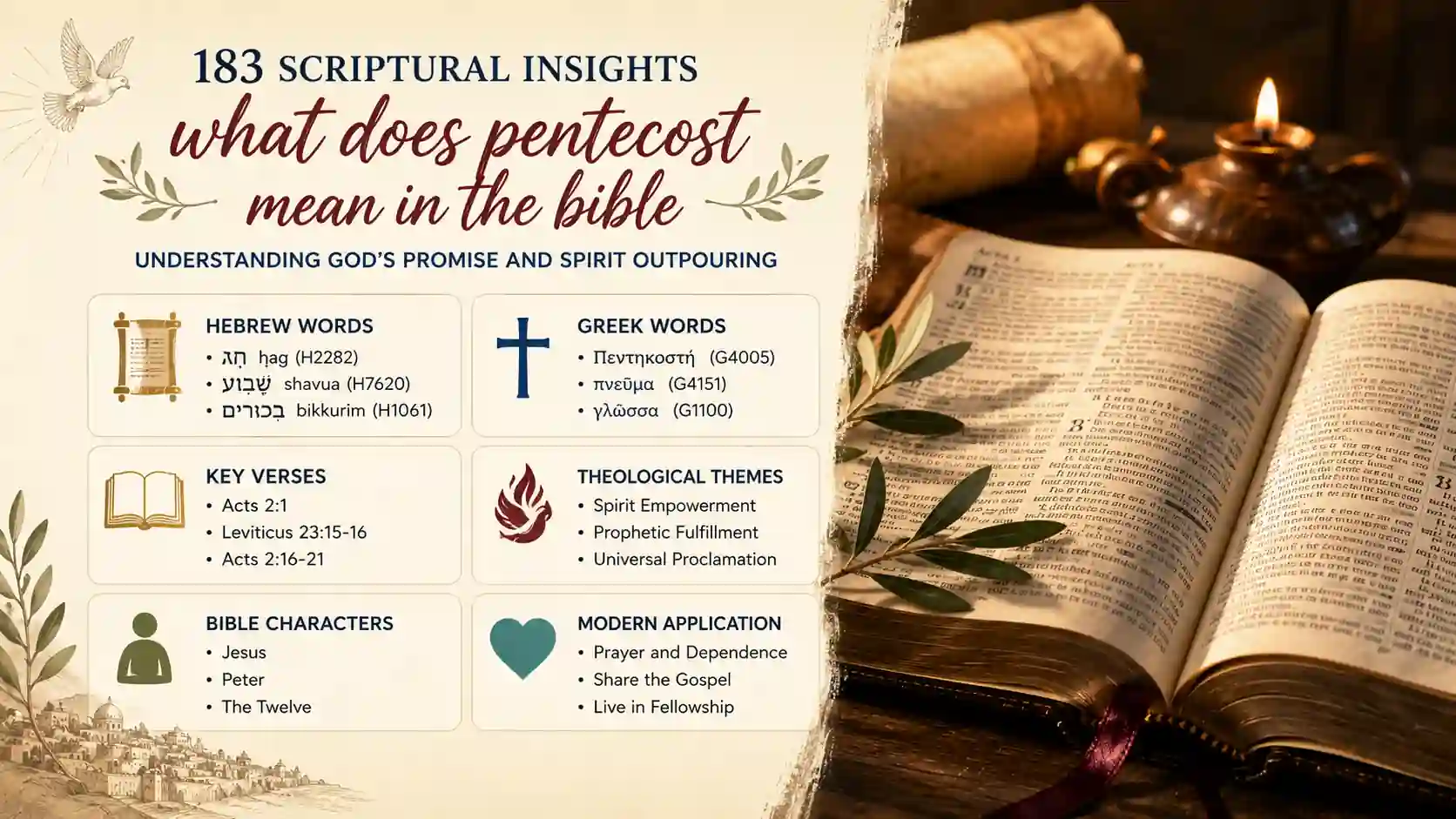
What does Pentecost mean in the Bible? The word identifies the fiftieth day, when Israel celebrated the Feast of Weeks and presented the firstfruits of the wheat harvest before God. In Acts, that appointed day became the setting for the promised outpouring of the Holy Spirit.
Pentecost therefore joins Israel’s worship, Christ’s resurrection and exaltation, the Spirit’s empowering presence, and the church’s worldwide mission. As you study it, you see one unfolding purpose rather than an isolated miracle.
Key Pentecost Scripture References
| Verse | Passage Snippet | Context |
|---|---|---|
| Exodus 23:16 | Feast of harvest | Firstfruits of Israel’s labor |
| Exodus 34:22 | Feast of Weeks | Firstfruits of wheat harvest |
| Leviticus 23:15-16 | Count fifty days | Festival calendar established |
| Leviticus 23:17 | Two wave loaves | New grain offering presented |
| Numbers 28:26 | Day of firstfruits | Sacred assembly commanded |
| Deuteronomy 16:10 | Freewill offering | Giving according to blessing |
| Acts 1:4-5 | Wait for the promise | Jesus prepares His disciples |
| Acts 2:1-4 | Day of Pentecost | Spirit fills the gathered believers |
| Acts 2:16-21 | Spoken through Joel | Peter explains the outpouring |
| Acts 2:41 | About three thousand | Gospel harvest begins |
Pentecost Bible Translation Comparison
| Verse | KJV | NIV | ESV | NASB |
|---|---|---|---|---|
| Exodus 34:22 | feast of weeks | Festival of Weeks | Feast of Weeks | Feast of Weeks |
| Leviticus 23:16 | fifty days | fifty days | fifty days | fifty days |
| Numbers 28:26 | day of the firstfruits | day of firstfruits | day of the firstfruits | day of the first fruits |
| Deuteronomy 16:10 | feast of weeks | Festival of Weeks | Feast of Weeks | Feast of Weeks |
| Acts 1:5 | baptized with the Holy Ghost | baptized with the Holy Spirit | baptized with the Holy Spirit | baptized with the Holy Spirit |
| Acts 2:1 | fully come | came | arrived | had come |
| Acts 2:2 | rushing mighty wind | violent wind | mighty rushing wind | violent rushing wind |
| Acts 2:3 | cloven tongues | tongues of fire | divided tongues | tongues as of fire |
| Acts 2:4 | other tongues | other tongues | other tongues | different tongues |
| Acts 2:17 | pour out of my Spirit | pour out my Spirit | pour out my Spirit | pour out of My Spirit |
People and Characters Associated with Pentecost
| Person | Role | Connection |
|---|---|---|
| Moses | Covenant mediator | Received the festival commands |
| Aaron | High priest | Served within Israel’s offering system |
| Jesus | Risen and exalted Lord | Promised and poured out the Spirit |
| Peter | Apostle and preacher | Interpreted the event from Scripture |
| The Twelve | Apostolic witnesses | Proclaimed Christ with Spirit-given power |
| Matthias | Chosen apostle | Joined the Eleven before Pentecost |
| Mary | Mother of Jesus | Prayed with the disciples |
| Joel | Old Testament prophet | Foretold the Spirit’s outpouring |
| David | King and psalmist | His psalms shaped Peter’s sermon |
| The pilgrims | International hearers | Heard God’s works in their languages |
Original Hebrew and Greek Words for Pentecost
| Original Word | Transliteration | Strong’s # | Literal Meaning |
|---|---|---|---|
| Πεντηκοστή | Pentēkostē | G4005 | Fiftieth |
| חַג | Ḥag | H2282 | Feast or pilgrimage festival |
| שָׁבוּעַ | Shavua | H7620 | Week or period of seven |
| קָצִיר | Qatsir | H7105 | Harvest |
| בִּכּוּרִים | Bikkurim | H1061 | Firstfruits |
| רֵאשִׁית | Reshit | H7225 | Beginning or first portion |
| רוּחַ | Ruaḥ | H7307 | Spirit, wind, or breath |
| πνεῦμα | Pneuma | G4151 | Spirit, wind, or breath |
| γλῶσσα | Glōssa | G1100 | Tongue or language |
| ἀπαρχή | Aparchē | G536 | Firstfruits or first portion |
Πεντηκοστή, Pentēkostē, names the fiftieth day. The Hebrew Scriptures usually call the celebration חַג שָׁבֻעוֹת, Ḥag Shavuot, the Feast of Weeks, because Israel counted seven complete weeks before observing it.
Related Biblical Concepts in Pentecost
| Concept | Connection | Supporting Verse |
|---|---|---|
| Passover | Begins the redemptive festival setting | Exodus 12:14 |
| Firstfruits | Precedes the fifty-day count | Leviticus 23:10-16 |
| Harvest | Pentecost celebrates gathered provision | Exodus 23:16 |
| Covenant worship | Israel appears before the Lord | Deuteronomy 16:16 |
| Resurrection | Jesus rises before the Spirit’s coming | Acts 1:3 |
| Ascension | Christ is exalted before the outpouring | Acts 2:33 |
| Promise | The Father’s gift is awaited | Acts 1:4 |
| Baptism in the Spirit | Jesus immerses His people in the Spirit | Acts 1:5 |
| Prophecy | Joel’s promise begins fulfillment | Acts 2:16-18 |
| Mission | Witness extends to all nations | Acts 1:8 |
Historical and Cultural Context of Pentecost
| Aspect | Detail | Biblical Source |
|---|---|---|
| Agricultural season | Wheat harvest reached its firstfruits | Exodus 34:22 |
| Festival timing | Fifty days were counted | Leviticus 23:15-16 |
| Pilgrimage | Israelite males appeared before God | Deuteronomy 16:16 |
| Offerings | Two leavened loaves were presented | Leviticus 23:17 |
| Sacrifices | Burnt, grain, sin, and peace offerings | Leviticus 23:18-19 |
| Sacred rest | Ordinary work ceased | Leviticus 23:21 |
| Generosity | Gifts reflected God’s blessing | Deuteronomy 16:10 |
| Inclusion | Families, Levites, and foreigners rejoiced | Deuteronomy 16:11 |
| Jerusalem gathering | Diaspora Jews attended the feast | Acts 2:5-11 |
| Public setting | The event occurred around nine o’clock | Acts 2:15 |
The Old Testament directly presents the Feast of Weeks as a harvest celebration. Its later association with the giving of the Torah at Sinai became prominent in Jewish tradition, but Acts itself emphasizes Jesus’ promise, Joel’s prophecy, and the exalted Christ’s gift of the Spirit.
Theological Themes Revealed at Pentecost
| Theme | Explanation | Scripture |
|---|---|---|
| Divine fulfillment | God acts according to His promised plan | Acts 2:16 |
| Christ’s exaltation | The risen Jesus pours out the Spirit | Acts 2:32-33 |
| Spirit empowerment | Believers receive power for witness | Acts 1:8 |
| Prophetic fulfillment | Joel’s promised outpouring begins | Acts 2:17-21 |
| Universal proclamation | Many peoples hear God’s mighty works | Acts 2:5-11 |
| Gospel harvest | Thousands respond to Peter’s message | Acts 2:41 |
| New community | Believers share worship and fellowship | Acts 2:42-47 |
| Repentance and forgiveness | Hearers are called to turn to God | Acts 2:38 |
| Covenant continuity | Israel’s feast frames Christ’s work | Leviticus 23:15-21 |
| Last-days hope | The Spirit signals the messianic age | Acts 2:17 |
Modern Pentecost Application for Believers
| Area | Practice | Scripture |
|---|---|---|
| Prayer | Wait on God with other believers | Acts 1:14 |
| Witness | Speak openly about the risen Christ | Acts 1:8 |
| Scripture | Interpret experience through God’s Word | Acts 2:16 |
| Repentance | Turn from sin toward Christ | Acts 2:38 |
| Baptism | Publicly identify with Jesus | Acts 2:41 |
| Fellowship | Share life with the church | Acts 2:42 |
| Worship | Praise God with gladness | Acts 2:46-47 |
| Generosity | Meet genuine needs willingly | Acts 2:44-45 |
| Mission | Welcome people from every nation | Acts 2:5-11 |
| Dependence | Rely on the Spirit’s enabling | Acts 2:4 |
Πεντηκοστή Names the Fiftieth Day of Israel’S Harvest Feast
The Greek noun Πεντηκοστή, Pentēkostē, means “fiftieth.” In Acts 2:1 it does not initially name a uniquely Christian holiday. It identifies the Jewish Feast of Weeks occurring after the prescribed count of fifty days. The Greek name describes the festival’s place in the calendar.
In the Torah, the feast is rooted in God’s provision. Israel brought the first produce of the wheat harvest and rejoiced before the Lord. Your study should therefore begin with gratitude, consecration, and recognition that the land and its yield belonged to Israel’s covenant God.
What Does Pentecost Mean in the Bible’S Story of Promise?
Before His ascension, Jesus commanded the disciples to remain in Jerusalem until they received the Father’s promise. He connected this promise with baptism in the Holy Spirit and power for worldwide witness. Pentecost answers that expectation with a public act of God.
The rushing sound, fire-like tongues, and Spirit-enabled languages reveal divine initiative. The disciples did not create the event through technique or emotional effort. God filled them, and their speech declared His mighty works to pilgrims representing a broad range of nations and languages.
רוּחַ And πνεῦμα Join God’S Presence with God’S Mission
Both רוּחַ, ruaḥ, and πνεῦμα, pneuma, can carry the senses of spirit, wind, or breath. Acts does not say that the Spirit was merely natural wind. It says that a sound “like” a powerful wind filled the house, providing an audible sign of God’s arriving presence.
The Spirit’s presence immediately serves the proclamation of Christ. Peter explains Jesus’ death, resurrection, exaltation, and lordship from Israel’s Scriptures. Biblical Pentecost is therefore deeply Christ-centered. The Spirit does not distract from Jesus but enables faithful witness to Him.
Firstfruits, Three Thousand Hearers, and the Expanding People of God
Israel offered firstfruits at the Feast of Weeks, and Acts records a striking spiritual harvest. About three thousand people receive Peter’s message and are baptized. This does not reduce the Torah festival to an allegory, but the harvest setting helps you appreciate the fruitfulness of the gospel.
The new believers devote themselves to apostolic teaching, fellowship, shared meals, and prayers. Pentecost means more than a moment of supernatural speech. It produces a worshiping, learning, generous, witnessing community formed around the risen Lord and sustained by the Holy Spirit.
Frequently Asked Questions About Pentecost
Does Πεντηκοστή, Pentēkostē, literally mean the Holy Spirit?
No. It literally means “fiftieth,” while the events of Acts 2 give the day its distinctive Christian significance.
Is שָׁבוּעַ, shavua, the Hebrew word for Pentecost?
It means “week,” and its plural form underlies Shavuot, the Hebrew name for the Feast of Weeks.
Were the γλῶσσαι, glōssai, in Acts 2 recognizable languages?
Acts 2:6-11 presents the pilgrims as hearing the disciples speak in their own native languages.
Why does Acts 2:1 differ between “had come,” “came,” and “fully come”?
The translations reflect different ways of expressing the Greek festival clause, but all place the event on the day of Pentecost.
How should Pentecost shape your Christian life?
It calls you to depend on the Holy Spirit, proclaim Christ, study Scripture, share life with the church, and welcome God’s worldwide mission.