
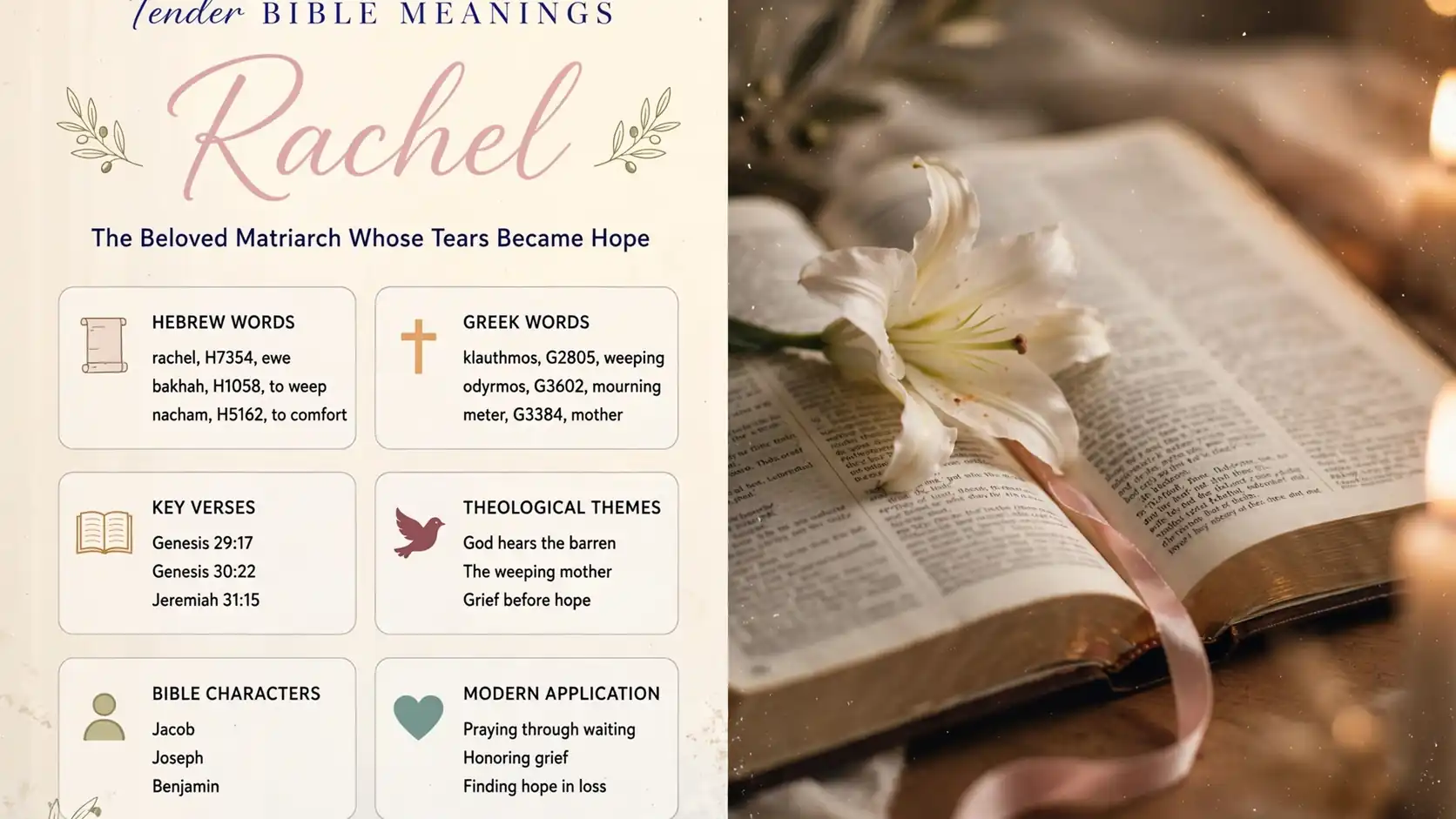
When you ask what does rachel mean in the bible, you are asking about far more than a name. You are stepping into the tent of Jacob, into years of waiting, into a love story that cost fourteen years of labor and a death that marked the road to Bethlehem forever.
Rachel means ewe in Hebrew, a picture of gentleness and prized value. Yet her story carries grief and glory together. In this study you will trace her name, her family, and her tears through Scripture and find why her meaning still speaks to your faith today.
Key Scripture References About Rachel
| Verse | Passage Snippet | Context |
|---|---|---|
| Genesis 29:6 | Rachel his daughter comes with the sheep | Jacob first hears her name at the well |
| Genesis 29:17 | Rachel was beautiful in form and appearance | Her introduction and Jacob’s love at first sight |
| Genesis 29:20 | Jacob served seven years for Rachel | The bride price years seemed like days |
| Genesis 30:1 | Give me children, or I shall die | Her cry in the anguish of barrenness |
| Genesis 30:22 | God remembered Rachel | The Lord opened her womb and Joseph was born |
| Genesis 35:16-19 | She died giving birth to Benjamin | Her death on the road to Bethlehem |
| Jeremiah 31:15 | Rachel weeping for her children | Her lament over Israel’s exile |
| Ruth 4:11 | Like Rachel and Leah | Blessing on the builders of Israel’s house |
| Genesis 29:12 | Jacob told Rachel he was Rebekah’s son | Their kinship discovered at the well |
| Genesis 31:34 | Rachel hid the household gods in the saddle | Her trick that protected Jacob from Laban |
Bible Translation Comparison for Rachel Passages
| Verse | KJV | NIV | ESV | NASB |
|---|---|---|---|---|
| Genesis 29:17 | Rachel was beautiful and well favoured | Rachel had a lovely figure and was beautiful | Rachel was beautiful in form and appearance | Rachel was beautiful of form and face |
| Genesis 29:20 | They seemed unto him but a few days, for the love he had to her | They seemed like only a few days to him because of his love for her | They seemed to him but a few days because of the love he had for her | They seemed to him but a few days because of his love for her |
| Genesis 30:1 | Give me children, or else I die | Give me children, or I will die | Give me children, or I shall die | Give me children, or else I die |
| Genesis 30:22 | God remembered Rachel, and opened her womb | God remembered Rachel and enabled her to conceive | God remembered Rachel and opened her womb | God remembered Rachel and opened her womb |
| Genesis 35:19 | Rachel died, and was buried in the way to Ephrath | Rachel died and was buried on the way to Ephrath | Rachel died, and she was buried on the way to Ephrath | Rachel died and was buried on the way to Ephrath |
| Jeremiah 31:15 | Rahel weeping for her children refused to be comforted | Rachel weeping for her children and refusing to be comforted | Rachel is weeping for her children; she refuses to be comforted | Rachel is weeping for her children; she refuses to be comforted |
| Matthew 2:18 | Rachel weeping for her children, and would not be comforted | Rachel weeping for her children and refusing to be comforted | Rachel weeping for her children; she refused to be comforted | Rachel weeping for her children; and she would not be comforted |
| Ruth 4:11 | Like Rachel and like Leah, which two did build the house of Israel | Like Rachel and Leah, who together built up the family of Israel | Like Rachel and Leah, who together built up the house of Israel | Like Rachel and Leah, both of whom built the house of Israel |
| Genesis 30:24 | She called his name Joseph; and said, The LORD shall add to me another son | She named him Joseph, and said, May the LORD add to me another son | She called his name Joseph, saying, May the LORD add to me another son | She named him Joseph, saying, May the LORD give me another son |
| Genesis 35:18 | As her soul was in departing, she called his name Benoni | As she breathed her last, she named her son Ben-Oni | As her soul was departing, she called his name Ben-oni | As her soul was departing, she named him Ben-oni |
People and Characters Associated with Rachel
| Person | Role | Connection |
|---|---|---|
| Jacob | Husband | Loved Rachel and labored fourteen years to win her |
| Laban | Father | Deceived Jacob by substituting Leah at the wedding |
| Leah | Older sister | Rival who became her partner in building Israel |
| Joseph | Firstborn son | Born after years of barrenness through God’s mercy |
| Benjamin | Second son | His birth cost Rachel her life near Bethlehem |
| Bilhah | Rachel’s maidservant | Bore Dan and Naphtali on Rachel’s behalf |
| Dan | Son through Bilhah | Named in Rachel’s contest with her sister |
| Naphtali | Son through Bilhah | His name recalls her struggle and prevailing |
| Jeremiah | Prophet | Voiced her weeping over the exiles of Israel |
| Herod | King of Judea | His massacre fulfilled her lament in Matthew |
Original Hebrew and Greek Words Behind Rachel
| Original Word | Transliteration | Strong’s # | Literal Meaning |
|---|---|---|---|
| רָחֵל | rachel | H7354 | ewe, female sheep |
| בָּכָה | bakhah | H1058 | to weep, to bewail |
| נָחַם | nacham | H5162 | to comfort, to console |
| רָמָה | ramah | H7414 | height, high place |
| רֶחֶם | rechem | H7358 | womb |
| עָקָר | aqar | H6135 | barren, childless |
| אָהַב | ahav | H157 | to love |
| κλαυθμός | klauthmos | G2805 | weeping, loud lament |
| ὀδυρμός | odyrmos | G3602 | mourning, lamentation |
| μήτηρ | mētēr | G3384 | mother |
Related Biblical Concepts Connected to Rachel
| Concept | Connection | Supporting Verse |
|---|---|---|
| Barrenness opened by God | The Lord heard her prayer and gave her Joseph | Genesis 30:22 |
| Mother of two tribes | Joseph and Benjamin founded great tribes | Genesis 35:18 |
| The weeping mother | Her tears became Israel’s national lament | Jeremiah 31:15 |
| Refused comfort | Her grief pictures loss too deep for words | Matthew 2:18 |
| Builder of Israel’s house | Named with Leah in a wedding blessing | Ruth 4:11 |
| Love that labors | Jacob’s fourteen years of faithful service | Genesis 29:20 |
| Rachel’s tomb | Her pillar marked the road to Bethlehem | Genesis 35:20 |
| From grief to hope | Her weeping is followed by promised return | Jeremiah 31:16-17 |
Historical and Cultural Context Around Rachel
| Aspect | Detail | Biblical Source |
|---|---|---|
| Bride price | Jacob paid with seven years of labor | Genesis 29:18 |
| Wedding veiling | Laban used the veil to substitute Leah | Genesis 29:23-25 |
| Surrogate custom | A maidservant could bear children for her mistress | Genesis 30:3 |
| Mandrakes | Believed to aid fertility in ancient custom | Genesis 30:14-16 |
| Roadside burial | Rachel was buried on the way, not in the family cave | Genesis 35:19 |
| Burial pillar | Jacob set up a pillar over her grave | Genesis 35:20 |
| Ramah’s location | A town north of Jerusalem on the exile route | Jeremiah 31:15 |
| Bethlehem setting | Ephrath near Bethlehem frames her death and later hope | Genesis 35:19 |
Theological Themes in Rachel’s Story
| Theme | Explanation | Scripture |
|---|---|---|
| God hears the barren | The Lord remembered Rachel and opened her womb | Genesis 30:22 |
| Beloved yet afflicted | Chosen love did not spare her suffering | Genesis 29:30-31 |
| The weeping mother | Her grief voices the pain of the whole nation | Jeremiah 31:15 |
| Grief before hope | Her tears are answered with a promised return | Jeremiah 31:16-17 |
| Death that gives life | Her dying brought Benjamin into the world | Genesis 35:18 |
| Love that works | True devotion shows itself in patient labor | Genesis 29:20 |
| Remembered forever | Her tomb became a landmark of faith | 1 Samuel 10:2 |
| Sorrow turned to joy | God transforms mourning into gladness | Jeremiah 31:13 |
Modern Application for Believers Learning from Rachel
| Area | Practice | Scripture |
|---|---|---|
| Praying through waiting | Bring barren seasons honestly before God | Genesis 30:22 |
| Honoring grief | Let lament have its rightful place in worship | Jeremiah 31:15 |
| Trusting God’s timing | His remembering comes in the fullness of time | Genesis 30:22 |
| Loving sacrificially | Serve those you love with patient devotion | Genesis 29:20 |
| Finding hope in loss | Hold the promise that follows weeping | Jeremiah 31:16-17 |
| Building family faith | Pass the stories of God’s faithfulness onward | Ruth 4:11 |
| Resting in being loved | Your worth is not measured by what you produce | Genesis 29:18 |
| Weeping with others | Comfort begins by sitting with the sorrowful | Matthew 2:18 |
What Does Rachel Mean in the Bible Beyond a Beautiful Name
The name itself is simple. רָחֵל, rachel, is the Hebrew word for a ewe, a female sheep. In the world of the patriarchs sheep were wealth, and a prized ewe was gentle, valuable, and worthy of care. Her name tells you how Jacob saw her from the very start.
Yet Scripture never lets a name stay small. By the time her story ends, Rachel has become a mother of tribes, a voice of national grief, and a marker on the road to Bethlehem. Her meaning grows from gentle ewe to enduring witness.
The Hebrew Root רָחֵל and the World of the Patriarchs
Everything in Rachel’s story happens at the pace of ancient Near Eastern life. Jacob met her at a well, worked seven years for her hand, and was deceived on his wedding night because custom veiled the bride. You can almost feel the dust of Haran on these pages.
In that world a woman’s worth was often tied to children, which makes her cry, Give me children, or I shall die, so raw and real. God met her there. When the text says God remembered Rachel, it means He acted for her, turning her barren years into the birth of Joseph.
Rachel Weeping in Ramah, a Lament That Points to Hope
Centuries after her death, Jeremiah pictured Rachel weeping in Ramah as the exiles were led away. She refuses comfort because her children are gone. Matthew later heard the same cry in Bethlehem when Herod murdered the infants. Her name became Scripture’s voice for unbearable loss.
But Jeremiah does not leave her weeping. The very next verses promise that her work will be rewarded and her children will return. Your grief is never the last word in God’s story. Rachel’s tears point forward to a day when every tear is answered.
The Tomb on the Road to Bethlehem and the Promise It Keeps
Rachel died giving birth to Benjamin, and Jacob buried her on the road to Ephrath, setting a pillar over her grave. Travelers passed that pillar for centuries, and Samuel later used it as a landmark. Her resting place kept preaching long after her voice fell silent.
Bethlehem would one day cradle another birth announced to shepherds, the keepers of ewes like the one Rachel was named for. God loves to rhyme His story. When you stand with Rachel at that roadside tomb, you stand near the beginning of a hope that runs all the way to the manger.
Frequently Asked Questions About Rachel in the Bible
Does the name Rachel (רָחֵל, H7354) really mean ewe, and why would a parent choose it?
Yes, it is the ordinary Hebrew word for a female sheep, a name picturing gentleness and prized value in a shepherd culture.
Why does Jeremiah picture Rachel weeping in Ramah centuries after her death?
Prophets often let a founding mother voice the nation’s grief, and her tomb region near Ramah made her the fitting mourner for the exiles.
Why do translations describe Leah’s eyes differently in Genesis 29:17?
The Hebrew phrase is rare, so the KJV reads tender eyed while the NIV reads weak eyes, but all agree the contrast highlights Rachel’s beauty.
How can Rachel refuse comfort in Jeremiah 31:15 when verse 16 promises hope?
Her refusal honors the depth of real loss, and God’s promise answers it, showing that grief and hope can stand side by side.
What does Matthew 2:18 teach us about reading Rachel’s lament today?
It shows that Scripture’s sorrows echo across generations, and that Christ’s coming meets the deepest cries of God’s people.