
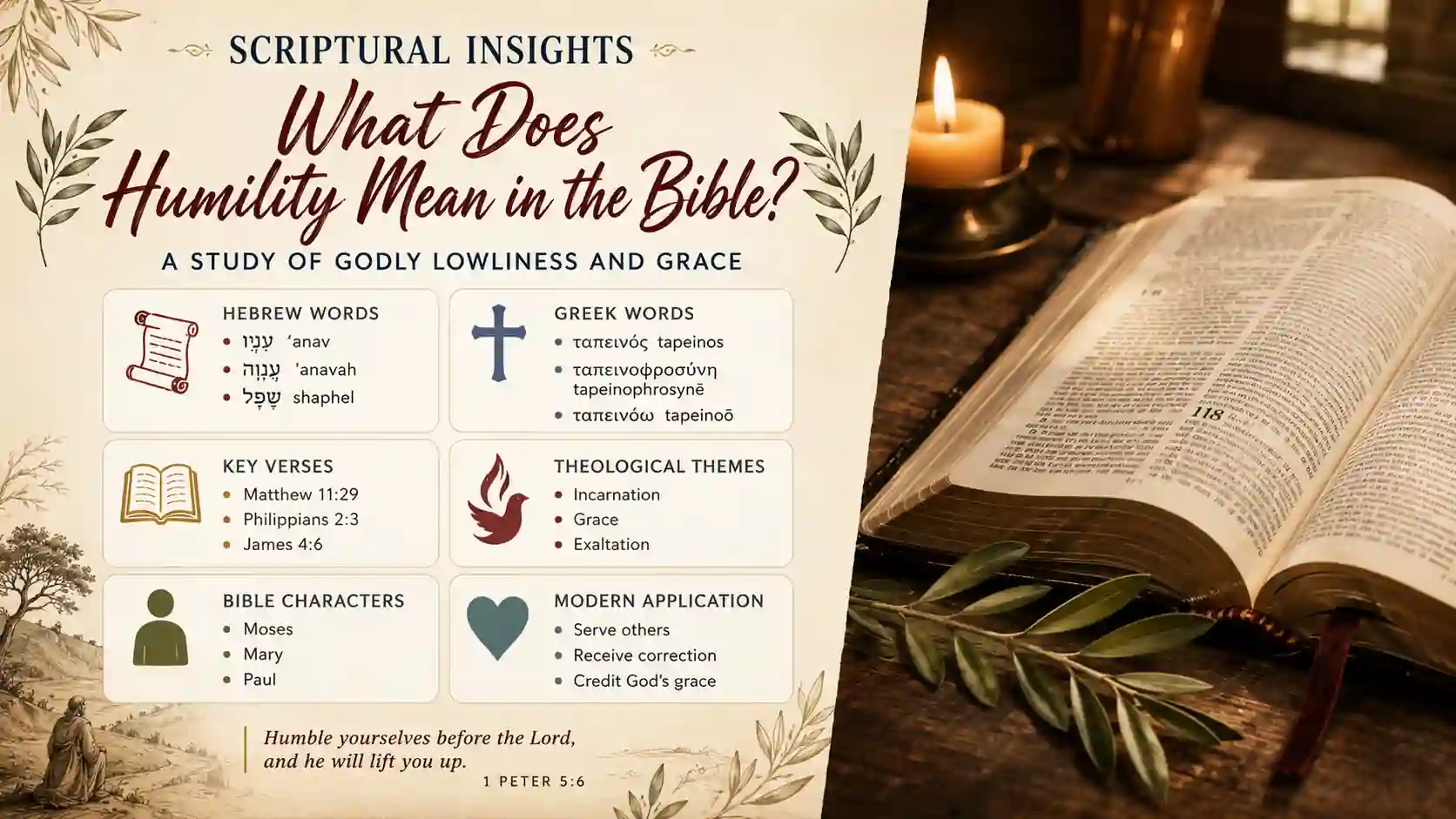
What does humility mean in the Bible? Scripture presents humility as a truthful posture before God that recognizes your dependence on him, submits to his authority, and values others without seeking personal exaltation. It is not weakness, self-hatred, or denial of God-given abilities.
Biblical humility joins reverence, teachability, repentance, service, and trust. From Moses and David to Mary, John the Baptist, Paul, and Jesus Christ, humble people acknowledge that every gift and achievement rests upon God’s grace.
Humility Key Scripture References
| Verse | Passage Snippet | Context |
|---|---|---|
| Numbers 12:3 | Moses was very meek | Moses endures personal criticism |
| 2 Chronicles 7:14 | Humble themselves and pray | Covenant people seek restoration |
| Proverbs 11:2 | With humility comes wisdom | Pride is contrasted with wisdom |
| Proverbs 22:4 | Humility and fear of the Lord | Reverence produces lasting reward |
| Micah 6:8 | Walk humbly with your God | God summarizes covenant faithfulness |
| Matthew 11:29 | Gentle and humble in heart | Jesus describes his own character |
| Philippians 2:3 | In humility value others | Believers reject selfish ambition |
| James 4:6 | Grace to the humble | Repentance receives divine grace |
| 1 Peter 5:6 | Humble yourselves under God | Suffering believers trust God’s timing |
These passages show that humility concerns your relationship with God, your treatment of other people, and your response to correction, suffering, responsibility, and honor.
Humility Bible Translation Comparison
| Verse | KJV | NIV | ESV | NASB |
|---|---|---|---|---|
| Numbers 12:3 | Very meek | Very humble | Very meek | Very humble |
| Proverbs 11:2 | With the lowly | With humility | With the humble | With the humble |
| Micah 6:8 | Walk humbly | Walk humbly | Walk humbly | Walk humbly |
| Matthew 11:29 | Lowly in heart | Humble in heart | Lowly in heart | Humble in heart |
| Philippians 2:3 | Lowliness of mind | In humility | In humility | With humility |
| Colossians 3:12 | Humbleness of mind | Humility | Humility | Humility |
| James 4:6 | Grace unto the humble | Favor to the humble | Grace to the humble | Grace to the humble |
| 1 Peter 5:5 | Clothed with humility | Clothe yourselves with humility | Clothe yourselves with humility | Clothe yourselves with humility |
Translation differences usually reflect whether an English version emphasizes lowliness, meekness, or humility of mind. These renderings describe related attitudes rather than competing virtues.
Humility People and Characters Associated
| Person | Role | Connection |
|---|---|---|
| Moses | Prophet and covenant mediator | Called exceptionally meek |
| Hannah | Mother of Samuel | Prays with dependence and gratitude |
| David | King and psalmist | Confesses sin and honors God |
| Josiah | Reforming king | Humbles himself before God’s Word |
| Daniel | Exiled prophet | Prays with corporate confession |
| Mary | Mother of Jesus | Receives God’s calling as a servant |
| John the Baptist | Forerunner of Christ | Desires Christ to increase |
| Paul | Apostle to the Gentiles | Serves with humility and tears |
| Jesus Christ | Messiah and Lord | Takes a servant’s form |
Humility does not prevent leadership. Moses confronts Pharaoh, David rules Israel, Daniel advises kings, and Paul establishes churches. Their humility appears in their dependence upon God rather than in passivity.
Humility Original Hebrew and Greek Words
| Original Word | Transliteration | Strong’s # | Literal Meaning |
|---|---|---|---|
| עָנָו | ʿanav | H6035 | Humble, meek, afflicted |
| עֲנָוָה | ʿanavah | H6038 | Humility, meekness |
| עָנִי | ʿani | H6041 | Poor, afflicted, lowly |
| כָּנַע | kanaʿ | H3665 | To humble or subdue |
| שָׁפֵל | shaphel | H8217 | Low, humble, brought down |
| שְׁפָלוּת | shephaluth | H8216 | Lowliness, humble condition |
| ταπεινός | tapeinos | G5011 | Lowly, humble |
| ταπεινοφροσύνη | tapeinophrosynē | G5012 | Humility of mind |
| ταπεινόω | tapeinoō | G5013 | To humble or make low |
The Hebrew family related to עָנָו, ʿanav, often connects humility with meekness, affliction, and reliance on God. The Greek noun ταπεινοφροσύνη, tapeinophrosynē, combines the ideas of lowliness and mindset, describing a deliberate humility of thought.
Humility Related Biblical Concepts
| Concept | Connection | Supporting Verse |
|---|---|---|
| Fear of the Lord | Recognizes God’s authority | Proverbs 22:4 |
| Wisdom | Rejects proud self-confidence | Proverbs 11:2 |
| Repentance | Confesses sin without excuse | 2 Chronicles 7:14 |
| Meekness | Strength submitted to God | Numbers 12:3 |
| Servanthood | Places another’s good first | Mark 10:45 |
| Grace | Received rather than earned | James 4:6 |
| Submission | Trusts God’s ordering | 1 Peter 5:5 |
| Contentment | Releases status-seeking | Philippians 4:11 |
| Worship | Gives glory to God | Psalm 115:1 |
These concepts keep humility from becoming mere politeness. Biblical humility grows from knowing who God is and responding appropriately to his holiness, mercy, wisdom, and rule.
Humility Historical and Cultural Context
| Aspect | Detail | Biblical Source |
|---|---|---|
| Ancient kingship | Rulers commonly displayed power | Daniel 4 |
| Covenant renewal | Humbling accompanied prayer | 2 Chronicles 7 |
| Fasting | Bodily practice expressed dependence | Ezra 8 |
| Sackcloth | Signaled grief or repentance | 1 Kings 21 |
| Banquet seating | Status shaped social honor | Luke 14 |
| Foot washing | Usually performed by servants | John 13 |
| Patronage | Benefactors expected public honor | Luke 22 |
| Roman hierarchy | Rank governed social relationships | Philippians 2 |
| Early churches | Humility protected communal unity | Ephesians 4 |
In honor-based societies, public rank and reputation carried enormous weight. Jesus challenged status competition by telling guests to take the lower place and by washing his disciples’ feet.
Paul’s instruction to the Philippians also confronted the Roman pursuit of honor. Christ possessed the highest status, yet accepted a servant’s role and endured crucifixion before receiving public exaltation from the Father.
Humility Theological Themes
| Theme | Explanation | Scripture |
|---|---|---|
| Creation | Humans remain dependent creatures | Genesis 2:7 |
| Providence | God raises up and brings low | 1 Samuel 2:7 |
| Covenant | God’s people submit to his Word | Deuteronomy 8:2 |
| Repentance | The sinner abandons self-defense | Psalm 51 |
| Incarnation | The Son assumes servant form | Philippians 2:6-7 |
| Atonement | Christ obeys unto death | Philippians 2:8 |
| Grace | God favors the humble | James 4:6 |
| Discipleship | Greatness is expressed through service | Mark 10:43 |
| Exaltation | God lifts the humble in his time | 1 Peter 5:6 |
Humility is not a method for forcing God to reward you. The humble person entrusts exaltation to God, accepts his timing, and obeys even when obedience brings no immediate recognition.
Humility Modern Application for Believers
| Area | Practice | Scripture |
|---|---|---|
| Prayer | Confess dependence on God | Luke 18:13 |
| Bible study | Receive correction from Scripture | Isaiah 66:2 |
| Relationships | Consider another’s interests | Philippians 2:4 |
| Leadership | Serve rather than dominate | Mark 10:43 |
| Conflict | Listen before answering | Proverbs 18:13 |
| Success | Credit God’s grace | 1 Corinthians 15:10 |
| Failure | Admit wrong without excuses | Proverbs 28:13 |
| Anxiety | Place your cares upon God | 1 Peter 5:6-7 |
| Spiritual gifts | Use abilities for others | Romans 12:3-6 |
Humility becomes visible through ordinary choices. You practice it when you receive correction, apologize honestly, share credit, serve unnoticed, and refuse to measure your worth through comparison.
You also practice humility by using your gifts faithfully. Hiding an ability out of fear is not necessarily humble. Scripture calls you to acknowledge God’s grace and employ what he has given for the good of others.
עֲנָוָה And the Old Testament Posture of Dependence
The Hebrew concept of עֲנָוָה, ʿanavah, joins humility with meekness and lowliness. It often describes someone who lacks worldly power yet relies upon the Lord. Poverty or affliction does not automatically produce virtue, but such conditions can expose human dependence.
Moses illustrates this truth. His meekness in Numbers 12:3 does not mean that he lacks courage. He confronts rulers and leads a difficult nation, yet when Miriam and Aaron challenge him personally, God becomes his defender. Humility refuses to make personal vindication the center of obedience.
What Does Humility Mean in the Bible’S Covenant Story?
Within Israel’s covenant life, humility means hearing God’s Word, confessing rebellion, and returning to faithful obedience. Deuteronomy 8 explains that God humbled Israel in the wilderness so the nation would learn that life depends upon his sustaining word.
Second Chronicles 7:14 places humility beside prayer, seeking God, and turning from wickedness. Humbling yourself is therefore not an isolated emotion. It involves a changed response to God that rejects self-sufficiency and accepts his moral verdict.
Ταπεινοφροσύνη And the Mind of Christ
The Greek word ταπεινοφροσύνη, tapeinophrosynē, means humility or lowliness of mind. Paul uses it in Philippians 2:3 when he instructs believers to reject selfish ambition and regard others as worthy of serious concern.
Christ provides the controlling example. Philippians 2 does not teach that the Son stopped being divine. It shows that he refused to exploit his status for selfish advantage. He took the servant’s path, obeyed the Father, and accepted the shameful death of the cross.
Grace, Exaltation, and the Danger of False Humility
James 4 and 1 Peter 5 quote the principle that God opposes the proud but gives grace to the humble. Humility receives grace because it approaches God without claims of self-sufficiency. It recognizes that forgiveness, strength, wisdom, and final honor come from him.
Scripture also warns about counterfeit humility. Colossians 2 describes a self-made humility connected with impressive religious practices. Genuine humility directs attention toward Christ and loving obedience, while false humility can become another way of displaying spiritual superiority.
Questions About Biblical Humility
Does עָנָו, ʿanav, mean weak or powerless?
No. It describes meekness or lowliness that depends upon God, not an absence of courage or responsibility.
Why does Micah 6:8 sometimes say “walk humbly” and sometimes “walk prudently”?
The Hebrew expression can emphasize modest, careful fellowship with God, so translations highlight either humility or wise attentiveness.
Does Philippians 2:3 require you to believe everyone is more talented than you?
No. It calls you to reject selfish rivalry and treat another person’s welfare as more important than protecting your status.
How can Jesus be humble if he openly claimed divine authority?
His humility is truthful, not self-denying. He reveals his identity while using his authority in obedient, sacrificial service.
What is the difference between humility and low self-esteem?
Humility accepts God’s truthful assessment of your limits, sins, gifts, and value, while low self-esteem may distort that truth through shame.