
What does froward mean in the Bible? In the King James Version, froward describes someone morally crooked, contrary, deceitful, stubborn, or deliberately turned away from what is right. It does not merely describe an unpleasant personality. It points to a heart, mouth, or path that has become twisted against God’s wisdom.
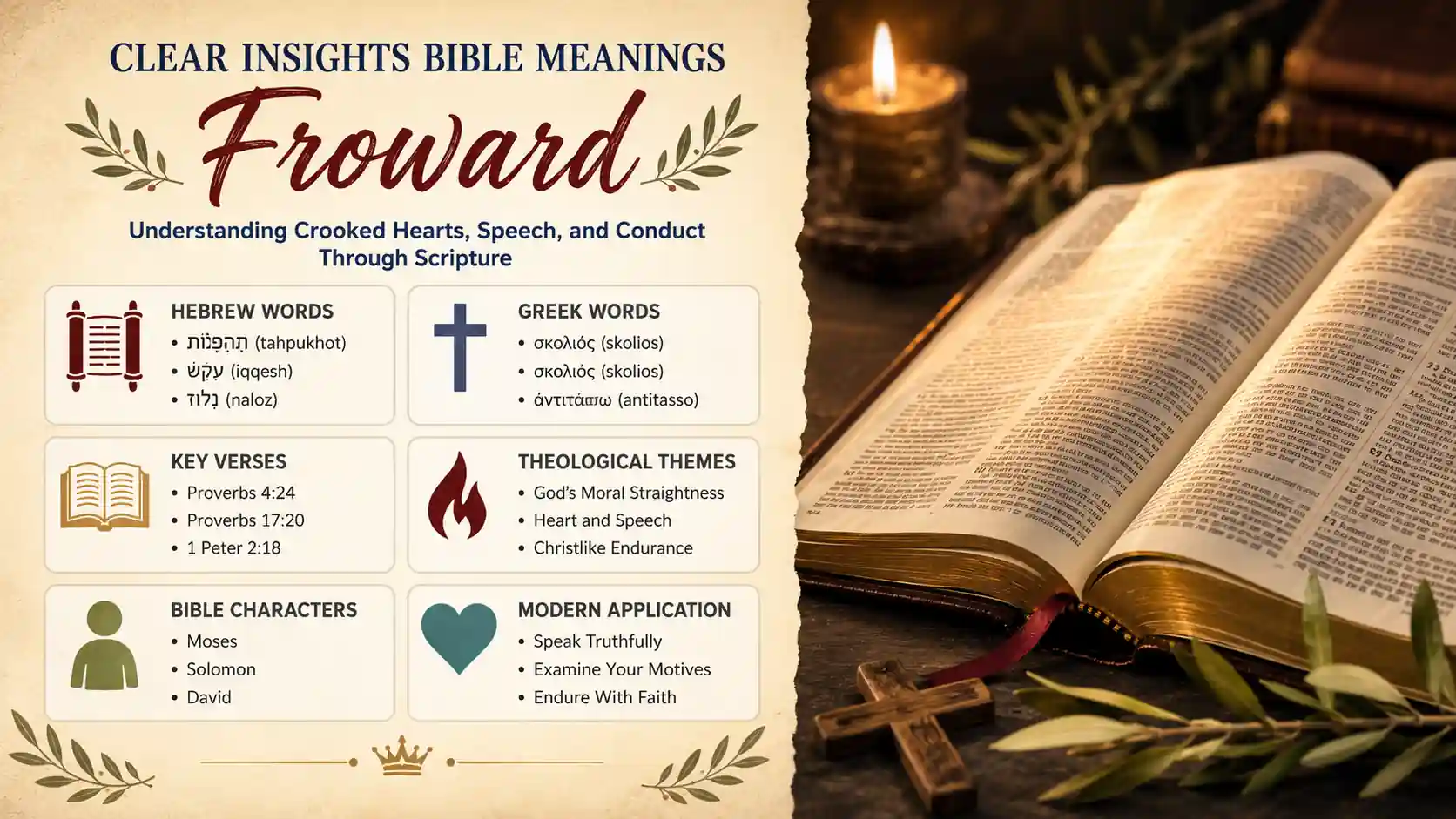
The biblical writers use several Hebrew words and one notable Greek word behind this older English term. As you study them, you will see that frowardness affects motives, speech, relationships, worship, and conduct.
Froward Key Scripture References
| Verse | Passage Snippet | Context |
|---|---|---|
| Deuteronomy 32:20 | “A very froward generation” | Moses describes covenant unfaithfulness |
| Psalm 18:26 | “With the froward thou wilt shew thyself froward” | David praises God’s just dealings |
| Proverbs 2:12 | “The man that speaketh froward things” | Wisdom rescues from corrupt teachers |
| Proverbs 3:32 | “The froward is abomination to the LORD” | The crooked are contrasted with the upright |
| Proverbs 4:24 | “Put away from thee a froward mouth” | A father instructs his son |
| Proverbs 6:12 | “A wicked man walketh with a froward mouth” | Deceptive conduct marks a troublemaker |
| Proverbs 8:13 | “The froward mouth, do I hate” | Personified Wisdom declares God’s values |
| Proverbs 11:20 | “Of a froward heart” | Inner perversity opposes moral integrity |
| Proverbs 17:20 | “A froward heart findeth no good” | Crooked character brings painful consequences |
| 1 Peter 2:18 | “Not only to the good…but also to the froward” | Christian servants endure unjust masters |
Froward Bible Translation Comparison
| Verse | KJV | NIV | ESV | NASB |
|---|---|---|---|---|
| Deuteronomy 32:20 | Froward generation | Perverse generation | Perverse generation | Perverse generation |
| Psalm 18:26 | Froward | Devious | Crooked | Crooked |
| Proverbs 2:12 | Froward things | Perverse things | Perverted speech | Perverse things |
| Proverbs 3:32 | Froward | Perverse | Devious | Devious |
| Proverbs 4:24 | Froward mouth | Perversity from your mouth | Crooked speech | Deceitful mouth |
| Proverbs 8:13 | Froward mouth | Perverse speech | Perverted speech | Perverted mouth |
| Proverbs 11:20 | Froward heart | Perverse heart | Crooked heart | Perverse in heart |
| 1 Peter 2:18 | Froward | Harsh | Unjust | Unreasonable |
Modern translations rarely use froward because the word is no longer common English. Depending on the original term and context, translators choose words such as crooked, devious, perverse, harsh, or unreasonable. These renderings preserve different aspects of the older word rather than changing the underlying moral teaching.
People and Characters Associated with Froward Conduct
| Person | Role | Connection |
|---|---|---|
| Moses | Covenant mediator | Condemns Israel’s froward generation |
| David | King and psalmist | Sings of God confronting crooked people |
| Solomon | Wisdom teacher | Repeatedly warns against froward hearts |
| The strange man | Corrupt teacher | Speaks froward things in Proverbs 2 |
| The worthless man | Social troublemaker | Uses a froward mouth in Proverbs 6 |
| Personified Wisdom | Divine wisdom proclaimed | Hates the froward mouth |
| The foolish son | Covenant learner | Warned not to follow crooked paths |
| The unjust master | Roman household authority | Called froward in 1 Peter 2 |
| Christian servants | Believing household workers | Called to endure unjust treatment |
| Israel’s wilderness generation | Covenant community | Described as morally perverse |
Original Hebrew and Greek Words for Froward
| Original Word | Transliteration | Strong’s # | Literal Meaning |
|---|---|---|---|
| תַּהְפֻּכוֹת | tahpukhot | H8419 | Perversities, twisted things |
| תַּהְפֻּכָה | tahpukah | H8419 | Perversity or fraud |
| עִקֵּשׁ | iqqesh | H6141 | Crooked, distorted, perverse |
| נָלוֹז | naloz | H3868 | Turned aside, devious |
| הֲפַכְפַךְ | haphakpak | H2019 | Twisted, changeable, perverse |
| פְּתַלְתֹּל | petaltol | H6617 | Twisted or tortuous |
| תִּתְפַּתָּל | titpattal | H6617 | Show oneself astute or twisted |
| סָרַר | sarar | H5637 | Be stubborn or rebellious |
| סְקוֹלִיּוֹס | skolios | G4646 | Crooked, bent, unjust |
| σκολιός | skolios | G4646 | Morally warped or unreasonable |
The most frequent Hebrew term connected with froward speech is תַּהְפֻּכוֹת, tahpukhot, Strong’s H8419. It comes from the idea of overturning or reversing something. In wisdom literature, it describes words and attitudes that turn moral order upside down. The Greek σκολιός, skolios, Strong’s G4646, pictures something bent rather than straight.
Related Biblical Concepts Connected with Frowardness
| Concept | Connection | Supporting Verse |
|---|---|---|
| Crookedness | Froward conduct departs from straight paths | Proverbs 2:15 |
| Deceit | Crooked speech conceals dishonest purposes | Proverbs 6:12 |
| Rebellion | The will resists God’s covenant authority | Deuteronomy 32:20 |
| Pride | Self-exaltation nourishes perverse speech | Proverbs 8:13 |
| Falsehood | The tongue communicates distorted truth | Proverbs 4:24 |
| Injustice | Moral crookedness harms vulnerable people | Proverbs 17:20 |
| Folly | Rejection of wisdom produces twisted choices | Proverbs 2:12 |
| Hypocrisy | Outward appearance hides inward corruption | Proverbs 11:20 |
| Uprightness | The direct opposite of frowardness | Proverbs 3:32 |
| Holiness | God’s character establishes the straight standard | Psalm 18:26 |
Historical and Cultural Context of Froward Language
| Aspect | Detail | Biblical Source |
|---|---|---|
| Ancient roads | Straight paths pictured safe moral conduct | Proverbs 4:25–27 |
| Wisdom schools | Fathers trained sons in disciplined speech | Proverbs 4:1–24 |
| Covenant loyalty | Israel was expected to walk faithfully | Deuteronomy 32 |
| Royal justice | Kings judged crooked and upright conduct | Proverbs 16:10–13 |
| Public gates | Speech affected legal and civic decisions | Proverbs 22:22 |
| Household order | Servants could face unreasonable masters | 1 Peter 2:18 |
| Honor culture | Deceit damaged family and community trust | Proverbs 6:12–19 |
| Oral teaching | Wisdom was memorized through contrasts | Proverbs 10:31–32 |
| Agricultural imagery | Thorns pictured dangers on crooked paths | Proverbs 22:5 |
| Roman society | Household servants had limited legal power | 1 Peter 2:18–23 |
In ancient Israel, a “straight” way represented faithfulness, wisdom, and justice. A crooked path suggested danger, deception, or rebellion. This imagery was immediately understandable in a world where travelers depended on secure roads and where a wrong turn could expose them to injury, theft, or death.
Within the Roman household addressed by Peter, σκολιός described a master whose behavior was morally bent or unreasonable. Peter did not praise abuse or call injustice good. He taught suffering believers to remain conscious of God and follow Christ’s nonretaliatory example while enduring wrong.
Theological Themes within Froward Passages
| Theme | Explanation | Scripture |
|---|---|---|
| God’s moral straightness | God defines what is true and right | Psalm 18:25–26 |
| Divine opposition | God resists those committed to crookedness | Proverbs 3:32 |
| Covenant accountability | Rebellion violates a relationship with God | Deuteronomy 32:20 |
| Heart and speech | Corrupt words reveal inward distortion | Proverbs 17:20 |
| Wisdom’s holiness | True wisdom hates pride and perversion | Proverbs 8:13 |
| Moral consequences | Crooked choices produce trouble | Proverbs 11:3 |
| Intimacy with God | The upright receive God’s counsel | Proverbs 3:32 |
| Christlike endurance | Believers may suffer without retaliation | 1 Peter 2:18–23 |
| Transforming grace | God calls crooked people into obedience | 1 Peter 2:21 |
| Final justice | God will expose and judge deceit | Ecclesiastes 12:14 |
Modern Application of Froward Warnings
| Area | Practice | Scripture |
|---|---|---|
| Speech | Reject manipulative or double-minded words | Proverbs 4:24 |
| Motives | Ask God to expose hidden crookedness | Psalm 139:23–24 |
| Work | Act faithfully under difficult authority | 1 Peter 2:18 |
| Conflict | Refuse revenge when treated unjustly | 1 Peter 2:23 |
| Leadership | Make decisions without deception | Proverbs 16:12 |
| Relationships | Speak directly and truthfully | Ephesians 4:25 |
| Media use | Resist messages that celebrate moral reversal | Isaiah 5:20 |
| Repentance | Turn from crooked paths to God | Isaiah 55:7 |
| Discipleship | Receive correction rather than resist it | Proverbs 12:1 |
| Prayer | Seek an undivided and upright heart | Psalm 86:11 |
What Does Froward Mean in the Bible’S Wisdom Literature?
Proverbs presents frowardness as a deep moral distortion rather than a passing mistake. It can reside in the heart, shape the mouth, direct the feet, and corrupt relationships. The froward person does not simply stumble from the right path. He repeatedly turns truth around to serve selfish purposes.
This explains why Proverbs 3:32 uses such serious language. The froward person is “abomination to the LORD,” while God’s “secret” is with the righteous. The contrast concerns fellowship. God shares intimate counsel with the upright, but deliberate crookedness opposes his holy character.
תַּהְפֻּכוֹת Tahpukhot and the Reversal of God’S Order
The Hebrew noun תַּהְפֻּכוֹת, tahpukhot, describes perversities or things turned upside down. Proverbs applies it especially to speech. A person may use technically accurate words while arranging them to mislead, flatter, accuse falsely, or make evil appear desirable.
Wisdom therefore commands you to examine more than vocabulary. You must consider intention, direction, and effect. Does your speech clarify truth, protect your neighbor, and honor God, or does it twist facts for personal advantage? Biblical uprightness joins truthful words with a truthful purpose.
Why Psalm 18:26 Does Not Make God Froward
Psalm 18:26 can trouble modern readers because the KJV says that God shows himself froward with the froward. The verse does not teach that God becomes sinful, deceitful, or morally corrupt. David is describing God’s fitting response to people according to their moral posture.
With the faithful, God demonstrates faithfulness. With the pure, he demonstrates purity. With those who twist their ways, he proves impossible to manipulate and turns their schemes against them. Modern translations use terms such as “shrewd,” “astute,” or similar language to communicate this judicial response.
God remains perfectly holy throughout the verse. The change is not in his character but in how different people experience his unchanging justice. The upright experience his guidance as gracious fellowship. The crooked experience the same holy government as resistance and judgment.
σκολιός Skolios and Christlike Endurance in 1 Peter
In 1 Peter 2:18, the Greek adjective σκολιός, skolios, describes masters who are harsh, unreasonable, or morally crooked. The word originally referred to something bent or curved. Peter uses it for authorities whose behavior departs from justice.
The command to endure does not declare oppression morally acceptable. Peter names the conduct as crooked and places the sufferer under God’s care. Jesus becomes the pattern because he committed no sin, spoke no deceit, refused retaliation, and entrusted himself to the One who judges justly.
Your calling is not to imitate the froward person’s methods. You are to maintain truthful speech, righteous conduct, and confidence in God even when another person acts unjustly. Where lawful protection, wise counsel, or help is available, seeking safety can stand alongside Christian patience.
Questions Bible Students Ask About Froward
Does froward simply mean stubborn?
It can include stubbornness, but it more broadly describes conduct that is crooked, contrary, deceptive, rebellious, or morally perverse.
What is the main Hebrew word translated froward?
A prominent word is תַּהְפֻּכוֹת, tahpukhot, Strong’s H8419, meaning perversities, twisted things, or moral reversals.
Why do modern Bibles replace froward with different words?
Because froward is archaic, translators use words such as devious, perverse, crooked, harsh, or unreasonable according to each context.
Does Psalm 18:26 say that God behaves sinfully toward sinners?
No, it teaches that God wisely opposes crooked people and causes their deceptive schemes to meet his just resistance.
How can you avoid a froward heart and mouth?
Receive biblical correction, examine your motives, speak truth plainly, reject manipulation, and ask God to lead you in an upright path.