
What does the color blue mean in the Bible? Scripture most often connects blue with God’s sanctuary, Israel’s covenant obligations, priestly service, royal dignity, and heavenly visions. Yet the Bible never gives a simple statement declaring that blue always symbolizes one idea. Its meaning arises from the passages where it appears.
As you study blue in Scripture, you encounter sacred fabrics, priestly garments, tassels of remembrance, royal clothing, sapphire-like glory, and apocalyptic judgment. These settings help you interpret the color carefully without turning every appearance of blue into a hidden code.
Key Blue Scripture References
| Verse | Passage Snippet | Context |
|---|---|---|
| Exodus 24:10 | Pavement resembling sapphire | God’s glory above Sinai |
| Exodus 25:4 | Blue, purple, and scarlet yarn | Offerings for the tabernacle |
| Exodus 26:1 | Blue woven into curtains | Inner sanctuary craftsmanship |
| Exodus 28:31 | Robe made entirely of blue | High priestly garments |
| Numbers 4:6 | Cloth wholly of blue | Covering the ark in transit |
| Numbers 15:38 | Blue cord on each tassel | Reminder to obey God |
| Esther 8:15 | Mordecai wore blue and white | Public royal honor |
| Ezekiel 1:26 | Throne like sapphire | Vision of divine majesty |
| Ezekiel 23:6 | Assyrians clothed in blue | Wealth, rank, and attraction |
| Revelation 9:17 | Hyacinth-colored breastplates | Terrifying vision of judgment |
These references show that blue does not possess one mechanical meaning. In the Torah, it frequently belongs to worship and covenant remembrance. In Esther and Ezekiel, it may communicate status, splendor, or majesty. Revelation uses a blue-violet shade within an alarming scene of divine judgment.
Blue in Major Bible Translations
| Verse | KJV | NIV | ESV | NASB |
|---|---|---|---|---|
| Exodus 25:4 | Blue | Blue yarn | Blue yarns | Blue material |
| Exodus 26:1 | Blue | Blue yarn | Blue yarns | Blue material |
| Exodus 28:31 | Robe of the ephod | Robe of the ephod | Robe of the ephod | Robe of the ephod |
| Numbers 4:6 | Cloth wholly of blue | Solid blue cloth | Cloth all of blue | Cloth of pure blue |
| Numbers 15:38 | Ribband of blue | Blue cord | Cord of blue | Violet thread |
| Esther 8:15 | Royal apparel of blue | Royal robes of blue | Royal robes of blue | Royal robes of blue |
| Ezekiel 23:6 | Clothed with blue | Dressed in blue | Clothed in purple | Clothed in purple |
| Jeremiah 10:9 | Blue and purple | Blue and purple | Violet and purple | Violet and purple |
| Revelation 9:17 | Jacinth | Dark blue | Sapphire blue | Hyacinth |
| Revelation 21:20 | Jacinth | Jacinth | Jacinth | Jacinth |
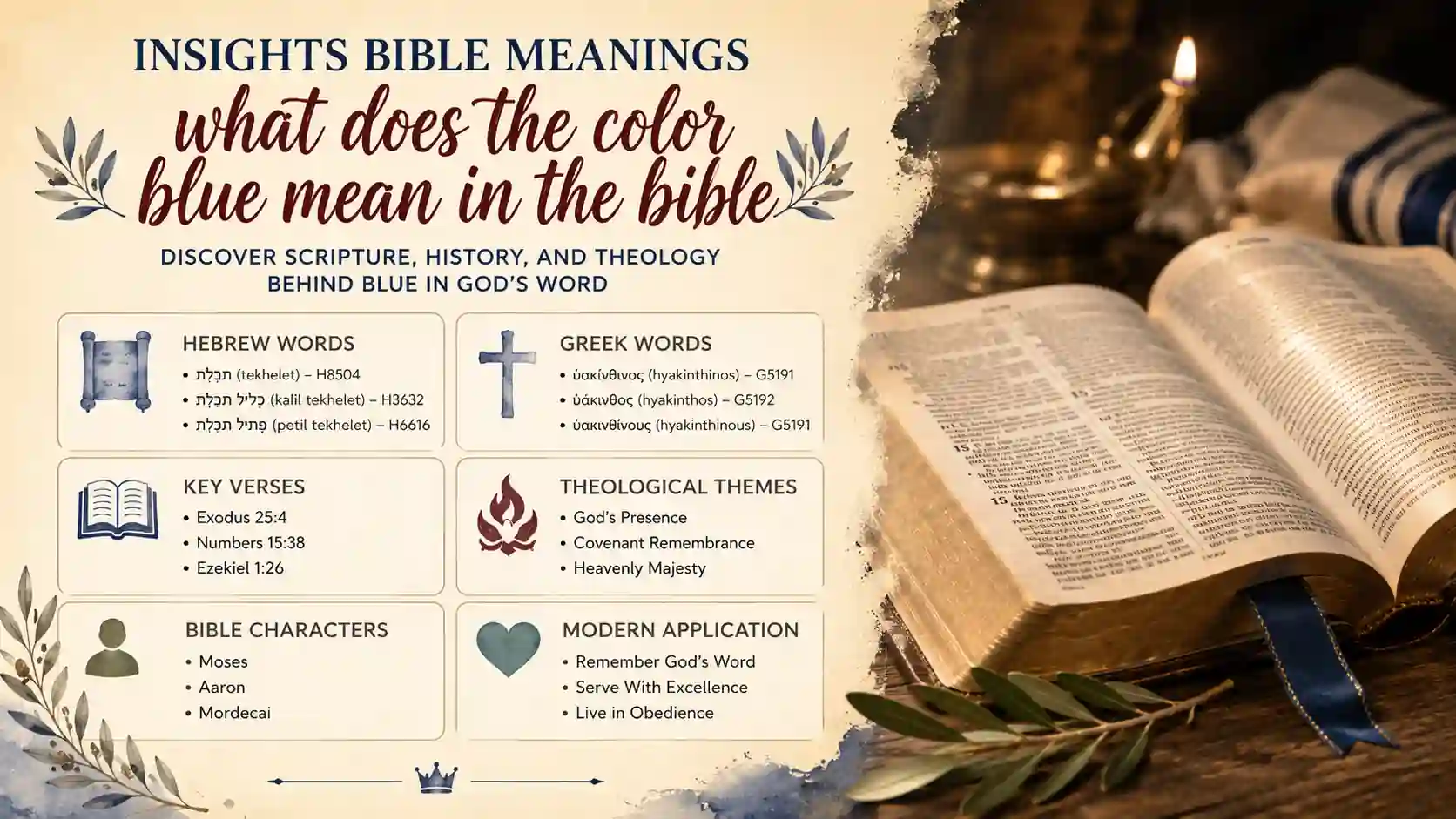
Translation differences often reflect the color range of ancient terms. Hebrew תְּכֵלֶת, tekhelet, may be rendered blue, violet, or blue-purple. Greek ὑακίνθινος, hyakinthinos, describes a hyacinth-like hue that English versions variously call jacinth, dark blue, sapphire blue, or hyacinth.
People and Characters Connected with Blue
| Person | Role | Connection |
|---|---|---|
| Moses | Covenant mediator | Received tabernacle instructions |
| Aaron | High priest | Wore the blue robe |
| Bezalel | Chief craftsman | Made sacred fabrics and garments |
| Oholiab | Skilled artisan | Assisted tabernacle construction |
| Israelite worshipers | Covenant community | Donated blue-dyed material |
| Israelite families | Commandment keepers | Wore blue cords on tassels |
| Kohathites | Sanctuary transporters | Carried furnishings under blue cloth |
| Mordecai | Jewish royal official | Appeared in blue royal clothing |
| Ezekiel | Exilic prophet | Saw sapphire-like heavenly glory |
| John | Apostolic seer | Saw hyacinth-colored breastplates |
The strongest personal connections concern Moses, Aaron, and the Israelites. Blue was woven into the shared life of covenant worship. It appeared before the priest, around sacred objects, and on ordinary garments, joining sanctuary holiness with daily obedience.
Mordecai’s blue clothing belongs to a different setting. His garments marked royal promotion after Haman’s downfall. Ezekiel and John did not wear blue. They witnessed blue or blue-violet imagery within visions of heavenly authority and judgment.
Original Hebrew and Greek Words for Blue
| Original Word | Transliteration | Strong’s # | Literal Meaning |
|---|---|---|---|
| תְּכֵלֶת | tekhelet | H8504 | Blue or blue-violet material |
| כָּלִיל תְּכֵלֶת | kalil tekhelet | H3632, H8504 | Entirely blue |
| פְּתִיל תְּכֵלֶת | petil tekhelet | H6616, H8504 | Cord of blue |
| אֶבֶן־סַפִּיר | even sappir | H68, H5601 | Sapphire stone |
| סַפִּיר | sappir | H5601 | Sapphire or lapis-like stone |
| ὑακίνθινος | hyakinthinos | G5191 | Hyacinth-colored, blue-violet |
| ὑάκινθος | hyakinthos | G5192 | Jacinth or hyacinth stone |
| ὑακινθίνους | hyakinthinous | G5191 | Hyacinth-colored objects |
| תְּכֵלֶת וְאַרְגָּמָן | tekhelet we’argaman | H8504, H713 | Blue and purple |
| מַעִיל | me’il | H4598 | Robe or outer garment |
The primary Hebrew term is תְּכֵלֶת, tekhelet, Strong’s H8504. It occurs repeatedly in tabernacle instructions and is commonly understood as a costly blue or blue-violet dyed textile. The biblical text does not explain the manufacturing process, though ancient evidence and later Jewish tradition associate tekhelet with marine dye production.
The principal Greek color adjective is ὑακίνθινος, hyakinthinos, Strong’s G5191, found in Revelation 9:17. The related noun ὑάκινθος, hyakinthos, G5192, names the jacinth foundation stone in Revelation 21:20. Both terms suggest a deep blue-violet range rather than a modern standardized shade.
Biblical Concepts Related to Blue
| Concept | Connection | Supporting Verse |
|---|---|---|
| Divine presence | Sapphire-like pavement under God | Exodus 24:10 |
| Holiness | Blue woven into sanctuary fabrics | Exodus 26:1 |
| Priesthood | High priest’s robe was blue | Exodus 28:31 |
| Consecration | Gold plate fastened with blue cord | Exodus 28:36–37 |
| Remembrance | Blue tassel recalled commandments | Numbers 15:38–40 |
| Obedience | Tassels discouraged spiritual wandering | Numbers 15:39 |
| Reverence | Ark covered with blue cloth | Numbers 4:5–6 |
| Kingship | Blue appeared in royal clothing | Esther 8:15 |
| Heavenly majesty | Throne appeared sapphire-like | Ezekiel 1:26 |
| Judgment | Blue-violet armor accompanied destruction | Revelation 9:17 |
Blue’s clearest biblical connection is not merely “heaven,” but holiness expressed through ordered worship and obedient living. The sanctuary materials were made according to the pattern God revealed, and the tassel command gave blue an ethical function.
The color therefore joined beauty with responsibility. Israel was not told merely to admire the blue cord. They were told to see it, remember God’s commandments, and obey them.
Historical and Cultural Context of Blue
| Aspect | Detail | Biblical Source |
|---|---|---|
| Dye production | Blue dye was costly and specialized | Exodus 25:4 |
| Textile value | Dyed yarn counted as a valuable offering | Exodus 35:23 |
| Skilled labor | Artisans spun and embroidered blue material | Exodus 35:25, 35 |
| Sanctuary curtains | Blue was woven with purple and scarlet | Exodus 26:1 |
| Priestly clothing | Blue distinguished sacred service | Exodus 28:31 |
| Garment tassels | Blue entered ordinary Israelite dress | Numbers 15:38 |
| Sacred transport | Blue covered holy furnishings | Numbers 4:6–12 |
| Persian royalty | Blue and white signaled official honor | Esther 8:15 |
| Assyrian prestige | Blue clothing suggested elite rank | Ezekiel 23:6 |
| Visionary language | Sapphire described transcendent splendor | Ezekiel 1:26 |
In the ancient world, producing durable dyed cloth required materials, expertise, and labor. Blue fabric was not a cheap decorative addition. Its repeated use in the tabernacle emphasized the value, order, and skill devoted to Israel’s worship.
Blue also crossed social boundaries. It appeared in royal and priestly settings, yet Numbers placed a blue cord on the garments of the covenant community. Something associated with sacred beauty became a visible reminder in everyday life.
Theological Themes Expressed Through Blue
| Theme | Explanation | Scripture |
|---|---|---|
| God’s transcendence | Sapphire imagery points beyond earthly glory | Exodus 24:10 |
| God’s presence | Blue belonged to the dwelling place | Exodus 25:8 |
| Revealed worship | Sanctuary design followed God’s pattern | Exodus 25:9 |
| Mediated holiness | Priestly garments marked sacred office | Exodus 28:31 |
| Covenant memory | The blue cord prompted remembrance | Numbers 15:39 |
| Whole-life obedience | Memory was intended to produce action | Numbers 15:40 |
| Protection of holiness | Sacred objects were carefully covered | Numbers 4:15 |
| Providential reversal | Mordecai received royal honor | Esther 8:15 |
| Heavenly kingship | Sapphire imagery surrounds the throne | Ezekiel 1:26 |
| Righteous judgment | Hyacinth appears in a judgment vision | Revelation 9:17 |
Theologically, blue often stands where heaven and earth meet. It appears around the sanctuary, priesthood, commandments, and throne visions. Yet Scripture keeps the emphasis on God rather than on the color itself.
Blue does not carry spiritual power. It serves the inspired narrative by directing attention toward God’s holiness, rule, covenant, and righteous requirements. A biblical symbol must never replace the Lord to whom it points.
Modern Application of Biblical Blue
| Area | Practice | Scripture |
|---|---|---|
| Bible study | Interpret colors from context | Nehemiah 8:8 |
| Worship | Offer God thoughtful excellence | Exodus 35:30–35 |
| Obedience | Use reminders to practice truth | Numbers 15:39 |
| Memory | Regularly recall God’s commands | Deuteronomy 6:6–9 |
| Reverence | Treat holy matters seriously | Numbers 4:15 |
| Service | Use your skills for God’s purposes | Exodus 36:1 |
| Community | Remember that obedience is shared | Numbers 15:38 |
| Leadership | Wear honor with humility | Esther 8:15 |
| Hope | Look toward God’s heavenly reign | Ezekiel 1:26 |
| Discernment | Avoid superstition about colors | Deuteronomy 4:15–16 |
Your application should follow the function of blue within each passage. Numbers 15 may encourage you to establish visible reminders of Scripture, though Christians are not commanded to reproduce Israel’s tassel requirement as a means of earning righteousness.
The tabernacle passages can also shape your approach to service. Bezalel and Oholiab treated artistic skill as a God-given vocation. Their work shows that careful craftsmanship, beauty, and obedience may all belong within faithful worship.
תְּכֵלֶת And the Covenant Call to Remember
Numbers 15:37–41 offers the Bible’s most direct explanation of why blue was placed on Israelite clothing. The cord of תְּכֵלֶת, tekhelet, was attached to tassels so the people would look at it, remember the Lord’s commandments, and do them.
The command addressed the danger of following one’s own heart and eyes. Blue therefore became a covenant reminder that desire must be governed by revelation. Its meaning in this passage is practical, moral, and communal rather than mystical.
What Does the Color Blue Mean in the Bible’S Tabernacle?
In Exodus, blue appears throughout the tabernacle curtains, veil, entrance screens, coverings, and priestly garments. This repetition places it within the sphere of God’s dwelling, ordained worship, sacrificial ministry, and priestly mediation.
The text does not assign a separate symbolic definition to every colored thread. Still, the setting associates blue with holiness, beauty, and access to God on his appointed terms. You should respect that association without claiming more than Scripture reveals.
The Blue Robe of Aaron and Priestly Holiness
Aaron’s robe of the ephod was made entirely of blue. Its hem carried woven pomegranates and golden bells, which sounded as the high priest entered and left the holy place before the Lord.
The robe identified Aaron’s consecrated office, but it did not make him morally perfect. He still depended on sacrifice and divine mercy. The garment pointed to the seriousness of approaching God and the need for an appointed mediator.
Sapphire Glory from Sinai to Ezekiel’S Throne
Exodus 24:10 describes something under God’s feet like a pavement of sapphire, clear as the sky. Ezekiel later sees a throne with the appearance of sapphire above the living creatures. Both passages use comparison because God’s glory exceeds ordinary description.
These visions do not teach that God is literally blue. They use radiant, precious imagery to communicate purity, majesty, distance, and royal authority. The focus remains on the enthroned Lord, not on assigning supernatural power to a shade.
Questions About Blue in Scripture
Does תְּכֵלֶת, tekhelet, mean blue or purple?
It describes a blue to blue-violet dyed material, so translations may reasonably use blue, violet, or similar wording.
Why did God command a blue cord in Numbers 15:38?
The cord helped Israel remember and obey God’s commandments rather than follow sinful desires.
Does the blue robe of Exodus 28 represent Jesus?
The robe belongs directly to Aaron’s priesthood, though Christian readers may see the high priestly office as part of the broader biblical preparation for Christ.
Why do translations disagree about ὑακίνθινος in Revelation 9:17?
The ancient term describes a hyacinth-like blue-violet hue that has no single exact modern English equivalent.
Should Christians treat blue as a spiritually powerful color?
No. Blue may remind you of biblical truths, but Scripture assigns power and holiness to God, not to the color itself.