
What does Shiloh mean in the Bible? Scripture uses “Shiloh” primarily for an important worship center in the hill country of Ephraim. There Israel assembled, divided the land, placed the tabernacle, offered sacrifices, and heard God’s word through Samuel.
A second and more difficult use appears in Genesis 49:10. The Hebrew שִׁילֹה, Shiloh, may function as a title, a possessive expression meaning “the one to whom it belongs,” or a reference connected with the ancient sanctuary. Your study must therefore distinguish the city of Shiloh from the debated prophetic wording in Jacob’s blessing.
Shiloh Key Scripture References
| Verse | Passage Snippet | Context |
|---|---|---|
| Genesis 49:10 | “Until Shiloh comes” | Jacob blesses Judah |
| Joshua 18:1 | Congregation assembled at Shiloh | Tabernacle established |
| Joshua 18:8 | Surveyors return to Shiloh | Land allotment prepared |
| Joshua 19:51 | Inheritance divided before God | Tribal boundaries finalized |
| Judges 18:31 | House of God at Shiloh | Danite idolatry contrasted |
| Judges 21:19 | Annual feast of the Lord | Shiloh festival remembered |
| 1 Samuel 1:3 | Worship and sacrifice at Shiloh | Elkanah’s yearly pilgrimage |
| 1 Samuel 3:21 | Lord revealed himself there | Samuel receives God’s word |
| Psalm 78:60 | God forsook Shiloh’s dwelling | Sanctuary judged |
| Jeremiah 7:12 | “Go now to Shiloh” | Jerusalem warned by history |
Shiloh Bible Translation Comparison
| Verse | KJV | NIV | ESV | NASB |
|---|---|---|---|---|
| Genesis 49:10 | “Until Shiloh come” | “Until he…shall come” | “Until tribute comes” | “Until Shiloh comes” |
| Joshua 18:1 | Tabernacle set up | Tent of Meeting set up | Tent of meeting set up | Tent of meeting established |
| Joshua 18:8 | Go through the land | Make a survey | Walk through the land | Walk through the land |
| Judges 18:31 | House of God in Shiloh | House of God in Shiloh | House of God at Shiloh | House of God at Shiloh |
| Judges 21:19 | Feast of the Lord | Annual festival | Yearly feast | Yearly feast |
| 1 Samuel 1:3 | Worship and sacrifice | Worship and sacrifice | Worship and sacrifice | Worship and sacrifice |
| Psalm 78:60 | Tabernacle of Shiloh | Tabernacle of Shiloh | Dwelling at Shiloh | Dwelling place at Shiloh |
| Jeremiah 7:12 | Place which was in Shiloh | Place in Shiloh | Place that was in Shiloh | Place that was in Shiloh |
The differences in Genesis 49:10 reflect genuine difficulty in the ancient Hebrew text. Some translations preserve “Shiloh” as a title, while others interpret the wording as “the one to whom it belongs,” “tribute,” or a related expression of rightful rule.
Shiloh People and Characters Associated
| Person | Role | Connection |
|---|---|---|
| Jacob | Patriarch | Speaks Genesis 49:10 |
| Judah | Son of Jacob | Receives royal blessing |
| Joshua | Israel’s leader | Establishes national assembly |
| Eleazar | High priest | Oversees land allotments |
| Elkanah | Israelite worshiper | Travels yearly to Shiloh |
| Hannah | Mother of Samuel | Prays and vows at Shiloh |
| Eli | Priest and judge | Serves at the sanctuary |
| Samuel | Prophet | Called by God at Shiloh |
| Hophni | Corrupt priest | Profanes Shiloh worship |
| Phinehas | Corrupt priest | Falls under divine judgment |
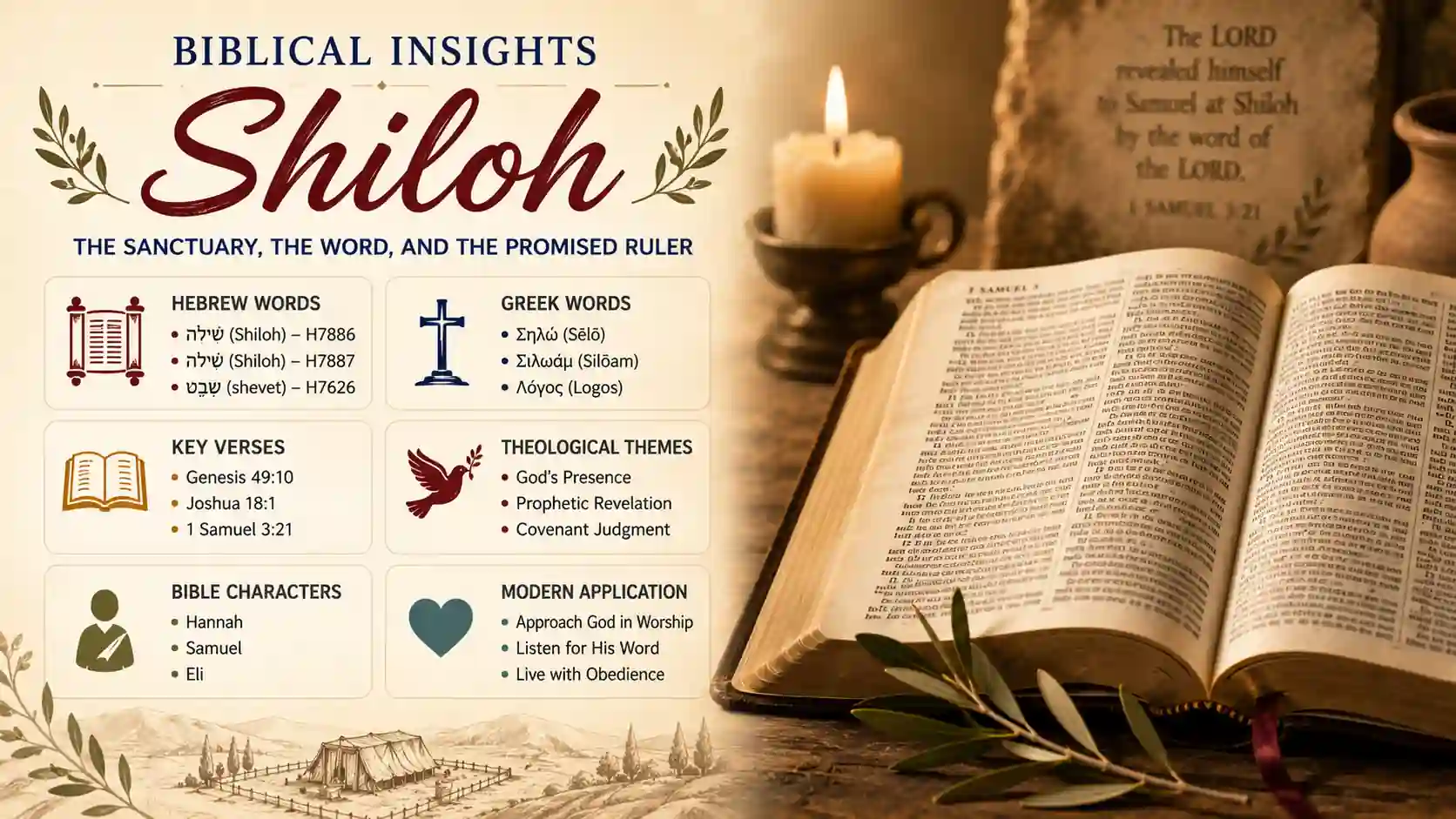
Shiloh Original Hebrew and Greek Words
| Original Word | Transliteration | Strong’s # | Literal Meaning |
|---|---|---|---|
| שִׁילֹה | Shiloh | H7886 | Shiloh, meaning disputed |
| שִׁלֹה | Shiloh | H7887 | Shiloh, Israelite town |
| שֵׁבֶט | shevet | H7626 | Scepter, staff, tribe |
| חָקַק | chaqaq | H2710 | Decree, inscribe, rule |
| יִקְּהָה | yiqqehah | H3349 | Obedience, gathering |
| עַם | am | H5971 | People, nation |
| מִשְׁכָּן | mishkan | H4908 | Dwelling, tabernacle |
| אֹהֶל | ohel | H168 | Tent |
| Σηλώ | Sēlō | LXX form | Shiloh |
| Σιλωάμ | Silōam | G4611 | Siloam, “Sent” |
Strong’s distinguishes שִׁילֹה, Shiloh, in Genesis 49:10 as H7886 from שִׁלֹה, Shiloh, the geographical name listed as H7887. H7886 occurs only in Jacob’s blessing, while H7887 identifies the sanctuary town throughout Joshua, Judges, Samuel, Kings, Psalms, and Jeremiah.
The Greek Σηλώ, Sēlō, is the Septuagint’s form of the place-name and does not have a standard New Testament Strong’s number. Σιλωάμ, Silōam, G4611, names the Pool of Siloam in John 9, but it represents Hebrew שִׁלֹחַ, Shiloach, rather than the sanctuary town and should not be treated as an identical biblical word.
Shiloh Related Biblical Concepts
| Concept | Connection | Supporting Verse |
|---|---|---|
| Judah’s kingship | Shiloh appears in royal blessing | Genesis 49:10 |
| Tribal inheritance | Land divided before the Lord | Joshua 18:10 |
| Central worship | Tabernacle placed at Shiloh | Joshua 18:1 |
| Pilgrimage | Families traveled there yearly | 1 Samuel 1:3 |
| Prayer | Hannah poured out her soul | 1 Samuel 1:15 |
| Prophetic calling | Samuel heard God’s voice | 1 Samuel 3:10 |
| Priestly accountability | Eli’s house was judged | 1 Samuel 2:27–34 |
| Ark of the covenant | Ark was brought from Shiloh | 1 Samuel 4:4 |
| Divine presence | God revealed himself there | 1 Samuel 3:21 |
| Covenant judgment | Shiloh became a warning | Jeremiah 7:12 |
Shiloh Historical and Cultural Context
| Aspect | Detail | Biblical Source |
|---|---|---|
| Location | Hill country of Ephraim | Joshua 16:5–6 |
| Tribal setting | Within Ephraim’s territory | Joshua 18:1 |
| National assembly | Israel gathered there | Joshua 18:1 |
| Sanctuary | Tent of Meeting established | Joshua 18:1 |
| Land administration | Lots cast before the Lord | Joshua 18:10 |
| Annual worship | Families brought sacrifices | 1 Samuel 1:3 |
| Priestly center | Eli and his sons served | 1 Samuel 1:9 |
| Prophetic center | Samuel ministered there | 1 Samuel 3:21 |
| Military crisis | Ark removed before battle | 1 Samuel 4:3–4 |
| Later ruin | Used as judgment example | Jeremiah 7:12–14 |
Shiloh became Israel’s principal sanctuary during the era between the conquest and the monarchy. The tabernacle’s presence made the town a center of worship, government, sacrifice, prophetic revelation, and tribal administration.
The Bible does not narrate Shiloh’s destruction in a single detailed account. Psalm 78 declares that God abandoned the dwelling there, and Jeremiah later points to its condition as visible proof that a sacred location could not protect persistently rebellious people.
Shiloh Theological Themes
| Theme | Explanation | Scripture |
|---|---|---|
| God’s presence | God chose to dwell among Israel | Joshua 18:1 |
| Rightful rule | Judah receives enduring authority | Genesis 49:10 |
| Worship | Israel approached God by sacrifice | 1 Samuel 1:3 |
| Prayer | God heard Hannah’s anguish | 1 Samuel 1:20 |
| Revelation | God spoke through Samuel | 1 Samuel 3:21 |
| Holiness | Priests were accountable to God | 1 Samuel 2:29 |
| Judgment | Privilege did not excuse rebellion | Psalm 78:60 |
| Covenant faithfulness | God’s word remained sure | 1 Samuel 3:19 |
| Human presumption | The ark was treated as a charm | 1 Samuel 4:3 |
| Messianic hope | Nations obey Judah’s ruler | Genesis 49:10 |
Shiloh Modern Application for Believers
| Area | Practice | Scripture |
|---|---|---|
| Worship | Approach God with reverence | 1 Samuel 1:3 |
| Prayer | Speak honestly before God | 1 Samuel 1:15 |
| Parenting | Dedicate children to God | 1 Samuel 1:27–28 |
| Listening | Respond when God speaks | 1 Samuel 3:10 |
| Leadership | Honor God above family pressure | 1 Samuel 2:29 |
| Scripture | Receive God’s revealed word | 1 Samuel 3:21 |
| Repentance | Learn from former judgment | Jeremiah 7:12 |
| Discernment | Reject superstitious religion | 1 Samuel 4:3 |
| Community | Gather around God’s purposes | Joshua 18:1 |
| Hope | Trust God’s promised ruler | Genesis 49:10 |
What Does Shiloh Mean in the Bible in Genesis 49:10?
Genesis 49 records Jacob’s final blessings over his sons. When he speaks to Judah, he uses the images of a lion, a scepter, a ruler’s staff, prosperous vineyards, and the obedience of peoples. The setting is unmistakably royal, even though Israel had no human king when Jacob spoke.
The phrase עַד כִּי־יָבֹא שִׁילֹה, ad ki yavo Shiloh, is difficult. It can be read traditionally as “until Shiloh comes,” but several scholars understand the consonants as expressing “until he comes to whom it belongs,” an interpretation resembling Ezekiel 21:27 and emphasizing the arrival of Judah’s rightful ruler.
Shiloh as the Sanctuary of Israel’S Tribal Era
When Israel assembled at Shiloh in Joshua 18, the land had been subdued, but seven tribes still lacked assigned territories. Joshua sent representatives to survey the land, and he cast lots for them “before the Lord” at Shiloh. Worship and national decision-making were joined under God’s authority.
Shiloh was not merely a meeting hall or military headquarters. The אֹהֶל מוֹעֵד, ohel moed, the Tent of Meeting, stood there, representing God’s covenant presence among his people. The location was holy because God chose to place his dwelling there, not because the soil possessed independent spiritual power.
Hannah, Samuel, and God’S Word at Shiloh
The opening chapters of 1 Samuel show both the beauty and corruption associated with Shiloh. Hannah prayed there with such intensity that Eli misunderstood her. God heard her, gave her Samuel, and transformed a place of sorrow into a place of thanksgiving and dedication.
At the same sanctuary, Eli’s sons treated sacrifices contemptuously and abused their priestly authority. Yet God called Samuel and “revealed himself to Samuel at Shiloh by the word of the Lord.” The contrast teaches you that human failure cannot silence God, though unrepentant leaders remain accountable to his judgment.
From Shiloh’S Judgment to the Hope of Judah’S Ruler
Israel later carried the ark from Shiloh into battle as though the sacred object could guarantee victory. The Philistines captured it, Eli’s sons died, and the glory departed. Psalm 78 interprets this tragedy as God’s rejection of Shiloh’s dwelling because of Israel’s covenant rebellion.
Genesis 49:10 points in another direction, toward a ruler from Judah who receives the obedience of peoples. Christians have historically read this royal hope in light of Jesus Christ, the Lion from Judah and Davidic King. Even where the exact translation of שִׁילֹה remains debated, the verse firmly associates Judah with enduring rule and worldwide allegiance.
Questions About Shiloh in the Bible
Does שִׁילֹה, Shiloh, literally mean “peace”?
The name is sometimes associated with rest or tranquility, but the precise meaning of H7886 in Genesis 49:10 remains disputed.
Are H7886 and H7887 the same Strong’s entry?
No. H7886 marks the difficult Genesis 49:10 expression, while H7887 identifies the geographical sanctuary of Shiloh.
Why does the ESV say “until tribute comes” instead of “until Shiloh comes”?
The ESV follows one scholarly interpretation of an uncertain Hebrew phrase rather than preserving Shiloh as a personal title.
Was Jesus ever directly called Shiloh in the New Testament?
No. The New Testament does not use Shiloh as a name for Jesus, though Christians connect Genesis 49:10 with his rule from Judah.
What warning should you learn from Jeremiah’s reference to Shiloh?
Religious heritage and sacred places cannot replace obedience, repentance, justice, and genuine trust in God.