
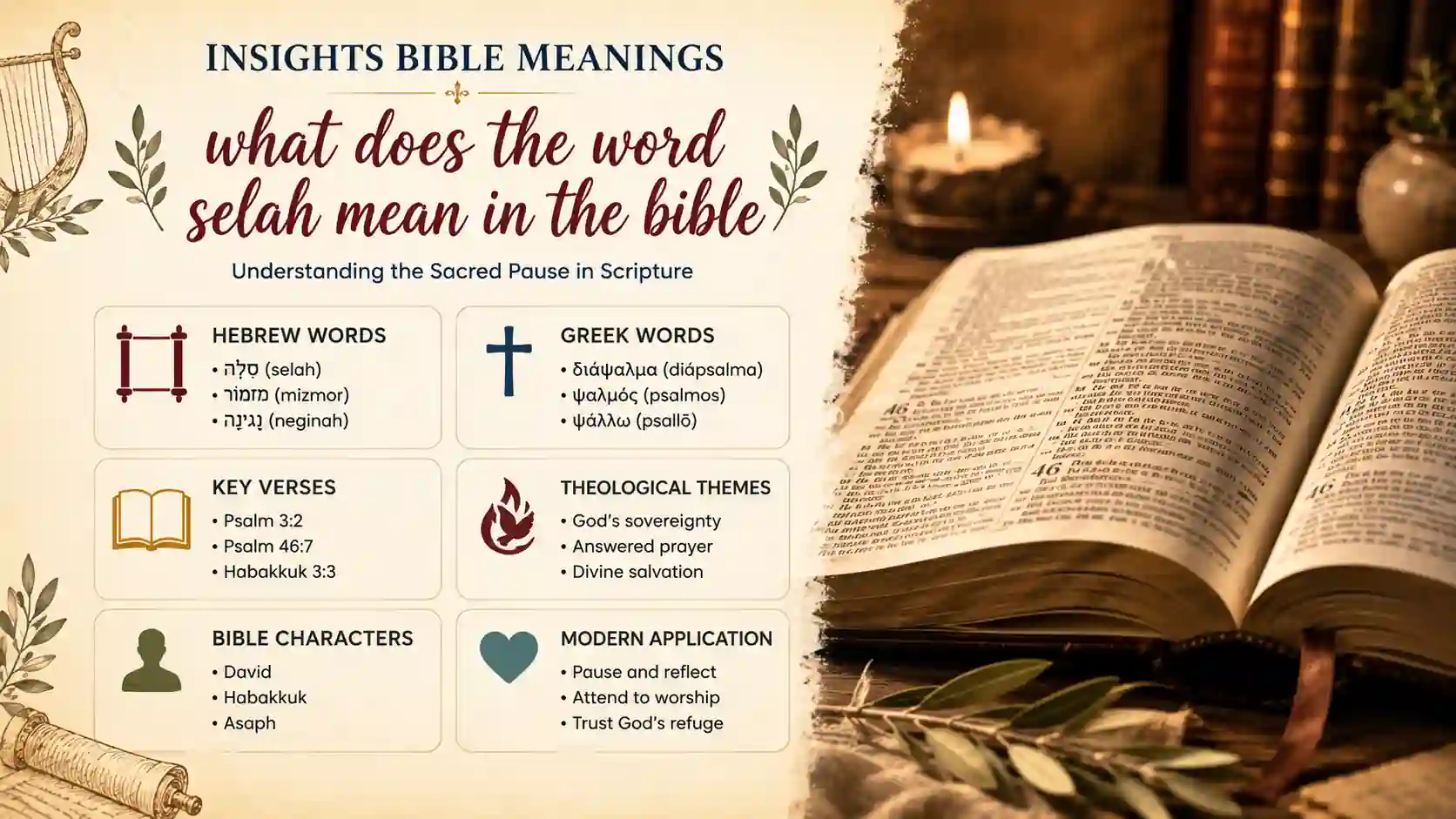
What does the word selah mean in the Bible? The most responsible answer is that סֶלָה (selah) is an ancient Hebrew liturgical or musical marker whose precise function is uncertain. It may signal a pause, an instrumental interlude, a change in musical performance, or an invitation to emphasize what has just been sung.
You encounter selah mainly in Psalms and three times in Habakkuk 3. Rather than treating it as a secret code, you should read it as part of Scripture’s poetic and worship setting, allowing the surrounding truth to receive careful attention.
Selah Key Scripture References
| Verse | Passage Snippet | Context |
|---|---|---|
| Psalm 3:2 | Enemies deny God will save | David flees Absalom |
| Psalm 3:4 | God answers from His hill | Prayer amid danger |
| Psalm 3:8 | Salvation belongs to the Lord | Closing confession |
| Psalm 24:6 | A generation seeks God | Entrance liturgy |
| Psalm 32:4 | God’s hand weighs heavily | Conviction before confession |
| Psalm 46:3 | Mountains tremble and waters roar | Cosmic disorder |
| Psalm 46:7 | God of Jacob is our fortress | Congregational refrain |
| Psalm 62:8 | Pour out your heart | Call to trust |
| Psalm 68:19 | God daily bears burdens | Praise for deliverance |
| Habakkuk 3:3 | The Holy One comes from Paran | Prophetic hymn |
Selah occurs seventy-four times in the Hebrew Bible, with seventy-one occurrences in Psalms and three in Habakkuk 3. Its placement often divides a song into thought units or follows a statement demanding emphasis.
Selah Bible Translation Comparison
| Verse | KJV | NIV | ESV | NASB |
|---|---|---|---|---|
| Psalm 3:2 | Retains “Selah” | Footnotes uncertainty | Retains “Selah” | Retains “Selah” |
| Psalm 3:4 | Retains “Selah” | Usually omits in text | Retains “Selah” | Retains “Selah” |
| Psalm 3:8 | Retains “Selah” | Notes Hebrew term | Retains “Selah” | Retains “Selah” |
| Psalm 24:6 | Retains “Selah” | Footnote treatment | Retains “Selah” | Retains “Selah” |
| Psalm 46:3 | Retains “Selah” | Notes Hebrew term | Retains “Selah” | Retains “Selah” |
| Psalm 46:7 | Retains “Selah” | Notes Hebrew term | Retains “Selah” | Retains “Selah” |
| Psalm 62:8 | Retains “Selah” | Footnote treatment | Retains “Selah” | Retains “Selah” |
| Habakkuk 3:3 | Retains “Selah” | Places it in footnote | Retains “Selah” | Retains “Selah” |
The differences do not mean one translation has discovered the definition while another has missed it. Translators must decide whether an ancient performance notation belongs in the printed text, in a footnote, or outside the readable sentence. The Hebrew manuscripts preserve the term, while modern English versions differ in presentation.
Selah People and Characters Associated
| Person | Role | Connection |
|---|---|---|
| David | King and psalmist | Named author of many Selah psalms |
| Absalom | David’s rebellious son | Historical setting of Psalm 3 |
| Habakkuk | Prophet and poet | Uses Selah three times |
| Sons of Korah | Temple singers | Associated with several Selah psalms |
| Asaph | Worship leader and psalmist | Uses Selah in communal songs |
| Jeduthun | Levitical music leader | Named in related psalm headings |
| Israelites | Covenant worshipers | Sang and heard these compositions |
| Temple musicians | Instrumental performers | Likely responded to the notation |
| Choir director | Worship supervisor | Received many marked psalms |
| God of Jacob | Covenant Lord | Praised between Selah refrains |
David is especially prominent because the first biblical occurrence appears in Psalm 3, written during his flight from Absalom. The term also appears in compositions connected with Asaph and the Sons of Korah, showing that it belonged to Israel’s wider worship tradition rather than to one author’s private vocabulary.
Habakkuk’s use is equally significant. His third chapter is a prayer written in elevated poetic form, complete with musical directions. This confirms that selah belongs naturally in sung or performed revelation, even when that revelation appears within a prophetic book.
Selah Original Hebrew and Greek Words
| Original Word | Transliteration | Strong’s # | Literal Meaning |
|---|---|---|---|
| סֶלָה | selah | H5542 | Pause or musical suspension |
| סָלַל | salal | H5549 | Lift up or raise |
| הִגָּיוֹן | higgayon | H1902 | Meditation or musical sound |
| מִזְמוֹר | mizmor | H4210 | Psalm or accompanied song |
| נְגִינָה | neginah | H5058 | Music on strings |
| תְּפִלָּה | tefillah | H8605 | Prayer |
| διάψαλμα | diápsalma | No NT number | Musical interlude |
| ψαλμός | psalmos | G5568 | Song with instrumental music |
| ψάλλω | psallō | G5567 | Sing or play strings |
| ἀεί | aei | G104 | Always or continually |
Strong’s Concordance identifies סֶלָה as H5542 and connects it with the idea of musical suspension or pause. Some lexicons relate it to a root meaning “lift up,” possibly suggesting lifted voices, elevated volume, or heightened emphasis. Yet the derivation is debated, so you should not present “lift up” as a proven translation.
The ancient Greek Septuagint commonly rendered selah as διάψαλμα (diápsalma), a term usually understood as an interlude or change within a psalm. Because diápsalma does not occur in the Greek New Testament, it has no standard New Testament Strong’s number.
Selah Related Biblical Concepts
| Concept | Connection | Supporting Verse |
|---|---|---|
| Meditation | Truth is given time to settle | Psalm 1:2 |
| Worship | Selah appears in sacred songs | Psalm 66:4 |
| Trust | Pauses often follow confessions | Psalm 62:8 |
| Lament | Grief is brought before God | Psalm 3:2 |
| Praise | God’s greatness is emphasized | Psalm 68:19 |
| Remembrance | Worship recalls God’s works | Psalm 77:11 |
| Refuge | God protects His people | Psalm 46:7 |
| Confession | Silence exposes hidden sin | Psalm 32:5 |
| Divine kingship | God rules nations and creation | Psalm 47:8 |
| Holy fear | God’s appearing produces awe | Habakkuk 3:3 |
Although “pause and reflect” is not a certain lexical translation, it is often a wise devotional response. When the biblical text places selah after a declaration of danger, deliverance, judgment, or praise, slowing down helps you follow the structure of the inspired poem.
The pause should serve the passage rather than replace it. You are not asked to empty your mind or search for a hidden message. You are invited to attend more carefully to what God has already revealed in the surrounding lines.
Selah Historical and Cultural Context
| Aspect | Detail | Biblical Source |
|---|---|---|
| Primary setting | Hebrew worship poetry | Book of Psalms |
| Secondary setting | Prophetic hymn | Habakkuk 3 |
| Total occurrences | Seventy-four | Hebrew text |
| Psalm occurrences | Seventy-one | Thirty-nine psalms |
| Habakkuk occurrences | Three | Habakkuk 3:3, 9, 13 |
| Common position | End of poetic unit | Psalm 3 |
| Rare position | Middle of a verse | Habakkuk 3:9 |
| Musical setting | Strings and choir | Psalm headings |
| Temple connection | Levitical musicians | 1 Chronicles 25 |
| Greek tradition | Rendered diápsalma | Septuagint Psalms |
The Psalms were not merely private reading material. Many were composed for communal worship, directed to a choirmaster, assigned to Levitical singers, or accompanied by stringed instruments. In that environment, a mark signaling an instrumental response, vocal lift, rhythmic change, or pause would have been practical.
The exact performance custom was lost early. Ancient translators already differed. The Septuagint used diápsalma, while other traditions associated the word with permanence or continuation. This variety is strong evidence that certainty had faded long before modern English translations appeared.
Selah Theological Themes
| Theme | Explanation | Scripture |
|---|---|---|
| God’s sovereignty | He rules over chaos | Psalm 46:1-3 |
| Covenant faithfulness | The God of Jacob remains present | Psalm 46:7 |
| Divine salvation | Rescue belongs to the Lord | Psalm 3:8 |
| Honest lament | Believers may voice anguish | Psalm 3:1-2 |
| Answered prayer | God hears from His holy hill | Psalm 3:4 |
| Human frailty | Life passes like a breath | Psalm 39:5 |
| Forgiveness | Confession meets mercy | Psalm 32:5 |
| Final justice | God judges wickedness | Psalm 9:16 |
| Universal worship | Nations praise God | Psalm 67:4 |
| Holy appearance | God comes in majesty | Habakkuk 3:3 |
Selah often appears where theology becomes confession. The psalmist does not merely discuss God’s power but declares, sings, and rests in it. The notation helps shape worship so that truth is not rushed past before the congregation responds.
Its placement also honors the emotional range of biblical faith. A pause may follow accusation, fear, repentance, confidence, or praise. Scripture teaches you neither to suppress sorrow nor to remain imprisoned by it. Lament is carried into the presence of the covenant God.
Selah Modern Application for Believers
| Area | Practice | Scripture |
|---|---|---|
| Bible reading | Pause at major declarations | Psalm 3:8 |
| Prayer | Leave room for quiet reflection | Psalm 62:8 |
| Worship | Attend to words and music | Psalm 66:4 |
| Anxiety | Recall God as refuge | Psalm 46:1 |
| Confession | Stop hiding sin | Psalm 32:5 |
| Decision-making | Reflect before responding | Proverbs 15:28 |
| Suffering | Bring honest lament to God | Psalm 77:1 |
| Gratitude | Remember daily mercies | Psalm 68:19 |
| Community | Confess truth together | Psalm 46:7 |
| Hope | Rest in God’s coming justice | Habakkuk 3:13 |
You can practice a faithful “Selah moment” by reading the preceding line again, identifying what it reveals about God, and responding in prayer. This is not a command built into the word’s proven definition. It is a disciplined way to respect the literary pause suggested by its placement.
In congregational worship, selah reminds you that music can carry theological meaning. Instrumental space is not necessarily empty. Silence, repetition, and musical response may help a congregation receive the words it has sung, provided the focus remains on God rather than on emotional performance.
The Hebrew סֶלָה and the Limits of Certainty
The safest definition of סֶלָה (selah) is “an uncertain liturgical or musical notation.” “Pause,” “interlude,” “lift up,” and “reflect” are plausible explanations, but none can be demonstrated beyond dispute. Responsible Bible study distinguishes a strong possibility from an established fact.
This uncertainty does not weaken biblical authority. Inspiration guarantees that the term belongs in the received Hebrew text, not that every ancient performance practice would remain fully recoverable. Your confidence rests in the clear message of each psalm, even where one technical notation remains obscure.
What Does the Word Selah Mean in the Bible’S Psalms?
In the Psalms, selah most likely directs the performance or reception of a song. It frequently occurs at the end of a stanza, after a striking confession, or before a shift in thought. Psalm 3 illustrates this clearly by placing the term after statements about opposition, answered prayer, and salvation.
You should therefore examine both sides of each occurrence. Ask what truth has just been stated and how the next line develops or answers it. In Psalm 46, for example, turmoil gives way to God’s presence, while the repeated declaration that the God of Jacob is a fortress anchors the entire song.
διάψαλμα In the Septuagint and Ancient Worship
The Septuagint’s διάψαλμα (diápsalma) shows that Jewish translators before the New Testament period understood selah as some kind of interruption or transition within a psalm. The rendering may suggest an instrumental passage, a musical change, or a break in regular singing.
Yet diápsalma is itself uncommon and does not settle every question. Its value lies in confirming that selah was treated as a worship notation, not as a personal name, place name, divine title, or mysterious spoken formula.
Habakkuk 3 and Selah in Prophetic Poetry
Habakkuk 3 places selah within a prayer describing God’s majestic coming from Teman and Mount Paran. The chapter echoes earlier displays of divine power associated with the exodus, Sinai, judgment, and covenant deliverance. Its language is meant to be heard as poetry and worship.
The prophet is facing the terror of Babylonian invasion, yet his vision rises beyond immediate circumstances. At each selah, the hearer is confronted with God’s holiness, His weapons of judgment, and His saving purpose for His people and His anointed one.
Questions About Selah
Does סֶלָה, selah, definitely mean “pause and reflect”?
No. That is a helpful devotional interpretation, but the exact lexical meaning remains uncertain.
Why does the NIV sometimes place Selah in a footnote?
The NIV treats it as an uncertain Hebrew notation rather than part of the spoken sentence.
Is διάψαλμα, diápsalma, the Greek translation of Selah?
Yes. The Septuagint commonly uses diápsalma, probably indicating an interlude or musical transition.
Why does Selah appear three times in Habakkuk 3?
Habakkuk 3 is a poetic prayer prepared for musical performance, so the notation fits its worship setting.
Should you say “Selah” aloud when reading a psalm?
You may, but Scripture does not clearly establish whether ancient worshipers pronounced it or followed it silently as a performance direction.