
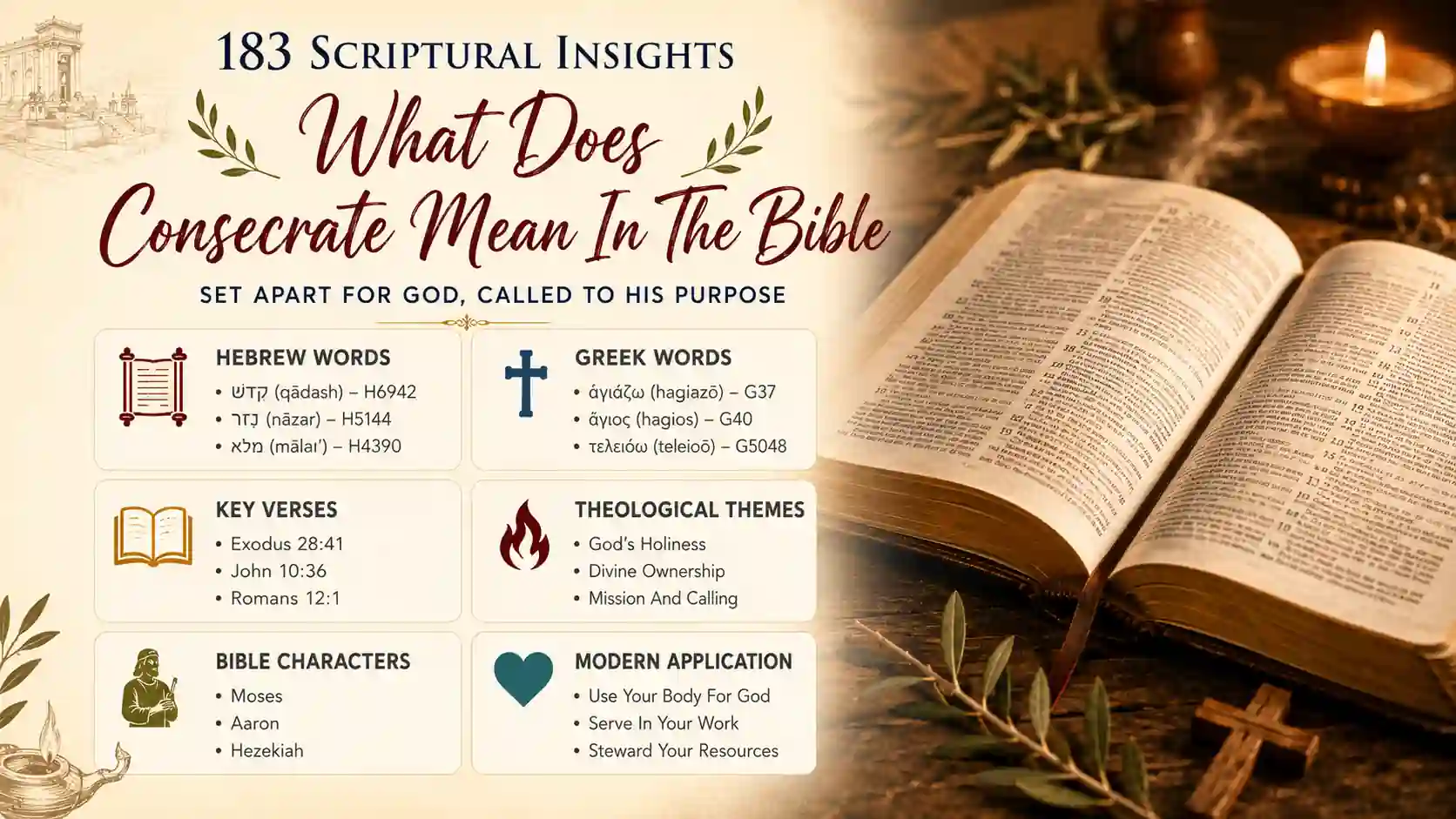
What does consecrate mean in the Bible? To consecrate means to set apart a person, place, object, or period of time as holy and devoted to God. Consecration involves belonging to God, becoming ready for His service, and treating His purposes as sacred rather than ordinary.
Scripture applies consecration to priests, worshipers, sacrifices, altars, sacred vessels, firstborn animals, the nation of Israel, and even Christ Himself. Your study must therefore consider ceremonial cleansing, covenant loyalty, divine calling, obedient service, and the transforming holiness God produces in His people.
Consecrate Key Scripture References
| Verse | Passage Snippet | Context |
|---|---|---|
| Exodus 19:10 | “Consecrate them today and tomorrow” | Israel prepares to meet God at Sinai |
| Exodus 28:41 | “Consecrate them, that they may serve me” | Aaron and his sons enter priestly service |
| Exodus 29:9 | “You shall ordain Aaron and his sons” | Priests receive sacred office |
| Leviticus 8:30 | “Consecrated Aaron and his garments” | Blood and oil mark priestly holiness |
| Joshua 3:5 | “Consecrate yourselves” | Israel prepares to cross the Jordan |
| 1 Samuel 7:1 | “Consecrated Eleazar his son” | Eleazar guards the ark |
| 2 Chronicles 29:5 | “Consecrate yourselves” | Hezekiah restores temple worship |
| John 10:36 | “Whom the Father consecrated and sent” | Jesus describes His divine mission |
| John 17:19 | “For their sake I consecrate myself” | Jesus prepares to offer Himself |
| Romans 12:1 | “Present your bodies as a living sacrifice” | Christian devotion becomes whole-life worship |
Consecrate Bible Translation Comparison
| Verse | KJV | NIV | ESV | NASB |
|---|---|---|---|---|
| Exodus 19:10 | “sanctify them” | “consecrate them” | “consecrate them” | “consecrate them” |
| Exodus 28:41 | “consecrate them” | “consecrate them” | “consecrate them” | “consecrate them” |
| Exodus 29:9 | “consecrate Aaron” | “ordain Aaron” | “ordain Aaron” | “ordain Aaron” |
| Joshua 3:5 | “Sanctify yourselves” | “Consecrate yourselves” | “Consecrate yourselves” | “Consecrate yourselves” |
| 1 Chronicles 15:12 | “sanctify yourselves” | “consecrate yourselves” | “consecrate yourselves” | “consecrate yourselves” |
| 2 Chronicles 29:5 | “Sanctify now yourselves” | “Consecrate yourselves now” | “Consecrate yourselves” | “Consecrate yourselves now” |
| Micah 4:13 | “consecrate their gain” | “devote their ill-gotten gains” | “devote their gain” | “devote their profit” |
| John 10:36 | “sanctified” | “set apart” | “consecrated” | “sanctified” |
| John 17:19 | “sanctify myself” | “sanctify myself” | “consecrate myself” | “sanctify Myself” |
| Hebrews 7:28 | “consecrated for evermore” | “made perfect forever” | “made perfect forever” | “made perfect forever” |
Consecrate People and Characters Associated
| Person | Role | Connection |
|---|---|---|
| Moses | Covenant mediator | Consecrated Israel and ordained the priests |
| Aaron | First high priest | Set apart through washing, clothing, oil, and blood |
| Aaron’s sons | Priests | Consecrated to minister at the altar |
| Eleazar | Guardian of the ark | Consecrated for sacred responsibility |
| Joshua | Israel’s leader | Commanded the people to consecrate themselves |
| Samuel | Prophet and judge | Led Israel in renewed covenant devotion |
| David | King and worship organizer | Arranged consecrated Levites for ark service |
| Hezekiah | Reforming king | Called priests and Levites back to holiness |
| Jesus Christ | Consecrated Son | Set apart and sent by the Father |
| Paul | Apostle | Called believers to present themselves to God |
Consecrate Original Hebrew and Greek Words
| Original Word | Transliteration | Strong’s # | Literal Meaning |
|---|---|---|---|
| קָדַשׁ | qādash | H6942 | Be holy, set apart, consecrate |
| קֹדֶשׁ | qōdesh | H6944 | Holiness, sacredness, holy thing |
| קָדוֹשׁ | qādosh | H6918 | Holy, sacred, separated |
| מָלֵא | mālēʾ | H4390 | Fill, complete, fill the hand |
| מִלֻּאִים | milluʾim | H4394 | Consecration, ordination, fillings |
| נָזַר | nāzar | H5144 | Separate, dedicate, consecrate |
| חָנַךְ | ḥānak | H2596 | Dedicate, inaugurate |
| ἁγιάζω | hagiazō | G37 | Sanctify, make holy, consecrate |
| ἅγιος | hagios | G40 | Holy, sacred, belonging to God |
| τελειόω | teleioō | G5048 | Complete, perfect, qualify fully |
The central Greek verb ἁγιάζω, hagiazō, can describe separation from common use, dedication to God, purification, or acknowledgment as holy. Strong’s G37 connects consecration closely with sanctification rather than treating them as unrelated ideas.
Consecrate Related Biblical Concepts
| Concept | Connection | Supporting Verse |
|---|---|---|
| Holiness | Consecration separates what belongs to God | Leviticus 20:7 |
| Sanctification | God makes His people holy | 1 Thessalonians 5:23 |
| Dedication | A person or object enters sacred service | Numbers 7:10 |
| Cleansing | Impurity is removed before ministry | Exodus 19:10 |
| Anointing | Oil marks divine appointment | Exodus 30:30 |
| Sacrifice | Consecration involves surrender to God | Romans 12:1 |
| Covenant | God claims a people as His possession | Exodus 19:5-6 |
| Priesthood | Priests are set apart to approach God | Exodus 28:41 |
| Obedience | Consecrated living follows God’s commands | Joshua 3:5 |
| Worship | Sacred devotion shapes all of life | Hebrews 13:15-16 |
Consecrate Historical and Cultural Context
| Aspect | Detail | Biblical Source |
|---|---|---|
| Ritual washing | Priests washed before sacred service | Exodus 29:4 |
| Priestly garments | Clothing displayed the dignity of office | Exodus 28:2 |
| Anointing oil | Oil signified God’s appointment | Exodus 29:7 |
| Sacrificial blood | Blood marked altar, garments, and priests | Leviticus 8:30 |
| Filling the hand | Ordination authorized priestly ministry | Exodus 29:9 |
| Sinai preparation | Israel washed and observed boundaries | Exodus 19:10-15 |
| Sacred vessels | Temple objects were removed from common use | 2 Chronicles 29:18 |
| Firstborn animals | Firstborn males belonged specially to God | Deuteronomy 15:19 |
| Nazirite vow | Voluntary separation involved visible disciplines | Numbers 6:1-8 |
| Temple reform | Neglected worship required renewed consecration | 2 Chronicles 29:3-11 |
Consecrate Theological Themes
| Theme | Explanation | Scripture |
|---|---|---|
| God’s holiness | Consecration begins with God’s holy character | Isaiah 6:3 |
| Divine ownership | What is consecrated belongs to the Lord | Leviticus 27:28 |
| Grace before service | God claims people before assigning duties | Exodus 19:4-6 |
| Cleansing for approach | Sin and impurity hinder sacred fellowship | Psalm 24:3-4 |
| Mediated access | Priests represented Israel before God | Exodus 28:29 |
| Mission | God sets people apart and sends them | Jeremiah 1:5 |
| Self-offering | Jesus consecrated Himself for His disciples | John 17:19 |
| Union with Christ | Believers are sanctified through Christ’s offering | Hebrews 10:10 |
| Whole-life worship | The body becomes an offering to God | Romans 12:1 |
| Future completion | God preserves His people for Christ’s coming | 1 Thessalonians 5:23 |
Consecrate Modern Application for Believers
| Area | Practice | Scripture |
|---|---|---|
| Body | Use your physical life to honor God | Romans 12:1 |
| Mind | Replace worldly patterns with renewed thinking | Romans 12:2 |
| Speech | Let your words give grace and truth | Ephesians 4:29 |
| Work | Serve sincerely as serving Christ | Colossians 3:23 |
| Time | Use your days wisely for God’s purposes | Ephesians 5:15-16 |
| Possessions | Hold resources as a faithful steward | 1 Timothy 6:17-19 |
| Relationships | Pursue purity, forgiveness, and love | Colossians 3:12-14 |
| Worship | Approach God with reverence and gratitude | Hebrews 12:28 |
| Ministry | Prepare yourself as a useful vessel | 2 Timothy 2:21 |
| Decisions | Submit your plans to the Lord’s will | James 4:15 |
What Does Consecrate Mean in the Bible Through קָדַשׁ?
The Hebrew root קָדַשׁ, qādash, provides the Bible’s central vocabulary for consecration. Its basic idea is holiness expressed through distinction. Something consecrated is removed from ordinary treatment because it now belongs especially to God. This does not necessarily mean the object has changed physically. Its status, purpose, and relationship to God have changed.
At Sinai, the Israelites were consecrated before God descended upon the mountain. They washed their garments, respected the boundaries God established, and prepared themselves for His appearing. These actions did not purchase divine favor. They taught Israel that the holy God must not be approached casually, presumptuously, or according to human invention.
The Priestly Meaning of Filling the Hand
Several passages describe priestly ordination with the Hebrew expression connected to מָלֵא, mālēʾ, meaning “to fill.” To “fill the hand” of a priest was to install or authorize him for sacred service. Exodus 29 joins this action with washing, special garments, anointing oil, sacrifices, blood, and a shared ceremonial meal.
This background explains why biblical consecration includes more than private sincerity. Aaron and his sons received a defined calling within God’s covenant order. Their hands were filled for work at the sanctuary. Genuine consecration therefore places your abilities, responsibilities, and daily actions under God’s authority rather than merely producing an intense religious feeling.
Christ’S Consecration in John 10 and John 17
In John 10:36, Jesus says the Father consecrated Him and sent Him into the world. The verb ἁγιάζω, hagiazō, identifies Jesus as the One uniquely set apart for the Father’s saving mission. His consecration does not suggest that He was formerly sinful. It speaks of divine appointment, holy identity, and purposeful sending.
In John 17:19, Jesus says He consecrates Himself for His disciples so that they also may be sanctified in truth. He willingly sets Himself apart to complete the Father’s will through His sacrificial death. Christian consecration rests on His offering. You do not make yourself acceptable by devotion. You respond because Christ has acted to make His people holy.
From Temple Consecration to Living Sacrifice
The New Testament carries the language of holiness beyond Israel’s sanctuary without erasing its seriousness. Believers are called saints, meaning holy ones, because they belong to God in Christ. Paul describes the church as God’s temple and urges each believer to become a cleansed vessel, sanctified and useful to the Master.
Romans 12:1 captures the practical shape of consecration. You present your body as a living sacrifice in response to God’s mercies. Your worship includes thought, work, sexuality, money, speech, relationships, and service. Consecration is not withdrawal from every ordinary responsibility. It is the surrender of ordinary life for holy obedience.
Questions About Consecrate in the Bible
Does קָדַשׁ, qādash, mean moral perfection every time it appears?
No. It often means being set apart as sacred, though moral purity should correspond to that holy status.
Why does the KJV say “sanctify” where newer translations say “consecrate”?
Both words can translate קָדַשׁ or ἁγιάζω because sanctifying and consecrating both involve making or treating something as holy.
Why is Exodus 29:9 translated as consecration in some Bibles and ordination in others?
The Hebrew idiom “fill the hand” describes installing Aaron and his sons into authorized priestly service.
Was Jesus made holy only when the Father consecrated Him in John 10:36?
No. The verse speaks of His unique appointment and mission, not a change from sinfulness to holiness.
How can you consecrate yourself without trusting in your own religious effort?
You offer yourself in response to God’s mercy, relying on Christ’s completed sacrifice and the Spirit’s sanctifying work.