
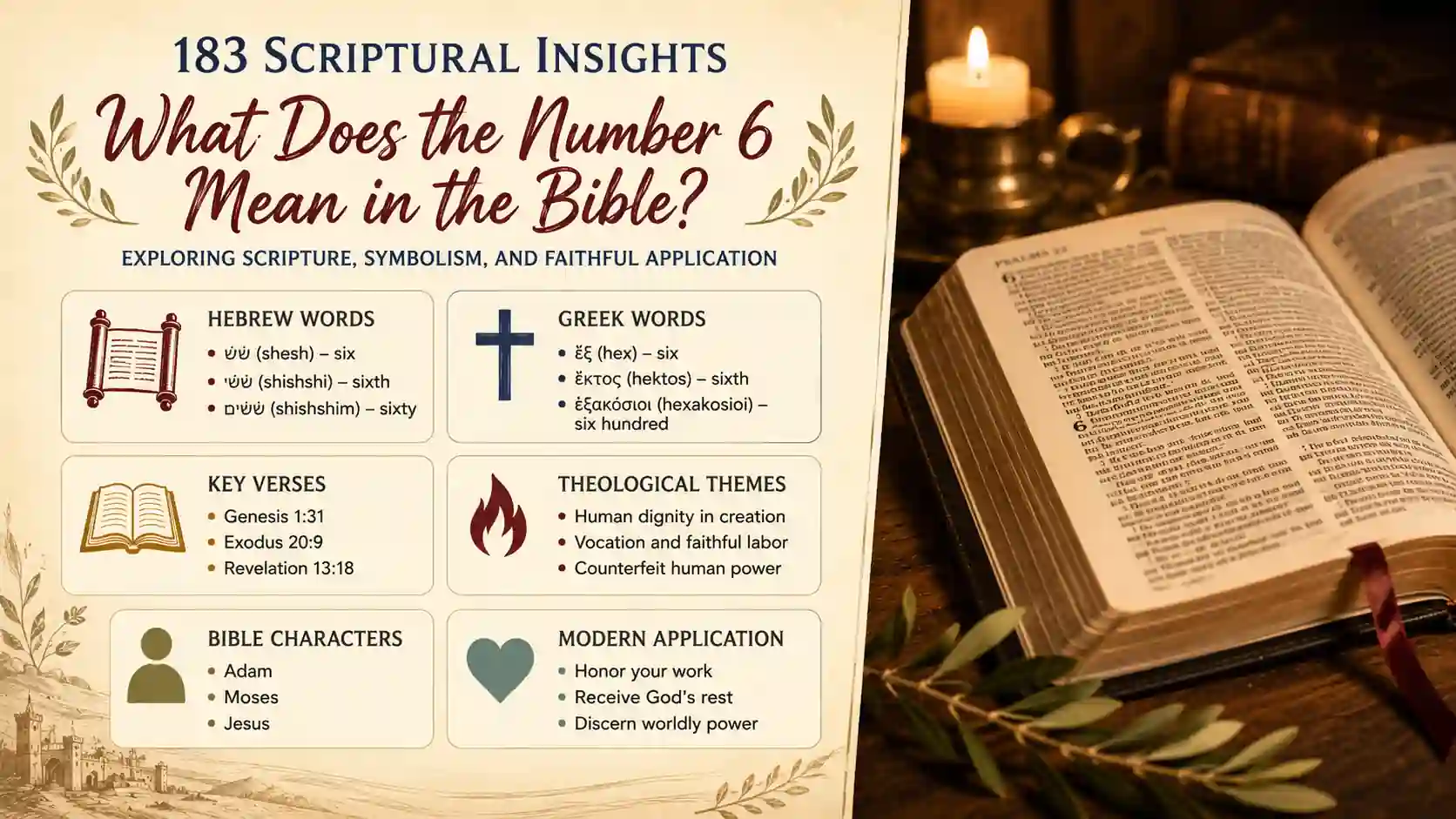
What does the number 6 mean in the Bible? Scripture does not provide a simple dictionary declaring that six always symbolizes one fixed idea. Instead, its meaning emerges from repeated biblical settings. Six marks the completion of ordinary labor, humanity’s creation, measured service, preparation before sacred rest, and, in Revelation, human power raised in rebellion against God.
As you study these passages, you will see that six is not inherently evil. Its significance depends on context. It often describes good work under God’s order, yet it can also expose human limitation when humanity refuses the rule of its Creator.
Key Number 6 Scripture References
| Verse | Passage Snippet | Context |
|---|---|---|
| Genesis 1:31 | “the sixth day” | God completes creation and declares it very good |
| Exodus 20:9 | “Six days shalt thou labour” | The Sabbath command establishes work and rest |
| Exodus 21:2 | “serve six years” | A Hebrew servant receives freedom in the seventh year |
| Exodus 24:16 | “six days” | The cloud covers Sinai before God calls Moses |
| Joshua 6:14 | “six days” | Israel circles Jericho before the seventh-day climax |
| 1 Kings 10:19 | “six steps” | Solomon’s throne displays royal splendor |
| John 2:6 | “six waterpots” | Jesus transforms purification water into wine |
| Revelation 13:18 | “six hundred threescore and six” | The beast’s number represents hostile human power |
Number 6 Bible Translation Comparison
| Verse | KJV | NIV | ESV | NASB |
|---|---|---|---|---|
| Genesis 1:31 | “the sixth day” | “the sixth day” | “the sixth day” | “the sixth day” |
| Exodus 20:9 | “shalt thou labour” | “you shall labor” | “you shall labor” | “you shall labor” |
| Exodus 21:2 | “serve six years” | “serve you for six years” | “serve six years” | “serve for six years” |
| Exodus 24:16 | “covered it six days” | “covered it for six days” | “covered it six days” | “covered it for six days” |
| Joshua 6:3 | “six days” | “six days” | “six days” | “six days” |
| Proverbs 6:16 | “six things” | “six things” | “six things” | “six things” |
| John 2:6 | “six waterpots” | “six stone water jars” | “six stone water jars” | “six stone waterpots” |
| Revelation 13:18 | “Six hundred threescore and six” | “666” | “666” | “six hundred and sixty-six” |
People and Characters Associated with Number 6
| Person | Role | Connection |
|---|---|---|
| Adam | First man | Created with Eve on the sixth day |
| Eve | First woman | Created within the sixth-day account |
| Moses | Covenant mediator | Receives laws involving six days and six years |
| Hebrew servant | Covenant community member | Serves six years before release |
| Joshua | Israel’s leader | Leads six days of marching around Jericho |
| Solomon | King of Israel | Builds a throne approached by six steps |
| Jesus | Messiah | Uses six purification jars at Cana |
| John | Apostle and seer | Records 666 as the beast’s number |
Original Hebrew and Greek Words for Number 6
| Original Word | Transliteration | Strong’s # | Literal Meaning |
|---|---|---|---|
| שֵׁשׁ | shesh | H8337 | six |
| שִׁשָּׁה | shishshah | H8337 | six, masculine form |
| שֵׁשֶׁת | sheshet | H8337 | six, construct form |
| שִׁשִּׁי | shishshi | H8345 | sixth |
| שִׁשִּׁית | shishshit | H8345 | sixth part |
| שִׁשִּׁים | shishshim | H8346 | sixty |
| שִׁת | shith | H8353 | six or sixth in Aramaic |
| ἕξ | hex | G1803 | six |
| ἕκτος | hektos | G1623 | sixth |
| ἑξακόσιοι | hexakosioi | G1812 | six hundred |
The principal Hebrew cardinal number is שֵׁשׁ, shesh, Strong’s H8337, while the common Greek equivalent is ἕξ, hex, Strong’s G1803. The Hebrew ordinal שִׁשִּׁי, shishshi, means “sixth,” and the Greek ordinal ἕκτος, hektos, carries the same basic sense.
Related Biblical Concepts Connected with Number 6
| Concept | Connection | Supporting Verse |
|---|---|---|
| Creation | God’s earthly work reaches completion on day six | Genesis 1:31 |
| Humanity | Male and female are created on the sixth day | Genesis 1:26-31 |
| Labor | Six days are assigned to ordinary work | Exodus 20:9 |
| Sabbath | Six days prepare for seventh-day rest | Exodus 20:10 |
| Servitude | Service ends after six years | Exodus 21:2 |
| Agriculture | Land is sown for six years | Leviticus 25:3-4 |
| Preparation | Sinai is covered for six days | Exodus 24:16 |
| Judgment | Six days precede Jericho’s fall | Joshua 6:14-16 |
| Purification | Six jars serve Jewish purification customs | John 2:6 |
| Rebellion | 666 identifies the beast’s blasphemous authority | Revelation 13:18 |
Historical and Cultural Context of Number 6
| Aspect | Detail | Biblical Source |
|---|---|---|
| Israelite week | Six workdays led to the Sabbath | Exodus 20:8-11 |
| Creation pattern | Human labor imitates God’s ordered work | Exodus 20:11 |
| Debt service | Hebrew servants were released after six years | Exodus 21:2 |
| Farming cycle | Fields were cultivated for six years | Leviticus 25:3 |
| Sinai encounter | Six days of waiting preceded Moses’ summons | Exodus 24:16 |
| Warfare ritual | Jericho was circled once daily for six days | Joshua 6:3 |
| Royal architecture | Six steps elevated Solomon’s throne | 1 Kings 10:19 |
| Purification customs | Stone jars held ceremonial washing water | John 2:6 |
| Ancient numeration | Letters could carry numerical values | Revelation 13:18 |
| Imperial pressure | Revelation addressed churches facing coercive power | Revelation 13:15-17 |
Theological Themes Expressed Through Number 6
| Theme | Explanation | Scripture |
|---|---|---|
| Created goodness | The sixth day ends with creation called very good | Genesis 1:31 |
| Human dignity | Humanity bears God’s image | Genesis 1:26-27 |
| Human limitation | People remain creatures under God | Psalm 8:4-6 |
| Vocation | Six days validate faithful labor | Exodus 20:9 |
| Rest as gift | Work is incomplete without God-appointed rest | Exodus 20:10 |
| Freedom | The seventh year limits permanent servitude | Exodus 21:2 |
| Dependence | Israel waits before entering God’s presence | Exodus 24:16 |
| Judgment | Human defenses fall at God’s command | Joshua 6:20 |
| Transformation | Christ surpasses ceremonial provision | John 2:6-11 |
| Counterfeit rule | The beast imitates authority while opposing God | Revelation 13:4-8 |
Modern Application of Number 6 for Believers
| Area | Practice | Scripture |
|---|---|---|
| Work | Treat ordinary labor as a God-given calling | Exodus 20:9 |
| Rest | Receive regular rest rather than idolizing productivity | Exodus 20:10 |
| Identity | Value every person as God’s image-bearer | Genesis 1:27 |
| Humility | Remember that humanity is created, not divine | Psalm 100:3 |
| Justice | Resist systems that reduce people to property | Exodus 21:2 |
| Stewardship | Let land, resources, and workers receive relief | Leviticus 25:3-4 |
| Patience | Wait for God’s timing before acting | Exodus 24:16 |
| Obedience | Follow God even when his method seems unusual | Joshua 6:3-5 |
| Worship | Reject political or economic idolatry | Revelation 13:15-17 |
| Discernment | Test impressive power by loyalty to Christ | Revelation 13:18 |
שֵׁשׁ And the Sixth Day Reveal Human Dignity Under God
The first major theological setting for six is Genesis 1. God creates humanity on the sixth day, after forming the environments and creatures over which human beings will exercise stewardship. Adam and Eve are not divine, yet they are uniquely made in God’s image and commissioned to represent his wise rule.
This connection explains why six is sometimes called “the number of man,” but that phrase requires care. Genesis does not say that six itself means sinful humanity. The sixth day is pronounced “very good.” Six first points to humanity as created, dignified, commissioned, and dependent on the Creator.
Human limitation becomes clearer when the sixth day is viewed beside the seventh. Humanity enters a world whose work is already God’s work. Adam’s first full day is the sanctified seventh day, showing that fellowship with God and reception of his provision precede every human achievement.
Six Days of Labor Find Their Goal in Sabbath Rest
The six-and-seven rhythm becomes covenant law in Exodus 20:8-11. Israel is commanded to work for six days and rest on the seventh because God’s creation pattern governs the community’s time. Six therefore represents legitimate labor, responsibility, cultivation, and service within God’s established boundaries.
The same rhythm shapes Israel’s social and agricultural laws. A Hebrew servant serves six years and is released in the seventh. The land is sown and harvested for six years, then receives Sabbath rest. Human productivity must never become absolute ownership or endless exploitation.
These commands reveal that six often signifies work approaching its appointed limit. Labor is honorable, but it is not ultimate. The seventh interrupts human striving and confesses that Israel’s life, freedom, harvest, and future depend on the Lord rather than uninterrupted production.
What Does the Number 6 Mean in the Bible at Cana and Jericho?
At Jericho, Israel marches around the city once each day for six days. Nothing outwardly decisive happens during that period. The six days create a pattern of disciplined obedience and anticipation before the intensified seventh day, when the people circle the city seven times and God brings down its walls.
At Cana, six stone jars stand ready for Jewish purification rites. John gives their number, material, purpose, and capacity. Jesus fills them with wine of remarkable quality, revealing his glory and signaling an abundant messianic provision that surpasses what the existing vessels could supply.
Neither passage teaches that six is evil. In both accounts, six belongs to a preparatory setting. Jericho’s six days await God’s decisive intervention, while Cana’s six vessels become instruments through which Christ reveals his transforming glory.
Ἑξακόσιοι And 666 as the Climax of Rebellious Power
Revelation 13:18 presents the most debated occurrence of six. John calls for wisdom to calculate the beast’s number, 666, describing it as the number of a man or a human number. The text connects the number with a beastly regime demanding worship and controlling economic participation.
Many interpreters see gematria in the verse, a method in which letters possess numerical values. A widely held historical interpretation connects 666 with “Nero Caesar” when the name is written in Hebrew letters, though Revelation’s symbolism reaches beyond one emperor to every political order that claims God-like allegiance.
The threefold six should not be treated as a magical code attached to ordinary objects, dates, or accidental number patterns. In Revelation, its meaning belongs to a sustained vision of idolatrous authority, deceptive signs, coerced worship, and persecution of those faithful to Jesus.
Six here portrays human power exalting itself beyond its created place. The beast appears mighty, yet its number remains human. It cannot attain divine completeness, overthrow the Lamb, or escape judgment. Revelation calls you to wisdom, endurance, and exclusive worship of God.
Questions Bible Students Ask About Number 6
Does שֵׁשׁ, shesh, literally mean “human imperfection”?
No. שֵׁשׁ literally means “six,” while symbolic associations must be established from each passage’s context.
Is six always a negative number because humanity was created on the sixth day?
No. Genesis calls the completed sixth day “very good,” so six can accompany creation, vocation, and divine blessing.
Why are six days of work repeatedly followed by a seventh day or year?
The pattern places necessary labor under God’s authority and directs creation toward rest, release, worship, and dependence.
Do the six stone jars in John 2 prove that Judaism was spiritually defective?
Not by themselves. The jars provide the setting for Jesus’ sign, but John emphasizes Christ’s abundant provision rather than assigning a universal definition to six.
Does 666 identify every appearance of the digit six as evil?
No. Revelation 13:18 concerns a specific beastly claim to worship and power, not harmless numbers encountered in daily life.