
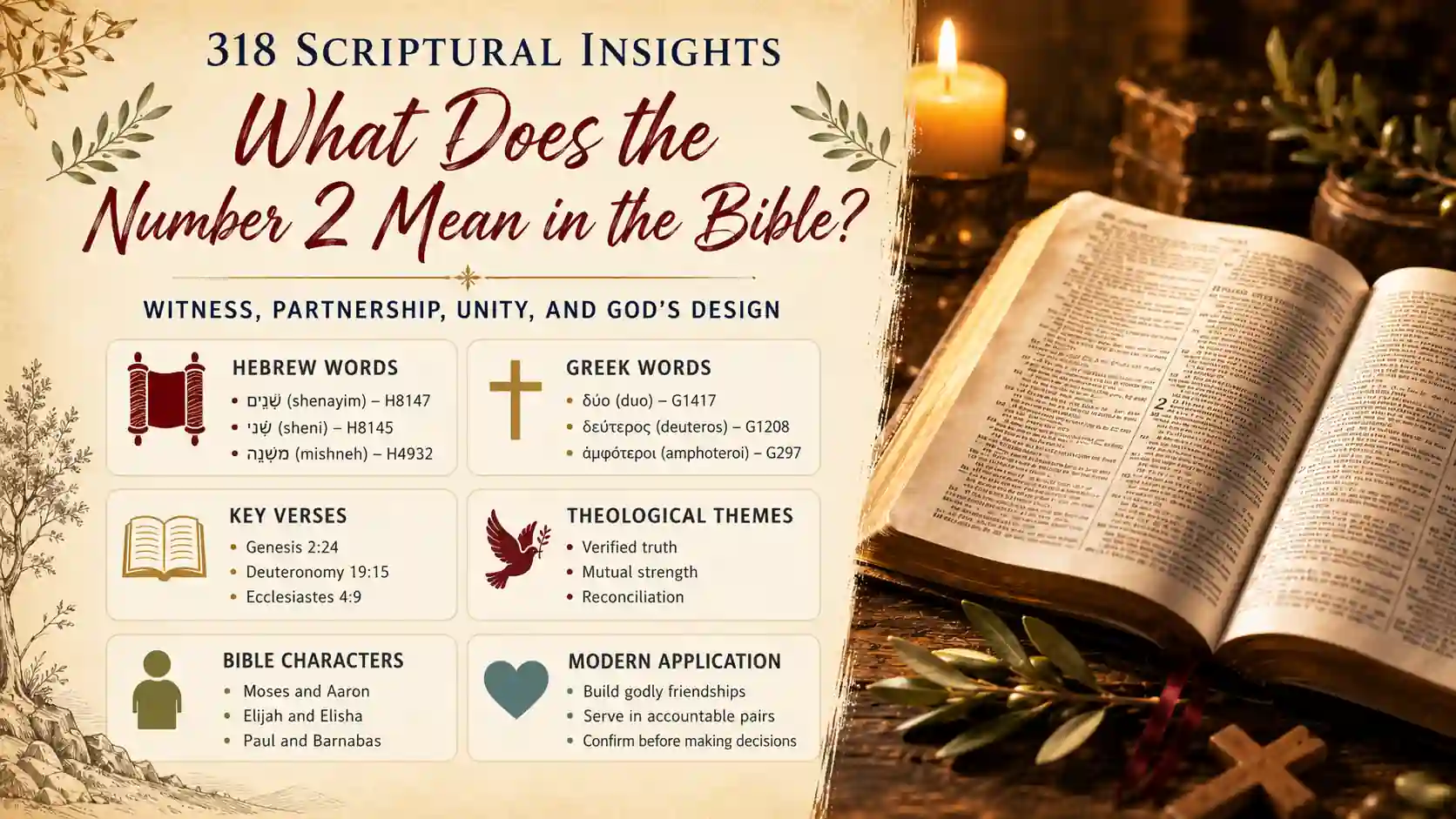
What does the number 2 mean in the Bible? Scripture uses two primarily as an ordinary number, yet repeated contexts give it recognizable theological associations. Two witnesses confirm testimony, two people provide companionship, paired messengers strengthen ministry, and two alternatives expose the necessity of decision.
You should not treat two as a secret code with one meaning in every passage. Its significance arises from context. Careful study reveals recurring themes of witness, partnership, distinction, covenant responsibility, and truths that belong together.
Key Scripture References About Two
| Verse | Passage Snippet | Context |
|---|---|---|
| Genesis 1:16 | Two great lights | God orders day and night |
| Genesis 2:24 | Become one flesh | Two persons joined in marriage |
| Genesis 7:9 | Two and two | Animals enter Noah’s ark |
| Exodus 31:18 | Two tablets of testimony | Covenant law given to Moses |
| Deuteronomy 19:15 | Two or three witnesses | Legal testimony requires confirmation |
| Ecclesiastes 4:9 | Two are better than one | Companionship strengthens labor |
| Mark 6:7 | Two by two | Jesus sends the Twelve |
| Matthew 18:20 | Two or three gathered | Christ is present with His people |
| Revelation 11:3 | My two witnesses | Prophetic testimony confronts rebellion |
Bible Translation Comparison for Two
| Verse | KJV | NIV | ESV | NASB |
|---|---|---|---|---|
| Genesis 2:24 | One flesh | One flesh | One flesh | One flesh |
| Genesis 7:9 | Two and two | Pairs | Two and two | By twos |
| Deuteronomy 19:15 | Two witnesses | Two witnesses | Two witnesses | Two witnesses |
| Ecclesiastes 4:9 | Better than one | Better than one | Better than one | Better than one |
| Mark 6:7 | Two and two | Two by two | Two by two | In pairs |
| Luke 10:1 | Two and two | Two by two | Two by two | In pairs |
| Hebrews 6:18 | Two immutable things | Two unchangeable things | Two unchangeable things | Two unchangeable things |
| Revelation 11:3 | Two witnesses | Two witnesses | Two witnesses | Two witnesses |
People and Characters Associated with Two
| Person | Role | Connection |
|---|---|---|
| Adam and Eve | First married couple | Two become one flesh |
| Moses and Aaron | Covenant leaders | Speak and confront Pharaoh together |
| Joshua and Caleb | Faithful spies | Two trust God’s promise |
| Elijah and Elisha | Prophets | Succession and shared prophetic ministry |
| Ruth and Naomi | Covenant companions | Loyalty expressed through relationship |
| David and Jonathan | Friends | Mutual faithfulness under pressure |
| Peter and John | Apostles | Serve and testify together |
| Paul and Barnabas | Missionaries | Sent as a ministry team |
| Two witnesses | Prophetic servants | Testify in Revelation 11 |
Original Hebrew and Greek Words for Two
| Original Word | Transliteration | Strong’s # | Literal Meaning |
|---|---|---|---|
| שְׁנַיִם | shenayim | H8147 | Two, both, a pair |
| שְׁתַּיִם | shettayim | H8147 | Two, feminine form |
| שְׁנֵי | shenei | H8147 | Two of, construct form |
| שֵׁנִי | sheni | H8145 | Second |
| מִשְׁנֶה | mishneh | H4932 | Second, double, copy |
| כֶּפֶל | kephel | H3718 | Double, twofold |
| δύο | duo | G1417 | Two |
| δεύτερος | deuteros | G1208 | Second, afterward |
| ἀμφότεροι | amphoteroi | G297 | Both, the two together |
| δίς | dis | G1364 | Twice |
Related Biblical Concepts Connected with Two
| Concept | Connection | Supporting Verse |
|---|---|---|
| Witness | Two testimonies establish a matter | Deuteronomy 19:15 |
| Marriage | Two persons become one flesh | Genesis 2:24 |
| Companionship | Partners support one another | Ecclesiastes 4:9 |
| Mission | Workers are sent in pairs | Mark 6:7 |
| Covenant law | Two tablets bear God’s commands | Exodus 31:18 |
| Confirmation | Repetition shows certainty | Genesis 41:32 |
| Choice | Two ways demand allegiance | Deuteronomy 30:19 |
| Reconciliation | Two divided groups become one | Ephesians 2:14 |
| Prophecy | Two witnesses testify publicly | Revelation 11:3 |
Historical and Cultural Context of Two
| Aspect | Detail | Biblical Source |
|---|---|---|
| Ancient courts | One witness was insufficient | Deuteronomy 19:15 |
| Capital cases | Multiple witnesses guarded justice | Deuteronomy 17:6 |
| Marriage covenant | Union created a new household | Genesis 2:24 |
| Covenant tablets | Stone tablets preserved divine law | Exodus 34:1 |
| Mission travel | Companions offered help and testimony | Luke 10:1 |
| Agricultural labor | Partners improved work and safety | Ecclesiastes 4:9–12 |
| Temple worship | Two cherubim overshadowed the ark | Exodus 25:18 |
| Atonement ritual | Two goats served distinct functions | Leviticus 16:7–10 |
| Prophetic symbolism | Two sticks represented divided kingdoms | Ezekiel 37:16–22 |
Theological Themes Expressed Through Two
| Theme | Explanation | Scripture |
|---|---|---|
| Verified truth | God values confirmed testimony | John 8:17 |
| Relational unity | Distinct persons may share covenant union | Genesis 2:24 |
| Mutual strength | Companions help each other endure | Ecclesiastes 4:10 |
| Responsible judgment | Accusations require adequate evidence | 1 Timothy 5:19 |
| Missionary fellowship | Gospel workers serve together | Acts 13:2 |
| Reconciliation | Christ makes divided peoples one | Ephesians 2:14–16 |
| Confirmation | Repeated revelation emphasizes certainty | Genesis 41:32 |
| Moral distinction | Scripture contrasts life and death | Deuteronomy 30:19 |
| Prophetic testimony | God maintains witness in hostile times | Revelation 11:3 |
Modern Application of Two for Believers
| Area | Practice | Scripture |
|---|---|---|
| Friendship | Build relationships of mutual encouragement | Ecclesiastes 4:9 |
| Marriage | Practice faithful covenant unity | Matthew 19:5–6 |
| Discernment | Confirm serious claims carefully | Deuteronomy 19:15 |
| Church discipline | Seek facts before judgment | Matthew 18:16 |
| Ministry | Serve with accountable partners | Mark 6:7 |
| Prayer | Gather with other believers | Matthew 18:20 |
| Evangelism | Support one another in witness | Luke 10:1 |
| Reconciliation | Pursue unity through Christ | Ephesians 2:14 |
| Decision-making | Choose obedience rather than compromise | Matthew 7:13–14 |
שְׁנַיִם Shows That Two Begins with Its Biblical Context
The principal Hebrew cardinal number is שְׁנַיִם, shenayim, Strong’s H8147. Its feminine form is שְׁתַּיִם, shettayim, while construct forms such as שְׁנֵי, shenei, appear before nouns. These grammatical forms normally identify an actual quantity rather than a mystical symbol.
The ordinal שֵׁנִי, sheni, Strong’s H8145, means “second.” A related noun, מִשְׁנֶה, mishneh, Strong’s H4932, can describe what is second, doubled, repeated, or copied. Deuteronomy 17:18 uses it for the king’s copy of the law, emphasizing faithful preservation rather than secret numerology.
What Does the Number 2 Mean in the Bible’S Laws of Witness?
The clearest recurring significance of two is confirmed testimony. Deuteronomy 19:15 declares that one witness cannot establish a charge. A matter must be confirmed by two or three witnesses. This requirement protected Israel’s courts from judgments based on unsupported accusations.
Jesus applies the same principle to reconciliation and church discipline in Matthew 18:16. Paul cites it when preparing to address the Corinthians in 2 Corinthians 13:1 and when discussing accusations against elders in 1 Timothy 5:19. Two therefore often suggests accountable, verifiable testimony.
This principle does not mean that every pair in Scripture symbolizes courtroom evidence. It means that when a passage concerns testimony, judgment, discipline, or public truth, the presence of two witnesses carries a recognizable covenant and legal significance.
δύο Joins Partnership with Responsible Mission
The usual Greek word for two is δύο, duo, Strong’s G1417. In the Gospels, it appears when Jesus sends disciples in pairs. Mark 6:7 records that He sent the Twelve two by two, and Luke 10:1 describes a similar pattern among the larger group of disciples.
Paired ministry offered companionship, practical assistance, shared discernment, and credible testimony. A messenger who became discouraged had support. A disputed report did not rest on one person alone. The pattern reflects both pastoral wisdom and Israel’s established concern for confirmed witness.
Ecclesiastes 4:9–12 supplies the wisdom foundation for this practice. Two receive a better return for their work, lift one another after a fall, share warmth, and resist an attacker. The passage does not promise that every partnership will be healthy, but it teaches that faithful companionship is one of God’s ordinary gifts.
Two Can Mark Unity, Distinction, or a Necessary Choice
Genesis 2:24 presents one of Scripture’s deepest uses of two. A man and woman remain distinguishable persons, yet marriage joins them as “one flesh.” Jesus quotes this text in Matthew 19:5–6, stressing that the union established by God must be treated with covenant seriousness.
Two may also mark distinction. Scripture speaks of two tablets, two kingdoms, two goats, two covenants, two ways, and two outcomes. The meaning depends upon what the text distinguishes. The two goats of Leviticus 16 have complementary roles, while the two ways of Matthew 7:13–14 lead to opposite destinations.
You should therefore resist the claim that two always means division, union, witness, or opposition. It can serve any of these ideas. Sound interpretation begins with grammar, literary setting, covenant background, and the author’s purpose before drawing broader theological connections.
The number may also highlight God’s power to reconcile what has been divided. Ezekiel joins two sticks to portray the future reunification of Israel and Judah. Ephesians 2:14–16 proclaims that Christ creates one new humanity from two estranged peoples, bringing peace through the cross.
Frequently Asked Questions About Two in Scripture
Does שְׁנַיִם, shenayim, always carry a symbolic meaning?
No. It usually means the literal quantity two, and symbolic significance must be established by the passage’s context.
Why did biblical law require two witnesses?
Two witnesses provided corroboration and helped protect people from false, mistaken, or malicious accusations.
Are “two by two” and “in pairs” a real translation disagreement?
No. They are different English expressions for the same basic idea of people being sent in groups of two.
Do the two goats in Leviticus 16 represent two different sacrifices?
They form one coordinated purification rite, with one goat slain and the other carrying confessed sins away.
How should you apply the biblical meaning of two today?
Seek trustworthy fellowship, verify serious claims, practice accountable ministry, and let each passage define the number’s significance.