
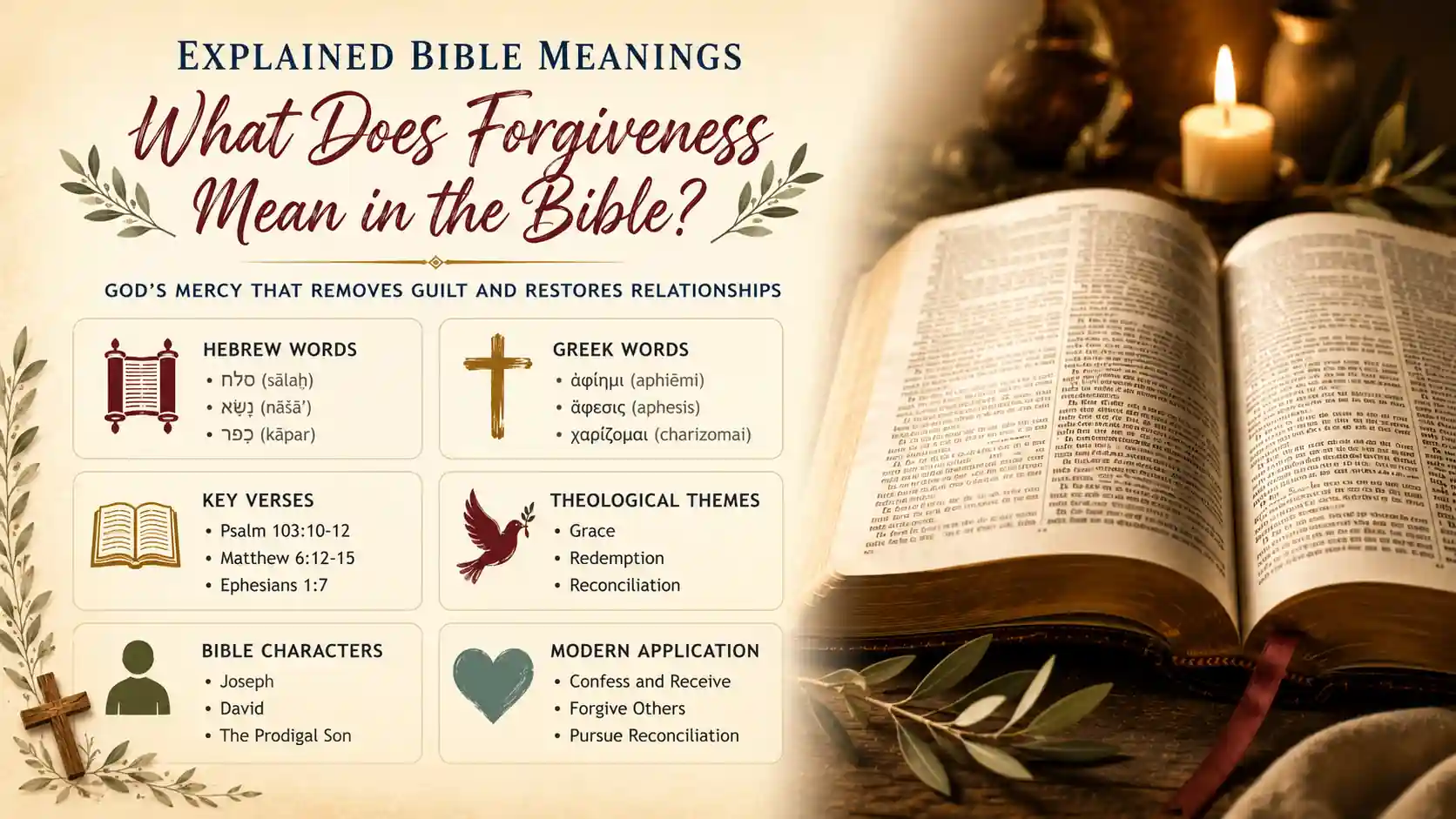
What does forgiveness mean in the Bible? Scripture presents forgiveness as God’s gracious removal of guilt, release from deserved judgment, and restoration of broken fellowship. It is not pretending that evil never happened or declaring injustice harmless. Biblical forgiveness faces sin truthfully while refusing to make vengeance the final word.
For you as a believer, forgiveness begins with God’s holy mercy and reaches its fullest expression through Jesus Christ. Because you have received pardon through Christ, you are called to release personal resentment, pursue peace, and extend to others the grace God has given you.
Key Forgiveness Scripture References
| Verse | Passage Snippet | Context |
|---|---|---|
| Exodus 34:6-7 | Forgiving iniquity and sin | God reveals His covenant character |
| Psalm 32:1-2 | Transgression is forgiven | David celebrates released guilt |
| Psalm 103:10-12 | Sins removed far away | God’s compassion toward His people |
| Isaiah 43:25 | Blots out transgressions | God forgives for His own sake |
| Micah 7:18-19 | Cast sins into the sea | The prophet praises covenant mercy |
| Matthew 6:12-15 | Forgive our debts | Jesus connects prayer and mercy |
| Luke 23:34 | Father, forgive them | Jesus prays for His executioners |
| Acts 10:43 | Forgiveness through His name | Peter proclaims Christ to Gentiles |
| Ephesians 1:7 | Redemption and forgiveness | Pardon rests in Christ’s blood |
| 1 John 1:9 | Faithful to forgive | Confession restores fellowship |
Forgiveness Bible Translation Comparison
| Verse | KJV | NIV | ESV | NASB |
|---|---|---|---|---|
| Matthew 6:12 | Forgive us our debts | Forgive us our debts | Forgive us our debts | Forgive us our debts |
| Matthew 6:14 | Forgive men their trespasses | Forgive other people | Forgive others | Forgive other people |
| Luke 7:47 | Her sins are forgiven | Her many sins forgiven | Her sins are forgiven | Her sins have been forgiven |
| Luke 23:34 | Father, forgive them | Father, forgive them | Father, forgive them | Father, forgive them |
| Acts 2:38 | Remission of sins | Forgiveness of your sins | Forgiveness of your sins | Forgiveness of your sins |
| Ephesians 1:7 | Forgiveness of sins | Forgiveness of sins | Forgiveness of trespasses | Forgiveness of wrongdoings |
| Colossians 3:13 | Forgiving one another | Forgive one another | Forgiving each other | Forgiving each other |
| 1 John 1:9 | Forgive us our sins | Forgive us our sins | Forgive us our sins | Forgive us our sins |
People and Characters Associated with Forgiveness
| Person | Role | Connection |
|---|---|---|
| Joseph | Son of Jacob | Forgave brothers who sold him |
| Moses | Covenant mediator | Interceded after Israel’s rebellion |
| David | King and psalmist | Confessed adultery and bloodguilt |
| Nathan | Prophet | Announced God’s pardon to David |
| Manasseh | King of Judah | Humbled himself after grave evil |
| Prodigal son | Repentant son | Received his father’s restoration |
| Unforgiving servant | Parable figure | Refused mercy after receiving mercy |
| Peter | Apostle | Asked how often to forgive |
| Stephen | First Christian martyr | Prayed for his killers |
| Jesus Christ | Savior and Lord | Secured forgiveness through His blood |
Original Hebrew and Greek Forgiveness Words
| Original Word | Transliteration | Strong’s # | Literal Meaning |
|---|---|---|---|
| סָלַח | sālaḥ | H5545 | Forgive or pardon |
| סְלִיחָה | selîḥâ | H5547 | Forgiveness or pardon |
| נָשָׂא | nāśāʾ | H5375 | Lift, carry, bear away |
| כָּפַר | kāpar | H3722 | Cover or make atonement |
| מָחָה | māḥâ | H4229 | Wipe out or blot |
| ἀφίημι | aphiēmi | G863 | Send away or release |
| ἄφεσις | aphesis | G859 | Release or remission |
| χαρίζομαι | charizomai | G5483 | Graciously grant or forgive |
| πάρεσις | paresis | G3929 | Passing over |
| ἀπολύω | apolyō | G630 | Release or set free |
Related Biblical Forgiveness Concepts
| Concept | Connection | Supporting Verse |
|---|---|---|
| Sin | The offense requiring pardon | Romans 3:23 |
| Repentance | Turning from sin toward God | Acts 3:19 |
| Confession | Honest acknowledgment of sin | 1 John 1:9 |
| Atonement | Sacrificial dealing with guilt | Leviticus 16:30 |
| Redemption | Liberation through a paid price | Ephesians 1:7 |
| Justification | God’s righteous declaration | Romans 5:1 |
| Reconciliation | Restored relationship with God | 2 Corinthians 5:19 |
| Mercy | Compassion toward the guilty | Micah 7:18 |
| Grace | God’s undeserved favor | Ephesians 2:8 |
| Restoration | Renewed fellowship and usefulness | John 21:15-19 |
Historical and Cultural Context of Forgiveness
| Aspect | Detail | Biblical Source |
|---|---|---|
| Sacrificial system | Offerings addressed guilt and impurity | Leviticus 4 |
| Day of Atonement | National cleansing occurred annually | Leviticus 16 |
| Scapegoat | Israel’s sins were symbolically carried away | Leviticus 16:20-22 |
| Covenant rebellion | Forgiveness preserved Israel despite sin | Numbers 14:19-20 |
| Debt imagery | Moral guilt could be pictured as debt | Matthew 6:12 |
| Royal pardon | A ruler could release a debtor | Matthew 18:27 |
| Temple worship | Sacrifice shaped Jewish ideas of remission | Hebrews 9:22 |
| Rabbinic debate | Peter asked about forgiveness limits | Matthew 18:21 |
| Roman crucifixion | Jesus prayed amid public execution | Luke 23:33-34 |
| Early church | Forgiveness marked Christian community life | Colossians 3:13 |
Theological Themes of Forgiveness
| Theme | Explanation | Scripture |
|---|---|---|
| Divine holiness | God never treats evil as morally trivial | Exodus 34:7 |
| Covenant mercy | God remains compassionate toward His people | Daniel 9:9 |
| Substitution | Christ bears sin on behalf of sinners | 1 Peter 2:24 |
| Redemption | Christ’s blood purchases release | Ephesians 1:7 |
| Grace | Forgiveness cannot be earned | Titus 3:5-7 |
| Repentance | Pardon summons sinners to turn | Luke 24:47 |
| Justification | Believers are counted righteous in Christ | Romans 4:5-8 |
| Reconciliation | Former enemies receive peace with God | Romans 5:10-11 |
| New covenant | God remembers sins no more | Hebrews 8:12 |
| Imitation of God | Forgiven people become forgiving people | Ephesians 4:32 |
Modern Application of Forgiveness for Believers
| Area | Practice | Scripture |
|---|---|---|
| Prayer | Confess sin without hiding it | Psalm 32:5 |
| Relationships | Release personal revenge | Romans 12:19 |
| Church life | Forgive complaints against one another | Colossians 3:13 |
| Marriage | Replace bitterness with tenderhearted mercy | Ephesians 4:31-32 |
| Conflict | Address sin honestly and privately | Matthew 18:15 |
| Repeated offenses | Maintain a readiness to forgive | Luke 17:3-4 |
| Accountability | Combine mercy with truthful correction | Galatians 6:1 |
| Memory | Refuse to weaponize pardoned wrongs | 1 Corinthians 13:5 |
| Justice | Entrust final judgment to God | 1 Peter 2:23 |
| Worship | Give thanks for redemption in Christ | Colossians 1:12-14 |
What Does Forgiveness Mean in the Bible Through סָלַח?
The Hebrew verb סָלַח, sālaḥ, is Scripture’s distinctive word for divine pardon. In the Old Testament, God is the one who performs this act. Israel’s priests, prophets, and worshipers ask Him to forgive, but forgiveness itself remains a gracious work of the Lord.
This pattern teaches you that pardon is not a human achievement. You cannot cleanse your own guilt through regret, religious activity, or personal improvement. Like Moses interceding for rebellious Israel and David pleading after his grievous sin, you must appeal to God’s revealed mercy.
The related noun סְלִיחָה, selîḥâ, appears in passages such as Psalm 130:4, where forgiveness produces reverence rather than carelessness. God’s pardon does not encourage you to treat sin lightly. It awakens worship because the holy Judge has chosen to show mercy.
Old Testament forgiveness belongs within covenant relationship. God forgives His people because He is compassionate, faithful, and true to His promises. Yet Exodus 34:6-7 also insists that He does not simply call guilt innocence. Mercy and justice remain perfectly united in His character.
Ἀφίημι And the New Testament Picture of Release
The Greek verb ἀφίημι, aphiēmi, can mean to send away, leave, release, or forgive. Its ordinary uses help illuminate its spiritual force. When God forgives sin, guilt is not merely ignored. It is released and sent away so that it no longer stands as a charge against the pardoned sinner.
The noun ἄφεσις, aphesis, carries the related idea of release or remission. John the Baptist preached a baptism of repentance connected with forgiveness, Jesus announced forgiveness to sinners, and the apostles proclaimed forgiveness through His name. The gospel declares a real liberation from sin’s condemning claim.
This release is pictured through several biblical images. Sin is a debt canceled by a merciful king, a stain washed clean, a record blotted out, and a burden carried away. Each image shows a different aspect of the same gracious reality without suggesting that the offense was unreal.
For your study, this means forgiveness is objective before it is emotional. Your sense of relief may develop slowly, but God’s promise rests on Christ rather than the intensity of your feelings. When you confess your sin and trust His word, you may rely upon His faithfulness.
Χαρίζομαι And Forgiveness Shaped by Grace
Paul often uses χαρίζομαι, charizomai, when instructing Christians to forgive one another. The verb is related to χάρις, charis, meaning grace. It portrays forgiveness as something freely and graciously given rather than extracted through payment or earned by the offender’s merit.
In Colossians 3:13, believers must bear with one another and forgive as the Lord forgave them. In Ephesians 4:32, kindness, compassion, and forgiveness flow from God’s action in Christ. You do not forgive because the wrong was small, but because divine grace has reshaped your life.
Biblical forgiveness does not require you to deny pain, abandon wise boundaries, or remain exposed to continuing abuse. Scripture permits truthful confrontation, calls offenders to repentance, and assigns civil authorities a role in restraining wrongdoing. Forgiveness releases personal vengeance, but it does not erase every consequence.
Reconciliation also requires careful distinction. You may adopt a forgiving posture before another person repents, refusing hatred and praying for that person’s good. Fully restored trust, however, normally depends upon truth, repentance, changed conduct, and patient rebuilding of the relationship.
The Cross Unites Justice, Atonement, and Forgiveness
The Bible’s teaching about forgiveness reaches its center at the cross. Jesus describes His blood as poured out for the forgiveness of sins, and the apostles connect redemption with His sacrificial death. God does not forgive by overlooking justice, but by dealing with sin through Christ.
The Old Testament sacrificial system prepared for this fulfillment. The sacrifices, priesthood, altar, and Day of Atonement taught Israel that guilt brings death and that cleansing requires God’s appointed provision. These ceremonies pointed beyond themselves to the once-for-all work of Jesus.
At the cross, Christ bears sin, satisfies justice, and opens the way for reconciliation. Forgiveness is therefore costly to God even though it is freely offered to you. Grace is not moral indifference. It is holy love providing what guilty people could never provide for themselves.
Receiving this pardon changes how you treat others. Jesus’ parable of the unforgiving servant warns against accepting mercy while withholding it from a fellow servant. Your forgiveness does not earn God’s salvation, but it reveals that His mercy has begun to govern your heart.
Questions About Biblical Forgiveness
Does סָלַח, sālaḥ, describe people forgiving one another?
In the Old Testament, סָלַח characteristically describes God’s act of pardoning sinners.
Why does Matthew 6:12 call sins “debts” while Luke 11:4 says “sins”?
Both passages portray wrongdoing as a real moral obligation that leaves the sinner accountable before God.
Does Matthew 6:14-15 teach that human forgiveness earns God’s forgiveness?
No, but persistent refusal to forgive exposes a heart that has not embraced the mercy it claims to receive.
Does ἀφίημι, aphiēmi, mean you must forget what happened?
No, it means releasing the offense and its personal claim for vengeance, not losing memory or denying reality.
Can you forgive someone while still maintaining boundaries?
Yes, forgiveness can reject revenge while wisdom, safety, justice, and restored trust are considered separately.