
What does circumcision mean in the Bible? Scripture presents it first as the physical sign of God’s covenant with Abraham and his household. The mark testified that Abraham’s descendants belonged to the covenant community and were called to walk faithfully before God.
Yet the Bible never permits the outward sign to replace inward obedience. Moses, the prophets, Jesus’ apostles, and especially Paul use circumcision language to describe a heart cleansed from stubbornness, devoted to God, and transformed through faith.
Circumcision Key Scripture References
| Verse | Passage Snippet | Context |
|---|---|---|
| Genesis 17:10 | Every male shall be circumcised | Covenant command to Abraham |
| Genesis 17:11 | Sign of the covenant | Mark placed in the flesh |
| Genesis 17:12 | Eight days old | Timing for male infants |
| Exodus 4:24-26 | Bridegroom of blood | Zipporah circumcises her son |
| Joshua 5:2-9 | Circumcise Israel again | Covenant renewal in Canaan |
| Deuteronomy 10:16 | Circumcise your heart | Israel must abandon stubbornness |
| Deuteronomy 30:6 | The Lord will circumcise | God enables wholehearted love |
| Jeremiah 4:4 | Circumcise yourselves to the Lord | Judah called to repentance |
| Romans 2:29 | Circumcision of the heart | Inward work of the Spirit |
| Colossians 2:11 | Circumcision made without hands | Union with Christ |
Circumcision Bible Translation Comparison
| Verse | KJV | NIV | ESV | NASB |
|---|---|---|---|---|
| Genesis 17:11 | Token of the covenant | Sign of the covenant | Sign of the covenant | Sign of the covenant |
| Exodus 4:26 | Bloody husband | Bridegroom of blood | Bridegroom of blood | Bridegroom of blood |
| Deuteronomy 10:16 | Circumcise your heart | Circumcise your hearts | Circumcise your heart | Circumcise your heart |
| Jeremiah 4:4 | Take away the foreskins | Circumcise your hearts | Remove the foreskin | Remove the foreskins |
| Romans 2:29 | In the spirit | By the Spirit | By the Spirit | By the Spirit |
| Romans 4:11 | Sign of circumcision | Sign of circumcision | Sign of circumcision | Sign of circumcision |
| Philippians 3:3 | We are the circumcision | We are the circumcision | We are the circumcision | We are the circumcision |
| Colossians 2:11 | Made without hands | Not performed by human hands | Made without hands | Made without hands |
The translations agree on the central covenant vocabulary. Their differences mainly concern whether spiritual circumcision is expressed as occurring “in the spirit” or “by the Spirit,” and how literally prophetic images such as removing the heart’s foreskin should be rendered.
Circumcision People and Characters Associated
| Person | Role | Connection |
|---|---|---|
| Abraham | Covenant patriarch | First commanded to bear the sign |
| Ishmael | Abraham’s son | Circumcised at thirteen |
| Isaac | Promised son | Circumcised on the eighth day |
| Moses | Covenant mediator | Nearly judged during circumcision crisis |
| Zipporah | Wife of Moses | Circumcised her son in Exodus 4 |
| Joshua | Israel’s leader | Renewed circumcision at Gilgal |
| John the Baptist | Prophetic forerunner | Circumcised and named on day eight |
| Jesus | Messiah | Circumcised on the eighth day |
| Peter | Apostle | Defended Gentile inclusion by faith |
| Paul | Apostle to Gentiles | Opposed requiring Gentile circumcision |
Abraham obeyed immediately, circumcising Ishmael and every male in his household on the day God commanded it. Isaac later received the sign at eight days old, establishing the pattern followed in Israel and in the infancy accounts of John and Jesus.
Circumcision Original Hebrew and Greek Words
| Original Word | Transliteration | Strong’s # | Literal Meaning |
|---|---|---|---|
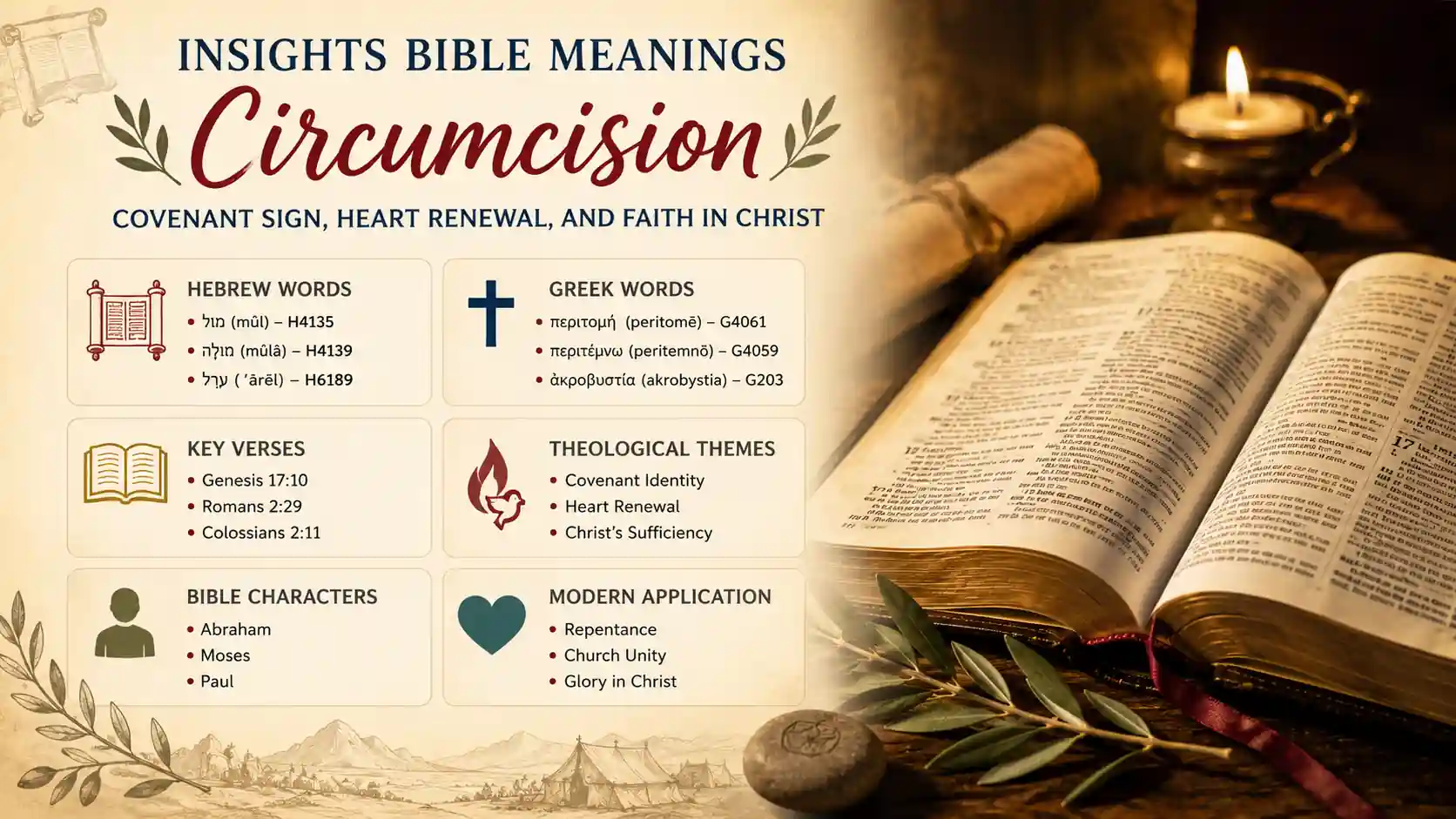
| מוּל | mûl | H4135 | To circumcise or cut short |
| מוּלָה | mûlâ | H4139 | Circumcision |
| עָרֵל | ʿārēl | H6189 | Uncircumcised or obstructed |
| עָרְלָה | ʿorlâ | H6190 | Foreskin or uncircumcision |
| בְּרִית | berit | H1285 | Covenant |
| περιτομή | peritomē | G4061 | Circumcision or the circumcised |
| περιτέμνω | peritemnō | G4059 | To cut around or circumcise |
| ἀκροβυστία | akrobystia | G203 | Foreskin or uncircumcision |
| ἀπερίτμητος | aperitmētos | G564 | Uncircumcised |
| καρδία | kardia | G2588 | Heart or inner person |
The Hebrew verb מוּל, mûl, describes the act of circumcising and carries the basic idea of cutting short. The related noun מוּלָה, mûlâ, appears in the difficult “bridegroom of blood” account involving Moses and Zipporah.
The Greek noun περιτομή, peritomē, can identify the physical rite, Jewish people collectively, or the spiritually renewed people of God. Its opposite, ἀκροβυστία, akrobystia, may describe the physical state of uncircumcision or Gentiles as a group.
Circumcision Related Biblical Concepts
| Concept | Connection | Supporting Verse |
|---|---|---|
| Covenant | Circumcision signs Abrahamic belonging | Genesis 17:11 |
| Faith | Abraham believed before receiving the sign | Romans 4:9-11 |
| Obedience | The sign required covenant faithfulness | Genesis 17:9 |
| Passover | Circumcision preceded participation | Exodus 12:48 |
| Purity | Prophets applied the image inwardly | Jeremiah 4:4 |
| Heart renewal | God removes spiritual resistance | Deuteronomy 30:6 |
| Holy Spirit | True circumcision is inward | Romans 2:29 |
| Baptism | Linked with union in Christ | Colossians 2:11-12 |
| New creation | Physical status cannot save | Galatians 6:15 |
| Unity | Jew and Gentile belong through Christ | Ephesians 2:11-18 |
Circumcision was never intended to function as a magical guarantee of righteousness. Paul explains that Abraham was counted righteous while still uncircumcised, then received circumcision as a sign and seal of the righteousness he already possessed through faith.
Circumcision Historical and Cultural Context
| Aspect | Detail | Biblical Source |
|---|---|---|
| Covenant origin | Commanded to Abraham at ninety-nine | Genesis 17:1-14 |
| Physical procedure | Removal of the male foreskin | Genesis 17:11 |
| Appointed age | Eighth day after birth | Leviticus 12:3 |
| Household scope | Sons, servants, and purchased males | Genesis 17:12-13 |
| Covenant penalty | Uncircumcised male was cut off | Genesis 17:14 |
| Passover access | Circumcised males could participate | Exodus 12:43-49 |
| Wilderness interruption | Generation remained uncircumcised | Joshua 5:5-7 |
| Gilgal renewal | Joshua circumcised the new generation | Joshua 5:2-9 |
| Jewish identity | Distinguished Jews from Gentiles | Ephesians 2:11 |
| Early church dispute | Gentile requirement debated | Acts 15:1-29 |
Circumcision existed among some ancient peoples, but Genesis gives Israel’s practice a distinct covenant meaning. It was not merely a health custom, tribal initiation, or mark of adulthood. In Abraham’s household, infants received it before they could demonstrate personal merit.
The eighth-day command became part of Israel’s law and communal life. An uncircumcised foreigner could not eat the Passover unless he entered the covenant community through circumcision, after which the same Passover ordinance applied to him.
Circumcision Theological Themes
| Theme | Explanation | Scripture |
|---|---|---|
| Divine promise | The sign rests on God’s covenant pledge | Genesis 17:7 |
| Covenant identity | The fleshly mark identified God’s people | Genesis 17:11 |
| Faith before ritual | Abraham was justified before circumcision | Romans 4:10 |
| Outward and inward | Physical status cannot replace obedience | Romans 2:28-29 |
| Human stubbornness | The uncircumcised heart resists God | Deuteronomy 10:16 |
| Divine transformation | God circumcises hearts to produce love | Deuteronomy 30:6 |
| Christ’s sufficiency | Believers are complete in Christ | Colossians 2:10-11 |
| Spirit-led worship | God’s people glory in Christ | Philippians 3:3 |
| Gentile inclusion | Circumcision is not required for salvation | Acts 15:19 |
| New creation | What counts is God’s renewing work | Galatians 6:15 |
Genesis calls circumcision a “sign” of the covenant rather than the source of the covenant promise. God had already called Abraham, promised descendants, and credited his faith as righteousness before giving him the physical mark.
This order becomes central to Paul’s argument in Romans 4. Abraham can be the father of believing Jews and believing Gentiles because justification rests on faith, not on receiving a bodily rite.
Circumcision Modern Application for Believers
| Area | Practice | Scripture |
|---|---|---|
| Personal faith | Trust Christ rather than religious status | Philippians 3:3 |
| Repentance | Remove cherished patterns of sin | Jeremiah 4:4 |
| Inner life | Ask God to soften your heart | Deuteronomy 30:6 |
| Worship | Glory in Christ, not human achievement | Philippians 3:3 |
| Church unity | Welcome believers across ethnic lines | Galatians 3:28 |
| Spiritual identity | Remember your union with Christ | Colossians 2:11 |
| Humility | Refuse confidence in external credentials | Philippians 3:4-9 |
| Obedience | Let inward faith produce faithful living | Romans 2:29 |
| Discernment | Reject additions to the gospel | Galatians 5:2-6 |
| Community | Avoid judging by ceremonial distinctions | 1 Corinthians 7:19 |
For your Christian life, circumcision teaches that outward religious credentials cannot create a faithful heart. Baptism, church membership, family heritage, theological knowledge, and ministry activity are precious in their proper places, but none can replace repentance and faith.
You should also resist treating cultural similarity as proof of spiritual maturity. The gospel joins Jewish and Gentile believers, and people from every background, through their shared union with Christ rather than through one ethnic or ceremonial identity.
What Does Circumcision Mean in the Bible’S Abrahamic Covenant?
In Genesis 17, circumcision is the physical sign of the covenant God established with Abraham. God promised to be Abraham’s God, to bless his descendants, to give them the land of Canaan, and to bring nations and kings from his family line.
The sign was placed on the male reproductive organ, connecting it visibly with the promised offspring. Yet the promise depended on God’s faithfulness, not human strength. Abraham and Sarah could not produce the promised son by natural ability alone, so the mark accompanied a promise fulfilled by divine power.
Circumcision also separated Abraham’s household as a covenant community. Everyone under his authority was included, whether naturally born into the family or brought into the household from outside. The command therefore concerned communal allegiance as well as individual identity.
The severe warning in Genesis 17:14 shows that rejecting the sign amounted to rejecting God’s covenant order. To be “cut off” from the people corresponded soberly to refusing the covenantal cutting commanded by God.
מוּל MûL and the Circumcision of the Heart
The physical action described by מוּל, mûl, becomes a powerful metaphor in Deuteronomy. Moses tells Israel to circumcise the foreskin of the heart and cease being stubborn. The problem was not the body but an inward resistance that prevented loving obedience.
Deuteronomy 30:6 adds a vital dimension. Israel is commanded to turn, yet God promises that he himself will circumcise their hearts so they will love him fully. Genuine covenant faithfulness requires both human repentance and divine transforming grace.
Jeremiah develops the same image when Judah possesses the physical sign but lives in idolatry and injustice. His call to “circumcise yourselves to the Lord” exposes the danger of trusting an external covenant marker while withholding the heart from the covenant Lord.
Other prophets speak of uncircumcised hearts, ears, and lips. In each case, “uncircumcised” describes an obstruction that makes a person resistant, unreceptive, or unfit for holy service. Spiritual circumcision means that God removes what hinders faithful response.
Περιτομή Peritomē in Romans, Galatians, and Philippians
Paul does not condemn circumcision as though God’s Old Testament command had been evil. He circumcised Timothy because of Timothy’s Jewish background and the practical needs of ministry. Yet Paul refused to circumcise the Greek believer Titus when others demanded it as a condition of full Christian acceptance.
That distinction explains Paul’s strong language in Galatians. Receiving circumcision for cultural or family reasons was not the central issue. Depending on it for justification placed a person under obligation to keep the whole law and denied the sufficiency of Christ.
Romans 2:28-29 declares that the truest covenant identity cannot be reduced to what is outward in the flesh. True circumcision is a matter of the heart, accomplished by the Spirit, and praised by God rather than merely recognized by people.
Philippians 3:3 applies the title “the circumcision” to those who worship by God’s Spirit, glory in Christ Jesus, and place no confidence in the flesh. Paul’s own circumcision and distinguished ancestry could not provide the righteousness that comes through faith in Christ.
Christ’S Circumcision Made without Hands
Colossians 2:11 says believers have received a circumcision “made without hands.” Paul describes no physical Christian ceremony. He speaks of a decisive spiritual removal associated with Christ’s death, burial, and resurrection.
The phrase “the circumcision of Christ” has been interpreted as Christ performing spiritual circumcision, believers participating in Christ’s death, or the sinful nature being stripped away through union with him. Each reading centers salvation on Christ rather than human ritual.
Paul then joins circumcision imagery with baptism. This does not make the two words identical, nor does it reduce either to empty symbolism. His emphasis is that believers have been buried and raised with Christ through faith in God’s powerful working.
Your confidence, then, rests in what Christ has accomplished. Physical ancestry, ceremonial performance, and respectable religious credentials cannot cleanse the conscience. God gives new life, forgives trespasses, and forms a people whose defining mark is union with his Son.
Circumcision Questions Bible Students Ask
Why did God choose circumcision as the sign of the Abrahamic covenant?
It visibly marked Abraham’s household and connected the covenant sign with God’s promise of offspring.
What does the Hebrew command מוּל, mûl, mean?
It means to circumcise or cut short and is numbered H4135 in Strong’s Concordance.
Why does Deuteronomy command circumcision of the heart if God later promises to perform it?
The two texts hold together Israel’s duty to repent and God’s gracious power to create wholehearted love.
Does Romans 2:29 teach that the church simply replaces ethnic Israel?
The verse emphasizes inward, Spirit-produced faithfulness without by itself resolving every question about Israel’s continuing place in God’s purposes.
Does Colossians 2:11 make physical circumcision necessary for Christians?
No, Paul describes a circumcision made without hands that believers receive through union with Christ.