
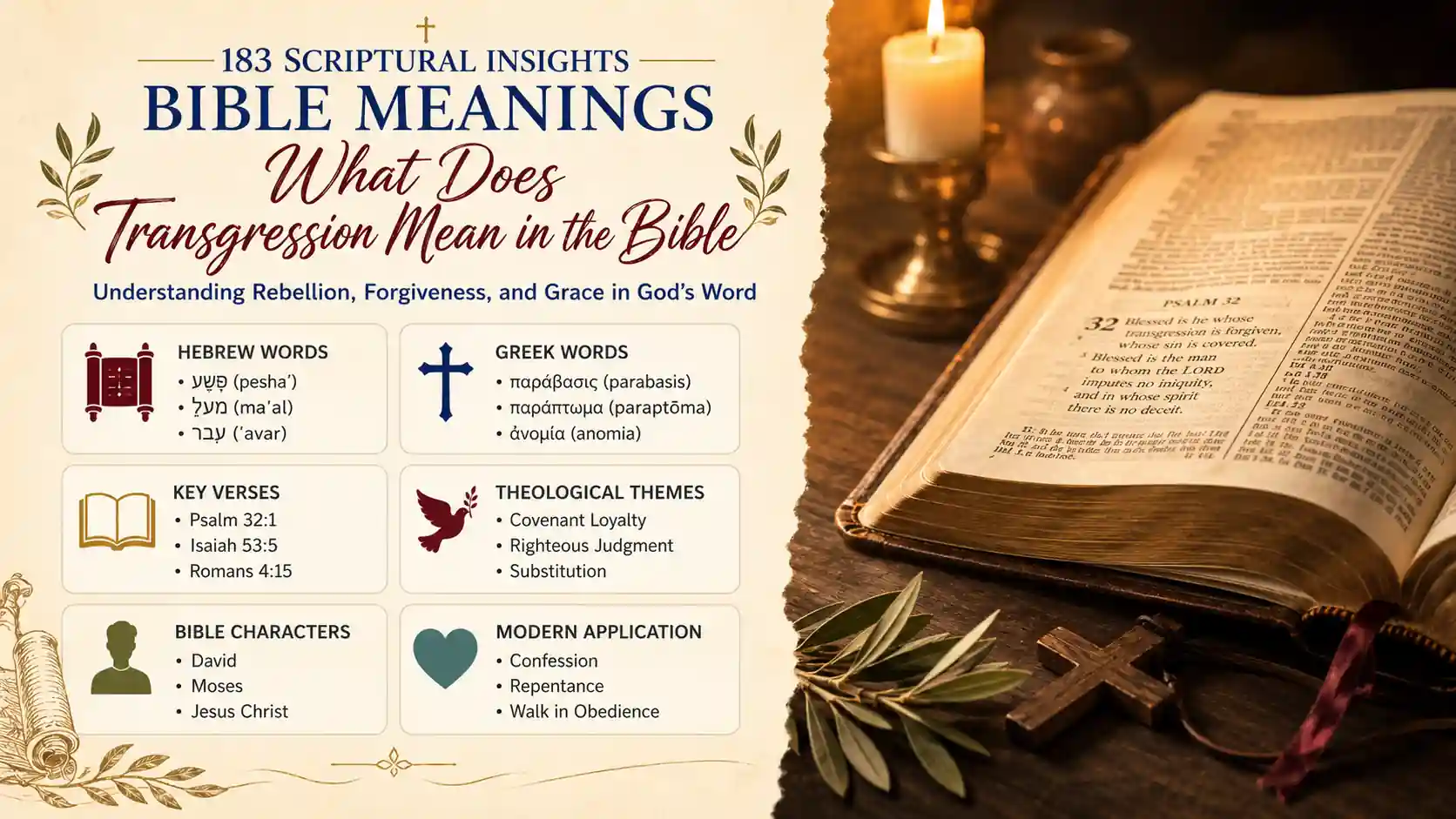
What does transgression mean in the Bible? Scripture presents transgression as more than an accidental mistake. It is the crossing of a known boundary, the violation of God’s command, and often an act of rebellion against a covenant relationship. The biblical words translated “transgression” can describe revolt, trespass, lawlessness, or stepping beyond an established limit.
As you study these terms, you see both the seriousness of human guilt and the greatness of divine mercy. God exposes transgression truthfully, yet He also provides forgiveness, cleansing, and restoration for those who repent and trust Him.
Key Transgression Scripture References
| Verse | Passage Snippet | Context |
|---|---|---|
| Exodus 34:7 | “Forgiving iniquity and transgression” | God reveals His merciful character to Moses |
| Psalm 32:1 | “Whose transgression is forgiven” | David celebrates the blessing of pardon |
| Psalm 51:1 | “Blot out my transgressions” | David repents after his sin with Bathsheba |
| Isaiah 53:5 | “Wounded for our transgressions” | The Servant suffers for the guilt of others |
| Isaiah 59:12 | “Our transgressions are multiplied” | Israel confesses national covenant unfaithfulness |
| Daniel 9:24 | “To finish the transgression” | Gabriel describes God’s redemptive purpose |
| Romans 4:15 | “Where there is no law” | Paul connects transgression with revealed law |
| Galatians 3:19 | “Added because of transgressions” | The law exposes sin until Christ comes |
| Hebrews 2:2 | “Every transgression and disobedience” | Neglecting God’s message brings just judgment |
Transgression Bible Translation Comparison
| Verse | KJV | NIV | ESV | NASB |
|---|---|---|---|---|
| Psalm 32:1 | transgression | transgressions | transgression | wrongdoing |
| Psalm 51:1 | transgressions | transgressions | transgressions | wrongdoings |
| Isaiah 53:5 | transgressions | transgressions | transgressions | offenses |
| Isaiah 59:12 | transgressions | offenses | transgressions | wrongdoings |
| Daniel 9:24 | transgression | rebellion | transgression | wrongdoing |
| Romans 4:15 | transgression | transgression | transgression | violation |
| Romans 5:14 | transgression | sin | transgression | offense |
| Galatians 3:19 | transgressions | transgressions | transgressions | violations |
| Hebrews 2:2 | transgression | violation | transgression | violation |
People and Characters Associated with Transgression
| Person | Role | Connection |
|---|---|---|
| Adam | First man | His trespass brought sin and death into human experience |
| Moses | Covenant mediator | Israel transgressed the law delivered through him |
| Saul | First king of Israel | He rebelled against God’s command concerning Amalek |
| David | King and psalmist | He confessed serious personal transgressions |
| Bathsheba | Wife of Uriah | David’s sin involving her prompted Psalm 51 |
| Israel | Covenant nation | The prophets repeatedly charged Israel with rebellion |
| Isaiah | Prophet | He announced judgment and atonement for transgression |
| Daniel | Exiled prophet | He confessed Israel’s covenant violations |
| Jesus Christ | Suffering Servant | He was pierced for the transgressions of others |
Original Hebrew and Greek Words for Transgression
| Original Word | Transliteration | Strong’s # | Literal Meaning |
|---|---|---|---|
| פֶּשַׁע | peshaʿ | H6588 | Rebellion, revolt, transgression |
| פָּשַׁע | pashaʿ | H6586 | To rebel, revolt, break away |
| מַעַל | maʿal | H4604 | Unfaithful or treacherous act |
| מָעַל | maʿal | H4603 | To act faithlessly or trespass |
| עָבַר | ʿavar | H5674 | To cross over or pass beyond |
| παράβασις | parabasis | G3847 | A stepping across, violation |
| παραβαίνω | parabainō | G3845 | To go aside or transgress |
| παράπτωμα | paraptōma | G3900 | Trespass, false step, offense |
| ἀνομία | anomia | G458 | Lawlessness, disregard for law |
Related Biblical Concepts of Transgression
| Concept | Connection | Supporting Verse |
|---|---|---|
| Sin | The broad condition and practice of missing God’s standard | Romans 3:23 |
| Iniquity | Guilt involving crookedness or moral distortion | Psalm 32:5 |
| Trespass | A false step or offense against God or another person | Ephesians 2:1 |
| Rebellion | Deliberate resistance to divine authority | 1 Samuel 15:23 |
| Lawlessness | Living in disregard of God’s righteous rule | 1 John 3:4 |
| Covenant breaking | Violating obligations established by God | Hosea 6:7 |
| Guilt | Liability resulting from wrongdoing | Leviticus 5:5 |
| Confession | Truthfully acknowledging transgression before God | Psalm 32:5 |
| Atonement | God’s provision for removing guilt and restoring fellowship | Isaiah 53:5 |
Historical and Cultural Context of Transgression
| Aspect | Detail | Biblical Source |
|---|---|---|
| Ancient treaties | Rebellion against a sovereign violated covenant loyalty | Deuteronomy 28 |
| Mosaic law | Commands established identifiable moral boundaries | Exodus 20 |
| Sacrificial system | Certain offenses required confession and sacrifice | Leviticus 5 |
| Day of Atonement | Israel’s transgressions were symbolically carried away | Leviticus 16:21 |
| Kingship | A king’s disobedience could affect the whole nation | 1 Samuel 15 |
| Prophetic lawsuits | Prophets charged Israel with covenant rebellion | Micah 6:1–8 |
| Exile | Persistent transgression brought covenant judgment | 2 Kings 17:7–23 |
| Penitential prayer | Worshipers confessed individual and national guilt | Daniel 9:4–19 |
| Roman law imagery | Greek terms pictured crossing a defined legal boundary | Romans 4:15 |
Theological Themes within Transgression
| Theme | Explanation | Scripture |
|---|---|---|
| Divine holiness | God’s character defines the boundary humans violate | Leviticus 19:2 |
| Human responsibility | Revealed commands make disobedience accountable | Romans 4:15 |
| Covenant loyalty | Transgression betrays a relationship, not only a rule | Hosea 6:7 |
| Universal guilt | Every person stands in need of grace | Romans 3:23 |
| Righteous judgment | God responds justly to rebellion and disobedience | Hebrews 2:2 |
| Confession | God calls sinners to acknowledge wrongdoing honestly | Psalm 32:5 |
| Substitution | Christ bears judgment for the transgressions of others | Isaiah 53:5 |
| Justification | Christ’s obedience answers Adam’s trespass | Romans 5:18–19 |
| Restoration | Forgiven people are brought back into fellowship | Galatians 6:1 |
Modern Application of Transgression for Believers
| Area | Practice | Scripture |
|---|---|---|
| Self-examination | Ask God to expose willful disobedience | Psalm 139:23–24 |
| Confession | Name your sins honestly before God | 1 John 1:9 |
| Repentance | Turn from rebellion toward obedient faith | Acts 3:19 |
| Relationships | Seek reconciliation when you wrong another person | Matthew 5:23–24 |
| Forgiveness | Extend mercy as God has forgiven you | Ephesians 4:32 |
| Scripture study | Learn the boundaries revealed in God’s Word | Psalm 119:11 |
| Accountability | Restore struggling believers with gentleness | Galatians 6:1 |
| Humility | Refuse to excuse or minimize known wrongdoing | Proverbs 28:13 |
| Faith in Christ | Rest in the One delivered for your trespasses | Romans 4:25 |
פֶּשַׁע Peshaʿ Reveals Transgression as Covenant Rebellion
The Hebrew noun פֶּשַׁע, peshaʿ, does not usually describe a harmless oversight. It frequently points to rebellion against rightful authority. The related verb פָּשַׁע, pashaʿ, can describe subjects revolting against a king, which gives the word its force when Scripture applies it to humanity’s relationship with God.
This background helps you understand why Israel’s transgressions were so serious. God had redeemed the nation, revealed His will, and entered a covenant with His people. Their disobedience was therefore personal and relational. They did not merely break impersonal regulations. They resisted the gracious King who had claimed them as His own.
What Does Transgression Mean in the Bible When Paul Uses παράβασις?
The Greek noun παράβασις, parabasis, pictures stepping across an established boundary. Paul writes that “where there is no law there is no transgression” in Romans 4:15. He is not saying that no sin exists without the Mosaic law. He is distinguishing sin generally from the violation of a specifically revealed command.
Adam illustrates this distinction. Romans 5:14 refers to “the likeness of Adam’s transgression” because Adam crossed a direct boundary given by God. Galatians 3:19 similarly says the law was added because of transgressions. It identified wrongdoing, exposed rebellion, and demonstrated humanity’s need for the promised Messiah.
Isaiah’S Suffering Servant Bears the Weight of Transgression
Isaiah 53 brings the biblical meaning of transgression into the heart of redemption. The Servant is “pierced for our transgressions” and crushed for our iniquities. The verse does not minimize human guilt. It declares that the punishment deserved by rebellious sinners falls upon the innocent Servant.
The New Testament identifies Jesus with this suffering figure. At the cross, Christ does not simply sympathize with people who have crossed God’s boundaries. He bears their guilt and judgment. Your forgiveness rests not on denying the seriousness of transgression, but on trusting the sufficient sacrifice God has provided.
Confession Turns Hidden Transgression into Forgiven Transgression
Psalm 32 records David’s movement from concealment to confession. While he kept silent, guilt consumed him. When he acknowledged his sin and stopped covering his iniquity, God forgave “the guilt” of his sin. Biblical confession therefore means agreeing with God’s truthful verdict rather than defending yourself.
Psalm 51 gives the same pattern after David’s grievous wrongdoing. He repeatedly calls his sins “transgressions” because he knowingly violated God’s commands. Yet he appeals to God’s steadfast love. In your study and prayer, confession should produce neither careless presumption nor hopeless despair, but humble dependence on divine mercy.
Frequently Asked Questions About Transgression
What is the difference between פֶּשַׁע, peshaʿ, and ordinary sin?
Peshaʿ especially emphasizes rebellion or violated loyalty, while “sin” can describe wrongdoing more broadly.
Why does Romans 4:15 say there is no transgression without law?
Paul means that transgression requires a known boundary, though wrongdoing and guilt existed before the Mosaic law.
Does παράπτωμα, paraptōma, mean the same thing as παράβασις, parabasis?
They overlap, but paraptōma often pictures a false step or trespass, while parabasis stresses crossing a defined command.
How can Isaiah 53:5 say the Servant was wounded for our transgressions?
It teaches substitution, meaning the Servant bears the judgment deserved by guilty people so they may receive peace and healing.
Can a believer still commit transgression after receiving forgiveness?
Yes, but believers are called to confess, repent, seek restoration, and rely on Christ rather than continue in deliberate rebellion.