
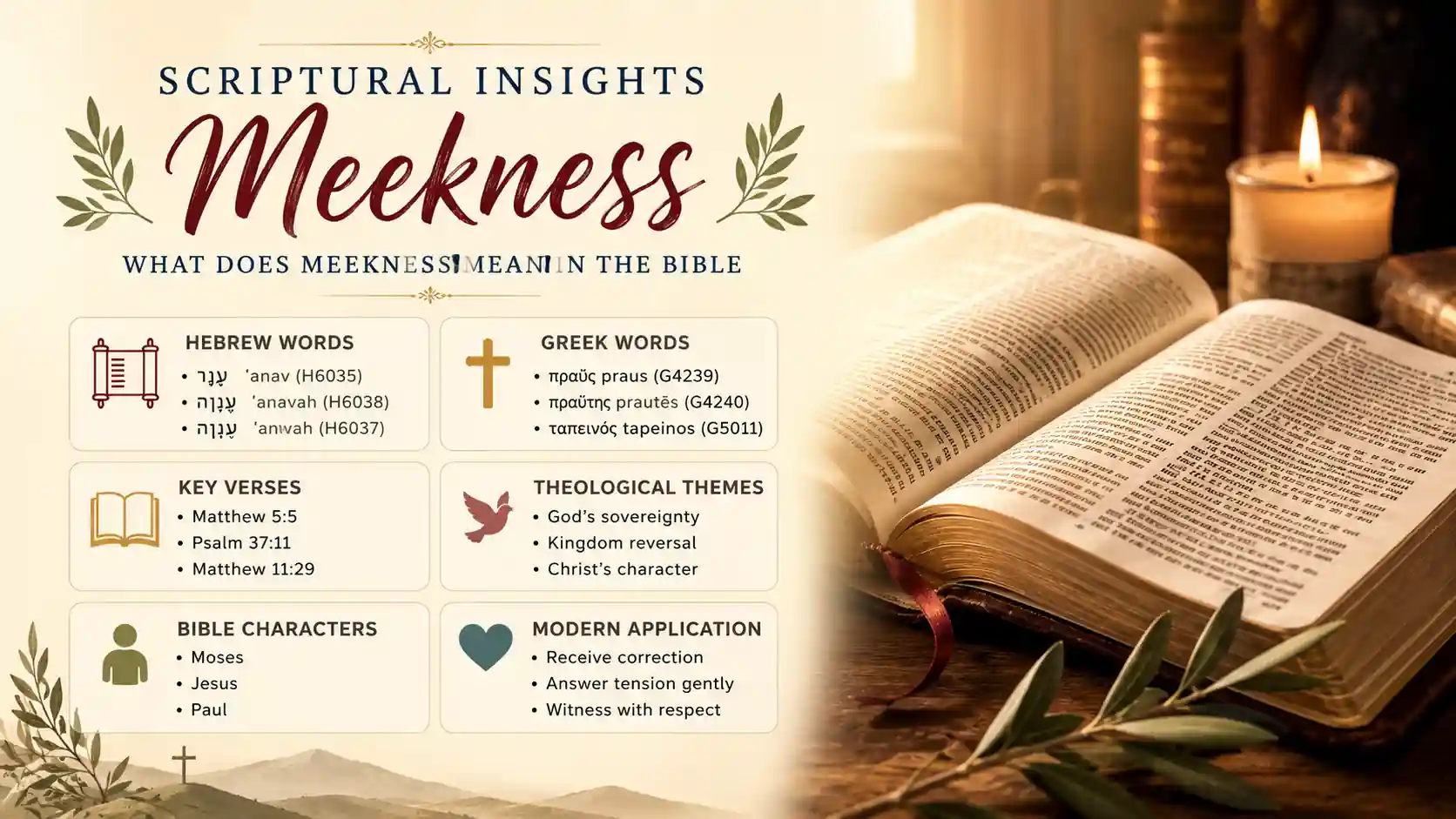
What does meekness mean in the Bible? Scripture presents meekness as a humble, gentle disposition that trusts God, receives his instruction, and refuses to answer injury with sinful self-assertion. Meek people are not powerless. They surrender their power, rights, and responses to God’s rule.
In both Testaments, meekness appears in faithful leaders, suffering worshipers, wise teachers, and supremely in Jesus Christ. As you study this virtue, you discover a strength shaped by submission, patience, teachability, and confident hope in God’s justice.
Meekness in Key Scripture References
| Verse | Passage Snippet | Context |
|---|---|---|
| Numbers 12:3 | Moses was very meek | Moses faces personal criticism |
| Psalm 25:9 | He guides the meek | God teaches humble sinners |
| Psalm 37:11 | The meek inherit the land | The righteous wait for God |
| Psalm 76:9 | God saves the meek | Divine judgment ends oppression |
| Psalm 147:6 | The Lord lifts the meek | God reverses human pride |
| Psalm 149:4 | He beautifies the meek | God delights in his people |
| Matthew 5:5 | Blessed are the meek | Jesus announces kingdom blessing |
| Matthew 11:29 | I am meek and lowly | Jesus invites the burdened |
| Galatians 5:23 | Meekness is spiritual fruit | The Spirit transforms character |
| James 1:21 | Receive the word with meekness | Believers submit to Scripture |
Meekness in Bible Translation Comparison
| Verse | KJV | NIV | ESV | NASB |
|---|---|---|---|---|
| Numbers 12:3 | very meek | very humble | very meek | very humble |
| Psalm 25:9 | meek in judgment | humble in what is right | humble in what is right | humble in justice |
| Psalm 37:11 | meek inherit the earth | meek inherit the land | meek inherit the land | humble inherit the land |
| Zephaniah 2:3 | seek meekness | seek humility | seek humility | seek humility |
| Matthew 5:5 | blessed are the meek | blessed are the meek | blessed are the meek | blessed are the gentle |
| Matthew 11:29 | meek and lowly | gentle and humble | gentle and lowly | gentle and humble |
| Galatians 5:23 | meekness | gentleness | gentleness | gentleness |
| Ephesians 4:2 | meekness | gentleness | gentleness | gentleness |
| 2 Timothy 2:25 | meekness | gently instruct | gentleness | gentleness |
| 1 Peter 3:15 | meekness and fear | gentleness and respect | gentleness and respect | gentleness and reverence |
The comparison shows why modern versions often use “gentle” or “humble.” The older English word “meek” once conveyed mildness, patience, and freedom from harsh self-assertion more clearly than it often does today.
Meekness in People and Biblical Characters
| Person | Role | Connection |
|---|---|---|
| Moses | Covenant mediator | Called exceptionally meek |
| David | King and psalmist | Waited for God’s vindication |
| Jeremiah | Suffering prophet | Endured opposition without abandoning truth |
| Zephaniah | Prophetic preacher | Called Judah to seek meekness |
| Jesus | Messiah and King | Meek and humble in heart |
| Paul | Apostle to the Gentiles | Appealed through Christ’s meekness |
| Timothy | Pastor and teacher | Told to correct opponents gently |
| Peter | Apostle and elder | Required gentle Christian witness |
| James | Wisdom teacher | Joined wisdom with meek conduct |
| Believers | New covenant people | Called to put on meekness |
Moses is the clearest Old Testament example, yet his meekness did not prevent decisive leadership or righteous anger. Jesus is the perfect revelation of meekness because he possessed complete authority while submitting himself fully to the Father’s will.
Meekness in Original Hebrew and Greek Words
| Original Word | Transliteration | Strong’s # | Literal Meaning |
|---|---|---|---|
| עָנָו | ʿanav | H6035 | humble, meek, lowly |
| עֲנָוָה | ʿanavah | H6038 | humility, meekness |
| עַנְוָה | ʿanvah | H6037 | gentleness, mildness |
| עָנִי | ʿani | H6041 | afflicted, poor, humble |
| כָּנַע | kanaʿ | H3665 | bow down, humble oneself |
| שָׁפָל | shaphal | H8217 | low, humble |
| πραΰς | praus | G4239 | gentle, meek, considerate |
| πρᾷος | praos | G4235 | mild, gentle, humble |
| πραΰτης | prautēs | G4240 | meekness, gentleness |
| ταπεινός | tapeinos | G5011 | lowly, humble |
The Hebrew עָנָו, ʿanav, can describe someone lowly, afflicted, or humbly dependent upon God. Its context often joins social vulnerability with spiritual trust. The meek do not seize security through violence or pride. They look to the covenant Lord for teaching, protection, and vindication.
The Greek πραΰς, praus, describes a gentle, humble, considerate disposition. Its related noun πραΰτης, prautēs, names meekness or gentleness as a moral quality. “Strength under control” can be a useful illustration, but the words themselves primarily emphasize gentleness, humility, and freedom from aggressive self-importance.
Meekness and Related Biblical Concepts
| Concept | Connection | Supporting Verse |
|---|---|---|
| Humility | Rejects self-exaltation | Colossians 3:12 |
| Teachability | Receives God’s instruction | Psalm 25:9 |
| Patience | Endures provocation faithfully | Ephesians 4:2 |
| Self-control | Restrains sinful reactions | Galatians 5:23 |
| Wisdom | Produces peaceable conduct | James 3:13 |
| Submission | Accepts God’s authority | James 1:21 |
| Mercy | Treats offenders compassionately | Galatians 6:1 |
| Faith | Waits for divine justice | Psalm 37:7-11 |
| Forgiveness | Releases personal vengeance | Colossians 3:12-13 |
| Hope | Expects God’s promised inheritance | Matthew 5:5 |
Meekness overlaps with humility but is not identical to it. Humility concerns your view of yourself before God, while meekness often becomes visible in your response to pressure, correction, hostility, or responsibility.
It also belongs beside self-control. The meek person does not permit wounded pride, anger, or fear to govern speech and conduct. Such restraint is not merely natural composure. Paul identifies it as fruit produced by the Holy Spirit.
Meekness in Historical and Cultural Context
| Aspect | Detail | Biblical Source |
|---|---|---|
| Ancient leadership | Rulers commonly displayed power publicly | Numbers 12:3 |
| Moses’ setting | His authority was challenged by family | Numbers 12:1-15 |
| Israel’s land hope | The faithful awaited covenant inheritance | Psalm 37:9-11 |
| Royal expectation | Zion’s king arrives humbly | Zechariah 9:9 |
| Donkey symbolism | Peaceful kingship rather than conquest | Matthew 21:5 |
| Honor culture | Public insult invited retaliation | Matthew 5:38-42 |
| Roman power | Empire praised status and domination | Matthew 20:25-28 |
| Early churches | Social tensions threatened unity | Ephesians 4:1-3 |
| Pastoral disputes | Teachers faced resistant opponents | 2 Timothy 2:24-25 |
| Christian witness | Believers faced questioning and hostility | 1 Peter 3:15 |
In the ancient Mediterranean world, honor was frequently defended through public challenge and retaliation. Jesus’ praise of the meek confronted the assumption that forceful self-promotion secures lasting honor. He taught that God, not aggressive human ambition, grants the final inheritance.
Matthew 5:5 also echoes Psalm 37:11. The psalm contrasts violent evildoers with faithful people who wait for the Lord. Jesus places that promise within the kingdom of heaven, affirming that God’s renewed world belongs to those who trust his reign rather than grasping for control.
Meekness in Major Theological Themes
| Theme | Explanation | Scripture |
|---|---|---|
| God’s sovereignty | The meek trust God to judge rightly | Psalm 37:5-11 |
| Kingdom reversal | The lowly receive the inheritance | Matthew 5:5 |
| Christ’s character | Jesus embodies perfect gentleness | Matthew 11:29 |
| Messianic kingship | The King comes without proud display | Zechariah 9:9 |
| Spiritual formation | The Spirit produces gentleness | Galatians 5:22-23 |
| Sanctification | Believers intentionally put it on | Colossians 3:12 |
| Biblical authority | Meek hearts receive God’s word | James 1:21 |
| Church unity | Gentleness preserves fellowship | Ephesians 4:2-3 |
| Restoration | Sinning believers are corrected gently | Galatians 6:1 |
| Christian apologetics | Truth is defended without hostility | 1 Peter 3:15 |
Meekness rests upon confidence in God’s sovereignty. Because God sees wrongdoing and will judge justly, you do not need to treat every insult as a threat to your identity. You may speak truth and pursue justice without becoming vindictive.
The virtue is also Christological. Jesus does not merely command meekness. He declares, “I am gentle and lowly in heart.” His welcome to burdened sinners, submission to the Father, patient suffering, and peaceful kingship reveal what meekness looks like in perfect holiness.
Meekness in Modern Application for Believers
| Area | Practice | Scripture |
|---|---|---|
| Bible study | Receive correction from the text | James 1:21 |
| Prayer | Submit desires to God’s wisdom | Matthew 26:39 |
| Marriage | Answer tension without contempt | Ephesians 4:2 |
| Parenting | Correct without provoking | Colossians 3:21 |
| Church life | Protect unity through patience | Ephesians 4:3 |
| Leadership | Serve rather than dominate | Matthew 20:26 |
| Conflict | Use calm, truthful words | Proverbs 15:1 |
| Restoration | Confront sin with gentleness | Galatians 6:1 |
| Witness | Defend hope respectfully | 1 Peter 3:15 |
| Persecution | Entrust judgment to God | 1 Peter 2:23 |
Practicing meekness does not require silence about evil. Biblical meekness can confront sin, defend the vulnerable, establish boundaries, and exercise authority. Its distinguishing feature is that these actions are governed by obedience and love rather than pride, cruelty, or revenge.
You cultivate meekness by receiving Scripture without defensiveness, confessing your desire for recognition, slowing angry responses, and praying for those who oppose you. You also remember that your standing with God rests in Christ, not in winning every argument.
What Does Meekness Mean in the Bible Through עָנָו?
The Hebrew עָנָו, ʿanav, connects meekness with lowliness and dependence. In many Old Testament settings, the meek are people without earthly advantage who nevertheless trust the Lord. Their security rests in God’s covenant faithfulness rather than wealth, influence, or force.
Psalm 25 says God guides and teaches the meek. This means meekness has an intellectual and spiritual dimension. You cannot be guided while insisting that your judgment is always sufficient. A meek student of Scripture approaches God’s word ready to listen, repent, and obey.
Psalm 37 and the Meek Who Inherit the Land
Psalm 37 addresses the distress caused by prosperous evildoers. The faithful are commanded not to fret, because the apparent success of the wicked will not last. The meek inherit the land because they wait for the Lord instead of adopting the violent methods of their oppressors.
When Jesus repeats this promise in Matthew 5:5, he is not praising passivity. He is identifying the heirs of God’s kingdom. They may appear overlooked in the present age, but they will receive what human ambition can never secure, full participation in God’s righteous reign.
πραΰς And the Meekness of Jesus the Messiah
The Greek adjective πραΰς, praus, appears in Jesus’ description of himself and in Matthew’s presentation of his royal entry. Jesus is meek, yet he teaches with authority, confronts hypocrisy, commands creation, and drives corruption from the temple. His gentleness cannot be reduced to timidity.
His power is always obedient, holy, and directed toward the Father’s purpose. At the cross, he refuses sinful retaliation, not because injustice is insignificant, but because he entrusts himself to the righteous Judge. Christian meekness grows as your conduct is conformed to this crucified King.
πραΰτης As the Spirit’S Fruit in the Church
Paul names πραΰτης, prautēs, among the fruit of the Spirit. Meekness is therefore more than a personality trait. A quiet temperament may avoid confrontation from fear, while a forceful personality may act gently through the Spirit’s transforming work.
This fruit becomes especially visible when relationships are strained. You restore a fallen believer gently, correct opponents without quarrelsomeness, and bear with fellow Christians patiently. Meekness protects truth from harshness and protects love from becoming morally indifferent.
Questions About Biblical Meekness
Does πραΰς mean “strength under control”?
It primarily means gentle, humble, or considerate, while “strength under control” is a helpful illustration when the context includes real authority or power.
Why does Numbers 12:3 call Moses meek when he sometimes became angry?
The verse describes his prevailing humility under personal attack, not sinless emotional perfection or an inability to act firmly.
Why do some translations use “gentleness” instead of “meekness”?
“Gentleness” often communicates the present English sense of πραΰτης more clearly, since “meekness” can now be mistaken for weakness.
Does Matthew 5:5 promise that meek Christians will own earthly property?
Jesus echoes Psalm 37 and promises God’s people a final inheritance in his righteous kingdom, not automatic material prosperity now.
How can you practice meekness without tolerating abuse?
You can establish wise boundaries, seek protection, and speak truth while refusing hatred, prideful retaliation, or personal vengeance.