
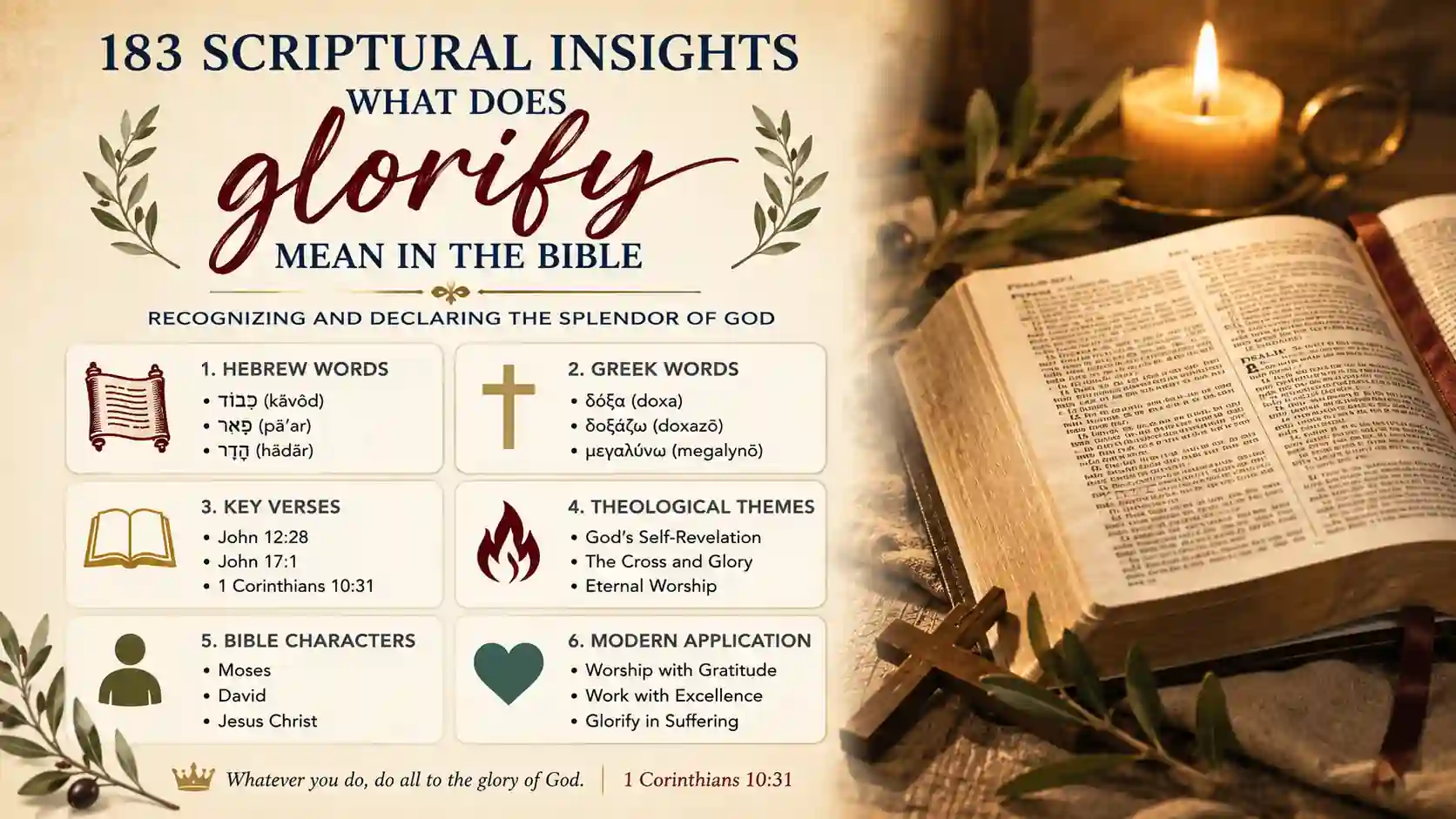
What does glorify mean in the Bible? To glorify means to recognize, declare, display, or reflect the supreme worth of God. Scripture uses the idea for worship offered to God, divine acts that reveal his character, and the honor God gives to Christ and his redeemed people.
The biblical meaning grows from Hebrew words associated with weight, splendor, and honor, together with Greek words describing praise, recognition, and manifested greatness. Your study will show that glorifying God involves more than spoken praise. It shapes your worship, conduct, suffering, service, and hope.
Glorify in Key Scripture References
| Verse | Passage Snippet | Context |
|---|---|---|
| Exodus 14:4 | “I will gain glory” | God defeats Pharaoh and reveals his sovereignty |
| Psalm 22:23 | “Glorify him” | Worshipers are summoned to honor the Lord |
| Psalm 50:15 | “You shall glorify me” | Deliverance produces grateful worship |
| Isaiah 49:3 | “I will be glorified” | God displays splendor through his servant |
| John 12:28 | “Father, glorify your name” | Jesus approaches his sacrificial death |
| John 13:31 | “The Son of Man glorified” | Judas departs and the passion begins |
| John 17:1 | “Glorify your Son” | Jesus prays before his arrest |
| Romans 8:30 | “He also glorified” | Salvation reaches its appointed completion |
| 1 Corinthians 10:31 | “To the glory of God” | Ordinary choices become acts of worship |
| 1 Peter 4:16 | “Glorify God” | Believers honor God while suffering |
Glorify in Bible Translation Comparison
| Verse | KJV | NIV | ESV | NASB |
|---|---|---|---|---|
| Exodus 14:4 | “honoured upon Pharaoh” | “gain glory through Pharaoh” | “get glory over Pharaoh” | “honored through Pharaoh” |
| Psalm 22:23 | “glorify him” | “revere him” | “glorify him” | “glorify Him” |
| Isaiah 49:3 | “I will be glorified” | “display my splendor” | “I might be glorified” | “I will show My glory” |
| Isaiah 60:7 | “glorify the house” | “adorn my glorious temple” | “beautify my beautiful house” | “glorify My glorious house” |
| John 12:28 | “glorify thy name” | “glorify your name” | “glorify your name” | “glorify Your name” |
| John 13:31 | “Son of man glorified” | “Son of Man glorified” | “Son of Man glorified” | “Son of Man glorified” |
| John 17:1 | “glorify thy Son” | “glorify your Son” | “glorify your Son” | “glorify Your Son” |
| Romans 8:30 | “them he also glorified” | “he also glorified” | “he also glorified” | “He also glorified” |
| 1 Corinthians 10:31 | “glory of God” | “glory of God” | “glory of God” | “glory of God” |
People Associated with Glorify in Scripture
| Person | Role | Connection |
|---|---|---|
| Moses | Covenant mediator | Witnessed God gain glory over Pharaoh |
| David | King and psalmist | Called Israel to glorify God in worship |
| Isaiah | Prophet | Foretold God’s glory through the servant |
| Ezekiel | Exilic prophet | Saw the radiant glory of the Lord |
| Mary | Mother of Jesus | Magnified the Lord for his saving mercy |
| Jesus Christ | Son and Messiah | Glorified the Father through obedient sacrifice |
| Lazarus | Restored friend | His illness became an occasion for divine glory |
| Peter | Apostle | Taught believers to glorify God in suffering |
| Paul | Apostle | Applied God’s glory to daily Christian conduct |
| Abraham | Patriarch | Gave glory to God through confident faith |
Glorify in Original Hebrew and Greek Words
| Original Word | Transliteration | Strong’s # | Literal Meaning |
|---|---|---|---|
| כָּבֵד | kāvēd | H3513 | To be heavy, honor, make weighty |
| כָּבוֹד | kāvôd | H3519 | Weight, honor, splendor, glory |
| פָּאַר | pāʾar | H6286 | To beautify, adorn, glorify |
| תִּפְאֶרֶת | tiphʾereth | H8597 | Beauty, magnificence, glory |
| הָדָר | hādār | H1926 | Majesty, splendor, honor |
| δόξα | doxa | G1391 | Glory, honor, splendor, reputation |
| δοξάζω | doxazō | G1392 | To glorify, praise, honor |
| ἐνδοξάζω | endoxazō | G1740 | To glorify in or among |
| μεγαλύνω | megalynō | G3170 | To magnify, declare great |
| τιμάω | timaō | G5091 | To value, honor, esteem |
Glorify and Related Biblical Concepts
| Concept | Connection | Supporting Verse |
|---|---|---|
| Worship | Glorifying God acknowledges his incomparable worth | Psalm 86:12 |
| Praise | Speech publicly celebrates God’s character and works | Psalm 50:23 |
| Holiness | Holy conduct displays God’s transforming power | Matthew 5:16 |
| Faith | Trust gives God honor by affirming his faithfulness | Romans 4:20 |
| Obedience | Christ glorified the Father by completing his work | John 17:4 |
| Thanksgiving | Gratitude directs credit toward the giver | Psalm 69:30 |
| Witness | Fruitful discipleship makes the Father known | John 15:8 |
| Suffering | Faithfulness under trial can honor Christ | 1 Peter 4:14 |
| Resurrection | The Father glorified Jesus after his humiliation | Acts 3:13 |
| Sanctification | Spirit-formed character reflects Christ’s glory | 2 Corinthians 3:18 |
Historical and Cultural Context of Glorify
| Aspect | Detail | Biblical Source |
|---|---|---|
| Ancient honor culture | Public reputation carried social weight | Proverbs 25:27 |
| Hebrew weight imagery | Importance was described as heaviness | 1 Samuel 2:30 |
| Pharaoh’s defeat | God’s judgment exposed Egypt’s powerless gods | Exodus 14:4 |
| Tabernacle presence | Divine glory filled Israel’s sanctuary | Exodus 40:34 |
| Temple dedication | Glory signified God’s covenant presence | 1 Kings 8:11 |
| Prophetic visions | Radiance communicated divine kingship | Ezekiel 1:28 |
| Roman imperial claims | Emperors received public honor and praise | Acts 12:22–23 |
| Crucifixion shame | John presents the cross as Christ’s glorification | John 12:23 |
| Resurrection proclamation | Apostles preached that God glorified Jesus | Acts 3:13 |
| Early Christian suffering | Martyr-like endurance honored God publicly | 1 Peter 4:16 |
Glorify in Major Theological Themes
| Theme | Explanation | Scripture |
|---|---|---|
| God’s self-revelation | God displays who he is through words and deeds | Exodus 33:18–19 |
| Divine supremacy | All rival powers are shown to be subordinate | Exodus 14:17–18 |
| Christ’s deity | Father and Son share divine glory | John 17:5 |
| The cross | Jesus reveals divine love through self-giving death | John 12:23–28 |
| Resurrection | The rejected Messiah is vindicated and exalted | 1 Peter 1:21 |
| Salvation | Redeemed people become evidence of divine grace | Ephesians 1:6 |
| Union with Christ | Believers share the Son’s promised glory | Romans 8:17 |
| Sanctification | The Spirit transforms believers into Christ’s image | 2 Corinthians 3:18 |
| Final judgment | Christ is glorified when he returns | 2 Thessalonians 1:10 |
| Eternal worship | Creation gives glory to God and the Lamb | Revelation 5:13 |
Glorify in Modern Application for Believers
| Area | Practice | Scripture |
|---|---|---|
| Worship | Praise God for his character, not only his gifts | Psalm 86:12 |
| Work | Serve honestly and wholeheartedly before God | Colossians 3:23 |
| Speech | Speak in ways that display grace and truth | Colossians 4:6 |
| Body | Honor God through morally faithful choices | 1 Corinthians 6:20 |
| Food and drink | Make ordinary decisions with God’s honor in view | 1 Corinthians 10:31 |
| Generosity | Give so that thanksgiving rises to God | 2 Corinthians 9:12–13 |
| Relationships | Receive fellow believers as Christ received you | Romans 15:7 |
| Suffering | Remain faithful without shame for Christ’s name | 1 Peter 4:16 |
| Service | Depend on God’s strength rather than self-display | 1 Peter 4:11 |
| Witness | Let good works point observers toward the Father | Matthew 5:16 |
כָּבוֹד And the Weight of God’S Worth
The Hebrew noun כָּבוֹד, kāvôd, comes from a word family associated with weight or heaviness. When applied to God, it does not suggest physical weight. It communicates overwhelming significance, dignity, splendor, and worth. God’s glory is the impressive reality of who he is made perceptible to his creatures.
This background explains why glorifying God is not the act of adding greatness to him. You cannot make the eternal God more majestic than he already is. You glorify him by treating his name as weighty, confessing his greatness, and ordering your life around his supreme value.
פָּאַר And God’S Displayed Beauty
The Hebrew verb פָּאַר, pāʾar, often carries the sense of beautifying, adorning, or glorifying. In Isaiah, God promises to glorify the place of his sanctuary and to display his splendor through his servant. The term emphasizes glory that becomes visible rather than honor that remains merely inward.
This helps you recognize the outward dimension of biblical glorification. God glorifies his name when his justice, mercy, holiness, and faithfulness become evident in history. Your life glorifies him when obedience makes the beauty of his character visible to other people.
What Does Glorify Mean in the Bible’S Gospel of John?
John uses δοξάζω, doxazō, in a striking way. Jesus’ glorification includes his crucifixion, resurrection, and return to the Father. The cross looked shameful by ordinary standards, yet Jesus called it his hour of glory because it revealed his obedience, divine love, and victory over evil.
In John 17, the Father glorifies the Son, and the Son glorifies the Father. This mutual glorification reveals their shared divine honor without erasing their personal distinction. Jesus also says his disciples glorify him when their faith and mission display the truth of who he is.
From Present Worship to Future Glorification
Romans 8:30 speaks of believers as already glorified, although their bodily transformation remains future. Paul uses the past tense to express the certainty of God’s saving purpose. Those whom God justifies will finally be conformed to Christ and share in resurrection life.
This promised glory never makes human beings independent rivals of God. Redeemed people shine with received glory, much as creation reflects light it did not produce. Your future glorification will display the success of divine grace and lead to deeper worship, not self-exaltation.
Questions About What Glorify Means in the Bible
Does כָּבוֹד, kāvôd, always mean visible brightness?
No. It can describe honor, reputation, abundance, majesty, or the perceptible splendor of God’s presence.
Why does John describe Jesus’ crucifixion as glorification?
The cross reveals the Son’s obedience, the Father’s love, and God’s victory through what appeared to be defeat.
Is δοξάζω, doxazō, different from simply praising God?
Yes. It includes praise but can also mean honoring, revealing, displaying, or acknowledging someone’s true greatness.
How can Romans 8:30 say believers are already glorified?
Paul describes the future completion of salvation as certain because it rests on God’s unbreakable purpose.
Can ordinary activities truly glorify God according to 1 Corinthians 10:31?
Yes. Everyday choices glorify God when they arise from faith, love, gratitude, and concern for the good of others.