
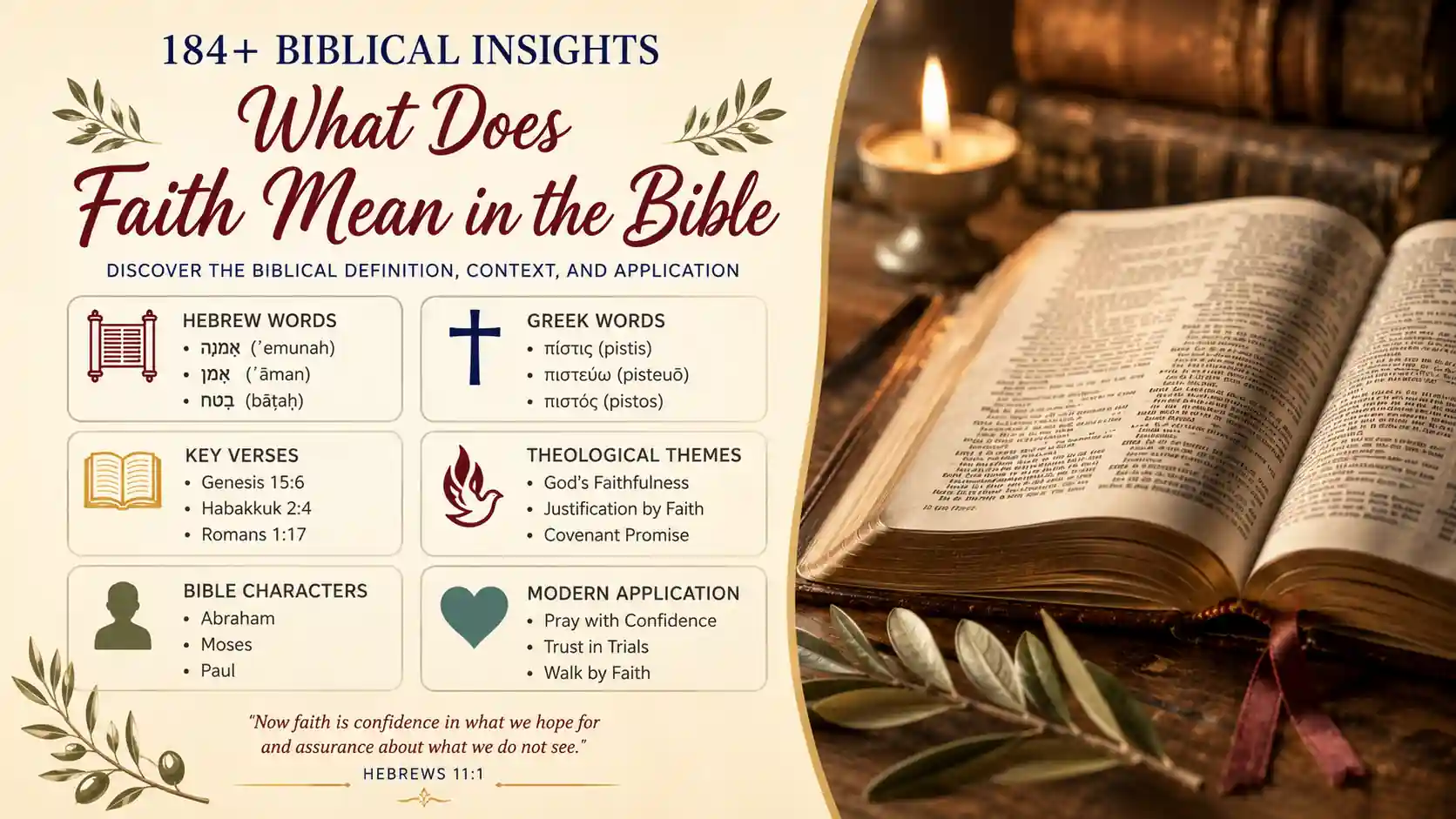
If you have ever wondered what does faith mean in the Bible, you are asking one of Scripture’s most foundational questions. Faith is not merely positive thinking or religious optimism. Throughout the Old and New Testaments, faith describes a trusting response to God’s character, promises, and saving work. It shapes the lives of ordinary believers and remarkable biblical figures alike.
Your study becomes richer when you examine the original Hebrew and Greek words, the historical setting, and the unfolding story of redemption. Scripture presents faith as confident reliance upon the Lord that produces obedience, perseverance, and hope even when circumstances remain uncertain.
Key Scripture References About Faith
| Verse | Passage Snippet | Context |
|---|---|---|
| Genesis 15:6 | Abraham believed the LORD | God’s covenant promise to Abraham |
| Deuteronomy 32:20 | Children with no faithfulness | Israel’s covenant unfaithfulness |
| Psalm 37:3 | Trust in the LORD | Wisdom for righteous living |
| Habakkuk 2:4 | The righteous shall live by his faith | Faith during national crisis |
| Mark 9:24 | I believe, help my unbelief | A father’s honest prayer |
| John 20:29 | Blessed are those who have not seen | Jesus after the resurrection |
| Romans 1:17 | The righteous shall live by faith | Gospel theme introduced |
| Galatians 2:20 | Live by faith in the Son of God | Union with Christ |
| Hebrews 11:1 | Faith is confidence | Definition with examples |
| James 2:17 | Faith without works is dead | Genuine faith demonstrated |
Bible Translation Comparison for Faith
| Verse | KJV | NIV | ESV | NASB |
|---|---|---|---|---|
| Genesis 15:6 | believed | believed | believed | believed |
| Habakkuk 2:4 | faith | faithfulness | faith | faith |
| Romans 1:17 | live by faith | live by faith | live by faith | live by faith |
| Hebrews 11:1 | substance | confidence | assurance | certainty |
| James 2:17 | faith without works | faith by itself | faith by itself | faith by itself |
| Mark 11:22 | have faith in God | have faith in God | have faith in God | have faith in God |
| Ephesians 2:8 | through faith | through faith | through faith | through faith |
| Galatians 2:16 | faith of Jesus Christ | faith in Jesus Christ | faith in Jesus Christ | faith in Christ Jesus |
| 2 Corinthians 5:7 | walk by faith | live by faith | walk by faith | walk by faith |
People and Characters Associated with Faith
| Person | Role | Connection |
|---|---|---|
| Abraham | Patriarch | Model of believing God’s promise |
| Sarah | Matriarch | Trusted God’s promise despite age |
| Moses | Deliverer | Chose obedience through faith |
| Rahab | Resident of Jericho | Trusted Israel’s God |
| David | King | Relied on God in conflict |
| Habakkuk | Prophet | Declared life by faith |
| Peter | Apostle | Learned faith through testing |
| Thomas | Apostle | Moved from doubt to belief |
| Paul | Apostle | Taught justification by faith |
| Jesus | Messiah | Perfect object and example of faithfulness |
Original Hebrew and Greek Words Behind Faith
| Original Word | Transliteration | Strong’s # | Literal Meaning |
|---|---|---|---|
| אֱמוּנָה | ʾemunah | H530 | Faithfulness, steadfastness |
| אָמַן | ʾāman | H539 | To support, confirm, believe |
| בָּטַח | bāṭaḥ | H982 | Trust, rely securely |
| חָסָה | ḥāsāh | H2620 | Seek refuge |
| πίστις | pistis | G4102 | Faith, trust, conviction |
| πιστεύω | pisteuō | G4100 | Believe, entrust oneself |
| πιστός | pistos | G4103 | Faithful, trustworthy |
| ὀλιγόπιστος | oligopistos | G3640 | One of little faith |
Related Biblical Concepts Connected to Faith
| Concept | Connection | Supporting Verse |
|---|---|---|
| Grace | Salvation received through faith | Ephesians 2:8 |
| Justification | Declared righteous by faith | Romans 5:1 |
| Hope | Faith produces confident hope | Hebrews 11:1 |
| Obedience | Genuine faith responds to God | James 2:22 |
| Covenant | Faith trusts God’s promises | Genesis 15:6 |
| Perseverance | Faith endures suffering | James 1:3 |
| Salvation | Faith receives Christ | John 3:16 |
| Righteousness | Credited through faith | Romans 4:3 |
| Assurance | Confidence in God’s word | Hebrews 10:22 |
Historical and Cultural Context of Faith
| Aspect | Detail | Biblical Source |
|---|---|---|
| Abrahamic Covenant | Promise before the Law | Genesis 15 |
| Sinai Covenant | Israel called to faithful obedience | Exodus 19 |
| Exile | Faith sustained God’s people | Habakkuk 2 |
| Second Temple Judaism | Expectation of Messiah | Luke 2 |
| Roman World | Churches faced persecution | 1 Peter 1 |
| Greco Roman Society | Loyalty language shaped understanding | Philippians 1 |
| Early Church | Faith united Jews and Gentiles | Acts 15 |
| House Churches | Faith practiced in community | Romans 16 |
| Hebrews Audience | Encouraged to endure | Hebrews 10 |
Theological Themes of Faith
| Theme | Explanation | Scripture |
|---|---|---|
| God’s Faithfulness | God remains trustworthy | Deuteronomy 7:9 |
| Justification | Faith receives God’s verdict | Romans 3:28 |
| Covenant Promise | Faith embraces God’s word | Genesis 15:6 |
| Christ’s Lordship | Faith centers on Jesus | Romans 10:9 |
| Endurance | Faith remains steadfast | Hebrews 12:2 |
| New Birth | Believers receive life through faith | John 1:12 |
| Sanctification | Faith shapes daily living | Galatians 2:20 |
| Future Hope | Faith anticipates God’s kingdom | Hebrews 11:13 |
| Worship | Faith honors God | Hebrews 11:6 |
Modern Application for Believers
| Area | Practice | Scripture |
|---|---|---|
| Prayer | Pray with confidence | Mark 11:24 |
| Trials | Trust God’s purposes | James 1:3 |
| Decision Making | Seek God’s wisdom | Proverbs 3:5 |
| Evangelism | Share the gospel faithfully | Romans 1:16 |
| Worship | Draw near confidently | Hebrews 10:22 |
| Giving | Trust God’s provision | 2 Corinthians 9:8 |
| Relationships | Forgive as Christ forgave | Ephesians 4:32 |
| Daily Living | Walk by faith | 2 Corinthians 5:7 |
| Hope | Wait confidently for Christ | Titus 2:13 |
The Meaning of ʾEmunah and Pistis Reveals What Does Faith Mean in the Bible
The Bible presents faith as much more than intellectual agreement. The Hebrew word אֱמוּנָה (ʾemunah) often emphasizes steadfastness, reliability, and faithfulness. It describes both God’s unwavering character and the faithful response He desires from His people. Closely related is אָמַן (ʾāman), the verb that carries the idea of being firm, established, or believing because something is trustworthy.
In the New Testament, the primary Greek word is πίστις (pistis). It includes trust, confidence, loyalty, and conviction. The related verb πιστεύω (pisteuō) means to believe or entrust yourself to someone. Biblical faith is not simply accepting facts about God. It is placing your whole confidence in Him and responding with obedience because He is worthy of trust.
Faith in the Covenants from Abraham to Christ
Abraham provides Scripture’s defining picture of faith. Genesis 15:6 says he believed the Lord, and that belief was counted to him as righteousness. God’s promise came before the giving of the Mosaic Law, showing that a relationship with God begins with trusting His promise rather than earning His favor through human effort.
The New Testament repeatedly returns to Abraham because his experience points forward to Jesus Christ. Paul explains in Romans and Galatians that believers are justified by faith just as Abraham was. The gospel fulfills God’s covenant promises, inviting people from every nation to become children of Abraham through faith in Christ.
Faith Produces Obedience Rather than Replacing It
One of the Bible’s richest themes is the relationship between faith and works. Paul teaches that salvation comes by grace through faith, not by human achievement. James teaches that genuine faith naturally produces visible obedience. These teachings complement each other rather than compete.
Hebrews 11 illustrates this pattern repeatedly. Noah built the ark by faith. Abraham left his homeland by faith. Moses chose suffering with God’s people by faith. Rahab welcomed the spies by faith. In every case, inward trust expressed itself through outward action. Their deeds did not create faith. Their actions revealed that faith was alive.
Jesus also connected faith with discipleship. He invited people not only to believe His words but also to follow Him. The Gospels record moments of great faith alongside examples of little faith, showing that spiritual growth involves learning to trust Christ more deeply through life’s joys and trials.
Living by Faith in Every Season of Life
Habakkuk declared that “the righteous shall live by his faith” during a period of violence and uncertainty. That statement became one of the Bible’s most influential theological declarations. Paul quoted it in Romans and Galatians, while the author of Hebrews used it to encourage perseverance under pressure.
Living by faith means relying on God’s promises even when you cannot see the final outcome. Hebrews 11:1 describes faith as confidence in what is hoped for and conviction regarding what is unseen. Biblical faith does not ignore reality. Instead, it interprets present circumstances through the greater reality of God’s character and His promises.
Faith also grows through hearing God’s Word. Romans 10:17 teaches that faith comes through hearing the message concerning Christ. As you read Scripture, pray, worship, and remember God’s faithfulness, your trust matures. The Holy Spirit strengthens believers to remain faithful until Christ returns, enabling them to endure hardship with hope and joy.
Frequently Asked Questions
What is the difference between ʾemunah (אֱמוּנָה) and pistis (πίστις)?
ʾEmunah emphasizes steadfast faithfulness, while pistis highlights trust, confidence, and faithful reliance, though both describe wholehearted dependence on God.
Why does Habakkuk 2:4 sometimes read “faith” and other times “faithfulness”?
The Hebrew word ʾemunah can express both faith and faithfulness, so translations reflect different aspects of its meaning while preserving the verse’s central message.
Does James 2 contradict Paul’s teaching about justification by faith?
No, Paul explains how a person is justified before God by faith, while James explains that genuine faith is demonstrated through obedient works.
Why is Abraham the primary biblical example of faith?
Abraham trusted God’s promise before receiving its fulfillment, making him the foundational example of righteousness through faith in both Testaments.
How can you strengthen your pistis according to the New Testament?
Faith grows as you hear God’s Word, trust Christ’s promises, obey His commands, and persevere through trials with the Spirit’s help.