
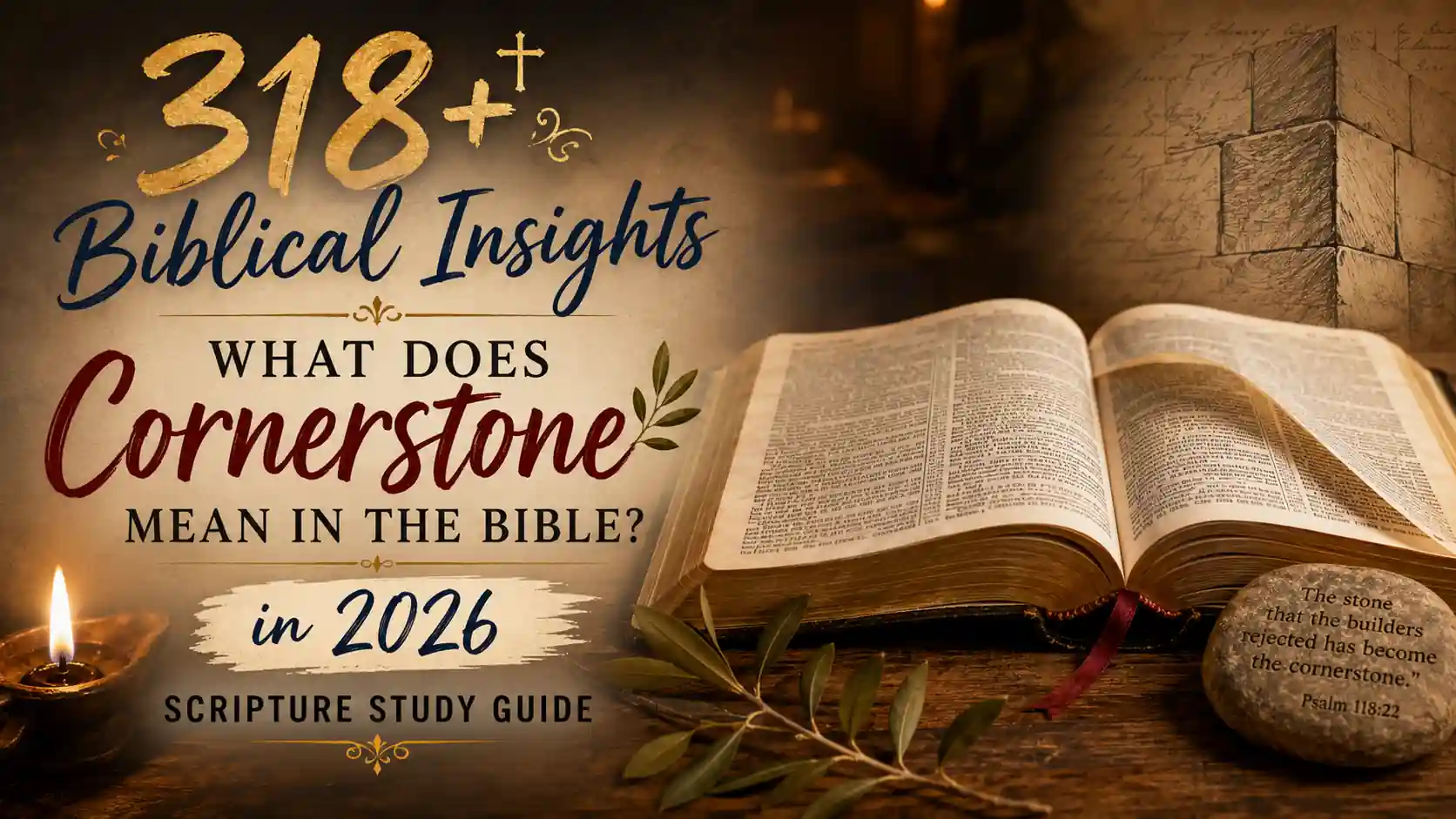
What does cornerstone mean in the Bible? A cornerstone is a foundational stone that establishes a building’s position, alignment, and stability. Scripture develops this architectural image into a rich revelation of Jesus Christ as God’s chosen foundation, the rejected stone, and the head of a new spiritual people.
As you trace this theme from Psalms and Isaiah into the Gospels, Acts, Ephesians, and 1 Peter, you see that the cornerstone identifies Christ as trustworthy, authoritative, saving, and essential to the unity of God’s people.
Cornerstone Key Scripture References
| Verse | Passage Snippet | Context |
|---|---|---|
| Psalm 118:22 | Rejected stone becomes cornerstone | A song of victory and thanksgiving |
| Isaiah 8:14 | A stone of stumbling | Unbelief turns refuge into judgment |
| Isaiah 28:16 | A tested, precious cornerstone | God answers Judah’s false security |
| Zechariah 10:4 | From Judah comes the cornerstone | God promises restored leadership |
| Matthew 21:42 | Builders reject the stone | Jesus confronts Israel’s leaders |
| Acts 4:11 | Rejected by you builders | Peter identifies Jesus before the council |
| Romans 9:33 | Believers will not be ashamed | Paul explains Israel’s stumbling |
| Ephesians 2:20 | Christ is the cornerstone | Jews and Gentiles form one temple |
| 1 Peter 2:6 | Chosen and precious cornerstone | Believers become living stones |
Cornerstone Bible Translation Comparison
| Verse | KJV | NIV | ESV | NASB |
|---|---|---|---|---|
| Psalm 118:22 | Head stone of the corner | Cornerstone | Cornerstone | Chief cornerstone |
| Isaiah 28:16 | Precious corner stone | Precious cornerstone | Precious cornerstone | Precious cornerstone |
| Zechariah 10:4 | Corner | Cornerstone | Cornerstone | Cornerstone |
| Matthew 21:42 | Head of the corner | Cornerstone | Cornerstone | Chief cornerstone |
| Mark 12:10 | Head of the corner | Cornerstone | Cornerstone | Chief cornerstone |
| Luke 20:17 | Head of the corner | Cornerstone | Cornerstone | Chief cornerstone |
| Acts 4:11 | Head of the corner | Cornerstone | Cornerstone | Chief cornerstone |
| Ephesians 2:20 | Chief corner stone | Chief cornerstone | Cornerstone | Cornerstone |
| 1 Peter 2:6 | Chief corner stone | Chosen cornerstone | Cornerstone | Cornerstone |
The translation differences reflect two related expressions. “Head of the corner” follows the wording of Psalm 118 more literally, while “cornerstone” communicates the architectural function in natural English. Neither expression makes Jesus merely decorative. Both present him as the stone of highest importance.
Cornerstone People and Characters Associated
| Person | Role | Connection |
|---|---|---|
| David | King and psalmist | Traditionally linked with Psalm 118 |
| Isaiah | Prophet to Judah | Announced God’s sure foundation in Zion |
| Zechariah | Postexilic prophet | Connected the cornerstone with Judah |
| Jesus Christ | Messiah and Son | Identified himself as the rejected stone |
| Peter | Apostle and witness | Proclaimed Jesus as the saving cornerstone |
| John | Apostle | Recorded stone and temple themes around Christ |
| Paul | Apostle to Gentiles | Described Christ joining one new humanity |
| Jewish leaders | Religious builders | Rejected the Messiah they examined |
| Gentile believers | Members of God’s household | Joined Israel’s believing remnant in Christ |
| The Father | Divine builder | Chooses, lays, and honors the cornerstone |
Cornerstone Original Hebrew and Greek Words
| Original Word | Transliteration | Strong’s # | Literal Meaning |
|---|---|---|---|
| אֶבֶן | ʾeven | H68 | Stone |
| פִּנָּה | pinnāh | H6438 | Corner |
| רֹאשׁ | rōʾsh | H7218 | Head, chief, top |
| מוּסָד | mûsād | H4143 | Foundation |
| λίθος | lithos | G3037 | Stone |
| γωνία | gōnia | G1137 | Corner |
| κεφαλή | kephalē | G2776 | Head, chief part |
| ἀκρογωνιαῖος | akrogōniaios | G204 | At the extreme corner |
| θεμέλιος | themelios | G2310 | Foundation stone |
The main Hebrew expression in Psalm 118:22 is רֹאשׁ פִּנָּה, rōʾsh pinnāh, literally “head of the corner.” Isaiah 28:16 combines אֶבֶן, ʾeven, with the language of testing, preciousness, corner placement, and a secure foundation. Strong’s H68 identifies אֶבֶן as “stone,” while H4143 מוּסָד refers to a foundation or foundation laying.
The distinctive New Testament adjective ἀκρογωνιαῖος, akrogōniaios, appears in Ephesians 2:20 and 1 Peter 2:6. It describes a stone positioned at the corner’s extremity. The phrase κεφαλὴ γωνίας, kephalē gōnias, translates the “head of the corner” language quoted from Psalm 118.
Cornerstone Related Biblical Concepts
| Concept | Connection | Supporting Verse |
|---|---|---|
| Foundation | Christ supports God’s spiritual house | 1 Corinthians 3:11 |
| Rejection | Human rulers refuse God’s chosen one | Psalm 118:22 |
| Election | God chooses what people despise | 1 Peter 2:4 |
| Zion | God places his saving stone there | Isaiah 28:16 |
| Faith | Trust in the stone prevents shame | Romans 9:33 |
| Stumbling | Unbelief collides with Christ | 1 Peter 2:8 |
| Temple | Believers are built together in him | Ephesians 2:21 |
| Priesthood | Living stones offer spiritual sacrifices | 1 Peter 2:5 |
| Unity | Christ joins Jews and Gentiles | Ephesians 2:14 |
| Judgment | The rejected stone confronts rebellion | Matthew 21:44 |
Cornerstone Historical and Cultural Context
| Aspect | Detail | Biblical Source |
|---|---|---|
| Stone construction | Major buildings depended on fitted stone | 1 Kings 5:17 |
| Foundation stones | Large stones stabilized sacred structures | Ezra 3:10 |
| Corner alignment | The corner governed adjoining walls | Ephesians 2:21 |
| Builders | Skilled workers inspected usable stones | Psalm 118:22 |
| Zion | Jerusalem represented God’s royal dwelling | Isaiah 28:16 |
| Temple worship | Stone imagery recalled God’s house | 1 Peter 2:5 |
| Royal procession | Psalm 118 celebrates deliverance and entry | Psalm 118:19 |
| Vineyard leadership | Builders symbolize responsible rulers | Matthew 21:33 |
| Public rejection | Jesus was condemned by recognized authorities | Acts 4:10 |
| New community | Christ formed one household from two peoples | Ephesians 2:19 |
A biblical cornerstone should not be confused with a modern ceremonial stone bearing a date or inscription. Ancient masonry required carefully selected stones to determine lines, angles, and structural relationships. The image therefore communicates orientation as well as support.
This background sharpens Jesus’ warning to the religious authorities. They acted like builders responsible for recognizing God’s work, yet they rejected the very stone God had selected. Their verdict did not cancel God’s purpose. God overturned their judgment and exalted his Son.
Cornerstone Theological Themes
| Theme | Explanation | Scripture |
|---|---|---|
| Christology | Jesus fulfills the stone prophecies | Matthew 21:42 |
| Divine sovereignty | God chooses the rejected stone | Psalm 118:23 |
| Salvation | Deliverance is found in Christ alone | Acts 4:11-12 |
| Faith | Trust rests on God’s tested foundation | Isaiah 28:16 |
| Judgment | Christ exposes unbelief and rebellion | Luke 20:18 |
| Resurrection | God vindicates the crucified Messiah | Acts 4:10 |
| Church unity | Christ joins diverse believers | Ephesians 2:20 |
| New temple | God dwells among a holy people | Ephesians 2:22 |
| Priesthood | Believers serve through Christ | 1 Peter 2:5 |
| Hope | Those trusting Christ will not be shamed | 1 Peter 2:6 |
Cornerstone Modern Application for Believers
| Area | Practice | Scripture |
|---|---|---|
| Faith | Rest your confidence in Christ | Isaiah 28:16 |
| Doctrine | Test teaching by Jesus and his word | Ephesians 2:20 |
| Identity | Receive your place as a living stone | 1 Peter 2:5 |
| Worship | Offer praise and obedient service | 1 Peter 2:5 |
| Community | Build relationships around Christ | Ephesians 2:21 |
| Unity | Welcome believers from every background | Ephesians 2:14 |
| Decisions | Align choices with Christ’s authority | Luke 6:46 |
| Witness | Speak clearly about salvation in Jesus | Acts 4:12 |
| Suffering | Remember that God vindicates the rejected | 1 Peter 2:4 |
| Repentance | Refuse to stumble through unbelief | Romans 9:32 |
What Does Cornerstone Mean in the Bible Through אֶבֶן And פִּנָּה?
The Hebrew Bible first gives you the vocabulary that shapes the image. אֶבֶן, ʾeven, is an ordinary word for stone, but its meaning becomes theological when God chooses a particular stone. פִּנָּה, pinnāh, means a corner, a turning point, or a position where structural lines meet.
In Psalm 118, the stone rejected by qualified builders becomes רֹאשׁ פִּנָּה, rōʾsh pinnāh. The reversal is God’s doing. Human evaluators declare the stone unsuitable, but the Lord grants it the chief position. The image celebrates divine vindication rather than human architectural wisdom.
Isaiah’S Precious Cornerstone Against Judah’S False Refuge
Isaiah 28 addresses leaders who believed their political arrangements could protect them from disaster. Their supposed refuge was unreliable. Against this false confidence, God announced that he was laying a tested stone in Zion, a precious cornerstone connected with a firmly established foundation.
The promise calls you away from panic-driven alliances and toward faith in what God establishes. The Hebrew text speaks of not acting hastily, while the Greek tradition and New Testament application emphasize not being put to shame. Both ideas express the security of trusting God’s chosen foundation.
Jesus as the Rejected Stone and Vindicated Messiah
Jesus quoted Psalm 118 after telling the parable of the wicked tenants. The tenants rejected the owner’s servants and killed his son. Jesus then applied the rejected-stone passage to the leaders who opposed him, showing that their rejection fulfilled rather than defeated God’s redemptive purpose.
Peter later made the identification unmistakable. The rejected stone is Jesus Christ of Nazareth, crucified by human authorities and raised by God. His resurrection is the Father’s public vindication of the Son, and Acts 4 joins the cornerstone image directly to salvation in Christ alone.
Ἀκρογωνιαῖος And the One Temple of Ephesians
In Ephesians 2:20, Paul calls Jesus ἀκρογωνιαῖος, akrogōniaios. Christ relates every part of God’s new temple to himself. Apostolic and prophetic testimony forms the foundational witness, but Jesus determines the building’s coherence, direction, and continuing growth.
This temple consists of people rather than quarried blocks. Jewish and Gentile believers, once separated, become fellow citizens and members of one household. Your place in that house is not self-created. You are fitted together with others through union with the cornerstone.
Frequently Asked Questions About the Biblical Cornerstone
Does רֹאשׁ פִּנָּה mean cornerstone or head of the corner?
It literally means “head of the corner,” while “cornerstone” expresses the phrase’s architectural significance.
Why does Isaiah 28:16 say “not be in haste” in some translations and “not be ashamed” in others?
The difference reflects the Hebrew wording and its Greek rendering, both emphasizing the believer’s security in God’s chosen stone.
Is ἀκρογωνιαῖος the same as an ordinary foundation stone?
No. The word identifies a strategically placed corner stone that orders the relationship of adjoining parts.
How can Jesus be both a cornerstone and a stone of stumbling?
He is a secure foundation for believers, but those who reject his authority encounter him as an unavoidable cause of judgment.
What does living as a stone built on Christ look like?
You trust Christ, remain aligned with apostolic truth, serve within his people, and offer your life to God in worship.