
If you are asking what is adultery mean in the bible, Scripture gives a much richer answer than simply calling it marital unfaithfulness. Adultery is a sexual violation of the marriage covenant, a sin against one’s spouse, neighbor, and ultimately God. It is forbidden directly in the Ten Commandments and repeatedly addressed throughout Scripture.
Jesus carries the command into the heart, exposing lustful intention as adultery’s inward root. The prophets also use adultery as an image of Israel’s covenant unfaithfulness to God, showing why Scripture treats marital faithfulness with such seriousness.
Adultery in Key Scripture References
| Verse | Passage Snippet | Context |
|---|---|---|
| Exodus 20:14 | “Thou shalt not commit adultery” | Seventh commandment given at Sinai |
| Leviticus 20:10 | Adulterer and adulteress judged | Israel’s covenant law addresses both participants |
| Deuteronomy 5:18 | “Neither shalt thou commit adultery” | Commandment repeated to Israel |
| Proverbs 6:32 | Adultery destroys oneself | Wisdom warns of moral and personal ruin |
| 2 Samuel 11:2-5 | David takes Bathsheba | David’s desire develops into adultery and deception |
| Jeremiah 3:8-9 | Judah pictured as adulterous | Spiritual unfaithfulness becomes prophetic imagery |
| Matthew 5:27-28 | Adultery committed in the heart | Jesus addresses lustful intention |
| Matthew 19:9 | Adultery discussed with divorce | Jesus teaches about marriage faithfulness |
| John 8:3-11 | Woman accused of adultery | Religious leaders bring an accusation before Jesus |
| Hebrews 13:4 | Marriage bed kept undefiled | Christians are called to sexual faithfulness |
Adultery Across Major Bible Translations
| Verse | KJV | NIV | ESV | NASB |
|---|---|---|---|---|
| Exodus 20:14 | “Thou shalt not commit adultery” | “You shall not commit adultery” | “You shall not commit adultery” | “You shall not commit adultery” |
| Deuteronomy 5:18 | “Neither shalt thou commit adultery” | “You shall not commit adultery” | “You shall not commit adultery” | “You shall not commit adultery” |
| Proverbs 6:32 | “committeth adultery” | “commits adultery” | “commits adultery” | “commits adultery” |
| Matthew 5:27 | “Thou shalt not commit adultery” | “You shall not commit adultery” | “You shall not commit adultery” | “You shall not commit adultery” |
| Matthew 5:28 | “adultery…in his heart” | “adultery…in his heart” | “adultery…in his heart” | “adultery…in his heart” |
| Matthew 19:9 | “committeth adultery” | “commits adultery” | “commits adultery” | “commits adultery” |
| Mark 7:21 | “adulteries” | “adultery” | “adultery” | “adulteries” |
| Hebrews 13:4 | “adulterers God will judge” | “adulterers God will judge” | “adulterous…God will judge” | “adulterers God will judge” |
The English wording varies slightly, but the major translations consistently identify adultery as prohibited sexual covenant-breaking. Matthew 5:27-28 also consistently preserves Jesus’ movement from the outward act to sinful desire within the heart.
Adultery and the Bible Characters Connected with It
| Person | Role | Connection |
|---|---|---|
| David | King of Israel | Committed adultery with Bathsheba |
| Bathsheba | Wife of Uriah | Became involved with David while married |
| Uriah | Hittite soldier | Betrayed by David after David took his wife |
| Nathan | Prophet | Confronted David through a prophetic parable |
| Hosea | Prophet | His marriage became a sign of covenant unfaithfulness |
| Gomer | Hosea’s wife | Central to Hosea’s marriage imagery |
| Jeremiah | Prophet | Compared Judah’s idolatry with adultery |
| Jesus | Messiah and teacher | Deepened the command to include lustful intent |
| Accused woman | Woman in John 8 | Publicly accused of adultery |
| Pharisees and scribes | Religious leaders | Tested Jesus through the adultery accusation |
Adultery in the Original Hebrew and Greek Words
| Original Word | Transliteration | Strong’s # | Literal Meaning |
|---|---|---|---|
| נָאַף | na’aph | H5003 | To commit adultery |
| נִאֻפִים | ni’uph | H5004 | Adultery, adulteries |
| זָנָה | zanah | H2181 | To practice sexual immorality or harlotry |
| זְנוּנִים | zenunim | H2183 | Harlotry, fornication, unfaithfulness |
| μοιχαλίς | moichalis | G3428 | Adulteress, adulterous |
| μοιχάομαι | moichaomai | G3429 | To commit adultery with |
| μοιχεία | moicheia | G3430 | Adultery |
| μοιχεύω | moicheuō | G3431 | To commit adultery |
| μοιχός | moichos | G3432 | Adulterer |
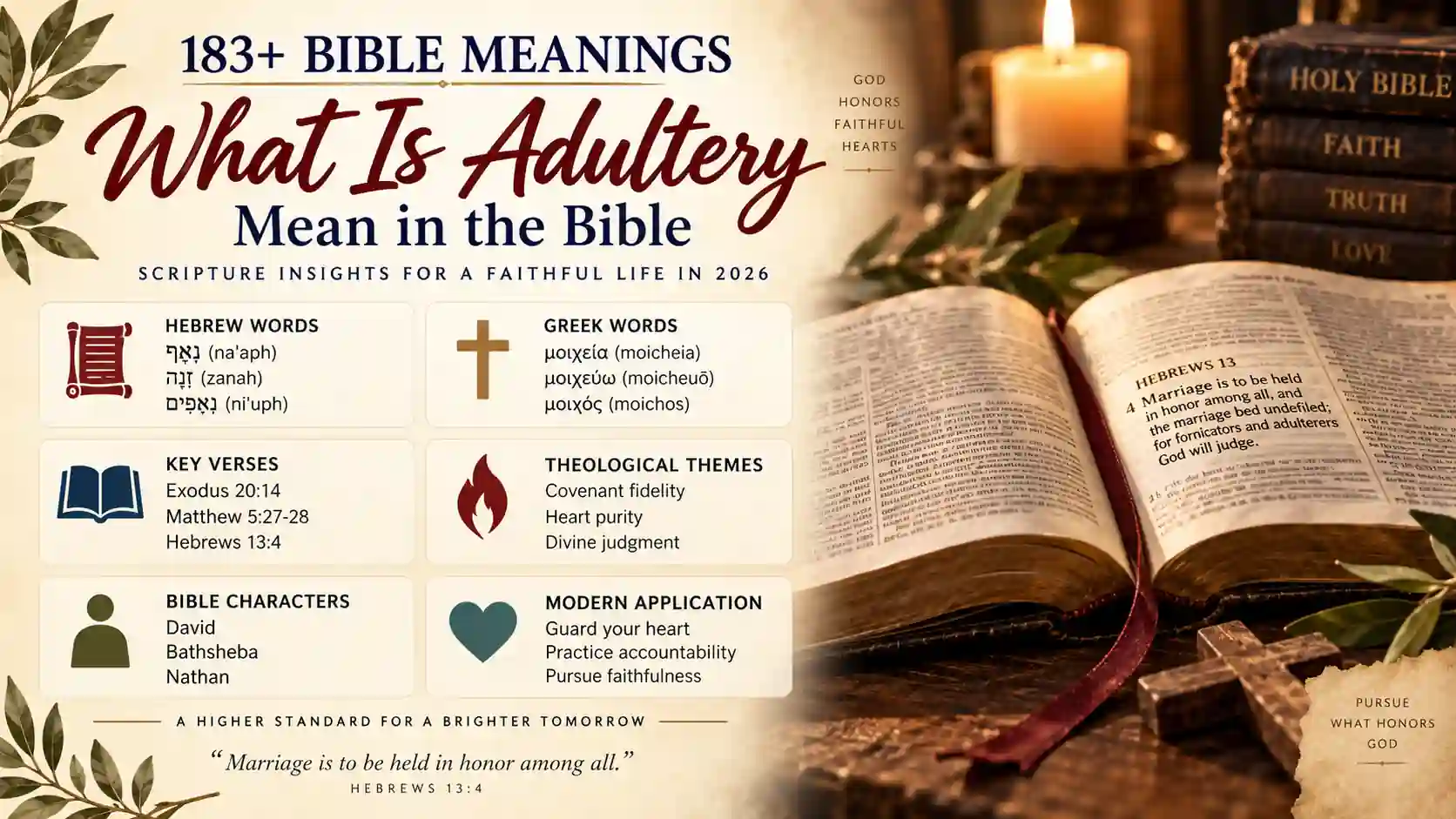
The central Old Testament verb is נָאַף (na’aph), Strong’s H5003, the term used in the prohibition against adultery. The New Testament word family includes μοιχεία (moicheia) for adultery and μοιχεύω (moicheuō) for committing adultery. μοιχός (moichos) identifies an adulterer.
The related Hebrew root זָנָה (zanah) has a broader range involving prostitution, sexual immorality, and figurative religious unfaithfulness. That distinction matters in careful word study because biblical writers can discuss overlapping sexual sins without treating every Hebrew term as an exact synonym.
Adultery and Related Biblical Concepts
| Concept | Connection | Supporting Verse |
|---|---|---|
| Marriage covenant | Adultery violates marital exclusivity | Malachi 2:14 |
| Faithfulness | Marriage calls spouses to fidelity | Hebrews 13:4 |
| Lust | Desire can reveal adultery’s inward root | Matthew 5:28 |
| Coveting | Desire for a neighbor’s wife is forbidden | Exodus 20:17 |
| Sexual purity | Believers belong to God bodily | 1 Corinthians 6:18-20 |
| Repentance | Sexual sin calls for genuine turning | Psalm 51:1-4 |
| Forgiveness | Repentant sinners may receive mercy | 1 John 1:9 |
| Idolatry | Prophets portray apostasy as adultery | Jeremiah 3:8-9 |
| Judgment | God takes adultery seriously | Hebrews 13:4 |
Adultery in Israel’s Historical and Cultural Setting
| Aspect | Detail | Biblical Source |
|---|---|---|
| Sinai covenant | Adultery appears in the Decalogue | Exodus 20:14 |
| Covenant renewal | The command is repeated to Israel | Deuteronomy 5:18 |
| Legal seriousness | Mosaic law prescribed severe judgment | Leviticus 20:10 |
| Mutual accountability | Law names both adulterer and adulteress | Leviticus 20:10 |
| Neighbor’s marriage | Adultery violates another household | Exodus 20:17 |
| Wisdom teaching | Adultery brings disgrace and destructive consequences | Proverbs 6:27-35 |
| Royal failure | David’s adultery produced far-reaching consequences | 2 Samuel 11-12 |
| Prophetic imagery | Idolatry is portrayed as marital betrayal | Jeremiah 3:6-10 |
| New Testament setting | Jesus reaffirms the command | Matthew 5:27 |
The civil penalties of Leviticus belong to Israel’s Mosaic covenant setting and should not simply be transferred into modern civil law. Yet the narrative, wisdom, prophetic, and New Testament texts continue to present adultery itself as morally serious.
Adultery and Its Major Theological Themes
| Theme | Explanation | Scripture |
|---|---|---|
| Covenant fidelity | Marriage involves pledged faithfulness | Malachi 2:14 |
| Holiness | God’s people are called away from sexual sin | 1 Thessalonians 4:3 |
| Heart purity | God addresses desire as well as behavior | Matthew 5:28 |
| Neighbor love | Adultery wrongs another person’s marriage | Romans 13:9 |
| Sin against God | Sexual wrongdoing is ultimately before God | Psalm 51:4 |
| Consequences | Forgiveness does not erase every earthly result | 2 Samuel 12:9-14 |
| Divine judgment | God judges sexual unfaithfulness | Hebrews 13:4 |
| Repentance | Confession seeks cleansing and renewal | Psalm 51:10 |
| Covenant metaphor | Spiritual apostasy resembles marital betrayal | Hosea 1-3 |
Adultery and Modern Application for Believers
| Area | Practice | Scripture |
|---|---|---|
| Marriage | Guard exclusive marital faithfulness | Hebrews 13:4 |
| Thought life | Refuse deliberately cultivated lust | Matthew 5:28 |
| Eyes | Establish wise boundaries for what you watch | Job 31:1 |
| Relationships | Avoid relationships that nurture temptation | Proverbs 5:8 |
| Digital life | Apply heart purity to private online behavior | Matthew 5:28 |
| Accountability | Bring hidden sin into truthful fellowship | James 5:16 |
| Repentance | Confess sin rather than conceal it | Proverbs 28:13 |
| Forgiveness | Seek God’s cleansing when genuinely repentant | 1 John 1:9 |
| Wisdom | Consider consequences before temptation grows | Proverbs 6:32 |
| Marriage care | Cultivate faithful love for your spouse | Proverbs 5:18-19 |
What Is Adultery Mean in the Bible According to נָאַף And μοιχεύω?
The Hebrew נָאַף (na’aph) gives you the basic Old Testament meaning. Adultery is not merely attraction to someone outside marriage. In its direct legal sense, it concerns sexual violation of an existing marital bond. Exodus 20:14 places that violation among the foundational covenant prohibitions given to Israel.
The Greek μοιχεύω (moicheuō) carries this meaning into the New Testament. Jesus does not cancel the command. He exposes the moral source from which adultery develops. The outward act remains sinful, but the heart that deliberately nurtures lust is also brought under God’s searching moral authority.
Jesus, Matthew 5, and Adultery in the Heart
Matthew 5:27-28 is sometimes misunderstood as though Jesus were saying that temptation itself and physical adultery are identical in every respect. His teaching is more searching than that. He identifies intentionally lustful looking as a violation of sexual purity within the heart, not merely an unfortunate physical reaction.
This means your study should distinguish temptation from the willing cultivation of lust. Jesus moves beyond outward respectability to inward allegiance. Biblical holiness involves what you choose to entertain inwardly as well as what you eventually do outwardly. The command therefore reaches imagination, intention, secrecy, and desire.
David, Bathsheba, and the Cost of Covenant Betrayal
Second Samuel 11 gives Scripture’s best-known narrative involving adultery. David saw Bathsheba, learned that she was Uriah’s wife, sent for her, and slept with her. The narrative then moves into concealment and David’s arrangement of Uriah’s death. Adultery becomes part of a widening pattern of abused power, deception, and bloodshed.
Second Samuel 12 shows that God does not treat David’s royal status as an excuse. Nathan confronts him, and David acknowledges his sin. The episode holds together two truths that your theology should not separate. God can forgive the repentant sinner, while sinful actions may still leave painful consequences within human lives and relationships.
Hosea, Jeremiah, and Spiritual Adultery Against God
The prophets expand adultery imagery beyond marriage without abandoning its ordinary meaning. Israel belonged covenantally to the Lord, yet repeatedly pursued idols and foreign gods. Hosea and Jeremiah therefore draw upon the anguish of marital betrayal to describe covenant apostasy. Related words from the זָנָה (zanah) family frequently serve this imagery.
This prophetic metaphor reveals why fidelity matters so deeply in biblical theology. Marriage is not simply a private arrangement for personal fulfillment. Scripture treats covenant promises as morally weighty. Human marital betrayal can therefore become an understandable, though painful, picture of the spiritual betrayal involved when God’s people abandon him for other gods.
Adultery Questions Bible Students Commonly Ask
Does נָאַף (na’aph) in Exodus 20:14 specifically mean adultery rather than every kind of sexual sin?
Yes. נָאַף (na’aph), H5003, specifically centers on adultery, while Scripture uses other terms for broader forms of sexual immorality.
Does Matthew 5:28 mean noticing an attractive person is automatically adultery?
Jesus specifically addresses looking with lustful intent, directing attention to deliberately cultivated desire within the heart rather than equating every involuntary temptation with the completed physical act.
Why does Leviticus 20:10 prescribe such a severe penalty for adultery?
The verse belongs to ancient Israel’s Mosaic covenant law and shows the seriousness attached to violating marriage, while explicitly holding both parties accountable.
What is the difference between μοιχεία (moicheia) and πορνεία (porneia)?
μοιχεία (moicheia) specifically means adultery, while πορνεία (porneia) functions more broadly for sexual immorality, so the terms overlap in subject matter without being identical.
Can someone who has committed adultery genuinely be forgiven according to the Bible?
Yes. Scripture treats adultery as serious sin while also teaching that genuine repentance, confession, and faith can receive God’s forgiveness and cleansing, even when earthly consequences remain.