
When you ask what does sow mean in the Bible, you are asking about one of Scripture’s most enduring pictures. To sow literally means to scatter or plant seed in cultivated ground, but biblical writers repeatedly use sowing to describe actions whose consequences develop and later produce a harvest.
From Israel’s fields to Jesus’ parables and Paul’s letters, sowing can represent preaching God’s Word, practicing righteousness, giving generously, pursuing sinful desires, or investing in spiritual life. Understanding the biblical vocabulary and agricultural setting helps you read these passages without reducing every reference to the same meaning.
Sow in Key Scripture References
| Verse | Passage Snippet | Context |
|---|---|---|
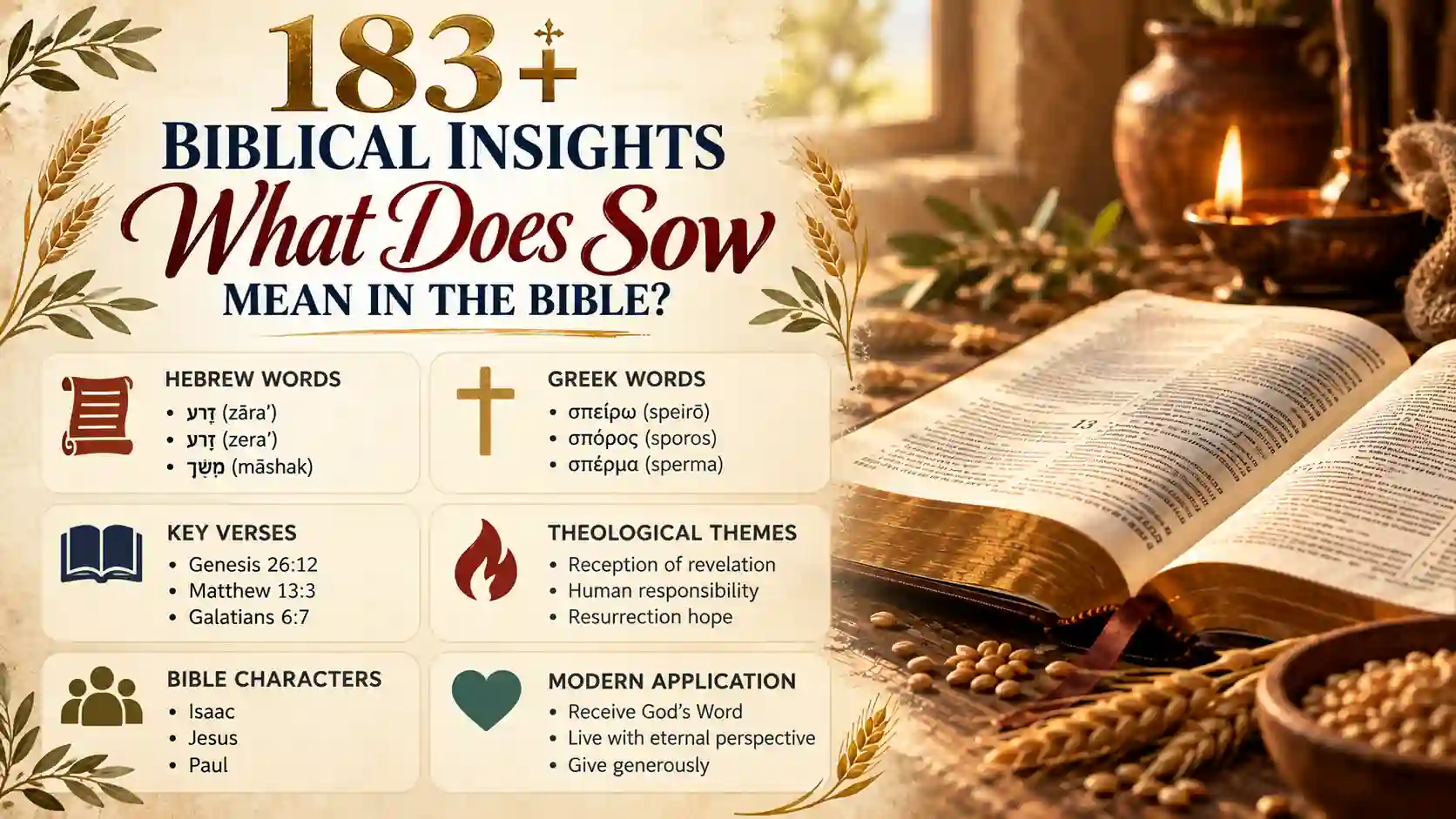
| Genesis 26:12 | Isaac sowed in that land | Isaac farms during famine and receives an abundant yield |
| Psalm 126:5 | Sow in tears | Sorrowful sowing becomes an image of joyful restoration |
| Proverbs 11:18 | Sows righteousness | Righteous conduct produces a sure reward |
| Hosea 10:12 | Sow righteousness | Israel is summoned to repentance and covenant faithfulness |
| Matthew 13:3 | A sower went out | Jesus introduces the parable of the soils |
| Mark 4:14 | The sower sows the word | Jesus identifies the seed with God’s message |
| 2 Corinthians 9:6 | Sows sparingly | Paul applies harvest imagery to generous giving |
| Galatians 6:7 | Whatever one sows | Human conduct carries corresponding consequences |
| Galatians 6:8 | Sows to the Spirit | Spirit-directed life anticipates eternal harvest |
Sow in Bible Translation Comparison
| Verse | KJV | NIV | ESV | NASB |
|---|---|---|---|---|
| Genesis 26:12 | “Isaac sowed” | “Isaac planted crops” | “Isaac sowed” | “Isaac sowed” |
| Psalm 126:5 | “sow in tears” | “sow with tears” | “sow in tears” | “sow in tears” |
| Proverbs 11:18 | “soweth righteousness” | “sows righteousness” | “sows righteousness” | “sows righteousness” |
| Hosea 10:12 | “Sow to yourselves” | “Sow righteousness” | “Sow for yourselves” | “Sow for yourselves” |
| Matthew 13:3 | “sower went forth” | “farmer went out” | “sower went out” | “sower went out” |
| Mark 4:14 | “sower soweth” | “farmer sows” | “sower sows” | “sower sows” |
| 2 Corinthians 9:6 | “soweth sparingly” | “sows sparingly” | “sows sparingly” | “sows sparingly” |
| Galatians 6:7 | “a man soweth” | “a man sows” | “one sows” | “a person sows” |
People and Characters Associated with Sow
| Person | Role | Connection |
|---|---|---|
| Isaac | Patriarch | Sows crops in Gerar and receives a remarkable harvest |
| Solomon | Wisdom teacher | Uses sowing to describe righteousness and wickedness |
| Hosea | Prophet | Calls Israel to sow righteousness and seek the Lord |
| Jesus | Messiah and teacher | Makes sowing central to several kingdom parables |
| Unnamed sower | Parable figure | Scatters seed across different kinds of soil |
| Paul | Apostle | Applies sowing to generosity, conduct, and resurrection |
| Corinthian believers | Early Christians | Encouraged to sow generously through material giving |
| Galatian believers | Early Christians | Warned about sowing to flesh or Spirit |
| God | Lord of harvest | Supplies seed and brings growth beyond human power |
Sow in the Original Hebrew and Greek Words
| Original Word | Transliteration | Strong’s # | Literal Meaning |
|---|---|---|---|
| זָרַע | zāraʿ | H2232 | Sow, scatter seed |
| זֶרַע | zeraʿ | H2233 | Seed, offspring |
| מָשַׁךְ | māshak | H4900 | Draw, drag, sometimes sow in rows |
| σπείρω | speirō | G4687 | Sow, scatter seed |
| σπόρος | sporos | G4703 | Seed, what is sown |
| σπέρμα | sperma | G4690 | Seed, offspring |
| σπορά | spora | G4701 | Sowing, seed |
| σπορεύς | sporeus | G4688 | Sower |
| ἐπισπείρω | epispeirō | G1986 | Sow upon, sow afterward |
Related Biblical Concepts Connected with Sow
| Concept | Connection | Supporting Verse |
|---|---|---|
| Seed | What the sower places into the soil | Matthew 13:3-8 |
| God’s Word | Seed in Jesus’ explanation | Mark 4:14 |
| Kingdom | Growth begins from seemingly small beginnings | Matthew 13:31-32 |
| Righteousness | Faithful conduct pictured as sowing | Hosea 10:12 |
| Justice | Righteous sowing anticipates steadfast fruit | Hosea 10:12 |
| Generosity | Giving resembles planting for future harvest | 2 Corinthians 9:6 |
| Flesh | Sin-directed living produces corruption | Galatians 6:8 |
| Spirit | Spirit-directed living leads toward eternal life | Galatians 6:8 |
| Resurrection | Burial and resurrection compared with seed | 1 Corinthians 15:36-44 |
Historical and Cultural Context of Sow
| Aspect | Detail | Biblical Source |
|---|---|---|
| Seed scattering | Seed could be broadcast by hand | Matthew 13:3-8 |
| Varied soil | Fields included paths, rocks, and thorny areas | Matthew 13:4-7 |
| Plowing | Cultivation prepared land for crops | Hosea 10:11-12 |
| Seasonal rains | Agricultural success depended heavily on rain | Deuteronomy 11:14 |
| Wheat | Major crop used in sowing imagery | Matthew 13:25 |
| Barley | Important grain of Israelite agriculture | Ruth 1:22 |
| Weeds | Harmful plants could grow among crops | Matthew 13:24-30 |
| Harvest | Sowing anticipated later reaping | Galatians 6:9 |
| Divine provision | God ultimately provides agricultural increase | 2 Corinthians 9:10 |
Theological Themes within Biblical Sow Imagery
| Theme | Explanation | Scripture |
|---|---|---|
| Reception of revelation | Hearts respond differently to God’s Word | Mark 4:14-20 |
| Human responsibility | Choices resemble seeds producing consequences | Galatians 6:7 |
| Divine sovereignty | God gives growth beyond human ability | 1 Corinthians 3:6-7 |
| Repentance | Israel must abandon sin and seek God | Hosea 10:12 |
| Perseverance | Harvest may require patient faithfulness | Galatians 6:9 |
| Generosity | Grace encourages openhanded giving | 2 Corinthians 9:6-11 |
| Resurrection | What is sown perishable is raised imperishable | 1 Corinthians 15:42 |
| Kingdom growth | Small beginnings can yield remarkable growth | Matthew 13:31-32 |
| Judgment | Evil sowing also produces a corresponding harvest | Galatians 6:7-8 |
Modern Application of Sow for Believers
| Area | Practice | Scripture |
|---|---|---|
| Scripture | Receive God’s Word with an attentive heart | Mark 4:20 |
| Character | Cultivate righteousness rather than sinful habits | Hosea 10:12 |
| Generosity | Give freely without treating giving as manipulation | 2 Corinthians 9:6-8 |
| Perseverance | Continue doing good when results seem delayed | Galatians 6:9 |
| Discipleship | Share God’s Word faithfully | Mark 4:14 |
| Decisions | Remember that choices carry consequences | Galatians 6:7 |
| Spiritual life | Direct your life toward the things of the Spirit | Galatians 6:8 |
| Ministry | Trust God rather than claiming credit for growth | 1 Corinthians 3:6-7 |
| Hope | View bodily death through resurrection hope | 1 Corinthians 15:42-44 |
זָרַע ZāRaʿ and the Old Testament Picture of Sowing
The primary Hebrew verb translated “sow” is זָרַע (zāraʿ), Strong’s H2232. At its literal level, it describes planting or scattering seed. Genesis 26:12 provides a straightforward agricultural example when Isaac sows in the land and receives an extraordinary crop. The same agricultural reality gives biblical writers language for describing moral and spiritual consequences.
That metaphor becomes particularly forceful in the prophets. Hosea 10:12 tells covenant-breaking Israel to sow righteousness, reap steadfast love, break up fallow ground, and seek the Lord. Here sowing is not a mechanical promise that good deeds automatically purchase blessings. The agricultural image belongs to a call for genuine repentance and renewed faithfulness to God.
What Does Sow Mean in the Bible When Jesus Says σπείρω?
The principal New Testament verb is σπείρω (speirō), Strong’s G4687, meaning “to sow.” Jesus uses the familiar activity of scattering seed to reveal spiritual realities. In Mark 4:14, He explains the parable directly. The sower sows the word. The different results arise as that word encounters different hearers.
This keeps you from interpreting the parable as merely a lesson about working harder. The emphasis falls heavily upon hearing and receiving God’s message. Some seed is taken away, some produces temporary growth, some is choked by competing desires, and some bears fruit. Sowing therefore becomes an especially vivid picture of proclaiming the Word and the varied responses it receives.
Sowing and Reaping from Hosea to Galatians
Scripture also uses sowing to express the connection between conduct and consequences. Proverbs 11:18 contrasts deceptive gain with sowing righteousness. Paul develops the same moral pattern in Galatians 6:7-8. A person who sows toward the flesh reaps corruption, while one who sows toward the Spirit reaps eternal life from the Spirit.
Paul’s language should not be reduced to a formula for earning salvation through moral effort. Galatians has already emphasized justification through faith in Christ. In chapter 6, sowing describes the direction and character of a person’s life. Your habits matter, and persistent choices reveal what kind of field you are cultivating while dependence upon God’s Spirit remains essential.
Paul’S Seed Theology of Generosity and Resurrection
In 2 Corinthians 9:6-11, Paul uses sowing to teach generosity. The believer who sows sparingly also reaps sparingly, while generous sowing anticipates generous reaping. Yet Paul immediately centers the passage on God, who supplies seed to the sower, provides bread, increases the harvest of righteousness, and enables believers to become generous.
The image reaches another theological height in 1 Corinthians 15. Paul compares the buried body with a seed that is sown before new life appears. The body is sown perishable, dishonorable, and weak but raised imperishable, glorious, and powerful. Agricultural sowing thus becomes a picture not merely of present consequences but of Christian resurrection hope grounded in God’s transforming power.
Frequently Asked Questions About Sow in the Bible
What does זָרַע (zāraʿ) mean in the Old Testament?
זָרַע means to sow or scatter seed and can describe literal agriculture as well as figurative moral and spiritual action.
Why does Jesus use σπείρω (speirō) in the parable of the sower?
Jesus uses ordinary seed sowing to portray the proclamation of God’s Word and the dramatically different ways people receive it.
Does Galatians 6:7 mean that “you reap what you sow” is an absolute formula for immediate consequences?
No. Paul’s agricultural metaphor stresses the real moral direction and eventual harvest of a life, while Galatians 6:9 explicitly recognizes that the harvest comes “in due season.”
Does 2 Corinthians 9:6 promise financial wealth when Christians sow money?
The context emphasizes willing generosity, God’s provision, thanksgiving, and a harvest of righteousness rather than guaranteeing material riches in proportion to a donation.
Why does Paul describe resurrection as sowing in 1 Corinthians 15?
Like a seed placed in the ground before emerging in a transformed condition, the perishable body is buried in weakness but raised by God’s power as an imperishable body.